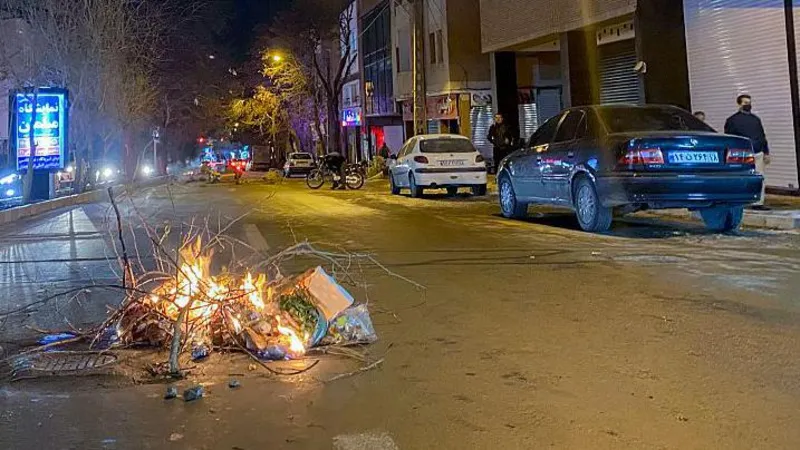
Protesters in Iran defied a deadly government crackdown on Saturday night, taking to the streets despite reports suggesting hundreds of people have been killed or wounded by security forces in the past three days.
Verified videos and eyewitness accounts seen by the BBC appeared to show the government was ramping up its response, as it continues an overarching internet blackout.
The country’s attorney general, Mohammad Movahedi Azad, said on Saturday that anyone protesting would be considered an “enemy of God” – an offence that carries the death penalty.
Hundreds of protesters are believed to have arrested since demonstrations began more than two weeks ago.
The protests were sparked by soaring inflation, and have spread to more than 100 cities and towns across every province in Iran. Now protesters are calling for an end to the clerical rulership of Iran’s Supreme Leader Ayatollah Ali Khamenei.
Khamenei has dismissed demonstrators as a “bunch of vandals” seeking to “please” US President Donald Trump.
The Iranian government has imposed the internet shutdown in an effort to stop the protests. Iran’s data infrastructure is tightly controlled by the state and security authorities. Internet access is largely limited to a domestic intranet, with restricted links to the outside world.
Over the past few years, the government has progressively curtailed access to the global internet. However, during the current round of protests, authorities have, for the first time, not only shut down access to the worldwide internet but also severely restricted the domestic intranet.
An expert told BBC Persian that the current shutdown is more severe than that imposed during the “Women, Life, Freedom” uprising three years ago. Alireza Manafi, an internet researcher, said internet access in Iran, in any form, was now “almost completely down”.
He added the only likely way to connect to the outside world was via Starlink, but warned users to exercise caution, as such connections could potentially be traced by the government.
The BBC and most other international news organisations are also unable to report from inside Iran, making obtaining and verifying information difficult.
Nonetheless, some video footage has emerged, and the BBC has spoken to people on the ground.
Verified video from Saturday night showed protesters taking over the streets in Tehran’s Gisha district. Several videos, verified and confirmed as recent by BBC Verify, show clashes between protesters and security forces on Vakil Abad Boulevard in Mashhad, Iran’s second largest city.
Masked protesters are seen taking cover behind wheelie bins and bonfires, while a row of security forces is seen in the distance. A vehicle that appears to be a bus is engulfed in flames.
Multiple gunshots and what sounds like banging on pots and pans can be heard as a green laser beam lights up the scene.
A figure standing on a nearby footbridge is visible in the footage and appears to fire multiple gunshots in several directions as a couple of people take cover behind a fence on the side of the boulevard.
Other videos have also emerged from the capital Tehran. One video, authenticated by BBC Verify, shows a large group of protesters and the sound of banging on pots in Punak Square in west Tehran, which has been one of the hotspots of protests this week.
Another clip, filmed in the Heravi district in north-east Tehran and confirmed by BBC Persian and BBC Verify, shows a crowd of protesters marching on a road and calling for the end of the clerical establishment.
BBC / Titilayo Kupoliyi
Follow us on Telegram and YouTube, and join our WhatsApp Update Group for more news updates.