Politics

By Oluwatoyin Adegoke

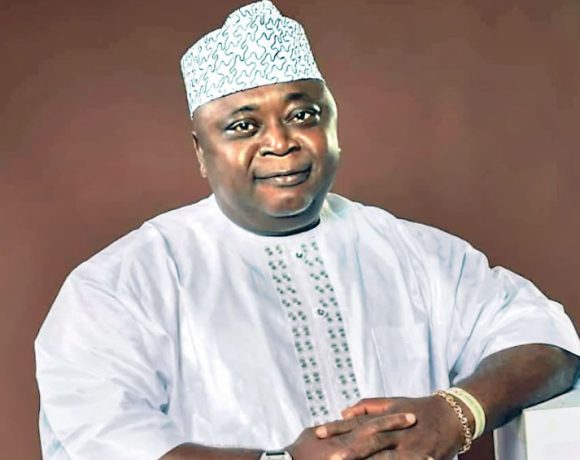
The Peoples Democratic Party, PDP, in Ogun State has selected its 2023 governorship candidate, Chief Ladi Adebutu, as the party’s flag bearer for the 2027 governorship election under a consensus arrangement.

Chief Adebutu emerged unopposed at the party’s governorship primary held in Abeokuta after delegates across the 236 wards of the state affirmed his candidature.

Chairman of the Governorship Primary Panel, Chief Afolabi Ariyo, declared him winner through a voice vote during the exercise attended by party leaders and stakeholders.

Former Governor of Ekiti State, Mr Ayodele Fayose, who attended the primary, expressed confidence in the PDP’s chances in the 2027 governorship election in Ogun State.

Mr Fayose said the outcome of the primary reflected renewed hope for the party, adding that Chief Adebutu’s political trajectory was now firmly directed towards becoming governor of Ogun State.

In his acceptance speech, Chief Adebutu appreciated party leaders, stakeholders and members for the unanimous support and described his emergence as historic.

He expressed confidence that the PDP would reclaim power in Ogun State, insisting that lessons had been learnt from the 2023 governorship election, which he claimed the party won but was denied.

Chief Adebutu also called for unity among party members, stressing that internal cohesion would be vital to defeating the ruling All Progressives Congress, APC.

Edited by Maxwell Oyekunle

Follow us on Telegram and YouTube, and join our WhatsApp Update Group for more updates.

Politics

By Iyabo Adebisi

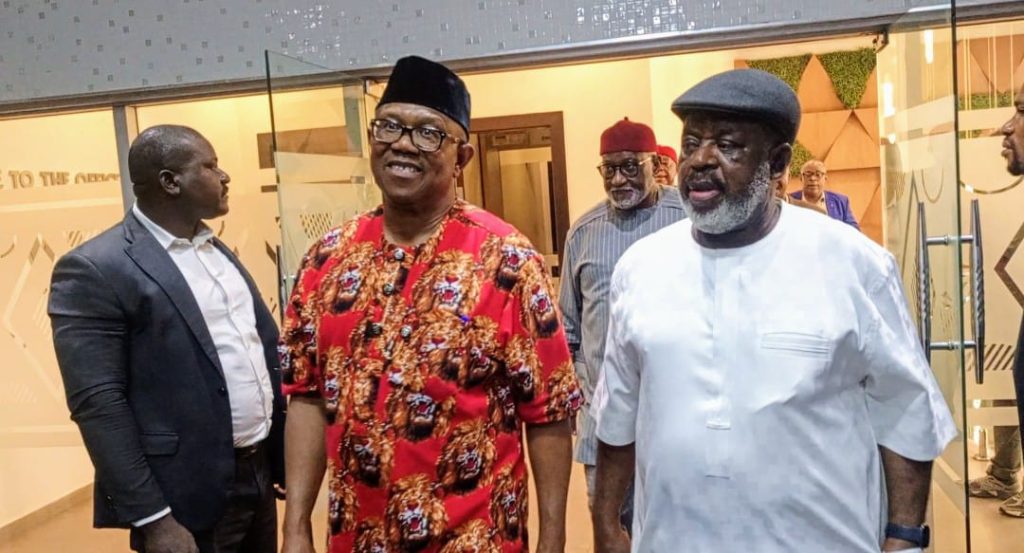
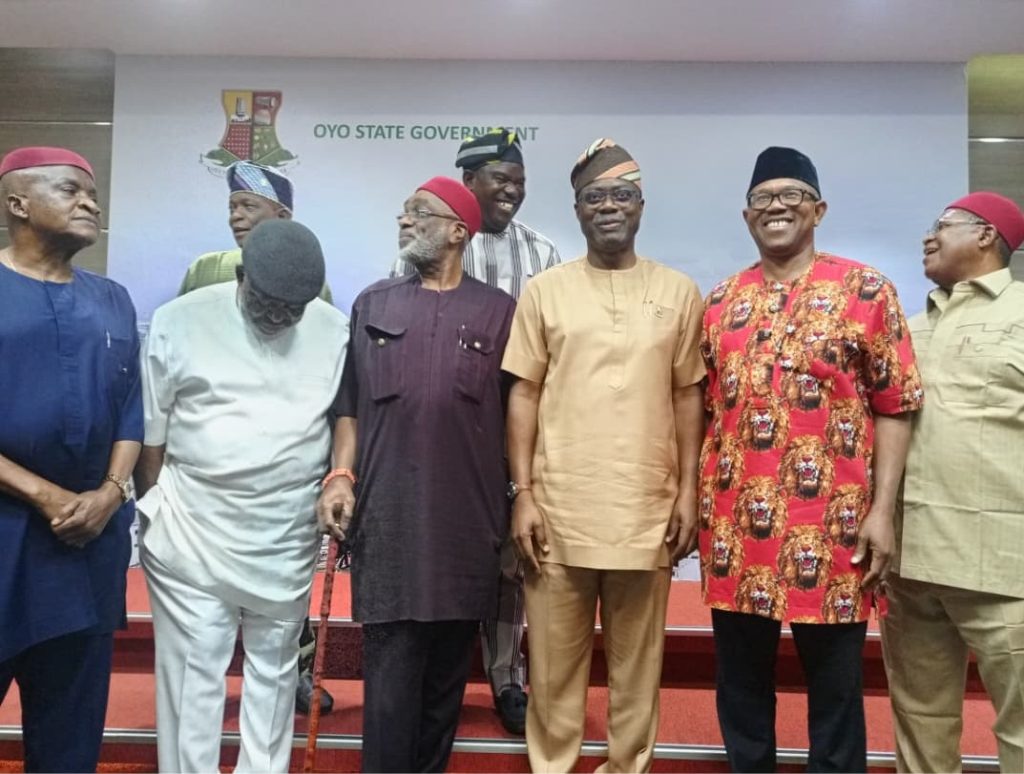
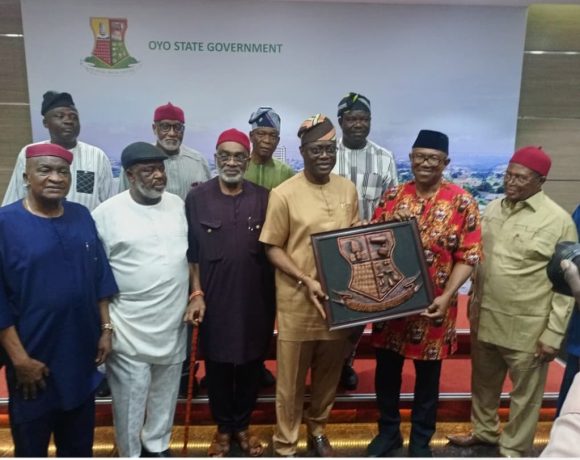
Ahead of 2027 elections, former Labour Party presidential candidate and African Democratic Congress, ADC, Chieftain, Mr Peter Obi, on Tuesday, in Ibadan, met with Oyo State governor, Engineer Seyi Makinde for further discussions on coalition of opposition parties.

Addressing journalists at the end of the meeting held at the courtesy room of the Governor’s office, Agodi Ibadan, Mr Obi said the coalition of opposition political parties, would produce a better, more united, secured and progressive Nigeria.

Recalled that notable opposition political party leaders last weekend in Ibadan held a summit where they agreed to field one presidential candidate for the 2027 election.

Among the political leaders at the summit were former vice president, Alhaji Abubakar Atiku; former Kano state governor, Mr Rabiu Kwankwaso; Alhaji Aminu Tambuwal, Mr Jerry Gana and Alhaji Babangida Aliyu.

Others include Mr Kabiru Turaki, Mr Rafiu Aregbesola; Sen.David Mark; Mr Pat Utomi, and and Mr Peter Obi.

Edited by Taiwo Akinola

Follow us on Telegram and YouTube, and join our WhatsApp Update Group for more updates.

Politics

By Abimbola Bamgbose

All Progressives Congress APC, leaders and stakeholders from Ogun East Senatorial District have unanimously nominated the state governor Prince Dapo Abiodun as the candidate for senate in 2027.

The APC leaders made this known in Iperu-Remo, Ikenne local government, while presenting the governor with a letter of nomination.

Presenting the endorsement letter, APC leaders including Chief Adeleke Adedoyin, Chief Kola Ogunjobi, Chief Segun Osibote, and Senator Lekan Mustapha commended the governor’s leadership style, describing his performance as outstanding and people-oriented.

They urged intensified mobilisation ahead of the 2027 elections and called for unity within the party, expressing confidence that the endorsement reflects the collective will of the people of Ogun East.

In his acceptance speech, the governor gave assurance that he would not be a passive legislature but one committed to delivering meaningful results to the people of the Ogun East and the state at large.

He appreciated party leaders and stakeholders for the trust reposed in him, promising not to let them down.

Governor, Prince Dapo Abiodun however declared that the All Progressives Congress, APC, is prepared to produce Senator Olamilekan Adeola as the next governor of the state.

Reflecting on his administration, Governor Abiodun noted that Ogun State had recorded significant transformation in the past seven years, particularly in infrastructure development, healthcare delivery, education, and road reconstruction.

Edited by Taiwo Akinola

Follow us on Telegram and YouTube, and join our WhatsApp Update Group for more updates.

Politics

By Olaolu Fawole

Nigeria’s political carpet is moving again.

Ahead of the 2027 elections, the flow of politicians into the All Progressives Congress has been steady and, at times, dramatic.

Governors, serving lawmakers and all categories of politicians have defected to the ruling party.

Some with fanfare, others with quiet paperwork.

The APC has publicly celebrated controlling 31 of the nation’s 36 state governments.

The names behind that number tell the fuller story.

Between April and December, 2025, governors of Delta, Akwa Ibom, Enugu, Bayelsa and Rivers States left the PDP for the APC.

In January 2026, Kano State Governor, Abba Yusuf moved from the NNPP to the APC, bringing lawmakers and local government chairmen with him.

Adamawa State Governor, Ahmadu Fintiri arrived in February in what analysts described as a wholesale political transplant.

Most recently, Zamfara State Governor, Dauda Lawal, who had strongly rejected calls to defect in June 2025, completed his crossing in March 2026.

In the National Assembly, the arithmetic has shifted.

The APC has more serving lawmakers than any other party, while, nine senators defected to the African Democratic Congress in March 2026 in one of the most significant counter movements in recent legislative history.

The case for defections

Nigeria’s constitution guarantees freedom of association.That right does not expire upon election. A politician who finds their party ideologically unrecognisable, or structurally dysfunctional has a legitimate basis to seek a better platform.

There are historical cases where defection served the public interest.

The 2015 merger that produced the APC itself was a product of political realignment , opposition figures leaving comfort zones to build a coalition strong enough to end sixteen years of PDP federal dominance.

The result was Nigeria’s first democratic transfer of power between political parties since 1999.

At the state level, some defections have enabled governance continuity, resolved dangerous internal party standoffs, and produced more stable legislative majorities.

A governor who has defected to align with the federal government’s party can, in theory, unlock better access to federal infrastructure, allocations, and political goodwill.

The outcomes, if delivered, would benefit the people of the state, regardless of the party flag under which they arrive.There is also an argument, uncomfortable but not without merit, that defections expose rather than create weakness.

A party that loses ten governors in twelve months did not simply suffer betrayal. It suffered a confidence crisis it could not survive.

The structural rot was already there. The defections made it visible.

The case against

The problem with Nigeria’s defection wave is not that it happens. It is the pattern, the timing, and the absence of principle.

When governors and lawmakers move in large numbers toward the ruling party before an election, the motivation is rarely ideological. It is existential.

Power in Nigeria concentrates around whoever controls federal patronage, INEC’s operating environment, and security infrastructure during elections.

Moving toward that power is not governance strategy, it is survival mathematics.

And survival mathematics, practised at scale, is a weapon.

What is unfolding ahead of 2027 is not merely a series of individual political decisions. It is a systematic weakening of the opposition, a deliberate erosion of the structures that give voters a credible alternative to the party in power.

When a political party is experiencing defection, it loses campaign infrastructure, state-level funding networks, and the local mobilisation machinery that turns voters into results.

When the NNPP loses Kano State, its crown jewel, it loses its most persuasive argument for national relevance.

The Labour Party, still rebuilding from the judicial disappointment of 2023, watches its potential coalition partners disappear one by one into the ruling party’s embrace.

From the APC’s perspective, this is legitimate political strategy. Brutal, but legal. Weaken what you cannot defeat outright, and arrive at the election with the field already narrowed.

From the electorate’s perspective, it is something else. Democracy does not merely require elections. It requires choices. When opposition parties are hollowed out by coordinated defection before a single vote is cast, the ballot becomes a formality rather than a verdict.

The voter pays a further price at the constitutional level.

The 1999 Constitution requires legislators who defect to vacate their seats, except in cases of party crisis or merger, but courts have repeatedly accepted elastic definitions of “party crisis,” allowing defectors to keep their positions.

For executive officeholders, the law says almost nothing at all.

A governor can defect the morning after his inauguration and face no legal consequence.

The result is a political culture where party platforms are decorative.

Where voters choose a candidate knowing the candidate may not stay chosen.

The Electoral Act does not adequately address this. Its defection related provisions are narrow, focused on candidacy rather than post election conduct.

Recent House of Representatives amendments to criminalise dual party membership, carrying a fine of N10 million, imprisonment of up to two years, or both are a partial response, but they do not touch executive defections, and enforcement remains an open question.

A democracy with one dominant party, a weakened opposition, and no meaningful legal deterrent against electoral mandate transfers is not a competitive democracy. It is a managed one.

The right to political association is real and must be protected. Also, is the voter’s right to a representative who stays representing them, and to an election that still has something worth deciding when polling day finally arrives.

Defections may reshape the field, but they do not own the result. That still belongs to the people.
Politics

By Mosope Kehinde

Elected political office holders under the Peoples Democratic Party, PDP, in Oyo State have unanimously passed a vote of confidence on Governor Seyi Makinde, commending his administration’s leadership, developmental strides, and commitment to the welfare of workers and pensioners across the state.

The endorsement was part of the resolutions reached at a strategic stakeholders’ meeting held in Ibadan.

The meeting brought together PDP elected representatives across various levels of government in the state, alongside key party leaders and stakeholders, to review the progress of governance under the PDP administration and deliberate on political developments within the party.

According to the communiqué issued at the end of the meeting, and read by the State Party Chairman, Mr. Dayo Ogungbenro, the gathering also focused on strengthening internal cohesion within the party and reaffirming the collective commitment of stakeholders to the unity and continued success of the PDP in Oyo State.

Stakeholders further reaffirmed the unity, strength, and stability of the PDP in Oyo State, urging all party leaders and members to continue to work together in harmony while placing the collective interest of the party above individual ambitions.

In preparation for the 2027 general elections, the meeting resolved that all elected officials and party stakeholders would remain united under the umbrella of the PDP and work collectively to ensure the continued success of the party in Oyo State.

Edited by Adetutu Adetule

Follow us on Telegram and YouTube, and join our WhatsApp Update Group for more updates.

Politics

By Abimbola Bamgbose

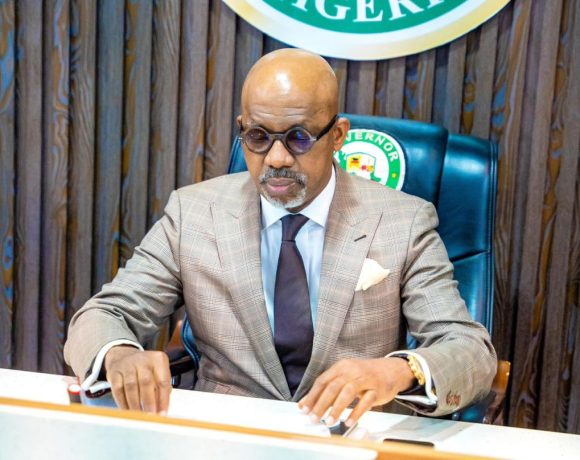
Ogun State Governor, Prince Dapo Abiodun, has assured residents of a seamless, peaceful and rancour-free transfer of power at the end of his second term in 2027.

The assurance was given during a Christmas service at St. James’ Anglican Church, Iperu-Remo, in Ikenne Local Government Area.

Governor Abiodun said his administration is determined to set a historic benchmark by handing over to a successor without acrimony.

He expressed confidence that, by God’s grace, his government would finish strong and preside over what he described as the first peaceful transition in the state’s history.

The Governor attributed his confidence to achievements recorded since assuming office, including solid governance, economic growth and people centered development.

He said his administration has reconstructed over 2,000 schools, created jobs, empowered farmers and attracted new industries across the state.

Governor Abiodun added that several projects are still ongoing across the three senatorial districts.

He reaffirmed his commitment to serving God and the people, describing projects such as the Gateway International Airport and other infrastructure as lasting legacies.

The Governor also commended President Bola Ahmed Tinubu for what he described as purposeful leadership under the Renewed Hope Agenda.

He cited improved availability of petroleum products, easing inflationary pressures and relative stability in the foreign exchange market.

Speaking on the Christmas season, Governor Abiodun urged residents to uphold love, peace and compassion, especially towards the less privileged.

He advised moderation in celebrations and cautioned against excessive alcohol consumption, urging residents to live Christ-like lives.

In a sermon titled “Christmas Is God’s Best Gift to You,” the Vicar, St. James’ Anglican Church, The Venerable Tolulope Akinwande, described Christmas as the season God gave Himself to humanity through the birth of Jesus Christ.

The cleric urged Christians to embrace salvation and live transformed lives.

He also commended Governor Abiodun’s leadership and prayed for a successful completion of his tenure.

Edited by Maxwell Oyekunle & Taiwo Akinola