Opinion

By Maxwell Oyekunle

As Nigerians, we have become a nation of pointing fingers, a chorus of blame directed at the faces on our screens.

We have scrutinized every flaw in our leaders, but we have refused to look into the one place where the rot might truly begin.

We Nigerians have refused to look in the mirror.

We often talk about how much our country needs to change — how the government has failed, how leaders have disappointed us, and how things keep getting worse.

But have we paused to ask what role we are personally playing in this decline?

The truth is, not everything wrong in our society is caused by those at the top.

Many of the issues we complain about start right where we are — in our homes, workplaces, and communities.

The local government chairman didn’t block the drainage; the residents who dump refuse in it did.

The governor didn’t inflate food prices; the trader who hiked prices of goods that have nothing to do with forex did — blaming it all on “the dollar.”

The president didn’t cheat customers or shortchange clients; business owners and artisans who lack integrity did.

When teachers collect salaries but don’t show up in class, they fail a generation.

When civil servants deliberately delay files unless “something passes under the table,” they become part of the rot they complain about.

When contractors use substandard materials to maximize profit, they build the foundation of future disasters.

Corruption is not just about stealing billions; it’s also about cheating in small ways — lying, cutting corners, inflating prices, arriving late to work, or not doing what you were paid to do.

True change begins when each Nigerian decides to act right, even when no one is watching.

When each citizen starts teaching their children honesty and responsibility by example.

When business owners deliver what they promised.

When drivers obey traffic rules even when no officer is watching.

When citizens stop looking for shortcuts and start valuing integrity again.

Let’s stop waiting for the government alone to fix everything. We are the government!.

Each of us represents a part of the system — and the system can only be as good as the people in it.

If we all do what is right at our own level — as teachers, traders, leaders, workers, parents, or students — we will begin to see the transformation we’ve been praying for.

Real change doesn’t start from Aso Rock — it starts from your street, your shop, your desk, your heart.

Nigerians!. Let’s make things right in our own corners and watch our nation rise again.

God bless you!

God bless the Federal Republic of Nigeria!!

Subscribe to our Telegram and YouTubeChannels, and also join our WhatsApp Update Group.
Economy

By Abiodun Adeoye

Osun State Government has expressed the hope that it will benefit maximally from the Federal Government’s largesse in Abuja.

The state’s Commissioner for Federal Affairs, Mrs Adenike Adeleke stated this in Abere while fielding questions from newsmen.

Mrs Adeleke pointed out that she saw her appointment as an opportunity to serve the interest of Osun State at the Federal seat of power, promising to make her impacts felt as one of the members of the State Executive Council representing the state in the Federal Capital Terrotory.

On the home front, she said the state government remained committed to its 5-point, and sees them as feasible and achievable.

The Federal Affairs Commissioner explained that the state’s helmsman, Governor Ademola Adeleke would maintain his pursuit of provision of dividends of democracy in areas such as health, agriculture, road construction and rehabilitation, workers welfare, rural and community development.

Subscribe to our Telegram and YouTube Channels also join our Whatsapp Update Group

Politics

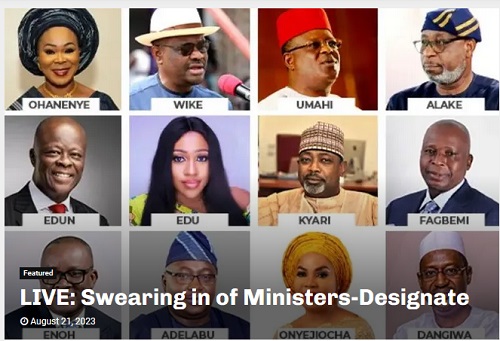
The inauguration of the 45 ministers-designate is ongoing at the Conference Centre of the State House, Abuja.

This comes less than a week after President Bola Tinubu announced the appointees’ portfolios.

The president had asked the Senate to confirm 48 nominees, but only 45 were cleared.

Nasir el-Rufai, former governor of Kaduna; Stella Okotete (Delta) and Danladi Abubakar (Taraba) were not confirmed.

Vice-President Kashim Shettima, Senate President Godswill Akpabio, Speaker Tajudeen Abbas are also at the ceremony.

Watch Video

FRCN Abuja/Simeon Ugbodovon

Subscribe to our Telegram and YouTube Channels also join our Whatsapp Update Group

Politics

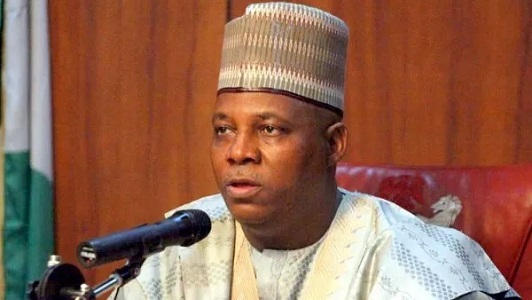
Vice-President Kashim Shettima is currently presiding over a meeting of the National Economic Council (NEC) in the Council Chambers of the State House, Abuja.

This is the third NEC meeting of the President Bola Tinubu administration.

The meeting comes amidst high inflation and hardship caused by the economic policies of the federal government.

The council consists of the 36 state governors, the governor of the Central Bank of Nigeria (CBN) and other government officials.

Today’s meeting is expected to consider varying issues, including the Federation’s financial status and other general issues. However, the most critical of the issues before the Council is the deployment of palliatives aimed at cushioning the harsh effects of the fuel subsidy removal.

Among the governors attending the meeting are: Abdulrahman Abdulrazak (Kwara), Hope Uzodinma (Imo), Inuwa Yahya (Gombe), Dauda Lawal (Zamfara), Dr Alex Otti (Abia), Babajide Sanwo-Olu (Lagos) and Ademola Adeleke (Osun).

Others are Senator Bala Mohammed (Bauchi), Senator Uba Sani(Kaduna), Sheriff Obrevwori (Delta), Prof Charles Soludo (Anambra), Godwin Obaseki (Edo), Yahaya Bello (Kogi) and Umaru Namadi (Jigawa).

Also at the meeting are Umo Eno (Akwa Ibom), Prince Bassey Otu (Cross River), Lucky Aiyedatiwa (Ondo State acting governor), Dapo Abiodun (Ogun), Ahmad Aliu (Sokoto), Agbu Kefas (Taraba), Abdullahi Sule (Nasarawa), Peter Mbah (Enugu) and Prof Babagana Zulum (Borno).

Deputy governors of Katsina, Rivers, Yobe, Adamawa, Kano, and Kebbi are also participating in the meeting.

Daniel Adejo

Subscribe to our Telegram and YouTube Channels also join our Whatsapp Update Group

Politics

President Bola Tinubu will swear in the recently appointed ministers, who have been assigned portfolios, on Monday.

William Bassey, the Director of Information in the office of the Secretary to the Government of the Federation (SGF), said in a statement.

On July 27, the President forwarded a list of 28 nominees to the Senate for screening and confirmation. Subsequently, on August 2, he submitted another list.

45 nominations were cleared by the Senate, but three, Nasir el-Rufai, Stella Okotete (Delta), and Danladi Abubakar (Taraba), faced complications in their confirmation process due to issues related to security clearance.

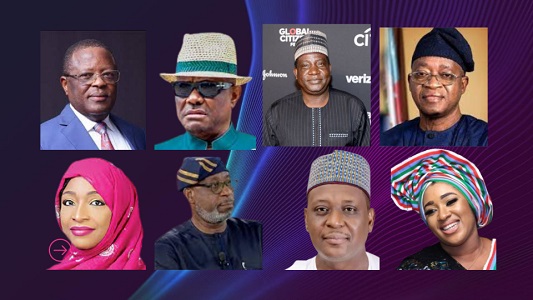
Nyesom Wike has been designated as the Minister of the Federal Capital Territory (FCT), a role that involves overseeing the development and administration of the nation’s capital.

Meanwhile, Dave Umahi is to assume the role of Minister of Works, where he will be responsible for spearheading and coordinating the nation’s infrastructure and construction projects.

Festus Keyamo is the minister of aviation and aerospace development.

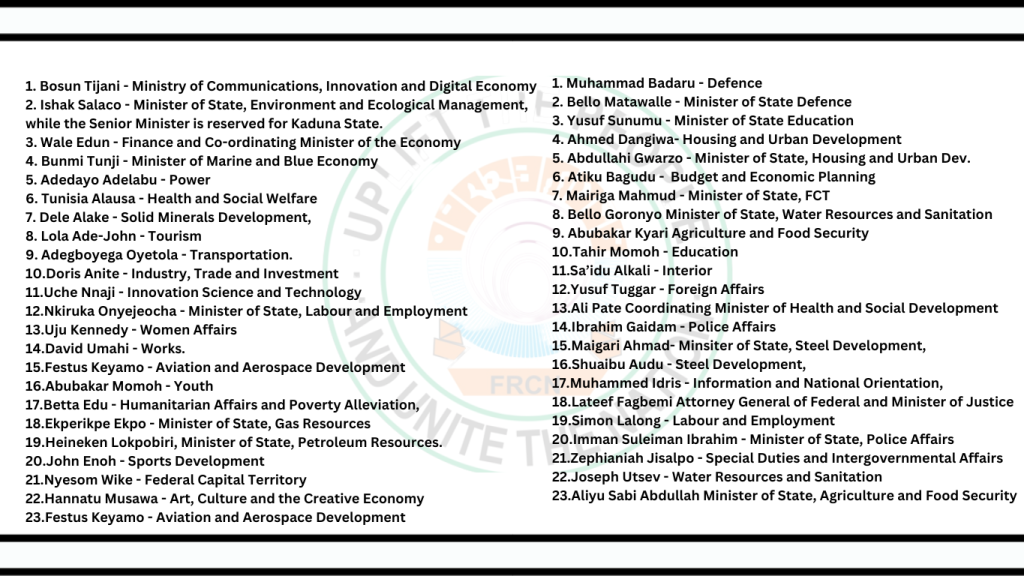
See the FULL LIST below

Analysing the composition of the list, it shows the Northwest region is represented by five Ministers and five Ministers of State.

The Southeast region was allocated four Ministers and one Minister of State.

The Southwest has seven Ministers and two Ministers of State, and the Northeast has six Ministers and two Ministers of State positions.

Additionally, the Northcentral region has six Ministers and one Minister of State, while the South-south region has five Ministers and two Ministers of State.

Abdallah Bello/Saadatu Albashir

Subscribe to our Telegram and YouTube Channels also join our Whatsapp Update Group


Security

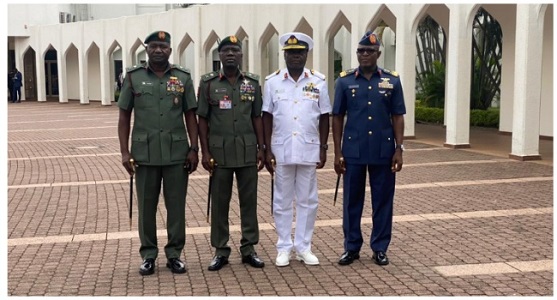
President Bola Ahmed Tinubu has performed the official decoration of the newly appointed Service Chiefs.

This pivotal event formally marks the beginning of their tenure as the nation’s topmost defence officers.

The ceremony which held inside the Council Chambers of the Presidential Villa, was witnessed by the Vice President, Senator Kassim Shetimma, top government officials and family members of the officers.

The Service Chiefs, whose appointments were initially declared on the 19th of June, have undergone comprehensive screening by the National Assembly.

Having successfully completed this legislative scrutiny, they now take up their roles as the chief architects of Nigeria’s defence and security strategies.

President Tinubu, in his capacity as Commander-in-Chief, presented the new Service Chiefs with their higher office insignia, signifying the weight of the responsibilities they now bear.

Each Chief, resplendent in their uniforms adorned with their high office’s symbols, pledged their dedication to ensuring the peace, unity, and security of the Nigerian state.

Channels/Titilayo Kupoliyi

Subscribe to our Telegram and YouTube Channels also join our Whatsapp Update Group

Opinion

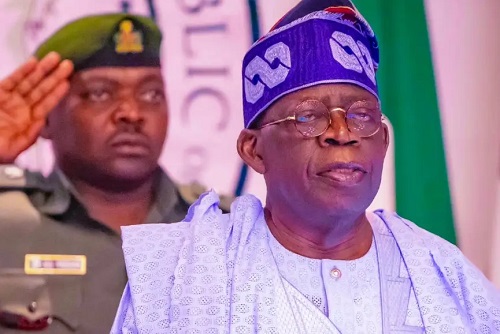
It is incontrovertible that the performance of President Tinubu has beaten the imagination of his close associates and other poles apart within a short interval since his inauguration on 29th May, 2023.

Obviously, steps and decisions so far taken indicate that BAT prepared himself for the plum job compared to most of his predecessors who once occupied Aso Rock.

Despite stiff challenges and opposition on all fronts, the President has hit the ground running, focused, assertive, fair, effective and decisive.

So far, the BAT’s presidency has in less than two months posted some scorecards, which include appointment of key aides including service chiefs with national spread, though there are feelings in some quarters that the appointments tilted more towards Yoruba, compared to other sections of the country, as was the case with the last administration.

Like Tsunami, Mr President gave the boot to Godwin Emefiele, the CBN governor, Ibrahim Bawa, the controversial EFCC Chairman and MDAs Boards that shaped the policies of the former administration.

Also noteworthy was the immediate signing students’ loan bill into law as well as four Executive Orders that overturned the prevailing anti-people’s policies, roadmap on economic policy and revival.

He has equally within the time frame held meeting with the representatives of Monarchs across the nation, parleyed with JOHESU, NLC and opposition leaders.

His election as Chairman of ECOWAS Heads of States/Governments at his first attendance could be described as a plus less than two months into his presidency.

However, there are issues which President Tinubu has inappropriately handled or has not adequately responded to. First was the abrupt removal of oil subsidy without providing any cushion for the masses resulting in general economic hardship.

Though the Students’ Loan Bill is a welcome development, it may not be appropriated by indigent students because of its stringent conditions while also the upward review of school fees by higher institutions looms in the country.

Deadly terror attacks has been recorded in Benue State, Plateau State, Southern Kaduna and some other places, and Nigerians await swift response from the President, who have also kept mute over alleged provocative utterance by former Gov. El-Rufai’s, which could inflame religious tension, though the Kaduna ex-governor has eventually said he was quoted out of context.

Nigerians want a clean departure from the immediate past administration, and are waiting to see if BAT will reverse questionable appointments made by the former president or his lieutenants at the eve of their exit, and the president has been silent on media speculation that he intends to appoint certain controversial and discredited individuals into his cabinet.

While the President mulls possibility of a unity government, suspicion is rife among the opposition political parties that they may soon lose their voice on the assumption that the nation may become a one-party state in the new dispensation.

This fear could be premised on past records.

By and large, Tinubu’s Presidency has lots of prospects if the current tempo is maintained and sustained. Concisely, the nation will like to see an administration immensely bringing its weight to bear on areas such as the  sanctity of human life, rule of law, fiscal federalism, discipline and sanity of MDAs and state apparatus, discontinuation of selective justice, discontinuation of political interference on high profile cases, bridging North/South suspicion and dichotomy, prudent management of oil and other mineral resources better, massive job creation, foreign investment, and infrastructure leap, with a view to reducing JAPA syndrome, efficient public service devoid of bottlenecks and undue bureaucracy, with reduction in the cost of governance.

And not the least, Nigerians want to sleep with their two eyes closed, hence Mr President should prioritise reorganizing the armed forces; pursuit of enhanced synergy among security agencies under a strong West African regional block could turn the tide in this direction as some countries in the block are plagued by extremists and other non-state actors.  

BAT has no god-father, will this count for his being able to take decisive actions on matters of public interest without minding stepping on toes?

Dr Sunday Olawale

Dr Sunday Olawale is a public affairs commentator

Subscribe to our Telegram and YouTube Channels also join our Whatsapp Update Group