Foreign

Russian  President, Vladimir Putin says, the country will send nuclear capable short-range missile systems to its ally Belarus in the coming months.

He said Iskander-M systems “can fire ballistic and cruise missiles, both conventional and nuclear types”.

The systems have a range of up to 500km (310 miles).

Report says, tensions between Russia and the West have escalated, following President Putin’s decision to invade Ukraine on 24 February.

Mr Putin has made several references to nuclear weapons since then, which some have interpreted as a warning to Western countries not to intervene.

Speaking in St Petersburg, Mr Putin said Russia would help to modify Belarusian SU-25 warplanes so that they could carry nuclear weapons, in response to a query from Mr Lukashenko.

Meanwhile several explosions were reported in Kyiv on Sunday morning, the city’s Mayor Vitali Klitschko said.

“Ambulances and rescuers are on site. In two buildings, the rescue and evacuation of residents is under way,” he added.

According to report, a residential complex in the city had been hit.

Taking the city means Russia now controls nearly all of Luhansk region and much of neighbouring Donetsk – the two regions that form the vast industrial Donbas.

In his video address late on Saturday, Ukrainian President Volodymyr Zelensky pledged to take back “all our cities” occupied by Russia.

But he said the war with Russia had entered an emotionally difficult stage and he did not know how many more blows and losses there would be.

On Friday night Russia launched a barrage of missiles at targets in the north and west of Ukraine. At least three people were killed and more may be buried under rubble in the town of Sarny west of Kyiv, a local official said.

Some of the rockets were fired from Belarus, Ukraine said. Belarus has provided logistical support to Russia but its army is not officially taking part in the conflict.

Ukraine’s intelligence service said the missile strikes were part of Kremlin efforts to draw Belarus into the war.

Russia’s capture of Severodonetsk comes ahead of a week of Western diplomacy, with US President Joe Biden flying to Germany for a G7 summit followed by Nato talks.

In recent months, the Western alliance has shown signs of strain and fatigue but on Saturday UK Prime Minister Boris Johnson said Ukraine could win its battle with Russia.

“Now is not the time to give up on Ukraine,” he said.

On Sunday Indonesian President Joko Widodo, who is due to attend the G7, said he would urge the Ukrainian and Russian leaders to restart dialogue.

“War has to stop and global food chains need to be reactivated,” he said.

At Saturday’s televised meeting with his Belarusian counterpart Alexander Lukashenko in St Petersburg, Mr Putin said: “We have made a decision: within the next few months we will hand over to Belarus the Iskander-M tactical missile systems.”

He said all the details of the transfer would be worked out by the ministries of defence of the two countries.

Iskander missiles have already been deployed in Kaliningrad, a small Russian Baltic exclave between Nato members Lithuania and Poland.

The Belarusian leader said Lithuania’s move was “a sort of declaration of war” and “unacceptable”.

Steel and some other Russian goods come under the EU sanctions imposed over Russia’s invasion of Ukraine. Lithuania says its measures affect only 1% of the normal Russian goods transit on the route, dismissing Russian talk of a “blockade” of Kaliningrad.

BBC /Taiwo Akinola

Foreign

A California man suspected of taking part in the US Capitol riots last year has been granted asylum in Belarus.

Evan Neumann fled the US after being charged in connection with the riots.

The 48-year-old first settled in Ukraine, before reaching Belarus where he asked for asylum – claiming he faced “political persecution” in the US.

A Belarusian official said Mr Neumann has been granted permission to remain in the country “indefinitely”.

State officials also alleged that Mr Neumann had been forced to cross the Belarusian border “illegally” after attracting “interest from local secret services” in Ukraine.

Mr Neumann told Belarusian state-owned news agency Belta he had “mixed feelings”.

“I am glad Belarus took care of me. I am upset to find myself in a situation where I have problems in my own country.”

In July last year, Mr Neumann was charged on six different counts, including violent entry and assaulting police officers.

He was accused of punching two police officers and using a metal barrier as a “battering ram” against police during the riots at the US Capitol building on 6 January 2021.

But, according to Mr Neumann, he had already sold his house and travelled across Europe to Ukraine.

After worrying the Ukrainian authorities were watching him, Mr Neumann says he crossed the border into Belarus on foot in August and the country does not have an extradition treaty with the US.

In November, Mr Neumann gave an interview to Belarusian state TV and rejected the charges against him.

“I do not believe that I have committed any crime,” he said. “One of the accusations was very upsetting. It is alleged that I hit a police officer. That is baseless.”

He said he was asking for “government protection” from Belarus because of the “political persecution” he faced in the US, including the FBI questioning his family and using a photo of him on its most-wanted list.

A video released by Belta on Tuesday showed an immigration official handing Mr Neumann a document confirming his refugee status and the head of the Brest police migration directorate, Yuryy Brazinski, told state TV that he will eventually be entitled to apply for citizenship.

Mr Neumann is among more than 650 people who have been charged for their actions on 6 January, when supporters of then-US President Donald Trump stormed the Capitol to protest against the result of the 2020 election.

Belarus leader under sanctions from the US

Belarus, led by authoritarian leader Alexander Lukashenko, has faced over alleged human rights abuses and its support for Russia’s invasion of Ukraine.

Mr Neumann told state TV he planned to stay in the Belarusian city of Brest.

“I have started a life here,” he said.

He added that he has plans “to move my family here,” but noted that the decision would ultimately be up to his wife.

BBC

Foreign

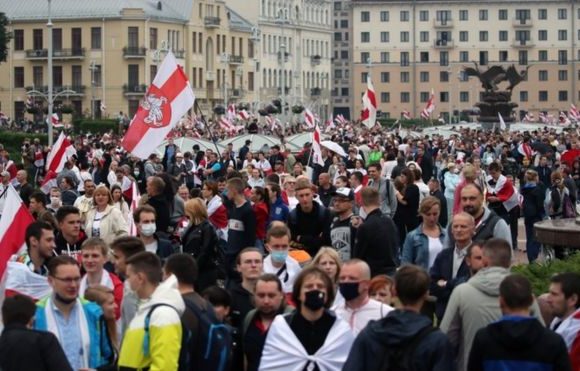
Opposition supporters in Belarus are holding a mass rally in the capital Minsk, two weeks after a disputed election gave President Alexander Lukashenko another term in office.

Tens of thousands filled the central square despite heavy police presence.

The protesters say Mr Lukashenko stole the election and want him to resign.

The president has vowed to crush the ongoing unrest and previously blamed the dissent on unnamed “foreign-backed revolutionaries”.

Recent protests were met with a crackdown in which at least four people were killed. Demonstrators said they had been tortured in prisons.

According to official results, Mr Lukashenko – who has ruled Belarus for 26 years – won more than 80% of the vote in the 9 August election and opposition leader Svetlana Tikhanovskaya 10%.

There were no independent observers and the opposition alleges massive vote rigging.

Ms Tikhanovskaya, who was forced to flee to neighbouring Lithuania the day after the election, vowed to “stand till the end” in the protests.

What is happening in Minsk?

Tens of thousands of people – from the elderly to those with small children – gathered in Independence Square on Sunday.

Many were carrying the opposition’s red and white flags, and chanted “freedom” and anti-government slogans.

Ahead of the protest the defence ministry issued a statement invoking Belarus’s sacrifices during World War Two, and saying the army would take over the protection of war memorials.

This weekend’s rally follows the country’s biggest protest in modern history last Sunday, when hundreds of thousands filled the streets.

Strike action in key factories across the country is also keeping up the pressure on the president.

BBC News