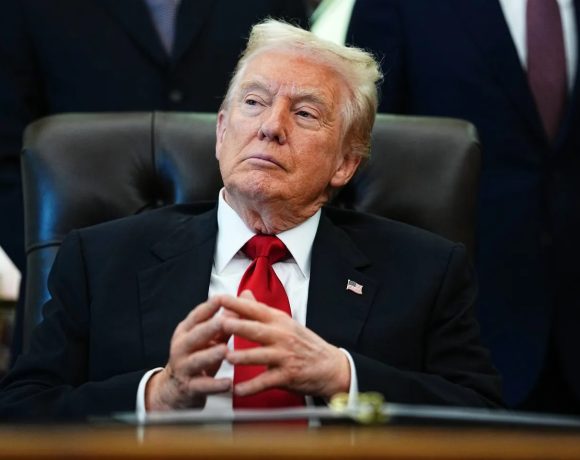
US President Donald Trump says he has an “obligation” to sue the BBC over an edited version of his January 6, 2021 speech shown in a Panorama documentary.
Speaking on Fox News, Trump accused the BBC of having “butchered” his words and “defrauded” viewers, claiming his remarks were “calming,” not inciting.
“They actually changed it… I have an obligation to sue because you can’t allow that,” he said.
Trump’s lawyers have demanded a retraction, apology, and $1 billion (£759m) in damages by Friday 22:00 GMT.
BBC chair Samir Shah earlier apologised for an “error of judgement,” while the corporation said it would respond “in due course.”
The controversy stems from a Panorama episode aired before the 2024 US election, which spliced two parts of Trump’s speech, implying he urged the Capitol riot.
A leaked BBC memo revealed that adviser Michael Prescott warned the edit was misleading.
The fallout led to Director General Tim Davie and Head of News Deborah Turness resigning.
Downing Street declined comment, calling it a BBC matter.
Meanwhile, Culture Secretary Lisa Nandy promised accountability in the BBC’s upcoming charter renewal talks.
The Culture Committee will question Shah, Prescott, and other BBC board members.
President-elect Donald Trump has said he will look at pardons for those involved in the 2021 US Capitol riot on his first day back in office next month.
“These people are living in hell,” he told NBC’s Meet the Press in his first broadcast network interview since winning November’s election.
The Republican also vowed to end automatic citizenship for anyone born in the country, but offered to work with Democrats to help some undocumented immigrants who were brought to the US as children.
In the wide-ranging sit-down, which was recorded on Friday, Trump promised to issue “a lot” of executive orders, including on immigration, energy and the economy, after he is inaugurated on 20 January.
While he suggested he would not seek a justice department investigation into Joe Biden, he said that some of his political adversaries, including lawmakers who investigated the Capitol riot, should be jailed.
Trump was asked whether he would seek to pardon the hundreds of people convicted of involvement in that riot, when supporters of his stormed Congress three months after his defeat in the 2020 election.
“We’re going to look at independent cases,” he said. “Yeah, but I’m going to be acting very quickly.”
“First day,” he added.
Trump continued: “You know, by the way, they’ve been in there for years, and they’re in a filthy, disgusting place that shouldn’t even be allowed to be open.”
The president-elect made other news in the NBC interview aired on Sunday:
He offered a caveat on whether he would keep the US in the North Atlantic Treaty Organization (Nato): “If they’re paying their bills, and if I think they’re doing a fair – they’re treating us fairly, the answer is absolutely, I’d stay with Nato”
Trump said he would not seek to impose restrictions on abortion pills, though when asked to make a guarantee, he added: “Well, I commit. I mean…things change”
The Republican said Ukraine should “probably” expect less aid when he returns to the White House
Trump said he thinks “somebody has to find out” if there is a link between autism and childhood vaccines – an idea that has been ruled out by multiple studies around the world. Trump suggested his nominee for health secretary, vaccine sceptic Robert F Kennedy Jr, would look into the matter
The president-elect repeated his promise that he will not seek to cut Social Security, nor raise its eligibility age, though he said he would make it “more efficient”, without offering further details
Pressed on whether his plan to impose tariffs on imports from major US trading partners would raise consumer prices for Americans, he said: “I can’t guarantee anything. I can’t guarantee tomorrow”
On the subject of immigration, Trump told NBC he would seek through executive action to end so-called birthright citizenship, which entitles anyone born in the US to an American passport, even if their parents were born elsewhere.
Birthright citizenship stems from the 14th Amendment of the US Constitution, which states that “all persons born” in the United States “are citizens of the United States”.
“We’re going to have to get it changed,” Trump said. “We’ll maybe have to go back to the people. But we have to end it.”
Trump also said he would follow through on his campaign pledge to deport undocumented immigrants, including those with family members who are US citizens.
“I don’t want to be breaking up families,” he said, “so the only way you don’t break up the family is you keep them together and you have to send them all back.”
Trump also said he wants to work with Congress to help so-called Dreamers, undocumented immigrants who were shielded under an Obama-era programme, Deferred Action for Childhood Arrivals, which Trump once attempted to scrap.
“I will work with the Democrats on a plan,” he said, adding that some of these immigrants have found good jobs and started businesses.
Trump seemed to offer mixed signals on whether he would follow through on his repeated vows to seek retribution against political adversaries.
Outgoing US President Joe Biden this week issued a sweeping pardon to his criminally convicted son, Hunter. The Democrat is reported to be considering other blanket pardons for political allies before he leaves office next month.
Trump seemed to indicate that he would not seek a special counsel investigation into Biden and his family, as he once vowed.
“I’m not looking to go back into the past,” he said. “I’m looking to make our country successful. Retribution will be through success.”
But he also said that members of the now-defunct, Democratic-led House of Representatives committee that investigated him “should go to jail”.
One member of the panel, former Republican congresswoman Liz Cheney, hit back at Trump on Sunday.
She said his comment that members of the committee should be jailed was a “continuation of his assault on the rule of law and the foundations of our republic”.
In his NBC interview Trump also said he would not direct the FBI to pursue investigations against his foes.
But he also told the network: “If they were crooked, if they did something wrong, if they have broken the law, probably.
“They went after me. You know, they went after me, and I did nothing wrong.”
The leader of a far-right militia has been sentenced to 18 years in prison for his role in the US Capitol riot.
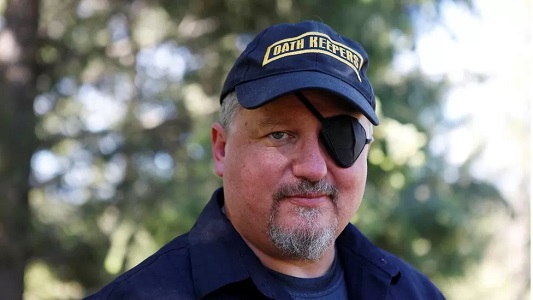
Stewart Rhodes, the founder of the Oath Keepers, was convicted on charges of seditious conspiracy and other crimes.
The sentence is the longest yet given to a Capitol rioter. Prosecutors had asked for 25 years.
Meanwhile, Kelly Meggs, the leader of the militia’s Florida chapter, was jailed for 12 years.
Rhodes remained outside the Capitol, but co-ordinated with Meggs and other members who stormed the building.
Rhodes and Meggs were also convicted of obstruction of an official proceeding and tampering with documents or proceedings in one of the highest-profile trials related to the riot on 6 January 2021.
At a hearing on Thursday, Rhodes showed little remorse, claiming he was a “political prisoner” and insisting that the Oath Keepers were standing in opposition to people “who are destroying our country”.
Judge Amit Mehta rejected those claims and expressed concern about Rhodes’ violent rhetoric, including a threat to hang former US House Speaker Nancy Pelosi.
“I dare say, Mr Rhodes, and I’ve never said this about anyone who I’ve sentenced: You, sir, present an ongoing threat and peril to this country, to the republic and the very fabric of our democracy,” the judge said.
“We all now hold our collective breaths with an election approaching,” he said. “Will we have another January 6th? That remains to be seen.”
Rhodes’ sentence was the longest handed out so far for the riot, where thousands of supporters of Donald Trump who objected to the result of the 2020 presidential election stormed the US legislature.
Prosecutors had asked for 25 years for Rhodes and 21 years for Meggs. Defence lawyers had argued for much lighter sentences of less than three years each.
Rhodes, a former US Army paratrooper and Yale-educated lawyer, founded the Oath Keepers in 2009.
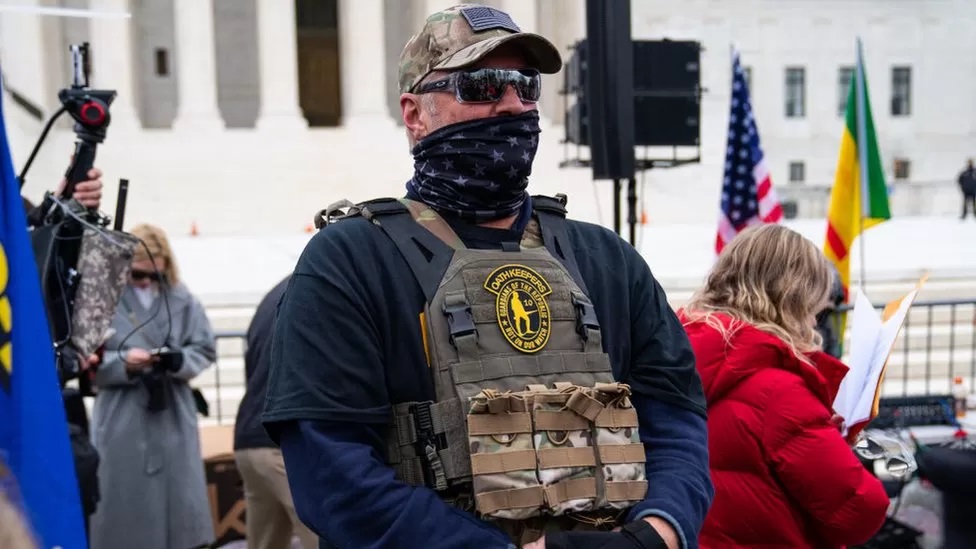
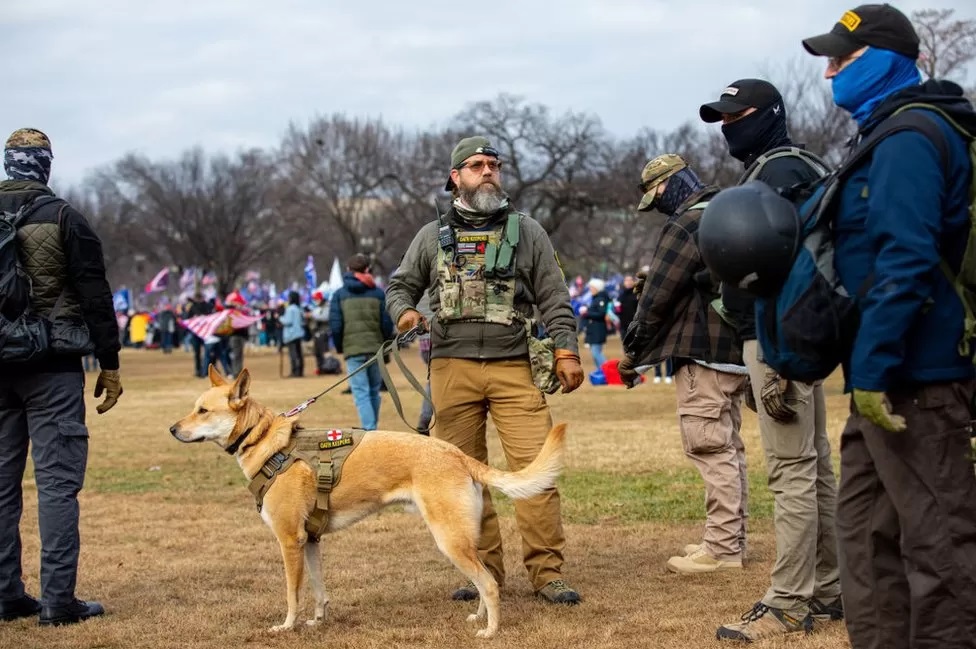
Armed members of the anti-government group showed up at a number of protests and standoffs, and eventually became staunch supporters of Donald Trump. Dozens were present at the riot.
What did the Oath Keepers do on January 6?
Rhodes began a campaign to reject the results of the election two days after the November 2020 vote, while ballots were still being counted.
He messaged supporters: “We aren’t getting through this without a civil war… Prepare your mind, body, spirit.”
Rhodes and other Oath Keepers then spent thousands of dollars on weapons and equipment and stashed them in a hotel room in nearby Virginia just prior to 6 January 2021.
During the riot itself, Rhodes stayed outside the building taking phone calls and messages while other Oath Keepers, including some led by Meggs, stormed the building. Prosecutors said Rhodes acted like a “battlefield general” during the melee.
Defence lawyers argued that the weapons stash was never used and that the militia was on a purely defensive mission. They plan to appeal the convictions.
In interviews with the BBC last year, Rhodes’ estranged family said they had suffered years of abuse and neglect while the militia leader organised anti-government activists across the country.
Earlier this week his ex-wife Natasha Adams tweeted that a Montana court had granted her a divorce from Rhodes.
What is seditious conspiracy?
Rhodes and Meggs were convicted of seditious conspiracy, a little-used Civil War-era law that carries a maximum 20-year prison sentence.
It is distinct from the crime of treason, which carries a high burden of proof outlined in the US Constitution, and can lead to the death penalty.
Three other Oath Keepers who went on trial at the same time were found not guilty of seditious conspiracy but were convicted of lesser charges.
Judge Mehta ruled in favour of prosecutors who argued for a stiffer sentence for Rhodes under a “terrorism enhancement”. They argued that the Oath Keepers had sought to use “intimidation or coercion” against the US government.
Four other Oath Keepers were convicted of seditious conspiracy in January, and four members of the far-right Proud Boys were convicted on the charge earlier this month.
Most of the Capitol rioters were not part of an organised group, however.
In total, more than 1,000 people have been arrested in connection with the riot, and more than half have pleaded guilty to crimes including assault, theft, weapons charges, trespassing and obstructing an official proceeding.
Around 80 have been found guilty following a trial, according to the US Justice Department.