Foreign

The Defence Ministers of Thailand and Cambodia in a joint statement have agreed to an immediate ceasefire.

According to report, the two sides have agreed to freeze the front lines where they are now, and allow civilians living in border areas to return home, halting almost three weeks of intense clashes in which hundreds of soldiers are believed to have died and nearly one million people displaced.

The statement says that, the ceasefire took effect at noon local time (05:00 GMT) on Saturday.

Once it has been in place for 72 hours, 18 Cambodian soldiers held by Thailand since July will be released, while breakthrough came after days of talks between the two countries, with diplomatic encouragement from China and the US.

Thailand’s Defence Minister Natthaphon Narkphanit described the ceasefire as a test for the “other party’s sincerity”.

“Should the ceasefire fail to materialise or be violated, Thailand retains its legitimate right to self-defence under international law,” he told reporters.

Thailand had been reluctant to accept the ceasefire, saying the last one was not properly implemented. They also resented what they saw as Cambodia’s efforts to internationalize the conflict.

Unlike the last ceasefire in July, US President Donald Trump was absent from this one, although the US State Department was involved.

That ceasefire agreement collapsed earlier this month, when fresh clashes erupted, as both sides have blamed each other for the breakdown of the truce.

BBC/Taiwo Akinola

Follow us on Telegram and YouTube, and join our WhatsApp Update Group for more news updates.

Foreign

A paramilitary soldier stands guard on the bank of Srinagar’s Dal lake on 10 May in Indian-administered Kashmir.


Both India and Pakistan have ceased hostilities since they announced the ceasefire but say they remain vigilant.


Top military officials from India and Pakistan are due to speak on Monday to discuss final details of the ceasefire agreed between them over the weekend.

The US-brokered ceasefire between the nuclear-armed neighbours appears to have held overnight after nearly four days of intense shelling and aerial incursions from both sides.

On Saturday, President Donald Trump announced the ceasefire between India and Pakistan, saying “it was time to stop the current aggression that could have led to the death and destruction of so many, and so much”.

India announced on Monday that it was reopening 32 airports for civilians that it had earlier said would remain closed until Thursday due to safety concerns.

The tensions were the latest in the decades-long rivalry between the neighbours who have fought two wars over Kashmir, a Himayalan region which they claim in full but administer in part.

The recent hostilities threatened to turn into a full-fledged war as both countries appeared unwilling to back down for days.

Both countries have said that dozens of people from both sides died over the four days of fighting last week, partly due to heavy shelling near the de facto border.

After the ceasefire, however, both the rivals have declared military victory.

On 7 May, India reported striking nine targets inside Pakistan and Pakistan-administered Kashmir this was in response to a deadly militant attack in Indian-administered Kashmir that killed 26 people.

The attack took place in a meadow in the picturesque Pahalgam valley on 22 April.

India blamed a Pakistan-based group for the attack but Islamabad denies any involvement.

In the days since the first strike, India and Pakistan accused each other of cross-border shelling and claimed to have shot down rival drones and aircraft in their airspace.

As the conflict escalated, both nations said they struck the rival’s military bases.

Indian officials reported striking 11 Pakistan Air Force bases, including one in Rawalpindi, near the capital Islamabad. India also claimed Pakistan lost 35-40 men at the Line of Control – the de facto border – during the conflict and that its air force lost a few aircraft.

Pakistan has accepted that some Indian projectiles landed at its air force bases.

Indian defence forces have also said that they struck nine armed group training facilities in Pakistan and Pakistan-administered Kashmir, killing more than 100 militants.

The Pakistan military, in turn, claims it targeted about 26 military facilities in India and that its drones hovered over capital Delhi.

India has confirmed that some Pakistani projectiles landed up at its air force bases, though it did not comment on the claim about Delhi.

Pakistan also claims to have shot down five Indian aircraft, including three French Rafales – India has not acknowledged this or commented on the number, though it said on Sunday that that “losses are a part of combat”.

Pakistan denied the claims that an Indian pilot was in its custody after she ejected following an aircraft crash. India has also said that “all our pilots are back home”.

BBC / Adebukola Aluko

Foreign

Residents of Sudan’s capital say parts of Khartoum feel like a ghost town, in stark contrast to the joyful mood usually seen during the Muslim holiday of Eid al-Fitr.

After a week of fighting between two factions of the country’s military leadership at least 400 people have been killed.

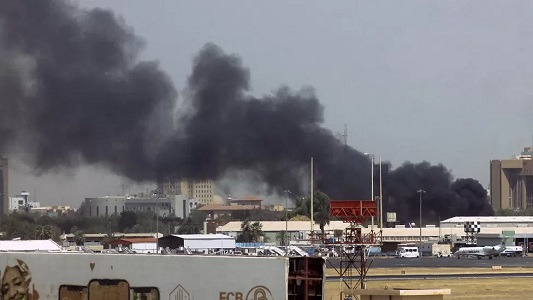
Witnesses say bombing, shelling and gunfire continue in Khartoum.

It means a three-day truce called by the UN, US and others has failed.

People in Khartoum and its twin city of Omdurman tell the BBC they are still feeling a mixture of shock and anger.

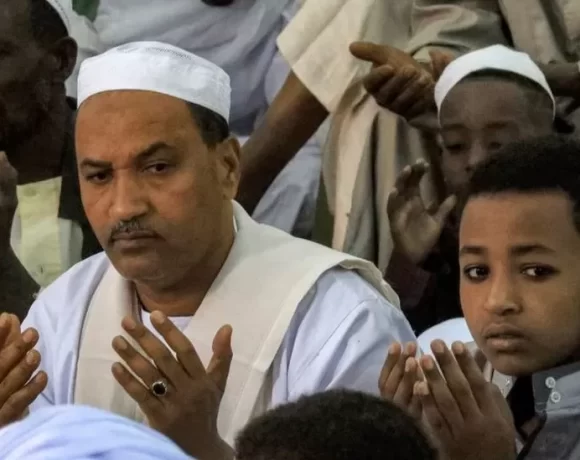
Two women crying at the entrance to a mosque explain they have lost several family members – including two children.

Eid is the Muslim festival marking the end of the fasting month of Ramadan – and Sudanese people usually relish it as a time for visiting family and eating together with their neighbours, while children play and enjoy sweets.

Prayer services would normally be packed on Eid, but on Friday many mosques in Khartoum and Omdurman are almost empty as people shelter at home.

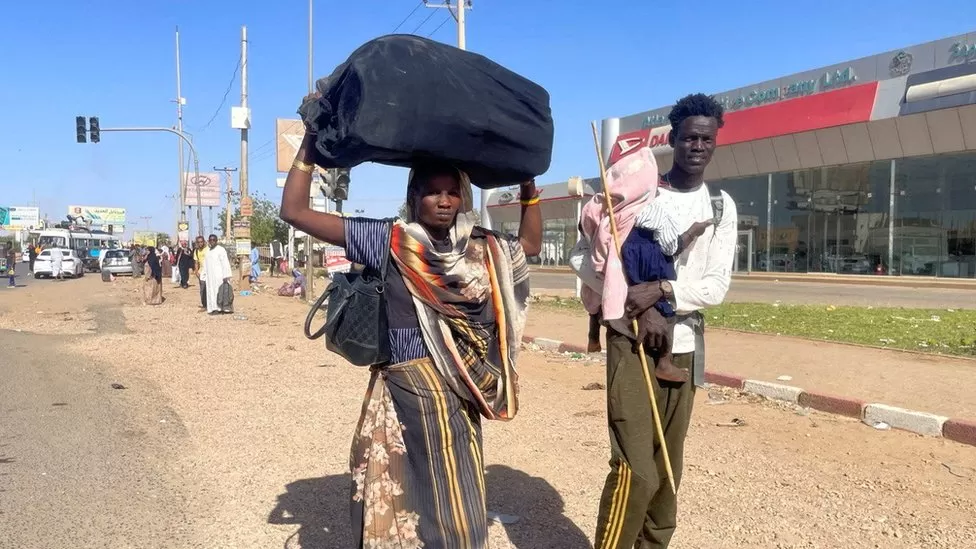
Others meanwhile have fled the capital for their home regions.

Two previous attempted ceasefires failed to take effect.

Diplomatic pressure is being stepped up to end the fighting – with numerous countries and international bodies calling for an immediate ceasefire and offering to mediate.

At its heart, this is a power struggle between two powerful military men over the roadmap for returning the country to civilian rule.

As part of that plan the country’s current military government – made up of the army led by General Abdel Fattah al-Burhan and the paramilitary Rapid Support Forces, led by Mohamed Hamdan “Hemedti” Dagalo – were supposed to merge their forces.

But the RSF has resisted this change, and began to mobilize its troops which escalated into full-blown fighting between the two sides on Saturday.

The UN has warned that between 10,000 and 20,000 people – mostly women and children – have fled Sudan, to seek safety in neighbouring Chad.

US Secretary of State Antony Blinken on Thursday appealed to the warring military leaders separately to join a ceasefire at least until Sunday – warning of the risk to civilians as well as humanitarian and diplomatic workers.

A Sudanese army statement said Gen Burhan had received calls from the Turkish, South Sudanese and Ethiopian leaders, as well as Mr Blinken and the Saudi and Qatari foreign ministers.

The two men at the centre of the crisis – Gen Burhan and Mr Hemedti – both served under the previous president, Omar al-Bashir, until they turned on him in 2019, after months of pro-democracy protests.

They have large numbers of troops at their disposal. Gen Burhan has the regular military – around 120,000 strong – while the RSF has as many as 150,000, with a fearsome reputation for violence.

They were part of a transitional administration that was supposed to pave the way for a democratic government.

But in 2021 Gen Burhan staged a military coup, putting all that on hold.

BBC/Taiwo Akinola

Subscribe to our Telegram and YouTube Channels also join our Whatsapp Update Group

Foreign

Sudan’s paramilitary group Rapid Support Forces (RSF) alleges it has shot down two military helicopters in a reprisal attack against the army.

The group said the army attacked its fighters in Omdurman, near the capital Khartoum on Thursday morning despite the truce announced on Wednesday.

“But the forces responded to the attack and inflicted heavy losses on the putschists in lives and equipment, including the shooting down of two helicopters,” the RSF said in a statement posted on Twitter

. The paramilitary group said it remained committed to the ceasefire.

The army is yet to comment on RSF attack claims.

BBC/Simeon Ugbodovon

Subscribe to our Telegram and YouTube Channels also join our Whatsapp Update Group