News

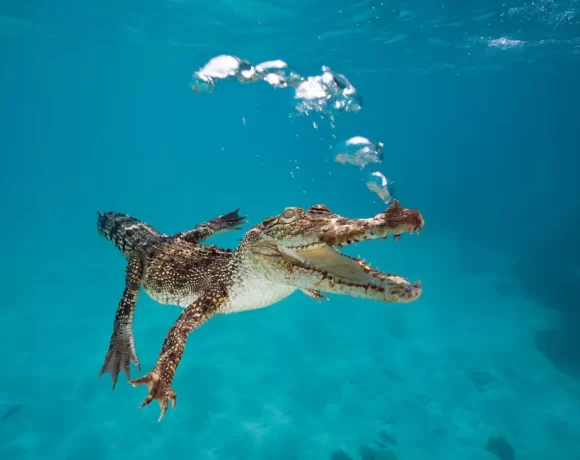
An Australian man has escaped from becoming a prey for a saltwater crocodile while snorkelling at an exclusive Queensland resort.

According to report, Marcus McGowan, 51, has explained how he managed to prise the predator’s jaws off his head, suffering lacerations, as he was airlifted to a nearby island hospital, and later flown to Cairns for further treatment.

Crocodile attacks are uncommon in Australia, but there have been several in recent months.

Mr McGowan said he was in the water with a group of people about 28km (17.3 miles) off Haggerstone Island near Cape York when he was bitten from behind.

“I thought it was a shark but when I reached up, I realised it was a crocodile. I was able to lever its jaws open just far enough to get my head out,” he said in a statement.

The crocodile – suspected to be a juvenile – came back for another go, he said, but he was able to push it away, suffering a bite to his hand.

Queensland’s environment department says it will investigate the incident, but “crocodiles in the open ocean can be difficult to locate as the animals often travel tens of kilometres per day”.

Haggerstone Island Resort describes itself as a “family-owned, exclusive luxury resort”. The entire island, some 600km north of Cairns, is available for hire at $7,600 a night.

Crocodiles are common in Australia’s tropical north, which has seen a series of attacks recently.

In February, rangers shot a 4.2m, crocodile that attacked a man and ate his dog at a remote boat ramp north of Cairns.

And earlier this month, the remains of 65-year-old fisherman Kevin Darmody were found inside a 4.1m crocodile on the nearby Kennedy River – the 13th fatal attack in Queensland since record-keeping began in 1985.

Under Queensland’s management programme, “problem crocodiles” are removed from areas where they threaten public safety and, in rare instances, euthanised.

Since crocodile hunting was banned in 1974, the state’s crocodile population has rebounded from a low of some 5,000 animals to around 30,000 today.

BBC/Taiwo Akinola
Foreign

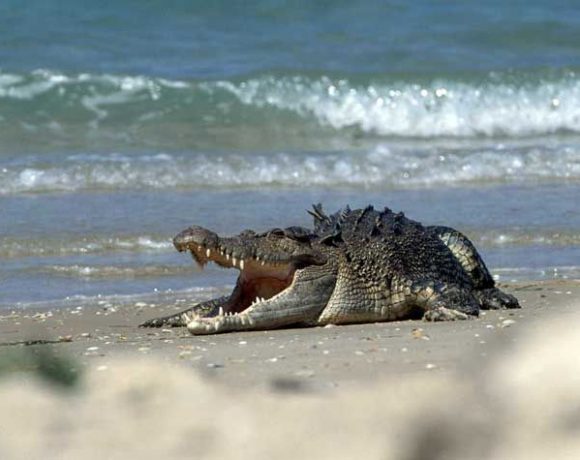
A “remarkably lucky” Australian man who forced a crocodile off his head by prizing open its jaws with his bare hands has managed to escape with minor injuries, paramedics said.

The 44-year-old Queensland man fought off the creature while swimming at Lake Placid, near Cairns, on Thursday.

He had puncture wounds on each side of his face but was “very, very calm” when healthcare workers arrived to treat him.

“A crocodile had bitten his head, and in his effort to remove the jaws of the crocodile he put his hands in to try and prize the jaws apart,” paramedic Paul Sweeney told reporters in Cairns. “In the process of trying to remove his hands, the jaws snapped shut on his forefinger. He’s a remarkably lucky gentleman.”

“Just a few centimeters lower and we have major blood vessels … had one of those been punctured then it would have been a very different story,” Sweeney said.

He added that the unnamed man estimated the saltwater crocodile was between a meter and a half and two meters (4.92 feet to 6.56 feet) in length.

Sweeney said the man had been swimming in that area three times a week for about eight years.

 “Certainly not a place I’d choose to swim,” Sweeney said, describing him as a “very fit individual”and saying “his vital signs were remarkably calm when you consider the ordeal he’d been through.”

“I would not be surprised if he ventured into those waters again for further exercise,” Sweeney added.

The Queensland Environment Department sent a team to the site and said a “search for the crocodile responsible for the attack is now underway.”

“Once rangers are at the site, any crocodile found to be present will be targeted for removal,” they said.

Crocodile attacks in Australia are rare, but Queensland officials run a public safety campaign to alert residents to the risks of swimming or relaxing near croc-infested waters.

In 2019, a Queensland fisherman narrowly escaped an attack by poking a crocodile in the eye. And last year, a massive 14-foot crocodile was captured at a tourist spot in neighboring Northern Territory.

CNN