Foreign

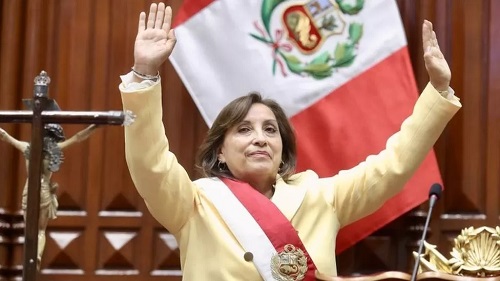
Peru’s Congress has voted to remove President Dina Boluarte from office, hours after a late-night session was called to debate her impeachment.

An overwhelming majority of lawmakers from across the political spectrum approved her ousting on grounds of “permanent moral incapacity”.

In an address on National television following the vote, Boluarte questioned the implications it would have on the stability of Peru’s democracy.

One of the world’s most unpopular leaders, with an approval rating of 2-4%, Boluarte’s tenure has been plagued by frequent protests, scandals and investigations, as well as a surge in gang violence.

Anti-government protests have escalated in recent months amid soaring crime. There was renewed anger earlier on Thursday following a shooting at a concert in the capital, Lima.

A total of 122 out of 130 lawmakers voted for Boluarte’s removal early on Friday, following votes resoundingly in favour of four motions of impeachment.

Congress leader Jose Jeri was sworn in as interim president early on Friday. Peru does not currently have a vice-president. Boluarte did not appear before Congress for the overnight hearing.

“At all times I have called for unity,” she told Peruvians after being removed, adding: “In this context, I had not thought of myself but of the more than 34 million Peruvians who deserve better.”

Protests have punctuated the 63-year-old leader’s less than three years in office, which followed the impeachment and imprisonment of her predecessor, Pedro Castillo.

Her presidency was overshadowed by several investigations, including a corruption inquiry dubbed “Rolexgate” over allegations she accepted Rolex watches as bribes.

Another probed whether she abandoned her post when she failed to appoint a caretaker president during an absence for nose surgery. She has denied any wrongdoing.

In July, her decision to double her salary to almost 35 times that of the monthly minimum wage in Peru was met with scorn and derision. Her economy minister noted at the time her salary had been the second lowest of 12 countries in South America.

Among the lawmakers who voted to remove Boluarte from office were factions once loyal to the president, including conservative parties that had previously supported her.

Boluarte rose to power in December 2022, when former President Castillo was impeached after attempting to dissolve Congress to avert his removal. She was elevated to the post as she was vice-president at the time.

Peru’s first female president, Boluarte was the Andean nation’s sixth leader since 2018. Three former leaders are behind bars. In the first three months of her presidency, there were more than 500 protests over her rule.

It followed the death of more than 50 Castillo supporters in a government crackdown on demonstrations calling for her resignation and fresh elections.

BBC/Adebukola Aluko

Subscribe to our Telegram and YouTube Channels, and also join our WhatsApp Update Group

Foreign

Authorities in Peru have held high-level talks to try to resolve a deepening political crisis triggered by the ousting of the former president.

The Council of State, the body made up of representatives of all branches of power, and church leaders had a three-hour meeting in the capital, Lima.

Earlier, two government ministers resigned, following days of violent protests over the impeachment of Pedro Castillo on 7 December.

More than 20 people have been killed.

After the meeting on Friday evening, the head of the National Board of Justice, José Ávila, called on Peruvians to avoid violence and engage in peaceful dialogue with the authorities.

He said government ministers would be travelling to the areas where people were protesting, in order to promote such a dialogue.

The new President, Dina Boluarte, gave no statement to the press.

In another development, thousands of tourists are trapped in the south-eastern city of Cusco after protesters forced the local airport to close.

Peru has been through years of political turmoil, with the latest crisis coming to a head when Mr Castillo announced he was dissolving Congress and introducing a state of emergency.

However, his plan backfired and Congress instead voted overwhelmingly to impeach him. Mr Castillo, who is currently in detention, is being investigated on charges of rebellion and conspiracy.

He denies all the accusations, insisting that is still the country’s legitimate president.

Demonstrators are calling for the closure of Congress, the resignation of Ms Boluarte and early elections. On Friday, Congress voted against a proposal to bring elections forward to next year.

Thursday’s clashes between the army and Castillo supporters in the central Ayacucho region left at least eight people dead, health authorities said. Footage on social media showed protestors blocking main roads and airports.

Just hours later, Education Minister Patricia Correa said she was stepping down. In a Twitter post on Friday, she wrote that the “death of compatriots has no justification”, and that “state violence cannot be disproportionate and cause death”.

Culture Minister Jair Perez also resigned.

The protests are also affecting the country’s tourism industry. The mayor of Cusco told AFP news agency that about 5,000 tourists are stranded in the city after the airport there closed when protesters tried to storm the terminal.

The city is the gateway to Macchu Picchu, an ancient Inca citadel which is visited by hundreds of thousands of people a year.

About 800 tourists are also stuck in the small town at the foot of the mountain where the citadel stands because the railway line which serves it has stopped running.

Some mostly American and European tourists have reportedly left the town on foot along the train tracks in an attempt to return to Cusco.

BBC/Simeon Ugbodovon

Subscribe to our Telegram and YouTube Channels also join our Whatsapp Update Group

Foreign

Peru has a female president for the first time after ex-president Pedro Castillo was impeached – hours after he tried to dissolve parliament.

Dina Boluarte – previously the vice-president – was sworn in after a dramatic day in Lima on Wednesday.

Earlier in the day, Mr Castillo had said he was replacing Congress with an “exceptional emergency government”.

But lawmakers ignored this, and in an emergency meeting impeached him. He was then detained and accused of rebellion.

Reports in local media say he was heading to the Mexican embassy in the capital when he was arrested.

Ms Boluarte, a 60-year-old lawyer, said she would govern until July 2026, which is when Mr Castillo’s presidency would have ended.

Speaking after taking the oath of office, she called for a political truce to overcome the crisis which has gripped the country.

“What I ask for is a space, a time to rescue the country,” she said.

Wednesday’s dramatic chain of events began with President Pedro Castillo giving an address on national television in which he declared a state of emergency.

He announced that he would dissolve the opposition-controlled Congress, a move which was met with shock both in Peru – several ministers resigned in protest – and abroad.

The head of the constitutional court accused him of launching a coup d’etat, while the US “strongly urged” Mr Castillo to reverse his decision.

Peru’s police and armed forces released a joint statement in which they said they respected the constitutional order.

Mr Castillo tried to dissolve Congress just hours before it was due to start fresh impeachment proceedings against him – the third since he came to office in July 2021.

In his televised address he said: “In response to citizens’ demands throughout the length and breadth of the country, we have decided to establish an exceptional government aimed at re-establishing the rule of law and democracy.”

He said that “a new Congress with constituent powers to draw up a new constitution” would be convened “within no more than nine months”.

But Congress, which is controlled by parties opposed to Mr Castillo, convened an emergency session and held the impeachment vote Mr Castillo had been trying to prevent.

The result was overwhelming: 101 voted in favour of impeaching him, with only six against and 10 abstentions.

After the impeachment, Mr Castillo was seen on police premises.

In the photos – which were shared by police on Twitter but subsequently deleted – he could be seen sitting, seemingly relaxed, and chatting with others. The footage was then released of Mr Castillo signing papers with prosecutors.

He was later detained and accused of rebellion for breaking the constitutional order.

Peru has been going through a rocky political period, with multiple presidents ousted from office in recent years. In 2020, it had three presidents within the space of five days.

Mr Castillo, who is a left-wing former school teacher, was elected in June 2021 in a polarising election in which he defeated his right-wing rival, Keiko Fujimori.

He had recently been fighting allegations of corruption, which he said were part of a plot to oust him.

BBC/Simeon Ugbodovon

Subscribe to our Telegram and YouTubeChannels also join our Whatsapp Update Group