Politics

… urges political parties to maintain a peaceful relationship 

By Nashirdeen Sherifdeen

The Chairman, Oyo State Independent Electoral Commission (OYSIEC ), Aare Isiaka Abiola Olagunju, SAN, has called on political parties in the state to uphold the laws guiding the conduct of Local Government Councils election in the state and maintain harmonious relationships to have a peaceful election. 

Olagunju, while speaking during a meeting with members of the Inter-Party Advisory Council (IPAC), Oyo State, held on Thursday at the Headquarters of the Commission, Agodi, Ibadan, sought continued cooperation and understanding of members of the political parties participating in the forthcoming election in a bid to have free, fair, transparent and acceptable elections.

While enumerating plans mapped out by the Commission ahead of the poll, Olagunju hinted that the pasting of voter registers is ongoing across the polling units for eligible voters to verify their names.

He reiterated that a permanent voter’s card would be the only document to be used for voting on the day of the election as agreed at previous engagements with the political parties.

While responding to questions and issues raised at the meeting, the OYSIEC boss explained that the police and some other security agencies have promised to collaborate with OYSIEC to have a successful election, noting that the Western Nigeria Security Network (WNSN) also known as Amotekun Corps will not be engaged for election activities.

He appealed to IPAC to present representatives to jointly monitor the electoral process, particularly during the distribution and delivery of voting materials across polling units.

He admonished political parties not to compromise with the election guidelines but to contribute their quota as true citizens of Oyo state to its development.

In his remarks, the IPAC Chairman, Oyo State, Otunba Adegbenro Fagbemi, revealed that the meeting provided a platform to identify challenges that could be confronted during the election.

He expressed the readiness of IPAC members to observe the distribution of election materials across the seven geopolitical zones of the state. 

He called for concerted efforts from relevant stakeholders and residents of the state to have a replica of the last general elections, which he said were peaceful.

In their separate remarks, the Secretary, All Progressives Congress, Oyo State, Alhaji Tajudeen Olanite and Mr.Kayode Babayemi of African Action Congress, urged members of participating political parties to abide by the election rules and regulations.

Kayode Babayemi also submitted that engagement with the security agencies and other relevant stakeholders is key to the success of the election, scheduled for April 27, 2024.

The meeting had in attendance representatives of participating political parties, OYSIEC Commissioners and the Directors of the commission.

Subscribe to our Telegram and YouTube Channels and also join our Whatsapp Update Group

Politics

On February 25, 2022, President Muhammadu Buhari signed into law the new electoral act amendment bill.

The electoral law aims at standardizing the nation’s electoral process by ensuring sanity and transparency in the coming elections.

For this goal to be achieved, there is the need for key actors especially the media and political parties to understand the provisions of the law to guide their performance.

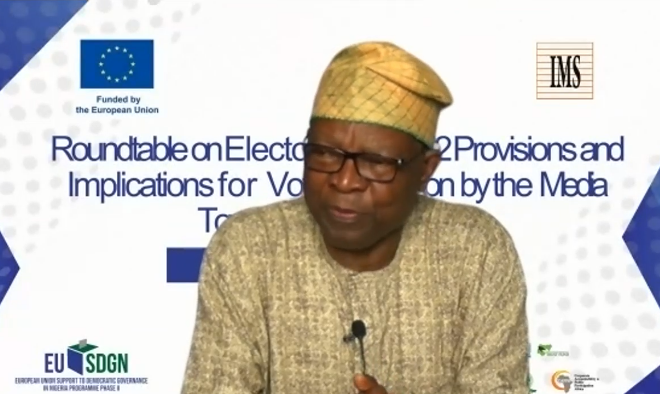
It was on this basis that stakeholders in the electoral process held a virtual roundtable to critically examine the new electoral law to enhance the capacity of the media and other relevant institutions before, during and after the elections.

Convener of the parley and Executive Director, Institute for Media and Society, IMS, Dr Akin Akingbulu explained that the forum was in line with the framework of European Union support to democratic project phase 2:which seeks to strengthen participatory democracy in Nigeria with special focus on the media which is an important component.

“This is important because electoral legislation provides the framework of performance of roles by actors and institutions in the electoral process which includes the media”.

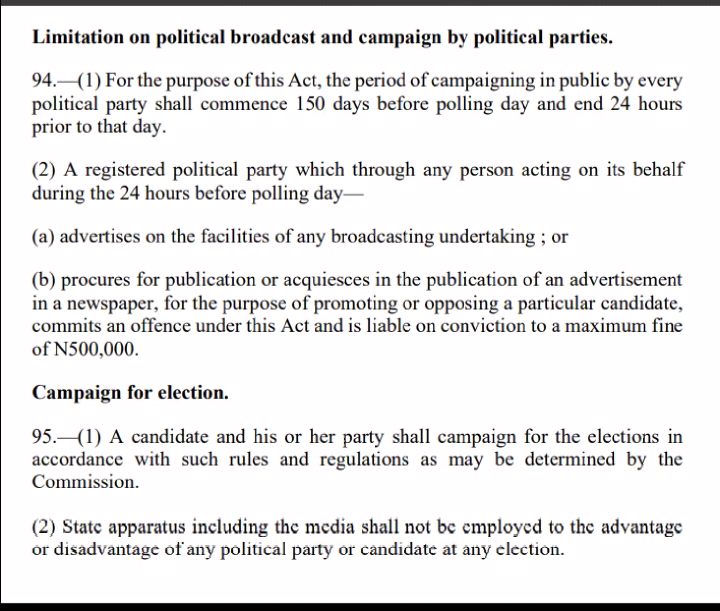
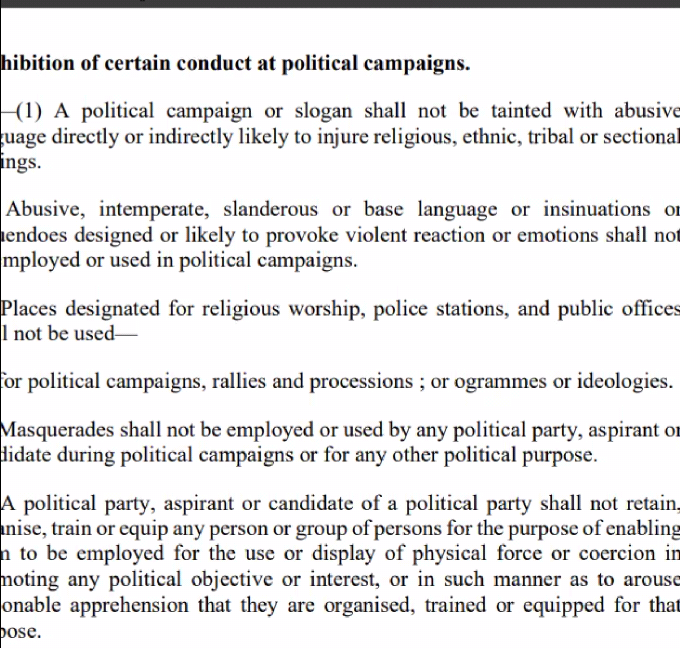
Participants delved into five key sections of the electoral law including section 54, sub-section 1 which gives adequate recognition to people with disabilities, special needs and the vulnerable, section 92, sub-sections 1-5 which prohibits incisive conduct at political campaigns and section 94 subsection 1 which outlines limitation on political broadcast and campaign by political parties 

The forum equally examined section 95 sub-sections 1&2 and section 96.

Participants dwelt extensively on the section that affects persons with disabilities.

Executive Director, Institute for Media and Society, Dr Akin Akingbulu said it would be good if the needs of persons with disabilities were adequately met as stipulated by the law.

Representative of the National Broadcasting Commission, Mrs Stella Erhuumse harped on the need for the media to create awareness on the provisions of the electoral law for persons with disabilities and special needs for their active participation during elections.

“It is the expectation of the National Broadcasting Commission that between now and time for the elections,the media would have done a lot in educating the electorate on this particular provision so that those who are visually impaired and incapacitated would know how they can function during the election “.

In the view of Professor Babatunde Ojebuyi from the University of Ibadan, the Independent National Electoral Commission, INEC,  must put in place certain measures that would encourage and make voting convenient for persons with disabilities.

“For example , INEC should try and produce a separate list at every polling unit for the physically challenged and when they get there, that is where they should go.They should not be listed among other people, otherwise they may be overcrowded, overpowered and they may not have the visibility that we want to give them”.

Lending his voice, the Acting Head of Journalism Department, Lagos State University Dr Tunde Akanni, suggested that INEC should make it possible for the physically challenged to cast their votes at any polling unit nearest to them.

“INEC has its data online in the cloud. All the INEC officials at any of these polling unit needs to do is just ask them for their names, and check up whether they are registered at all and it will bring out their names”.

While examining other sections of the law, another participant, Uzo Enwurum, expressed concern that many political campaigns were characterised by hate speeches despite the prohibition of such by the electoral law.

Reacting to perceived domineering attitude of any  government in power during electioneering,  a member of the academia, Professor Taye Obateru, advised the media to be guided by the provisions of law while performing their duties and not on assumption.

“As professionals, should also try as much as possible not to censor ourselves based on assumptions that our employers or party in power will not be happy with us when we do certain things. Let us be seen to be trying our best to give every party equal opportunity”.

It was also the consensus of participants that adequate security is provided at polling units for all eligible voters .

Olaitan Oye-Adeitan.