At least three people died when armed men in Haiti opened fire at journalists, police and medical staff during a briefing to announce the reopening of the country’s biggest public hospital.
Two journalists and a police officer were reportedly shot dead, while others were wounded in Tuesday’s attack in the general hospital in the capital Port-au-Prince.
The site had been recaptured by Haiti’s government in July, after being occupied and destroyed by gangs.
The Viv Ansanm gang alliance, which controls much of the city, has owned up to the attack.
Pictures posted online appear to show several people injured or dead inside the building.
Journalists were waiting for the arrival of Health Minister Lorthe Blema when the shooting began.
Journalists Markenzy Nathoux and Jimmy Jean were killed during the attack, Robest Dimanche, spokesman for the Online Media Collective, told AFP news agency.
Other journalists were wounded, he added.
An officer was also killed, police spokesman Lionel Lazarre told AFP.
“It felt like a terrible movie,” Dieugo André, a photojournalist who witnessed the violence, was quoted as saying by The Haitian Times.
“I have the blood of several injured journalists on my clothes.”
In an online video claiming the attack, the Viv Ansanm gang alliance said it had not authorised the reopening of the hospital, which they occupied and destroyed in March.
The head of Haiti’s presidential transitional council, Leslie Voltaire, said: “We express our sympathy to all the victims’ families, in particular to the Haiti National Police and all the journalists’ associations.
“We guarantee them that this act will not remain without consequences.”
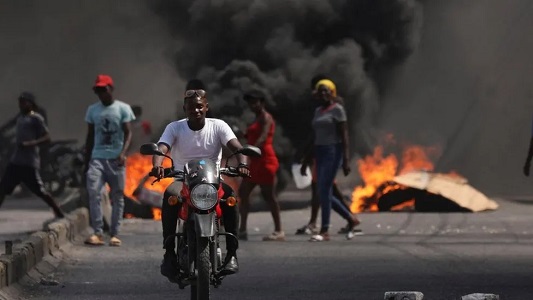
People in Haiti continue to suffer from unbearable levels of gang violence, despite the installation of a new transition government in April and the deployment of an international force led by Kenyan police officers six months ago.
Haiti has been engulfed in a wave of gang violence since the assassination in 2021 of the then-president, Jovenel Moïse.
An estimated 85% of Port-au-Prince is still under gang control.
The UN says that as many as 5,000 people have been killed in violence in Haiti this year alone, and the country is now on the verge of collapse.
Haiti has declared a 72-hour state of emergency and night curfew in and around the capital because of two jailbreaks and spiralling insecurity.
At the weekend, armed gangs stormed a major Port-au-Prince prison, leading to the killing of at least 12 people and the release of around 4,000 inmates.
Gang leaders say they want to force the resignation of Prime Minister Ariel Henry, who is outside the country.
The groups aiming to oust him control around 80% of Port-au-Prince.
A government statement said two prisons – one in the capital and the other in nearby Croix des Bouquets – were stormed over the weekend.
Among those detained in Port-au-Prince were gang members charged in connection with the 2021 killing of President Jovenel Moïse.
The latest upsurge in violence began on Thursday when the prime minister travelled to Nairobi to discuss sending a Kenyan-led multinational security force to Haiti.
Gang leader Jimmy Chérizier (nicknamed “Barbecue”) declared a coordinated attack to remove him.
“All of us, the armed groups in the provincial towns and the armed groups in the capital, are united,” said the former police officer, who is thought to be behind several massacres in Port-au-Prince.
Haiti’s police union had asked the military to help reinforce the capital’s main prison, but the compound was stormed late on Saturday.
On Sunday the doors of the prison were still open and there were no signs of officers, Reuters news agency reported. Three inmates who tried to flee lay dead in the courtyard, the report said.
One volunteer prison worker told the Reuters news agency that 99 prisoners – including former Colombian soldiers jailed over President Moïse’s murder – had chosen to remain in their cells for fear of being killed in the crossfire.
Violence has been rife since President Moïse’s assassination. He has not been replaced and elections have not been held since 2016.
Under a political deal, elections were to be held and the unelected Mr Henry was due to stand down by 7 February, but that did not happen.
A gang in Haiti has shot and killed at least seven people who were marching in a big protest organised by a church leader.
Hundreds of parishioners, some armed with machetes, marched through a suburb of the capital, Port-au-Prince, in a bid to rid the area of gang members.
The gang is said to have opened fire on them with machine guns.
Soaring gang violence in Haiti has left more than 2,400 people dead in 2023 alone.
There are fears the death toll from Saturday’s shooting could increase, with several people wounded and others kidnapped.
Reuters news agency says unverified videos on social media showed people being shot at in the street, bodies lying on the ground and people who appeared to be hostages saying they thought the march was peaceful and had no idea it was about taking on the gang.
The protest happened in the suburb of Canaan, which was founded by survivors of the devastating 2010 earthquake.
Canaan is controlled by a gang led by a man identified only as “Jeff”, who is believed to be allied with the 5 Segonn “5 Seconds” gang.
Gédéon Jean, director of Haiti’s Center for Analysis and Research in Human Rights, told the Associated Press news agency that he watched the event unfold online and planned to ask the Ministry of Justice to investigate.
He accused the pastor who organised the march of being irresponsible because he “engaged a group of people and put them in a situation like this”.
“Police should have stopped them from going,” Mr Jean said. “It’s extremely horrible for the state to let something like this happen.”
Decades of instability, disasters and economic woes have left Haiti one of the poorest and most violent countries in the world.
Gang violence has soared since the assassination of President Jovenel Moïse in 2021, which led to much of the Caribbean country’s territory falling out of government control, so now around 80% of the capital is controlled by gangs.
Turf wars have since driven a surge in refugees, severe food shortages, murders, kidnappings and sexual violence.
UN rights office spokeswoman Ravina Shamdasani said that in the year to 15 August, at least 2,439 Haitians had been killed, 902 injured and 951 kidnapped.
Amid the soaring violence Haitians have organised a violent movement known as “bwa kale” that targets suspected gang members. More than 350 people have been killed since that uprising began in April, according to the UN.
C is for Cookie, and that’s good enough for me. Cookie, cookie, cookie starts with C.”
It’s the song that defined the childhood of countless Western children – Sesame Street’s beloved Cookie Monster, tucking into his favorite sweet snack.
Cookies remain a beloved treat throughout America and beyond, with numerous kids looking forward to a daily serving.
The people of Haiti regularly eat cookies, too.
Sadly, the experience isn’t quite as enticing.
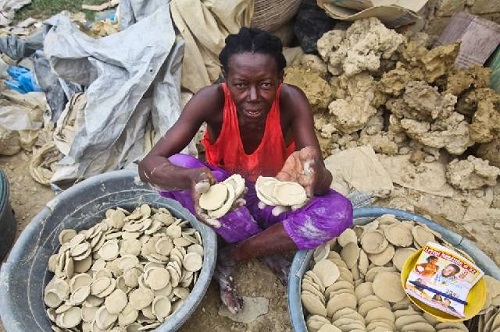
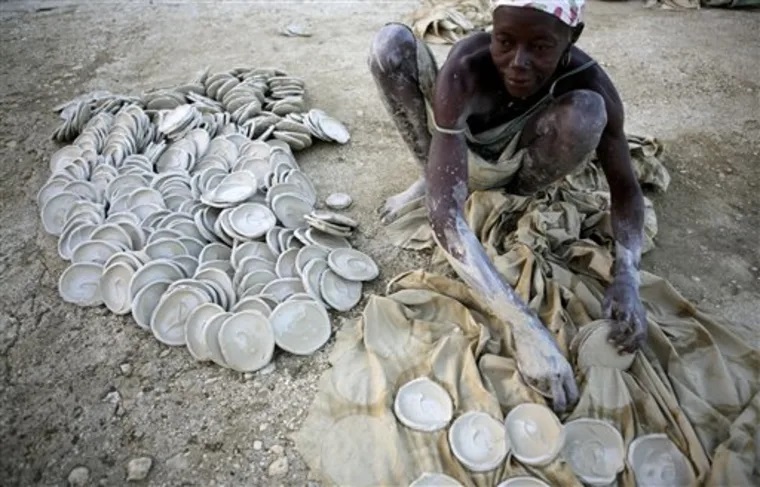
Haiti is one of the world’s poorest nations, with over 80% of the population living below the poverty line. This leaves the starving locals desperate for sustenance and creating cookies from mud simply to survive.
Well, it’s not exactly ideal, but sadly, the people of Haiti have no real alternative.
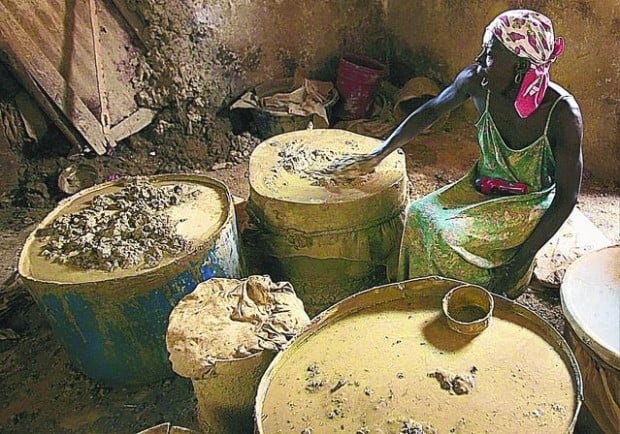
With food scarce and prices high, many Haitians are forced to create their own food from mud, with butter and salt added to make the snack comparatively palatable. In some cases, sugar may be applied, if it’s available.
As you can imagine, these ‘dirt cookies’ have virtually no nutritional value.
As the country already has the Western hemisphere’s highest rates of death in under-fives, that’s hardly ideal.
Haiti also has serious mortality issues surrounding respiratory infections, tuberculosis, and diarrhea, and eating dirt will do very little to alleviate this.
In the best case scenario, these mud cookies will bolster the weak immune systems of Haitians. With access to medication being very limited, the people of the country need to do all they can to help themselves.
At worst, however, eating soil can make somebody even sicker than they already are.
The water supply of Haiti is often contaminated. Naturally, this water will make its way into the soil as well as being drunk.
We want to make it abundantly clear that we don’t recommend or condone this. If you get sick as a result of this culinary experimentation, The Sized will carry no legal responsibility.
If you’re still determined to try this so that you can experience what life is like for the bottom end of the 99%, however, here’s how to do it.
Dig up some dirt from your backyard or a similar location.
Place it in a bowl.
Add water. You’ll want roughly half as much water as you have dirt or mud.
Sprinkle in some salt and butter or margarine. If you’re going to imitate a comparatively luxurious Haitian lifestyle, add some sugar too.
Mix all of these ingredients by hand and mold them into cookie shapes.
Place on a baking tray, and heat at around 180 degrees for 20 minutes.
This will give you a taste of Haiti, and hopefully, some perspective of just how challenging life is for the people of this nation. Mud cookies may not be appealing to the palate, but they’re all that stands between many Haitians and starvation.
Arizona Daily Star
If you hold the unwelcome title of the poorest country in the Western hemisphere, something has clearly gone very wrong somewhere along the way. Just how has Haiti ended up in such a state of economic turbulence?
The problems stem back to the 18th century when Haiti was a French colony that was exploited mainly for its slave labour.
The country had several sugar plantations, which were owned by a handful of precious fat cats.
This created an unequal distribution of wealth throughout the country that remains to this day.
Though not everybody in Haiti is so poor, they are reduced to eating dirt but many are.
NBC
Other countries have done little to help Haiti. France vacated the country in 1804 but insisted on being repaid the money they were owed due to lost slaves. It took Haiti until 1947 to repay this amount in full.
In between these dates, the USA had a turn at occupation early in the 20th century. Even after America moved out, it continued to meddle in Haitian politics. As the country has not enjoyed trustworthy governments over the years, this has hardly helped matters.
More recently, environmental disasters have devastated Haiti. In 2010, the country was rocked to its very core by an earthquake. International charities came to the rescue in theory. In reality, very little was achieved. Haiti was undoubtedly not “built back better,” as some catchy donation appeals claimed it would be.
This earthquake set Haiti back considerably. Any chance the nation then had of getting back on its feet was swept away in 2016, literally. Hurricane Michael rampaged through Haiti, destroying 90% of the homes on the coast and severely damaging hundreds of thousands of others.
Since these natural disasters, an outbreak of cholera has further decimated the country. Foreign assistance continues to pour in, but it seems that Haiti is consistently battling against a tide of ill fortune
Security forces in Haiti say they have taken control of a major fuel depot held by criminal gangs.
The government says fuel distribution will resume from the Varreux terminal, in the rundown Cité Soleil area, last Monday.
The gangs seized the port facility in September, blocking the delivery of imported fuel and hampering efforts to distribute food and medicines.
The terminal supplies most of the oil products in Haiti.
According to the report, it has been controlled and blockaded by a coalition of powerful gangs, known as G9, for more than a month.
The blockade has forced many businesses to close and complicated the distribution of petrol and bottled drinking water, while a cholera outbreak has worsened by the week.
All of this has contributed to civil unrest across the country.
The unrest has also escalated since Prime Minister Ariel Henry announced an end to government fuel subsidies on 11 September, which sent petrol and diesel prices skyrocketing.
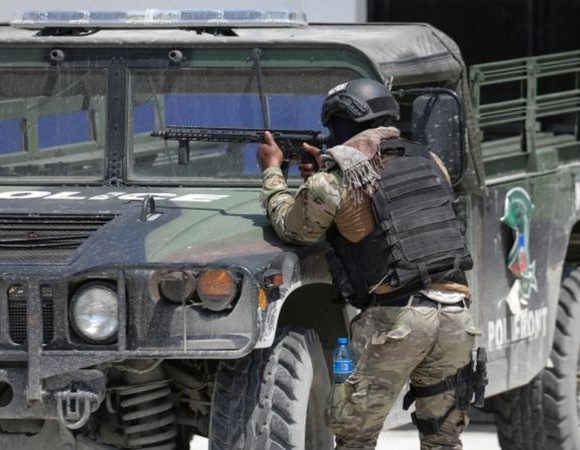
Amid the turmoil, police launched an operation to take control of the fuel terminal on Wednesday. Gunfire was heard in the area throughout the day.
A day later, a police source told AFP they had succeeded in taking control of the facilities and were in the process of clearing the roads.
Neither the police nor the government stated whether any deaths or injuries occurred.
Prime Minister Henry congratulated the police for retaking the terminal in a statement.
The police operation follows a recent warning from the UN High Commissioner for Human Rights, Voker Türk, that a “protracted, multifaceted crisis” in Haiti could descend into the country’s worst humanitarian emergency in decades.
The UN also recently urged all countries to suspend the repatriation of Haitian migrants to the country.
BBC/Taiwo Akinola
Subscribe to our Telegram Channel and join our Whatsapp Update Group
Last week, 400 Mawozo also kidnapped a diplomat from the Dominican Republic.
Carlos Guillén, the trade attaché at the Dominican embassy in Haiti’s capital Port-au-Prince, was seized by gang members while he was travelling to his home country, which is located on the same island as Haiti.
Haitian authorities have detained twenty-three people, including a Supreme Court judge, for their role in an alleged plot to overthrow President Jovenel Moise.
Announcing the arrests on Sunday, Prime Minister Joseph Jouthe told a news conference that a senior police official was also among those taken into custody, alongside money, guns and ammunition.
“These people had contacted national palace security officials, high-ranking officers of the national palace whose mission was to arrest the president… and also to facilitate the installation of a new president,” Mr. Jouthe said.
President Moise, speaking later at the Port-Au-Prince airport on his way to launch the annual carnival in the coastal town of Jacmel, said the plotters’ aim was to make an “attempt on my life”.
Sunday’s arrests come after leading opposition figures announced a plan to replace Mr. Moise with a new head of state, accusing the president of being authoritarian and presiding over economic chaos.
Anti-government demonstrators in the national capital, Port-Au-Prince, had earlier clashed with police, who responded with tear gas. There were also street protests against Mr. Moise in some other towns.
According to the opposition plan, members of civil society and opposition leaders were to pick a new president from one of the sitting Supreme Court judges, instead of waiting for general elections scheduled for September.
Mr. Moise, who has ruled the small Caribbean island-nation by decree since mid-January, has said he would hand over power to the winner of the elections, but would not step down until his term expires on February 2, 2022.
He has also put in place plans to hold a referendum on amending Haiti’s constitution in April, with the opposition voicing concerns the vote will neither be free nor fair and could give Mr. Moise too much power.
Haiti, a former colony of France, has remained a trouble-spot since gaining independence in the mid-19th-century. The latest coup plot there has only but exacerbated its lingering political tensions, in addition to its status as the poorest country in the Western hemisphere.