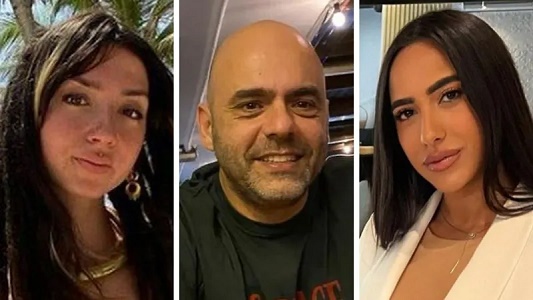
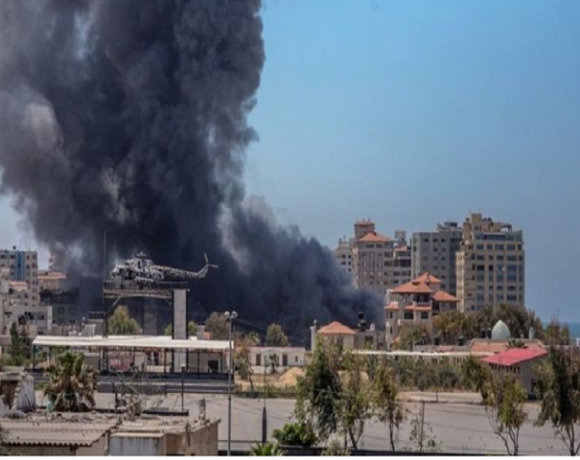
Hamas has announced it will release three hostages on Saturday under a ceasefire deal with Israel: Israelis Ofer Kalderon, 53, and Yarden Bibas, 34, along with American-Israeli Keith Siegel, 65.
Bibas is the father of Kfir, who was 10 months old when Hamas kidnapped him, his mother Shiri, and his brother Ariel, now five but their fate remains unknown.
Israel confirmed receiving the list and will release more Palestinian prisoners in exchange, marking the fourth such swap since the ceasefire began on January 19.
Hamas took 251 hostages during its October 7 attack on Israel, which killed about 1,200 people and triggered the war.
Gaza’s Hamas-run health ministry reports 47,460 Palestinians have died in Israel’s military offensive.
So far, 18 hostages and 400 Palestinian prisoners have been freed under the deal.
Four female Israeli soldiers taken hostage by Hamas on 7th October 2023, were released on Saturday as part of a swap which will also see 200 Palestinian prisoners freed.
Karina Ariev, Daniella Gilboa, Naama Levy and Liri Albag, all aged between 19 and 20, were released to the Red Cross in Gaza City during a heavily choreographed handover involving dozens of Hamas gunmen.
However, Israel accused Hamas of breaching the terms of the ceasefire because female civilian hostage Arbel Yehud was not included in Saturday’s release.
Israel said it would delay the planned return of displaced Palestinians to northern Gaza, while Hamas insisted the hostage would be released next weekend.
Despite the dispute, Israel released 200 Palestinian prisoners in return for the four hostages.
Among them are 70 people who will be immediately deported to neighbouring countries via Egypt due to the seriousness of their offences.
Some prisoners will be transferred to Gaza, while others will be allowed to return to their homes in the occupied West Bank and East Jerusalem.
The swap on Saturday was the second exchange since a ceasefire came into effect on 19 January. Three hostages and 90 Palestinian prisoners were released in the first swap.
BBC/Adebukola Aluko
Subscribe to our Telegram and YouTube Channels and also join our Whatsapp Update Group
Israel and Hamas have agreed on a Gaza ceasefire and hostage release deal following 15 months of war, mediators Qatar and the US say.
Qatari Prime Minister Sheikh Mohammed bin Abdul Rahman Al Thani said the agreement would come into effect on Sunday so long as it was approved by the Israeli cabinet.
US President Joe Biden said it would “halt the fighting in Gaza, surge much-needed humanitarian assistance to Palestinian civilians, and reunite the hostages with their families”.
Israeli Prime Minister Benjamin Netanyahu said the deal’s final details were still being worked on, but he thanked Biden for “promoting” it. Hamas leader Khalil al-Hayya said it was the result of Palestinian “resilience”.
Many Palestinians and Israeli hostages’ families celebrated the news, but there was no let-up in the war on the ground in Gaza.
The Hamas-run Civil Defence agency reported that Israeli air strikes killed more than 20 people following the Qatari announcement. They included 12 people who were living in a residential block in the Sheikh Radwan neighbourhood of Gaza City, it said. There was no immediate comment from the Israeli military.
Israel launched a campaign to destroy Hamas – which is proscribed as a terrorist organisation by Israel, the US and others – in response to an unprecedented cross-border attack on 7 October 2023, in which about 1,200 people were killed and 251 others were taken hostage.
More than 46,700 people have been killed in Gaza since then, according to the territory’s Hamas-run health ministry. Most of the 2.3 million population has also been displaced, there is widespread destruction, and there are severe shortages of food, fuel, medicine and shelter due to a struggle to get aid to those in need.
Israel says 94 of the hostages are still being held by Hamas, of whom 34 are presumed dead. In addition, there are four Israelis who were abducted before the war, two of whom are dead.
Qatar’s prime minister called for “calm” on both sides before the start of the first six-week phase of the ceasefire deal, which he said would see 33 hostages – including women, children and elderly people – exchanged for Palestinian prisoners in Israeli jails.
Israeli forces will also withdraw to the east away from densely populated areas of Gaza, displaced Palestinians will be allowed to begin returning to their homes and hundreds of aid lorries will be allowed into the territory each day.
Negotiations for the second phase – which should see the remaining hostages released, a full Israeli troop withdrawal and a return to “sustainable calm” – will start on the 16th day.
The third and final stage will involve the reconstruction of Gaza – something which could take years – and the return of any remaining hostages’ bodies.
Israel’s cabinet has to meet on Thursday morning to give its final approval.
The ceasefire and the release of the first three Israeli hostages is expected to come on Sunday although a senior Hamas official has told the BBC there are talks ongoing to bring the start forward to Thursday night.
Sheikh Mohammed said there was “a clear mechanism to negotiate phase two and three”, with the agreements set to be published “in the next couple of days, once the details are finalised”.
He also said Qatar, the US and Egypt, which also helped broker the deal, would work together to ensure Israel and Hamas fulfilled their obligations.
“We hope that this will be the last page of the war, and we hope that all parties will commit to implementing all the terms of this agreement,” he added.
President Biden said the plan, which he first outlined eight months ago, was “the result not only of the extreme pressure Hamas has been under and the changed regional equation after a ceasefire in Lebanon and the weakening of Iran – but also of dogged and painstaking American diplomacy”.
“Even as we welcome this news, we remember all the families whose loved ones were killed in Hamas’s 7 October attack, and the many innocent people killed in the war that followed,” a statement added. “It is long past time for the fighting to end and the work of building peace and security to begin.”
At a later news conference, Biden also acknowledged the assistance of President-elect Donald Trump, who put pressure on both parties by demanding hostages be released before his inauguration on Monday.
“In these past few days, we’ve been speaking as one team,” he said, noting that most of the implementation of the deal would happen after he left office.
Trump was the first to confirm reports the agreement had been reached, beating the White House and Qatar to a formal announcement.
In a later post on social media, he attempted to take the credit for the “epic” agreement, saying it “could have only happened as a result of our historic victory in November”.
Israeli Prime Minister Benjamin Netanyahu’s office thanked Trump “for his help in promoting the release of the hostages, and for helping Israel end the suffering of dozens of hostages and their families”.
“The prime minister made it clear that he is committed to returning all the hostages by any means necessary,” it said, before adding that he had also thanked Biden.
Later, the office said an official statement from Netanyahu would “be issued only after the completion of the final details of the agreement, which are being worked on at present”.
Israel’s President, Isaac Herzog, said the deal would bring with it “deeply painful” moments and “present significant challenges”, but that it was “the right move”.
The agreement is expected to be approved by the Israeli cabinet, possibly as soon as Thursday morning, despite opposition from Netanyahu’s far-right coalition partners.
Then the names of all the Palestinian prisoners due for release will be made public by the Israeli government, and the families of any victims will be given 48 hours to appeal. Some of the prisoners are serving life sentences after being convicted of murder and terrorism.
Hamas’s chief negotiator and acting Gaza chief, Khalil al-Hayya, said the agreement represented “a milestone in the conflict with the enemy, on the path to achieving our people’s goals of liberation and return”.
The group, he added, would now seek to “rebuild Gaza again, alleviate the pain, heal the wounds”.
But he also warned “we will not forget, and we will not forgive” the suffering inflicted on Palestinians in Gaza.
Celebrations erupted across Gaza as news of the agreement spread
As news of the agreement emerged, pictures showed people cheering and waving Palestinian flags in the central Gaza town of Deir al-Balah and the southern city of Khan Younis.
Sanabel, a 17-year-old girl living to the north in Gaza City, told BBC OS: “All of us are delighted.”
“We have been waiting for this for a long time,” she said. “Finally, I will put my head on my pillow without worrying… It is time to heal.”
Nawara al-Najjar, whose husband was among more than 70 people killed when Israeli forces launched an operation to rescue two hostages, said: “After the ceasefire I want to give my children the best life.”
“I want them to get over the fear we lived. My children are really scared. The terror has settled in their hearts.”
Supporters of the Israeli hostages’ families also celebrated in Tel Aviv
Sharone Lifschitz is a British-Israeli woman whose 84-year-old father Oded is among the remaining hostages. Her mother, Yocheved, was also abducted in the 7 October attack but was released after several weeks in captivity.
She told the BBC in London as news of the deal came through that it felt “like a bit of sanity”, but she admitted: “I know that the chances for my dad are very slim.”
“He’s an elderly man, but miracles do happen. My mum did come back, and one way or another, we will know. We will know if he’s still with us, if we can look after him.”
She warned: “There are more graves to come and traumatised people to come back, but we will look after them and make them see light again… May this be the start of something better.”
Moshe Lavi, the brother in-law of Omri Miran, a 47-year-old father-of-two young children, told the BBC that it was “a very mixed day for most families of hostages”.
“We want to see our families come home from their mass captivity. But we also understand that this is a phase deal. Only the first phase was agreed upon,” he said.
“We’ll have to keep fighting, keep advocating as families with all leaders with our own government to understand they have to release all the hostages.”
UN Secretary-General Antonio Guterres said the “priority now must be to ease the tremendous suffering caused by this conflict”.
The comments by Israel Katz appeared to mark the first time that Israel has acknowledged killing Ismail Haniyeh, who died in an explosion in Iran in July. Israel was widely believed to be behind the blast and leaders have previously hinted at its involvement.
In a speech Monday, Katz said the Houthis would meet a similar fate as the other members of an Iranian-led alliance in the region, including Haniyeh. He also noted that Israel has killed other leaders of Hamas and Hezbollah, helped topple Syria’s Bashar Assad and destroyed Iran’s anti-aircraft systems.
“We will strike (the Houthis’) strategic infrastructure and cut off the head of the leadership,” he said.
“Just like we did to Haniyeh, Sinwar and Nasrallah in Tehran, Gaza and Lebanon, we will do in Hodeida and Sanaa,” he said, referring to Hamas and Hezbollah leaders killed in previous Israeli attacks.
The Iranian-backed Houthis have launched scores of missiles and drones at Israel throughout the war, including a missile that landed in Tel Aviv on Saturday and wounded at least 16 people.
Israel has carried out three sets of airstrikes in Yemen during the war and vowed to step up the pressure on the rebel group until the missile attacks stop.
US President Joe Biden has urged Hamas to accept a new Israeli proposal to end the conflict in Gaza, saying that “it’s time for this war to end”.
The three-part proposal would begin with a six-week ceasefire in which the Israel Defense Forces (IDF) would withdraw from populated areas of Gaza.
There would also be a “surge” of humanitarian aid, as well as an exchange of some hostages for Palestinian prisoners.
The deal would eventually lead to a permanent “cessation of hostilities” and a major reconstruction plan for Gaza.
Hamas said it views the proposal “positively”.
Speaking at the White House on Friday, Mr Biden said that the first phase of the proposed plan would include a “full and complete ceasefire”, the withdrawal of IDF forces from populated areas and the exchange of hostages for Palestinian prisoners.
“This is truly a decisive moment,” he said. “Hamas says it wants a ceasefire. This deal is an opportunity to prove whether they really mean it.”
The ceasefire, he added, would allow more humanitarian aid to reach the beleaguered territory, with “600 trucks carrying aid into Gaza every single day”.
The second phase would see all remaining living hostages returned, including male soldiers. The ceasefire would then become “the cessation of hostilities, permanently.”
Among those who have urged Hamas to agree to the proposal was UK Foreign Secretary David Cameron, who said on X that the group “must accept this deal so we can see a stop in the fighting”.
“We’ve long argued a stop in the fighting can be turned into a permanent peace if we are all prepared to take the right steps,” Lord Cameron added. “Let’s seize this moment and bring this conflict to an end.”
UN Secretary General Antonio Guterres also welcomed the development in a post to X, formerly known as Twitter. He said the world had “witnessed too much suffering [and] destruction in Gaza” and said it was “time to stop”.
“I welcome [President] Biden’s initiative [and] encourage all parties to seize this opportunity for a ceasefire, release of all hostages, guaranteed unhindered humanitarian access [and] ultimately a durable peace in the Middle East,” he added.
In his speech, Mr Biden acknowledged that negotiations between phases one and two would be difficult.
As recently as a few days ago, Israeli Prime Minister Benjamin Netanyahu was letting it be known that he was implacably opposed to agreeing to end the war as part of a ceasefire deal – making Mr Biden’s reference to the war’s end particularly significant.
While the plan includes many of the details from previous, ultimately failed rounds of talks, the US calls for a permanent ceasefire appear to be a significant concession designed to try and draw Hamas back to negotiations on terms they have already said they would agree to. A permanent ceasefire has been one of the group’s key demands.
The third phase of the proposal would see the final remains of any deceased Israeli hostages returned, as well as a “major reconstruction plan” with US and international assistance to rebuild homes, schools and hospitals.
In his remarks, Mr Biden acknowledged that some Israelis – including officials within Israel’s government – would likely be opposed to the proposal.
“I’ve urged the leadership in Israel to stand behind this deal,” he said. “Regardless of whatever [political] pressure comes.”
The US president also directly addressed the Israeli people, telling them that “we can’t lose this moment”.
Notably, Mr Biden said that Hamas has now been degraded to the extent that it can no longer repeat an attack such as that which its fighters conducted on 7 October – a likely signal to the Israelis that Washington sees the war as done.
In a statement, Prime Minister Netanyahu insisted that the war would not end until its objectives were achieved, including the return of all hostages and the elimination of Hamas’ military and governing capabilities. He said the latest plan would allow Israel to uphold these principles.
Hamas, for its part, said that it views the proposal “positively” because of its call for a permanent ceasefire, the withdrawal of Israeli forces from Gaza, reconstruction and the exchange of prisoners.
The group said it was ready to “deal positively and constructively” with any proposal centred on a permanent ceasefire, provided that Israel “declares its explicit commitment to that”.
Another Palestinian official familiar with the negotiations who has seen the new Israeli proposal said that the document did not include a guarantee that the war will end, nor that IDF troops would withdraw from Gaza completely.
The proposal has been transmitted to Hamas through mediators based in Qatar.
Meanwhile, US Secretary of State Antony Blinken called his counterparts in Jordan, Saudi Arabia and Turkey to try to build a wider support for the proposal.
Mr Blinken “emphasized that Hamas should accept the deal and that every country with a relationship with Hamas should press it to do so without delay,” state department spokesman Matthew Miller said on Friday night.
Faced with mounting civilian casualties in Gaza, President Biden has faced growing domestic criticism over the level of US support for Israel, and calls to do more to encourage the warring sides to negotiate.
Earlier this week, however, the White House said that it does not believe that Israeli operations in Rafah amount to a “major ground operation” that could cross a red line and trigger a possible change in US policy.
The statement came after an Israeli air strike and resulting fire killed at least 45 Palestinians on Sunday.
In a separate announcement on Friday, US lawmakers from both sides of the political spectrum formally invited Mr Netanyahu to address Congress in Washington.
It is unclear when the address would take place.
More than 36,000 have been killed across Gaza since the start of the conflict, according to the Hamas-run health ministry.
The war began in October when Hamas gunmen launched an unprecedented attack on Israel, killing about 1,200 people and taking 252 back to Gaza as hostages.
Israeli forces have recovered the bodies of three hostages from Gaza, the Israel Defense Forces (IDF) say.
The bodies were those of Shani Louk, Amit Buskila, and Itzhak Gelerenter, it said. The IDF said they had been murdered on 7 October and their remains taken back to Gaza.
Local media reported that the bodies were found in a Hamas tunnel.
About 1,200 people were killed in an unprecedented attack when Hamas gunmen burst into Israel. They took 252 others back to Gaza as hostages.
Israeli Prime Minister Benjamin Netanyahu called the news “heart-breaking”.
“We will return all of our hostages, the living and the deceased alike,” he said.
In a statement, the IDF said the bodies had been recovered in an operation overnight. It said it had acted on intelligence gleaned from “interrogations of terrorists” who had been detained in Gaza.
It said the three victims had been killed at an intersection near the site of the Nova festival massacre in southern Israel, before their bodies were taken to Gaza.
More than 360 people were killed at the festival. About 125 hostages remain unaccounted for, with the others having been released or rescued.
In October, the mother of Shani Louk – a joint German-Israeli citizen – said the Israeli military had confirmed her daughter had died after a piece of her skull bone was found.
However, it was hoped that Amit Buskila and Itzhak Gelerenter were still alive.
Ms Buskila was a fashion stylist and social media influencer, who had been on the phone to her uncle while trying to hide when she was kidnapped on 7 October.
Mr Gelerenter was a father and grandfather who arrived at the Nova festival only hours before the attacks began.
The Hostages Family Forum, a group bringing together relatives of those being held, said they “bow their heads in deep sorrow and with broken hearts following the announcement”. They said the three had been killed by “Hamas terrorists”, adding, “may their memories be a blessing”.
Under a deal agreed in November, Hamas released 105 hostages in return for a week-long ceasefire and some 240 Palestinian prisoners in Israeli jails.
It is not clear how many of those unaccounted for are still alive.
Following the IDF’s announcement, the armed wing of Hamas said the captives they hold would return only through an “honourable exchange deal for our people”.
Long-running talks in Cairo aimed at securing a truce and further hostage releases are currently stalled.
After the 7 October attacks, Israel launched an offensive in Gaza that has killed more than 35,000 people, mostly civilians, according to the Hamas-run health ministry.
About 2.2 million Palestinians are facing chronic food shortages and are in urgent need of shelter and other assistance, the UN says.
Israel formally declared war and has given the green light for “significant military steps” to retaliate against Hamas following its weekend attack.
Israel’s military scoured the country’s south for Hamas fighters and guarded breaches in its border fence.
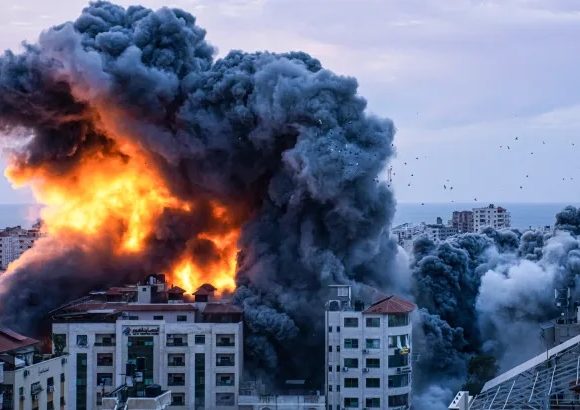
It pounded the Gaza Strip from the air on Monday as it vowed to lay total siege to the impoverished, Hamas-ruled territory in the wake of an unprecedented weekend incursion.
Israel’s vaunted military and intelligence apparatus was caught completely off guard, bringing heavy battles to its streets for the first time in decades.
Israel’s formal declaration of war portends greater fighting ahead, and a possible ground assault into Gaza — a move that has brought intensified casualties in the past.
Prime Minister Benjamin Netanyahu has vowed to destroy “the military and governing capabilities” of the militant group, which is deeply rooted in Gaza.
As Israel hit more than 1,000 targets in Gaza and its tanks and drones guarded openings in the border fence to prevent more infiltrations, Palestinian militants continued firing barrages of rockets, setting off air raid sirens in Jerusalem and Tel Aviv.
Israeli Defense Minister Yoav Gallant, meanwhile, ordered a “complete siege” on Gaza, saying authorities would cut electricity and block the entry of food and fuel.
Israel and Egypt have imposed various levels of blockade on the territory since Hamas seized power from rival Palestinian forces in 2007.
Israel’s health ministry says at least 545 people have been injured in the Palestinian attacks, according to the Reuters news agency.
Dozens of gunmen from the Islamist militant group Hamas appear to have infiltrated southern Israel in a surprise attack from the Gaza Strip
It comes as thousands of rockets were launched into Israel from Gaza, according to a Hamas leader, Mohammed Deif – “we’ve decided to say enough is enough”, he said
The Israel Defence Forces said “a number of terrorists” had infiltrated Israeli territory from Gaza
Israel’s security cabinet will meet at 1pm local time (11:00 BST), and the IDF has begun striking Hamas targets
Israel’s Prime Minister Benjamin Netanyahu has posted a video statement saying “we are at war”
Israel’s defence minister Yoav Gallant said Hamas has “made a grave mistake”, declaring that the “state of Israel will win this war”
Gun battles between Israeli and Palestinian forces are still under way in various locations in southern Israel, according to Israeli media
Hospitals in Israel say they are treating people injured in the surprise attacks – at least one person has died
Violence in Gaza and Israel shows no sign of abating amid continued rocket fire and air strikes, and civil unrest among Jewish and Israeli Arab mobs.
Deaths continue to mount, with at least 83 people now killed in Gaza and seven in Israel.
A BBC reporter in Gaza said it had been the “longest and most difficult night since the 2014 war”. Israel said it had been targeted with 1,600 rockets.
Israel is now mulling a possible ground operation in Gaza.
It has sent reinforcements to the border.
This is now the worst violence since 2014, fuelled initially by weeks of Israeli-Palestinian tension in East Jerusalem which led to clashes at a holy site revered by both Muslims and Jews. This spiralled into an incessant exchange of Palestinian rocket fire and Israeli airstrikes.
The fear among civilians on both sides is taking its toll.
Najwa Sheikh-Ahmad, a Gaza mother, said of Wednesday night: “You cannot sleep… In any moment your home might be your grave.
“You cannot be secure. As a mother it’s very terrifying, it’s very exhausting for my feelings, for my humanity,” she told the BBC’s Today programme.
In Israel, an apartment block was destroyed in the city of Petah Tikva shortly after residents had gone to their bomb shelters.
“We heard an alarm and suddenly there was a bang. Smoke entered the shelter, and the neighbour next to me who was sitting on a chair flew back,” one resident told the news website Ynet.
Mohammed Abu Rayya, a doctor living in Gaza told the BBC: “[There are] a lot of deaths, a lot of wounded – children, old women and old men. We cannot sleep at home, we are not feeling safe. Air strikes all over Gaza. There are not any places safe.”
Authorities in Gaza, which is controlled by the Islamist militant group Hamas, say many civilians have died, including 17 children.
Israel says dozens of those killed in Gaza were militants, and that some of the deaths are from misfired rockets from Gaza.
The Israel Defense Forces (IDF) said they had struck Hamas targets more than 600 times. They said they had targeted homes and businesses used by militants and a school Hamas was using “to hide a terror tunnel”.
In the Israeli city of Sderot, a young boy was killed when rocket fire from Gaza hit his home, and shrapnel penetrated the shelter he was hiding in.
The escalating conflict has prompted international airlines, including KLM, British Airways and Virgin Atlantic, to suspend services to Israel.
Earlier on Thursday, incoming flights were diverted south from Tel Aviv’s main Ben Gurion airport to Ramon airport amid a flurry of rocket launches.