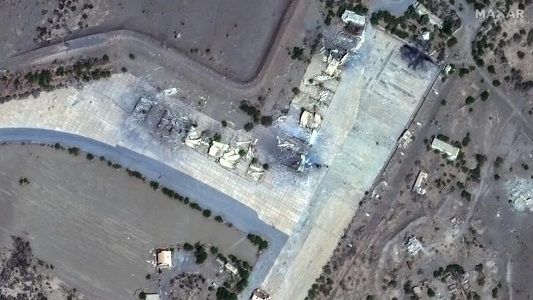
The US carried out further strikes against the Iran-backed Houthi group in Yemen on Sunday, US Central Command (Centcom) says.
Centcom said the US struck a land-attack cruise missile and four anti-ship missiles that “were prepared to launch against ships in the Red Sea”.
The latest action comes a day after joint US-UK strikes on Houthi targets.
The US has also warned that it intends to take further action against Iran-backed groups in Iraq and Syria.
On Friday, the US struck targets linked to the Iranian Revolutionary Guards Corps (IRGC) Quds Force and affiliated militias in Iraq and Syria, responding to the deaths of three US soldiers in a drone attack on a military base in Jordan on 28 January.
National security adviser Jake Sullivan told US media on Sunday there would be “more steps” to deter the militias.
Meanwhile US Secretary of State Antony Blinken is heading to the Middle East on a trip that will include stops in Israel, Egypt, Qatar, Saudi Arabia and the West Bank.
Mr Sullivan said Mr Blinken’s “top priority” would be a deal between Israel and Hamas that sees hostages released in exchange for a pause in fighting in Gaza.
“We are going to press for it relentlessly” but the ball is in Hamas’s court, Mr Sullivan said.
Israel’s offensive against Hamas has killed more than 26,000 Palestinians, the territory’s Hamas-run health ministry says. It was triggered by Hamas’s attack on southern Israel that killed about 1,300 people.
The Houthis say they began attacking shipping in the Red Sea in solidarity with Hamas, forcing major shipping companies to avoid the waterway and hitting international trade.
Egypt has said its revenue from the Suez Canal plunged by almost half in January, with the number of ships travelling through the key trade artery last month down by more than a third.
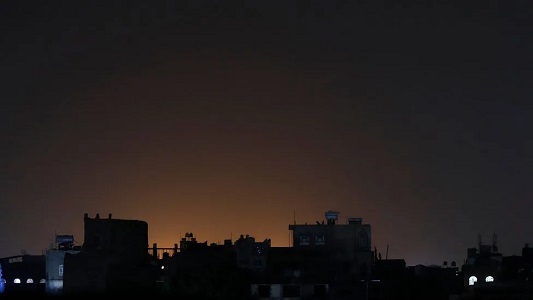
Saturday’s joint US-UK strikes lit up the night sky in the south of Yemen’s capital city, Sana’a, with one human rights activist and local resident telling the BBC houses were shaking.
Houthi officials struck a defiant tone in response to the US-led strikes – and vowed to respond.
Reacting to Saturday’s strikes, the group’s military spokesman, Yahya Sarea, wrote on X: “These attacks will not deter us from our moral, religious, and humanitarian stance in support of the resilient Palestinian people in the Gaza Strip and will not go unanswered or unpunished.”
Earlier, the White House warned that its air strikes on Iran-backed targets in Iraq and Syria were just “the beginning, not the end” of its response to Iran.
Iran has denied any involvement in the deadly drone attack on the US base in Jordan. A group linked to Iran, the Islamic Resistance in Iraq, has claimed responsibility.
But the US accuses Tehran of having its “fingerprints” on the attack and said the drone was Iranian-made.
In a letter to the US Congress on Sunday, President Joe Biden said the retaliatory strikes on Friday had targeted facilities used by Iran’s armed forces – the Islamic Revolutionary Guard Corps (IRGC) – and militia groups linked to the IRGC.
Iran’s IRGC is believed to have armed, funded and trained Islamic Resistance in Iraq.
Mr Biden said sites hit included those used for “command and control, weapons storage, training, logistics support, and other purposes”.
And he added that the strikes aimed to deter these groups from further attacks, and were taken in a way “to limit the risk of escalation and avoid civilian casualties”.
He also said that he would “direct additional measures, including against the IRGC and IRGC-affiliated personnel and facilities, as appropriate”.
The American retaliation is also drawing growing condemnation from others in the region, including from the Iraqi and Syrian governments.
“No warning was given during the strike or the night of the strike,” Farhad Alaaldin, a senior adviser to Iraq’s prime minister, told the BBC’s Newshour programme about Friday’s strikes.
He added that the “issue of warning or no warning makes no difference to the fact of the matter that Iraq is a sovereign state”.
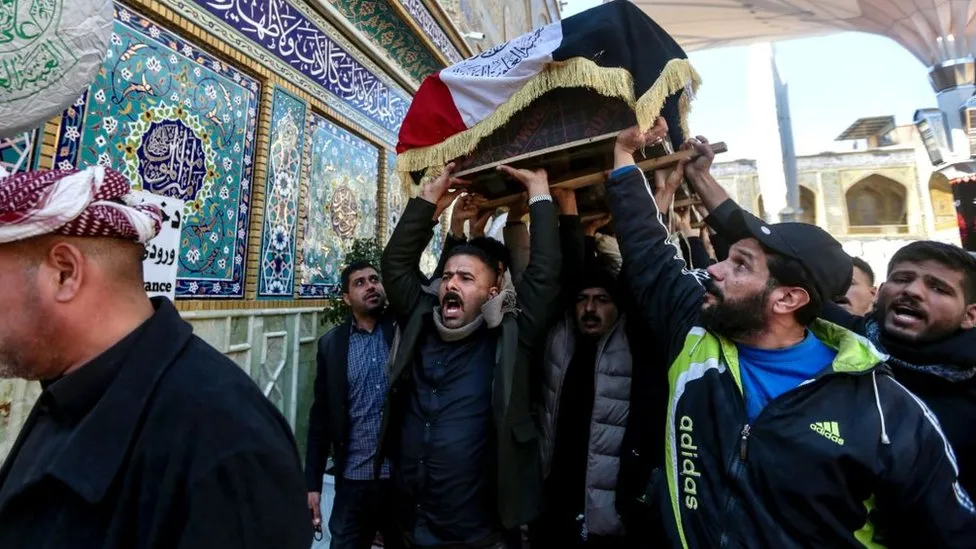
A crowd gathered in Baghdad on Sunday to mourn 17 militia members killed in the US air strikes.
The group chanted “America is the greatest devil” and held up pictures of the victims as they followed a fleet of ambulances carrying their bodies.
Oman’s foreign minister also spoke on Sunday to express his “grave concerns over the continuous escalation in the region”, in a statement shared with the Oman News Agency.
Badr Albusaidi questioned the effectiveness of US retaliatory attacks, noting that “such actions compromise the region’s safety, stability, and efforts to tackle challenges like violence and extremism”.
Washington believes the strikes have “had a good effect in degrading militia capabilities”, Mr Sullivan said on Sunday.
He said the US was not looking to wage an open-ended military campaign in the Middle East but “is prepared to deal with anything that any group comes” at them with.
He declined to say whether the US had ruled out strikes inside Iran.
Since the strikes in Iraq and Syria on Friday, there has been one attack on American forces, a US defence official told the BBC.
The attack in question targeted US forces based at Euphrates in Syria using rockets. The official said there were no injuries or damage.
BBC/Simeon Ugbodovon
Subscribe to our Telegram and YouTube Channels and also join our Whatsapp Update Group