Foreign

With most of the results now declared in Pakistan’s general elections, no political force has a clear majority.

Jailed former Prime Minister Imran Khan is claiming victory in Thursday’s poll, as independent candidates linked to him have won most seats so far.

But another ex-PM, Nawaz Sharif, says his party has emerged as the largest and urges others to join him in coalition.

There are reports that coalition talks between Mr Sharif’s PML-N party and other groups are already underway.

The final official results are yet to be announced.

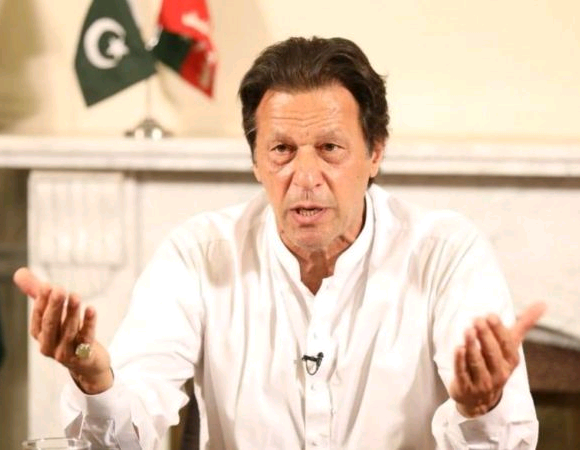
In a staunch video message posted on X that was generated using AI, a message credited to Mr Khan said his Pakistan Tehreek-e-Insaf (PTI) party had won a landslide victory – defying what he has called a crackdown on his party.

“I congratulate each and everyone of you for winning the 2024 election… you have made history,” the message said.

Mr Khan is currently in jail having been convicted in cases he says are politically motivated.

The success of the PTI-linked candidates was unexpected, with most experts agreeing that Mr Sharif – believed to be backed by the country’s powerful military – was the clear favourite.

But the PTI is not a recognised party after being barred from running in the election, so technically Mr Sharif’s Pakistan Muslim League (Nawaz), or PML-N, is the largest official political group.

The political horse-trading has begun in earnest, which means it could still be a while before anyone is able to claim outright victory.

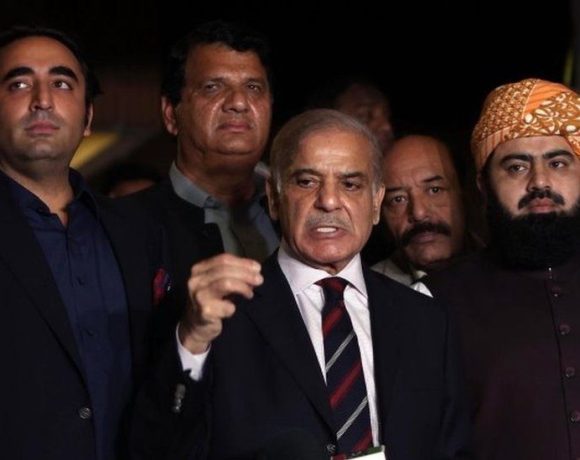
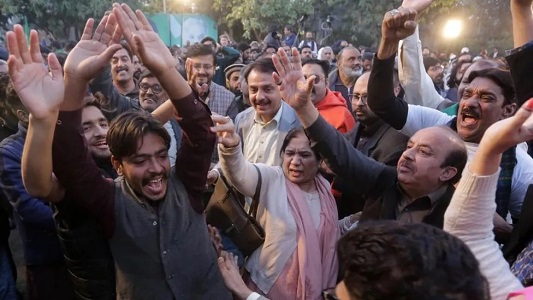
In a speech on Friday, Mr Sharif acknowledged that he did not have the numbers to form a government alone. But addressing supporters outside his party’s headquarters in the city of Lahore, he urged other candidates to join him in a coalition and said he could remove the country from difficult times.

Speaking to the BBC’s Newsnight programme on Friday, Mr Khan’s former special assistant Zulifkar Bukhari said: “Knowing Imran Khan and knowing the ethos of our political party PTI, I don’t think we’ll be making any coalition, forming a government with any of the main parties.

“However, we will be forming a coalition… to be in parliament – not as an independent but under one banner, one party”.

And asked about whether Mr Khan could potentially be released, Mr Bukhari said: “I think the minute we go to the high court and the supreme court we are extremely confident that he will be released, and a lot of the charges – if not all – will be thrown out on legal merit and procedural merit.”

The third biggest party appears to be the Pakistan People’s Party (PPP) led by Bilawal Bhutto, the son of PM Benazir Bhutto who was assassinated in 2007.

Burzine Waghmar, a member of the Centre for the Study of Pakistan at SOAS University of London, told the BBC that the elections “may well prove to be one of the most divisive and dangerous this chronically unstable, episodic democracy has ever confronted”.

As results trickled in, the UK and US voiced concerns over restrictions on electoral freedoms during the vote.

British Foreign Secretary David Cameron said the UK urged authorities in Pakistan “to uphold fundamental human rights including free access to information, and the rule of law”.

In a statement, he went on to express “regret that not all parties were formally permitted to contest the elections”.

Meanwhile, US State Department spokesman Matthew Miller criticised what he described as “undue restrictions on freedoms of expression, association, and peaceful assembly” during Pakistan’s electoral process.

He also cited “attacks on media workers” and “restrictions on access to the internet and telecommunication services” as reasons to worry about “allegations of interference” in the process.

Many analysts have said this is among Pakistan’s least credible elections.

Voters in Lahore told the BBC that the internet blackout on polling day meant it was not possible to book taxis to go and vote, while others said they could not co-ordinate when to head to polling stations with their family members.

An interior ministry spokesman said the blackouts were necessary for security reasons.

Support from the military in Pakistan is seen as important to succeed politically, and analysts believe Mr Sharif and his party currently have their backing, despite their differences in the past.

Maya Tudor, associate professor at the University of Oxford’s Blavatnik School of Government, said the lead taken by Imran Khan’s PTI was “shocking” in the context of the country’s past.

“A win would be remarkable – in every single other election in Pakistan’s recent history, the military’s preferred candidate has won,” Dr Tudor explained.

As many as 128 million people were registered to cast their votes, almost half of whom were under the age of 35. More than 5,000 candidates – of whom just 313 are women – contested 266 directly-elected seats in the 336-member National Assembly.

Pakistan’s former ambassador to the United States, Maleeha Lodhi, said Pakistan “desperately” needs political stability to address what she described as “the worst economic crisis in its history”.

But, in a hopeful note, Ms Lodhi said Pakistan’s voter numbers show a “belief in the democratic process”.

BBC/Simeon Ugbodovon

Subscribe to our Telegram and YouTube Channels and also join our Whatsapp Update Group
Foreign

Pakistan’s police have charged the country’s former Prime Minister, Imran Khan, under anti-terror laws.

Their investigation comes after he accused the police and judiciary of detaining and torturing his close aide.

Tensions are high in the country, with the former leader’s supporters gathering outside his house vowing to “take over” if he is arrested.

Since being ousted from power in April, Mr Khan has been a vocal critic of the government and the country’s army.

Police announced the charges after the cricketer-turned-politician accused authorities of torturing his close aide, who is himself being detained under sedition charges.

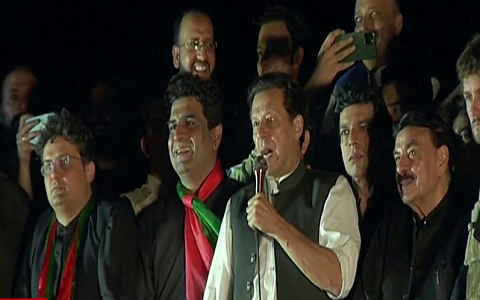
In a public speech on Saturday, Mr Khan condemned Islamabad’s police chief and a female judge for the detention and alleged mistreatment of his party colleague, Shahbaz Gill.

“You should also get ready as we will take action against you,” he said in the speech, referring to the pair directly.

Officials accused Mr Khan of breaching the country’s anti-terrorism act for allegedly making threats against the state officials.

Hundreds of the former prime minister’s supporters gathered outside his home in Islamabad after news of the investigation broke, vowing to “take over” the capital if police tried to detain him.

Police who were present at the scene said they were not there to arrest the former leader, but to maintain law and order.

The case comes at a time of heightened tension between Pakistan’s government and Mr Khan, who was ousted from power in April in a no-confidence vote.

Since then, the former leader has toured the country to deliver a series of fiery speeches calling for fresh elections and fiercely criticising both the government and the army.

On Saturday, Pakistan’s media regulator announced that television channels would be banned from broadcasting his speeches live, accusing Mr Khan of hate speech against state institutions.

The former leader claims the government is trying to censor him. On Sunday, he criticised the ban at another political rally in the city of Rawalpindi.

“What crime has Imran Khan committed? I will never accept this gang of thieves,” he told his supporters.

Mr Khan later accused the government of blocking access to YouTube halfway through the speech in an effort to prevent people from listening to him live.

Despite being ousted from power in a no-confidence vote earlier this year, Imran Khan continues to count on the support of many Pakistani voters.

Last month, his PTI party stunned rivals by taking control of a crucial provincial assembly in Punjab, defeating the PML-N party in what was expected to be an easy win for them.

Many saw July’s by-election victory as a signal of Mr Khan’s continued popularity at the ballot box – and a foretaste of what could happen if the early elections that he is seeking were to be held.

The charismatic politician was elected prime minister in 2018 but fell out with Pakistan’s powerful army towards the end of his tenure. After a series of defections, he lost his majority in parliament.

BBC/Simeon Ugbodovon

Subscribe to ourTelegram channel

Foreign

Pakistan’s parliament will select a new prime minister on Monday after Imran Khan was ousted in a no-confidence vote in the early hours of Sunday.

Shahbaz Sharif – the leader of an opposition coalition who worked to depose Mr Khan – is widely expected to win a majority of the vote.

Parliamentary voting will take place around 14:00 local time (09:00GMT).

Mr Khan, 69, was voted out after days of political drama and Supreme Court intervention.

He attempted to block a previous attempt to bring a no-confidence motion against him by dissolving parliament and calling for a snap election.

However, the country’s Supreme Court upheld an opposition petition that his actions were unconstitutional and ordered the vote to go ahead.

What do we know about Shahbaz Sharif?

Mr Sharif, 70, comes from one of Pakistan’s most powerful political dynasties. His older brother, Nawaz Sharif, was a former three-term Prime Minister who last held office from 2013 to 2017.

He leads one of the country’s main opposition parties, the Pakistani Muslim League Nawaz (PMLN).

He submitted his candidacy for the top post on Sunday and is widely tipped to have the numbers to ensure victory.

Other opposition leaders – like Bilawal Bhutto Zardari of the Pakistan Peoples Party (PPP) – have already indicated their support for him.

Mr Sharif is seen as a seasoned and effective administrator, having led the nation’s largest province of Punjab for three terms.

On Sunday, he heralded “a new dawn” for Pakistan following the vote.

However, Imran Khan, whose supporters protested across major cities after he was dismissed, is still blaming a “foreign conspiracy” for his removal as prime minister.

He has claimed, without evidence, that his rivals had colluded with the US to remove him because of his foreign policy stance on Afghanistan, Russia and China. Washington has strongly denied this. But the former international cricketer’s claims fed on anti-American sentiment held by many of his supporters.

He tweeted that the crowds seen were one of the largest protests in Pakistan’s history – a claim that has not been not independently verified.

BBC/Simeon Ugbodovon

Foreign

Pakistan’s Prime Minister Imran Khan has been ousted from power after losing a no-confidence vote in his leadership.
The vote was held past midnight after opposition parties brought a motion against him, following days of drama.
The motion was first brought last week, but the former cricket star blocked it by dissolving parliament.
Sunday’s vote took place after the country’s Supreme Court ruled in favour of opposition parties and said that Mr Khan had acted unconstitutionally.
Opposition leader Shehbaz Sharif – who is expected to be chosen as the new prime minister on Monday – said Pakistan and its parliament were “finally freed from a serious crisis”, adding in a tweet: “Congratulations to the Pakistani nation on a new dawn.”
If voted in by parliament, Mr Sharif – a long-time rival of Mr Khan and brother of former three-time Prime Minister Nawaz Sharif – would be able to hold power until October 2023, when the next election is due to be held.
The vote makes Mr Khan the first Pakistani prime minister to be ousted by a no-confidence motion, with opposition parties securing 174 votes in the 342-member house in support of the no-confidence motion.
His supporters are expected to take to the streets on Sunday evening.
‘International conspiracy’
Mr Khan has previously said he would not recognise an opposition government, claiming – without evidence – that there was a US-led conspiracy to remove him because of his refusal to stand with Washington on issues against Russia and China.
He has repeatedly said that Pakistan’s opposition parties are working with foreign powers. Members of his party (PTI) left the building just ahead of the vote, also insisting he was the victim of an international conspiracy.
The US has said there is “no truth” in these allegations, and Mr Khan has never provided any evidence.

BBC