*As the world grapples with the horrors of Russia’s invasion of Ukraine with trepidation and the need to avoid the crisis escalating into a third World War, Simeon Ugbodovon looks at core issue behind the booming canons.*
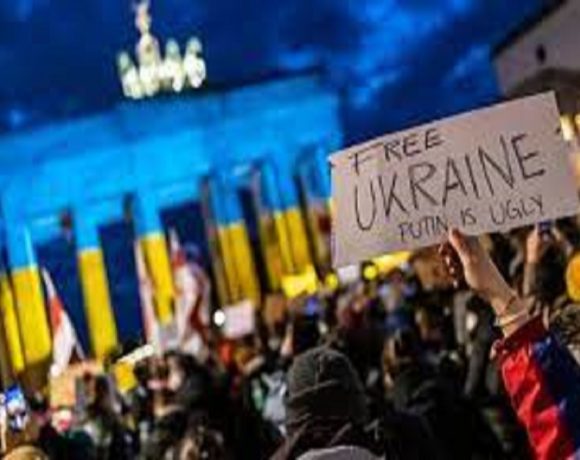
February 25 at 5:49 pm, the world found itself in a new face of conflict, Russian President, Vladimir Putin, launched a blistering attack on Ukraine after weeks of speculations and denials by the Kremlin.
The issues behind the needless wars would have been better handled through diplomatic channels if reason was allowed to prevail.
Now, the world is witnessing disruptions of much-desired political, economic and social symmetry, with the strong possibility of reversion to the Cold War Order, should the present conflagration thaw.
Four weeks into the internecine, the tolls are mounting while the Russian Defence Ministry puts its casualties at 9,861, US State Department of Defence estimates 10,000 while Ukraine puts the figure as high as 14,000. Among are some Russian generals, though none of the figures have been independently verified.
For Ukraine, the invasion by its neighbour has been equally catastrophic. Missiles from Moscow have targeted buildings and other key infrastructure. Civilian deaths according to the Office of the United Nations High Commission for Human Rights CHCHR, stands at 953 including 78 children with 1,557 injured including 9 children.
Ukraine claims to have lost 1,300 soldiers, with Russia claiming the figure is 2,870 and 3,700 injured.
Whatever, the claims and counter claims, should these catastrophes even have taken place?
It seems some leaders have yet to learn any lesson about the evil unbridled ambition, especially expansionism breeds.
Scroll back to 1939-1945 in Europe, the epicentre of the First and Second World wars, Adolf Hitler had craved a dominant Germany in Europe, claiming Australia and Czechoslovakia as first war booties or medals, so to say.
For the Czechs, the ordeal in the hands of Hitler started with dismemberment: not done with cession of Sudetenland areas to him, without a strong deterrent from Europe’s powerhouses. Like Oliver Twist, the Third Reich marched on Prague on March 15, 1939 to make the rest of Czechoslovakia German protectorate. Lithuanian was forced to cede Memel (Klaipeda), next to the northern frontier of East Prussia, to Hitler – the self-styled new emperor of Europe.
Russia’s invasion of Ukraine is following the same pattern, beginning with Crimea in 2014. Europe, though protested, complacently allowed Putin to keep Donetsk and Luhansk as the price of his invasion. Georgia had also initially had the bitter taste of Moscow’s bile in 2008 carving out South Ossetia and Abkhazia in Georgia as independent states, though unrecognized internationally.
But the North Atlantic Treaty Organisation, NATO, had also kept on mutating to the chagrin of Putin. From a twelve member body: Belgium, Canada, Denmark, France, Iceland, Italy, Luxembourg, Netherlands, Norway, Portugal, the United Kingdom, and the United States, in NATO membership increased to fifteen between 1952 and 1955, and 1982, with fourteen others joining after the end of the Cold War, from 1999 to 2020.
Of the thirty countries which make up NATO, 27 are within the jurisdiction of Europe while one country is in Eurasia, and only 2 in North America
Bosnia and Herzegovina, Georgia, and Ukraine are considered potential brides as part of the NATO Open Doors enlargement policy.
So, the old Soviet bloc has indeed shrunken, leaving Moscow with Armenia, Azerbaijan, Belarus, Georgia, Kazakhstan, Kyrgyzstan, Moldova, Russia, Tajikistan, Turkmenistan, Ukraine, and Uzbekistan, forming the Commonwealth of Independent States, as sphere of influence.
Russia’s cause had not been furthered helped by other members of the Warsaw Pact, Czechoslovakia, Poland Romania and Bulgaria, where communist regimes eventually collapsed, and who had already opted to join NATO
For Moscow, it is time to reflect on why old Warsaw Pact Countries prefer aligning with the West. Belarus strongman Alexander Lukashenko should watch it, should the Putin era give way to Gorbachev’s era Perestroika and Openness, he might find himself haunted by his actions.
Ukraine has now found itself in the eyes of the storm, drawing Putin’s ere for daring to become the coveted bride of the West, thus further reducing Moscow’s sphere of influence after the pro-Russian president, Victor Yushchenko was ousted through street protests in 2014.
The ongoing debacle in Ukraine will surely shore up more intrigues as countries weigh their options on where the pendulum is likely to swing at the end of it all.
China has seemingly stuck to Russia, with whom it hopes to counter the expansive NATO bloc, while also treading cautiously to avoid the angst of the West with its potential for economic consequences.
Ukraine president, Zelenski is a Jew, which should naturally draw support from Israel, but Tel Aviv is also being cautious not to fracture Russia’s cooperation with it over its raid in Syria as the Jewish state seeks to curtail Iran’s influence in Assad’s Syria.
India is not too willing to jettison its relations with Moscow which had always supported it with military hardware, and as well, being very mindful of arch-rivals in Asia Pakistan and China, which have warmed up to Putin.
At the same time, Delhi is mindful of the ability of the United States to wield the big stick, and it is well aware of the strategic importance of the Quadrilateral Security Dialogue, Quad involving the United States, Australia, India and Japan to its own security as the quartet seeks to curtail China’s footprints in Asia-Pacific.
For Venezuela’s Maduro, this is an opportunity to warm up to Big Brother, though Moscow had been supportive in its conflict with United States and opposition figure, Juan Guaido.
Crude oil from Venezuela would come in handy as the West seeks to boycott reliance on Russian oil, in exchange for some level of sanctions relief. The same applies to Iran as it negotiations over attempt to curb its nuclear programme remains on the table.
Surely, Israel will be all ears and eyes for any rapprochement or deal with Iran along such line, as it is opposed to any deal that gives Tehran with relief from sanctions or financial muscle to muster its nuclear programme.
This is Russian roulette; Putin is watching to see how different countries outside the West respond to it as the West ratchets up sanction to decimate Russia economically.
African countries have little or no sphere of influence in this matter. Countries such as Central African Republic, Sudan, Mozambique, Libya and Mali Wagner group, a mercenary firm believed to be strongly linked to Russia, provides military support against insurgency, will surely keep mute. Mali, in particular, will not go along with France as the honeymoon between France and its former colony remains sour as the junta in Mali has looked up to Russia in the war against Jihadist.
Oil-producing countries hold the leverage reaping windfalls from the hike in oil prices on the world market.
Unfortunately, this is not the case for Nigeria which, though endowed with black gold, has continued to import premium spirit rather than get refineries working.
Now, the nation smarts for it with the ongoing Russian invasion of Ukraine. Diesel now sells for N700 a litre; gas, N650 per kg and kerosene about N500.