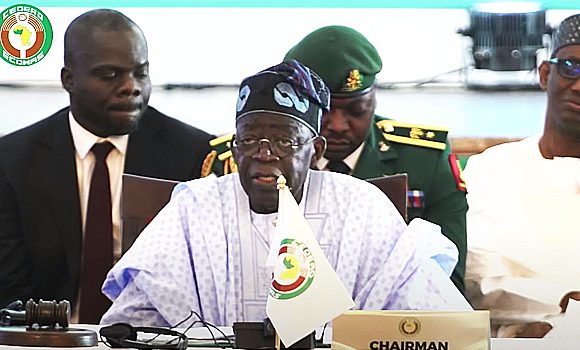
Chairman of the Authority of Heads of State and Government of the Economic Community of West African States’, ECOWAS, President Bola Tinubu of Nigeria, is currently presiding over an Extraordinary Summit of the regional body on the Political Situation in Niger Republic.
The summit at the State House Conference Center in Abuja is discussing recent developments in Niger Republic and deciding on the next steps after the junta’s removal of President Mohamed Bazoum.
Following the last ECOWAS Extraordinary Summit on July 30 in Abuja, sanctions were imposed on Niger, particularly on the coupists. The immediate release of President Bazoum, his family, and government members who are currently detained by the military was demanded.
Reading out the sanctions at the end of that Summit, President of the ECOWAS Commission, Omar Touray, had said “the following measures are to be applied with immediate effect. One, closure of land and air borders between ECOWAS countries and Niger. Two, institution of ECOWAS no-fly zone on all commercial flights to and from Niger.
“Suspension of all commercial and financial transactions between ECOWAS Member-states and Niger. Freeze all service transactions, including energy transactions. Freeze assets of the Republic of Niger in ECOWAS Central Banks Freeze of the assets of the Niger state and the state enterprises and parastatals in commercial banks.
“Suspension of measure from all financial assistance and transactions with all financial institutions, particularly, EBID. Call WAMU (West African Monetary Union) and all other regional bodies to implement this decision.
“Impose travel ban and asset freeze for the military officials involved in the coup attempt. The same applies to their family members and the civilians who accept to participate in any institutions or government established by these military officials”, the Authority said.
In an effort to de-escalate the crisis and avert any potential armed intervention, various stakeholders from Nigeria and Niger have been working together to advocate for a diplomatic approach and continued negotiations with both the ECOWAS and the military junta in Niger.
One of the stakeholders, former Emir Sanusi, speaking to State House Correspondents on Wednesday after his meeting with President Tinubu, said he went on the peace mission voluntarily, understanding his responsibility as a leader.
Sanusi emphasised that resolving the crisis requires efforts beyond just governments.
“I came to brief him on the details of my discussions with leaders of Niger. We’ll continue to do our best to bring the two parties together to improve understanding. This is the time for public diplomacy, it’s not a matter that we leave to governments, all Nigerians, all Nigeriens need to be involved to find a solution that works for Africa, a solution that works for Niger that works for Nigeria, and a solution that works for humanity”, he said.
Asked if he was a government emissary on the mission, he said “no, I was not sent by the government. Government officials were aware I was going, but it was my personal initiative, using my personal contacts to get there and I will continue to do my best. It is my duty as a leader to do that”.
Earlier today, however, the Abdourahamane Tchiani-led junta, announced a 21-member cabinet, to be led by Ali Mahaman Liman Zeine, who was appointed as Prime Minister by the military.
Among the Presidents and heads of government attending the meeting are: President Julius Maada Bio of Sierra Leone, President Umaro Mokhtar Sissoco of Guinea Bissau, President Everiste Ndayishimiye of Burundi, and President Alassane Ouattara of Côte d’Ivoire.
Others are President Mohamed Ould Ghazouani of Mauritinia, President Nana Akofo-Ado of Ghana, President Macky Sall of Senegal, and President Patrice Talon of Benin Republic.
Those yet to arrive are: Togo. Faure Essozimna Gnassingbé Eyadéma, and President Adama Barrow of The Gambia.
Tinubu’s Full Speech at Second ECOWAS Summit On Niger Coup
Your Excellency, the President of the ECOWAS Commission;
Your Excellency, President of the African Union Commission;
Your Excellency, President of the UEMOA Commission;
The Special Representative of the Secretary General of the United Nations in West Africa and the Sahel; and
Distinguished Ladies and Gentlemen.
1. Let me commence by welcoming you all to the Second (2nd) Extraordinary Summit on the Socio-Political Situation in the Republic of Niger, within the space of ten days. Your presence here, despite the short notice, demonstrates the unwavering dedication of our esteemed community to finding a lasting solution to the political situation in the Republic of Niger.
2. Today, we gather with a profound sense of urgency and firm determination, building upon the commitments made during our first Extraordinary Summit, on the grave political crisis befalling our sister nation. During that initial meeting, we voiced our solidarity with the people of Niger and their democratically elected President, H.E Mohamed Bazoum, by condemning the military take over and the unjust detention of their democratically elected President.
Your Excellencies, Distinguished Ladies and Gentlemen,
3. As you may recall, we called on the junta to rescind its decision of toppling a legitimate government. We proceeded to impose sanctions with the hope that this resolute measure would serve as a catalyst for the restoration of the constitutional order in Niger. Regrettably, the seven-day ultimatum we issued during the first Summit has not yielded the desired outcome. We have also made diligent efforts through the deployment of various ECOWAS mediation teams, to engage the military junta for a peaceful resolution of the political situation. One of the facilitators, former Head of State of Nigeria, General Abdulsalami Abubakar, would update us on the outcome of his mission to Niamey.
4. Similarly, as part of a coherent diplomatic initiatives, Special Envoys were dispatched to non-ECOWAS nations, particularly Libya and Algeria. During these engagements, the Envoy designated for Libya had the privilege of an audience with the President of Libya. This discourse resulted in an unequivocal expression of support for the resolutions adopted by ECOWAS aimed at restoring constitutional governance in Niger. In Algeria, the Envoy was received by the Minister of Foreign Affairs on behalf of the President of the country. These initiatives are aimed at presenting a cohesive and united stance regarding the ongoing circumstances in Niger, thus showing a collaborative and concerted approach among African nations.
Your Excellencies, Distinguished Ladies and Gentlemen,
5. Following the resolution of our previous Extraordinary Summit to initiate a meeting of the ECOWAS Chiefs of Defense Staff, the meeting of the Chiefs of Staff Committee was duly held from 2nd to 4thAugust, 2023. The outcome of that meeting, as well as a Memorandum by the President of the ECOWAS Commission on current socio-political developments in Niger, will be presented during this Summit. These will offer critical insights that will inform our collective decision-making process at this meeting.
6. Today’s Summit provides a significant opportunity to meticulously review and assess the progress made since our last gathering. It is essential to evaluate the effectiveness of our interventions and identify any gaps or challenges that may have hindered progress. Only through this comprehensive assessment can we collectively chart a sustainable path towards lasting peace, stability, and prosperity in Niger.
Moreso, in reaffirming our relentless commitment to democracy, human rights, and the well-being of the people of Niger, it is crucial that we prioritize diplomatic negotiations and dialogue as the bedrock of our approach. We must engage all parties involved, including the coup leaders, in earnest discussions to convince them to relinquish power and reinstate President Bazoum. It is our duty to exhaust all avenues of engagement to ensure a swift return to constitutional governance in Niger.
7. More specifically, as leaders of our respective nations, we must recognize that the political crisis in Niger not only poses a threat to the stability of the nation but also has far-reaching implications for the entire West African region. By remaining steadfast in our adherence to the principles of democracy, good governance, and the rule of law, we can restore peace, stability, and prosperity in the Republic of Niger, thereby fostering an environment conducive to growth and development for all.
Esteemed Excellencies, Distinguished Ladies and Gentlemen,
8. I am confident that this 2nd ECOWAS Extraordinary Summit on the Socio-Political Situation in the Republic of Niger will be a defining moment in our journey towards a stronger, more resilient, and integrated West Africa. Let us seize this opportunity to make a lasting impact on the lives of our fellow Africans as we strive to build a future defined by peace, progress, and prosperity.
9. In conclusion, I extend my gratitude to each of you for your attention to this critical issue. I trust that our deliberations will be productive and fruitful, leading us to find an amicable solution to the political crisis in Niger. As we continue to work together in solidarity and harmony, we can ensure a prosperous future for the entire West African region.
10. With these remarks, I hereby declare this Extraordinary Summit open.
Thank you all, for your attention.
Punch / Titilayo Kupoliyi
Subscribe to our Telegram and YouTube Channels also join our Whatsapp Update Group