At least 17 labourers working on a railway bridge being built across a ravine in India’s eastern Mizoram state were killed when it collapsed on Wednesday, officials said, with others reported missing.
Video footage posted by Mizoram Chief Minister, Zoramthanga showed a metal frame that had toppled off towering columns into a wooded valley below.
“Under construction railway over bridge at Sairang, near Aizawl collapsed today; at least 17 workers died,” Zoramthanga, who uses only one name, said on X, formerly known as Twitter.
The Indian Express newspaper quoted a policeman as saying that 17 bodies had been recovered and “many others” were missing. It was not possible to immediately verify the reports of people missing.
The Hindu newspaper, quoting state government officials, reported some 40 workers had been at the site when the bridge collapsed.
“Rescue operations are underway and all possible assistance is being given to those affected,” the office of Prime Minister Narendra Modi said.
Modi was “pained” by the accident and offered his “condolences to those who have lost their loved ones”, his office said on X.
The government will pay some $2,400 to the next of kin of those killed, it said.
Mizoram is in the far east of India, bordering Myanmar.
People had “come out in large numbers to help with rescue”, Zoramthanga said, adding he was “deeply saddened and affected by this tragedy”.
Accidents on large infrastructure construction sites are common in India.
At least 20 workers were crushed to death in western India this month when a crane collapsed above an under-construction expressway outside the financial capital Mumbai.
In October last year, 130 people were killed in Gujarat when a bridge collapsed soon after it was repaired.
And in 2016, the collapse of a flyover onto a busy street in Kolkata killed at least 26 people.
People found guilty over a deadly rail accident in eastern India will be “punished stringently”, the country’s Prime Minister Narendra Modi has said.
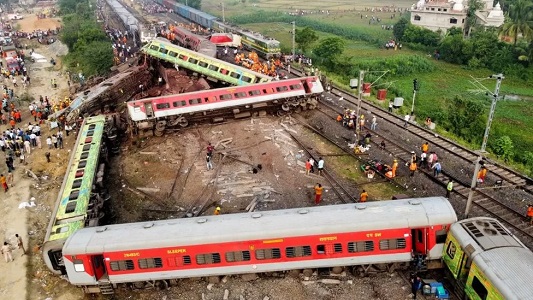
At least 288 people were killed and more than 800 injured in Friday’s incident in Odisha state, involving two passenger trains and a goods train.
Rescue efforts have concluded, with officials saying all trapped and injured passengers have been retrieved.
Mr Modi has visited the scene, labelling the incident a “painful” one.
He also met victims of the disaster in hospital, and vowed that his government would leave “no stone unturned for the treatment of those injured”.
It is still not clear what caused the multi-train collision in Balasore district, which has been described as India’s worst rail accident this century.
A full investigation has been launched, but a preliminary report indicates that the accident was the result of signal failure, said KS Anand, chief public relations officer of the South Eastern Railway.
Some 2,000 passengers are thought to have been on board the two passenger trains involved.
The exact sequence of events has been the subject of conflicting accounts.
Officials say several carriages from the Coromandel Express, travelling between Kolkata (formerly Calcutta) and Chennai (formerly Madras), derailed at about 19:00 (13:30 GMT) after hitting a stationary goods train. It remains unclear how the Express ended up on the same track as the goods train.
Several of the Coromandel Express’s coaches then ended up on the opposite track. Another train travelling in the opposite direction – the Howrah Superfast Express travelling from Yesvantpur to Howrah – collided with derailed carriages.
“The Coromandel Express was supposed to travel on the main line, but a signal was given for the loop line instead, and the train rammed into a goods train already parked over there,” Mr Anand said.
“Its coaches then fell on to the tracks on either side, also derailing the Howrah Superfast Express,” he said.
Sounds of ambulance sirens have been going off every 30 minutes outside the trauma centre in the SCB hospital in the city of Cuttack – where critically injured passengers have been wheeled in.
So far, close to 200 passengers from the train accident site have been brought in, and the numbers continue to rise.
The hospital is the largest in the state of Odisha, but is still three hours’ drive from the accident site.
The hospital staff – from junior doctors to nurses and ward boys – have been lined up and waiting in groups to assist patients as they are brought in. Wards have been expanded to handle the numbers coming in.
The constant sounds of whistles and announcements by hospital authorities interrupt the chaos.
Family members of the injured are waiting anxiously outside praying for their relatives’ wellbeing. But many are still looking for their loved ones, not knowing their whereabouts.
There is a counter set up to assist people who cannot locate their family members. It is crowded, and the lists run long.
Some people met by the BBC ran from the accident site to nearby hospitals before coming to the facility in Cuttack – searching for their families who were on board the trains.
Announcing the conclusion of rescue efforts on Saturday, the railway ministry said work to restore the crash site had begun.
Survivors and eyewitnesses earlier described chaotic scenes and the heroic efforts of people from nearby villages to save trapped passengers.
Mukesh Pandit, who was trapped for half an hour before being rescued, told the BBC he heard a “thunderous sound” shortly before the carriage overturned.
“Four passengers who were travelling from my village have survived, but a lot of people are injured or still missing. A lot of people died in the coach I was travelling in,” he added.
Residents of the neighbouring villages were among the first to reach the site of the accident and start the rescue operation.
India has one of the largest train networks in the world with millions of passengers using it daily, but a lot of the railway infrastructure needs improving.
Trains can get very packed at this time of year, with a growing number of people travelling during school holidays.
Both passenger trains involved in the crash were full and had many more people on the waiting list, according to passenger lists on the Indian rail ministry website reviewed by the BBC.
India’s worst train disaster was in 1981, when an overcrowded passenger train was blown off the tracks and into a river during a cyclone in Bihar state, killing about 800 people.
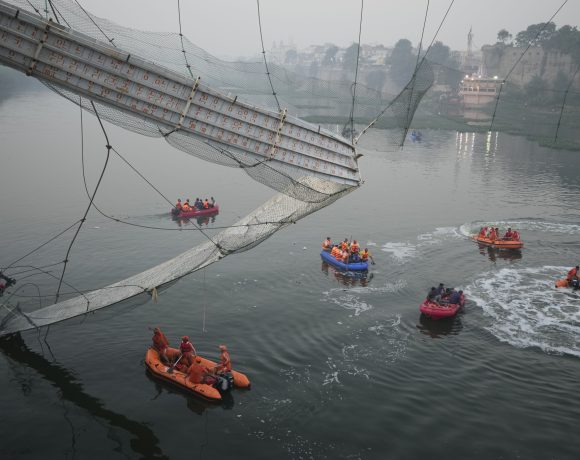
Dozens have died after a pedestrian suspension bridge collapsed in India’s Gujarat state on Sunday
The bridge had been reopened just days earlier after repairs
Reports say hundreds of people were on the bridge to perform rituals for a religious festival
At least 177 people have been rescued so far and search operations are underway for others who are missing
The Gujarat government has ordered an investigation into the incident
Rescuers who were in the vicinity of the collapsed Indian bridge used makeshift ropes made of torn clothing to pull out more than 160 people from the river, a witness has said.
Kantilal Amrutiya, a former legislator from the Bharatiya Janata Party, told Newsmen that he saw the bridge falling and managed to film and send out a video to local people to ask for help.
He explains that those near the bridge called the authorities immediately after it collapsed, but then entered the water themselves to save those at risk of drowning.
Mr Amrutiya says they were able to pull around 160 people from the river.
“We pulled them out with our shirts which we tore and made makeshift ropes. We also came with rubber tubes and threw it to some people to hold on.”
“We also came with rubber tubes and threw it to some people to hold on.”
While official updates are still awaited, Indian engineers believed that the suspension bridge – a bridge in which the deck is hung below cables on vertical suspenders – in Morbi may have collapsed due to poor maintenance.
“This is a 140-year-old bridge. You have to do regular, high-quality maintenance. The bearings, joints and rivets of the bridge have to be checked regularly. In India, we are not very rigorous about maintenance,” says Achyut Ghosh, a professor of structural engineering and a bridge expert.
Rahul Raj, a Delhi-based architect, says the quality of maintenance of infrastructure in India is “often compromised because the job goes to a
But Mr Ghosh said that hundreds of people standing on a suspension bridge was not likely to hurt the structure. “Bridges are designed and built for a lot of loading,”
“But what people should not be doing is marching in unison on the suspension bridge.” He said.
It is not clear whether people were doing that on the bridge in Morbi before it collapsed.
In the meantime, Prime Minister Narendra Modi’s office has announced that he will visit the town of Morbi in Gujarat, where a bridge collapse has killed 141 people.
Mr Modi, who is already in his home state on a political visit, will go to the site of the accident on Tuesday, news agency reports.
Earlier today, the prime minister said that he was deeply pained by the tragedy, which took place on Sunday evening.
Expressing his condolences, he pledged the government’s full support to the families of those who died in the accident.
BBC/Oluwayemisi Owonikoko
Subscribe to our Telegram Channel and join our Whatsapp Update Group
Ukraine’s recent counter-offensive will not change Russia’s plans, President Vladimir Putin has said in his first public comments on the matter.
In a rapid counter-attack, Ukrainian forces say they captured over 8,000 sq km (3,000 sq miles) in six days in the north-eastern Kharkiv region but Mr Putin said he was not in a hurry, and the offensive in Ukraine’s Donbas region remains on track.
He also noted that Russia had so far not deployed its full forces.
“Our offensive operation in the Donbas is not stopping. They’re moving forward – not at a very fast pace – but they are gradually taking more and more territory,” he said after a summit in Uzbekistan.
The industrial Donbas region in east Ukraine is the focus of Russia’s invasion, which Mr Putin falsely claims is necessary to save Russian speakers from genocide.
Parts of the Donbas have been occupied by Russian-backed separatists since 2014 and the Kharkiv region, where Ukraine’s recent counter-attack was launched, is not part of the Donbas.
In Friday’s comments, Mr Putin threatened a “more serious” response if Ukrainian attacks continue.
“I remind you that the Russian army isn’t fighting in its entirety… Only the professional army is fighting.”
Russia initially denied sending conscript soldiers to Ukraine, but several officers were disciplined after cases came to light of conscripts being forced to sign contracts and in some instances being taken prisoner.
So far, Russia has not officially declared war on Ukraine and only refers to its invasion as a “special military operation”.
President Putin put the country’s nuclear forces on “special” alert following its invasion of Ukraine in February and he has rarely left his country since then.
This week’s visit to the Shanghai Co-operation Organisation summit in Uzbekistan – where he met the Chinese leader Xi Jinping – highlights his need to foster ties with Asian countries after being sidelined by the West.
But even there, leaders have expressed concern over the invasion.
“Today’s time is not a time for war,” Indian Prime Minister Narendra Modi told Mr Putin.
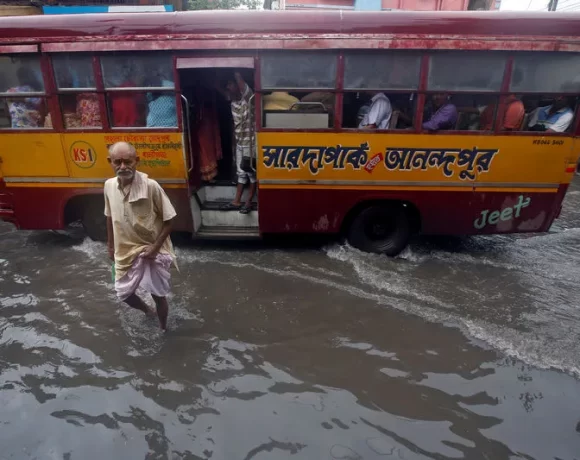
At least 18 people are confirmed dead after torrential rains swept through villages and flooded roads in the southern Indian state of Kerala.
Officials said rescuers recovered the bodies in two of the worst-hit districts, Kottayam and Idukki, where heavy downpours triggered massive landslides.
The National Disaster Response Force and the Indian Army deployed teams to help with rescue efforts, with more people feared missing, the Press Trust of India news agency said.
On Saturday, when the heavy rains began, TV footages showed people wading through chest-deep waters to rescue passengers from a bus that was nearly submerged by torrents flooding the roads.
The state’s Chief Minister Pinarayi Vijayan urged residents to exercise extreme caution, even though the intense rainfall had since eased.
More than 100 relief camps had been set up, he added.
Prime Minister, Narendra Modi said he spoke to the Chief Minister and added that authorities were working to rescue those affected.
In 2018, Kerala suffered catastrophic floods when heavy downpours during the monsoon season killed 223 people and drove hundreds of thousands from their homes.
India’s new coronavirus cases have hit a record peak for a fifth day on Monday, according to a health ministry statement.
The new infections come as countries around the world, including the UK, Germany and the US, pledged to deploy urgent medical aid to help tackle the crisis overwhelming Indian hospitals.
The health ministry said infections in the last twenty-four hours rose to 352,991, with overcrowded hospitals in Delhi and elsewhere sending away patients after running out of supplies of medical oxygen and beds.
On Sunday, Prime Minister Narendra Modi urged all Indians to get vaccinated and exercise caution, while hospitals and doctors have put out urgent notices saying they were unable to cope with the rush of patients.
In some of the worst-hit cities, including the capital, New Delhi, corpses were being burnt in makeshift facilities offering mass services.
On Sunday, US President Joe Biden said Washington would send raw materials for vaccines, medical equipment and protective gear to India. Germany and Britain joined a mounting list of countries that have promised to send supplies.
India, with a population of 1.3 billion, has a tally of 17.31 million infections and 195,123 deaths, added to 2,812 deaths overnight, according to health ministry data.
Health experts believe the death count to be probably far higher.