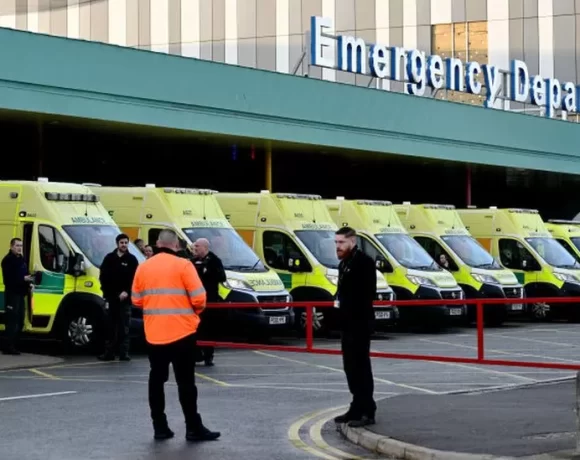
Health experts say patient safety cannot be guaranteed during strikes by ambulance workers in England and Wales.
But, NHS England says emergency care will continue to be provided, as people are being asked to use services “wisely” and only call 999 in a life-threatening emergency – with 111 online as the first port of call.
According to the report, ambulance response times are already twice as long as two years ago and there is a huge strain on A&Es.
In England, eight out of the 10 major ambulance services have declared critical incidents – a sign of the intense pressure they are already under.
Ministers have urged the public to take extra care and suggested they avoid contact sports and unnecessary car journeys.
Unions say life-threatening callouts will continue to be responded to over the next 24 hours but some urgent calls, for example for late-stage labour or a fall in the home, might not be answered.
No industrial action is taking place in Northern Ireland and Scotland, and there will be no strikes in the east of England or the Isle of Wight.
But elsewhere, there is likely to be major disruption as paramedics, call handlers, emergency care assistants and technicians go on strike.
About 750 armed forces staff are being drafted in to cover the walkouts, however, their role will be limited. They will not be sent on call-outs involving critical care, nor will they provide any clinical care.
Patients who are seriously ill or injured, or whose lives are in danger, are being advised by the NHS to call 999.
For all other healthcare needs, the NHS is advising people to contact NHS 111 online or via the NHS 111 helpline or to contact their local GP or pharmacy.
BBC/Taiwo Akinola
Subscribe to our Telegram and YouTube Channels also join our Whatsapp Update Group