Judiciary

By Folake Oye

The National Judicial Council has recommended the compulsory retirement of a judge of the Osun State High Court Justice Sakariyah Oyejide Falola.

The decision was reached at the 104th NJC Meeting chaired by Justice Olukayode Ariwoola between December 6 and 7, 2023, in Abuja.

The NJC said Justice Falola was found guilty of granting a garnishee order absolute against Polaris Bank for the sum of N283,174,000.00 in a questionable manner.

A statement by the Director of Information, NJC, Adesoji Oye, said the investigation committee found that Falola travelled to Lagos to visit the counsel to the bank on the issue of garnishee proceedings, an action it described as unprofessional.

 The NJC spokesman said the Council had recommended that Governor Ademola Adeleke of Osun State compulsorily retire Justice Falola.

He noted that the NJC had suspended Falola from office pending the approval of the recommendation of his compulsory retirement by Governor Adeleke.

Oye said, “The National Judicial Council, under the Chairmanship of Hon. Justice Olukayode Ariwoola, GCON, at its 104th Meeting of 6 and 7 December 2023, has recommended the compulsory retirement of Honourable Justice S. O. Falola of the Osun State High Court from the bench.

“The recommendation was made sequel to the findings of an investigation committee in a petition written against His Lordship by Mr. Dapo Kolapo Olowo and Polaris Bank for granting a garnishee order absolute against the bank for the sum of N283,174,000.00 questionably and strangely, and endorsement of the order, attaching the account of the garnishee with another garnishee and not the account of the judgment debtor, who had the legal obligation to pay the supposed judgment sum.

“It further found the conduct of the subject judge, travelling to Lagos to visit the counsel for the bank in his chambers on the issue of garnishee proceedings, unbecoming of the standard expected of a judicial officer.”

In a related development, the National Judicial Council has rejected the request of Osun State Governor, Senator Ademola Adeleke to appoint the next most senior judge in the state, Justice David Olayinka Afolabi, in an acting capacity.

This decision follows allegations against the state’s Chief Judge, Justice Oyebola Adepele Ojo and the resolution of the State House of Assembly to suspend her.

The NJC, which affirmed Justice Ojo as the recognized Chief Judge of Osun State, also rejected the resolution of the Osun State Assembly.

This decision was outlined in a statement signed by the NJC Director of Information, Soji Oye.

The Council, emphasizing its constitutional authority to investigate Judicial Officers and recommend actions to the Governor, directed Osun State to return to the status quo.

“Council considered and declined the request of Governor Ademola Adeleke of Osun State to swear in the next Most Senior Judge in the State in an acting capacity, following allegations against Hon. Justice Adepele Ojo, Chief Judge, Osun State, and the resolution of the State House of Assembly to suspend him.

“The Council affirmed that Hon. Justice Ojo is still the recognized Chief Judge of Osun State and would not act on the resolution of a State House of Assembly. Consequently, Osun State should revert to the status quo.”

Subscribe to our Telegram and YouTube Channels and also join our Whatsapp Update Group 
Politics

Implementation of the Judicial Financial management Law for Judiciary workers will commence this month in Ekiti state.

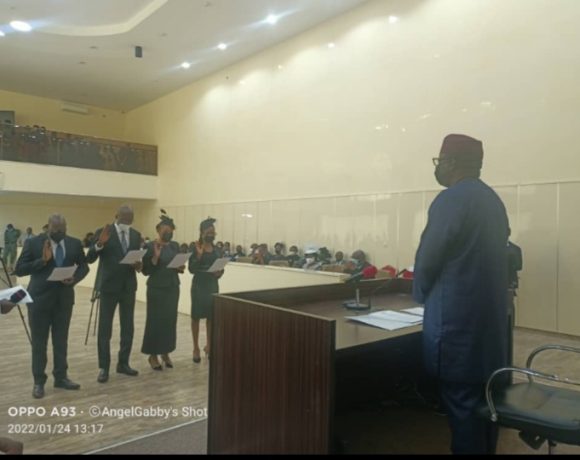
Governor kayode Fayemi announced this in Ado Ekiti.at the swearing in of four new legal practitioners recommended for appointment as judges by the National Judicial Council into the State High Court.

Governor Fayemi said the financial management law was geared towards improving the welfares of judicial workers.

The Governor also said he had directed the immediate payment of one month out of the arrears owed judicial workers in the state by past administration.

Governor Fayemi who charged the new judges to exhibit professionalism by sustaining the ethics of the bench, assured them that government would not shirk from its responsibilities to improve on the administration of justice in the state.

He expressed happiness at the recommendations of four judges by the National Judicial Council, NJC, which he said was In response to agitations to review the process and procedures of appointing young lawyers to the bench.

Responding, one of the newly sworn-in judges, Justice Johnson Apuabi thanked the Governor for the opportunity to serve with assurance that they would not betray their trust.

The four new judges are justices Johnson Apuabi, Olalekan Olatawura , Oyinkansola Oluboyede and Blessing Ajileye.

Tope Omobepade

Judiciary

The Oyo State House of Assembly, OYHA, has confirmed Justice Mashud Abass of the Oyo State High Court as the new President of the Customary Court of Appeal.

The confirmation followed a letter forwarded by the state’s governor, Engineer Seyi Makinde and read by the Speaker, Mr. Adebo Ogundoyin during the plenary.

Justice Mashud Abass will replace Justice Aderonke Aderemi who is retiring from the active service.

The nomination of Justice Abass was sequel to his recommendation to the National Judicial Council, NJC, by the Oyo State Judicial Service Commission according to the governor.

The letter reads, “Consequent upon the request, the National Judicial Council has recommended Honourable Justice Moshood Akintunde Akinfemi Abass as the new President of Oyo State Customary Court of Appeal. It is in view of this, that I am requesting the Speaker and other lawmakers to kindly deliberate and confirm his appointment as requested.”

Shortly after his confirmation, Justice Abass thanked the governor, Engineer Seyi Makinde, Speaker, Mr. Adebo Ogundoyin, and the entire lawmakers for the opportunity. 

He assured to give his best in the discharge of his duties when eventually sworn-in.

Justice Abass, who was born over 60 years ago, was appointed as a judge of the state High Court in 2001 after he was called to the Nigerian Bar in 1983.

He has attended several workshops and seminars within and outside the country. He is a Fellow, Institute of Chartered Mediators and Conciliators.

Mosope Kehinde

Judiciary

Three Judges are to appear before the National Judicial Council (NJC) for disciplinary action over granting of conflicting ex parte orders.

Director of Information, NJC, Mr. Soji Oye in a statement hints that the Chief Justice of Nigeria (CJN), Justice Tanko Muhammad has expressed his determination to set an example with the three judges.

According to the statement, the CJN directs state Chief Judges to henceforth take absolute charge of assigning cases, especially political matters, personally. 

He also warned Chief Judges to stop making newly appointed Judicial officers vacation Judges or assigning complex cases to inexperienced Judges.  

The CJN further advised all Heads of Court to be conversant with developments in the polity and judgments delivered by courts of various jurisdictions noting that the Judiciary would no longer condone indiscipline or allow any Judge to tarnish the image of the Judiciary.

Frcn, Abuja

Judiciary

Ekiti State Governor, Dr Kayode Fayemi has advocated the review of salaries and allowances of judicial officers in the country.
He urged the National Judicial Council (NJC) to renew negotiation for upward review of judicial officers’ salary as part of the agitation for judicial autonomy.
Dr Fayemi stated this in Ado Ekiti during the swearing in of Justice John Adeyeye as Acting Chief Judge of EKiti State.
He observed that judicial officers in the country had been on same salary structure for over a decade, even while other categories of public servants have had theirs reviewed .
“I am aware that between 1999 till date, the Federal Government reviewed the salaries and allowances of Public Servants specifically in 2000, 2005, 2007 and 2011. However the salaries of judicial officers were only reviewed twice during the same period.
“As a result judicial officers have been on the same salary structure for more than 10 years. It may now be necessary for the NJC to provide leadership on possible renewed negotiation on this issue as part of a holistic discussion on judicial autonomy.
“The frequency of closure of our courts constitutes threat to the security of this state. It is for this reason that I respectfully urged your lordship to enable practical solutions to ensure that the wheels of justice in our state continues to turn even during lockdowns of strike actions.” He said.
He also expressed concern on the shortage of female judges on the bench, adding that a gender diversified judiciary would positively shape the development of law in the State.
The Governor called on the Judiciary to support and strengthen the capacity of the Nigeria Police and the Ministry of Justice in the State to deal with all forms of sexual violence by reviewing rules and court procedures to ensure speedy prosecution of sexual violence matters.
Dr Fayemi who stressed that his administration was conscious of the benefit of an effective judicial system to the socio-political growth and development of the State, charged the new acting chief judge to key into his mission to a provide fair and equal access to justice system irrespective of gender, ethnic origin, economic status and other social indices.
Justice Adeyeye in his acceptance speech, pledged to uphold the oath of office which he swore to and promised to work with all stakeholders in the justice sector of the state to enhance speedy dispensation of justice that defines the 21st century judiciary.
He pledge to bring about a paradigm shift from the conventional mode of dispensing justice through the application of technology in the recording of court proceedings to enhance administration of justice in the State.
Justice Adeyeye who replaced the immediate past Chief Judge, Justice Ayodeji Daramola, solicited the supports of judicial officers with a promised to prioritize their welfare.
The acting chief Judge was born 1960 in Araromi Ugbesi in Ekiti East Local Government of Ekiti State and was called to bar in 1986 He started his career as a State counsel in the Civil service of the old Ondo State before joining the Ekiti State Judiciary Service Commission shortly after the creation of the State in 1996.
He was elevated to the position of a judge in the Ekiti State High Court in 2002 and has served at different time in the Election Petition Tribunals.

Amos Ogunrinde

News Analysis

As part of a democratic setting, the judiciary in the realm of conflict resolution plays a significant role in ensuring that individual rights which are enshrined in the constitution are well protected and the rule of law is religiously adhered to

As the 3rd arm of government judiciary has an indispensable role as the unbiased interpreter of the law

The roles of judges are tied to a set of characteristics and values that are essential for judicial function

These attributes are not limited to judges alone, it is also applicable to their supporting staffs, who assist them in the dispensation of justice 

In any democratic settings, the principle of separation of power where the allocation of government authority to separate institution in government limits arbitrary excesses by any arm of government

The primary goal of separation of powers is to enable the three arms of government to be functionally independent of each other.

In the appointment of judges at the federal and state level, the executive arm of government is saddled with this function based on the recommendations of the National Judicial Council, NJC, subject to the confirmation of the senate and House of Representatives.

This has made the executive to have so much power and influence on the judiciary as the judiciary looks up to the executive for financial obligations.

According to a maxim, he who plays the piper dictates the tune hence the need for the judiciary to be financially independent.

Unfortunately over the years, state judiciaries have relied on the executive for their funding.

Section 120 subjection 3 of the 1999 constitution {as amended} acknowledges the importance of financial autonomy for each arm of government

Equally section 121 subsection3 of the constitution states that any amount standing to the credit of state house of assembly and the judiciary in the consolidated revenue fund of the states shall be paid directly to the heads of the courts

 In spites of these constitution provisions, state judiciary in the country   have continued to be financially dependent on the executive making them to be at the whims and caprices of the executive

Regrettably, lack of financial autonomy on state judiciaries has made it difficult for judges at state high courts to be independent and impartial, especially in cases where the executive has a vested interest

It came as a succour when president Muhammahu Buhari on the 22nd of May, 2020 signed into law , the executive order no.1 of 2020 for the implementation of financial  autonomy for state legislature and state judiciary

The implication of this is that the judicial arm of government across the 36 states in Nigeria will now receive their financial allocations from the consolidated revenue fund without recourse to the executive.

With this executive order, order 10, it is with dismay that the implementation of this law has become a mirage, which propelled the judiciary staff of Nigeria, JUSUN, to commence an indefinite nationwide strike on the 6th of April calling for the implementation of the executive order 10 by the state government.

Corroborating the struggle of JUSUN, the Chief Justice of Nigeria, Justice Tanko Muhammed said the decision by court workers nationwide to press for financial autonomy for the judiciary was justified.

On the 20th of April a meeting was scheduled to hold between the minister of labour and employment, Chris Ngige and representatives of JUSUN where the representatives of the union walked out.

Landing their voice of support for financial autonomy, the Nigerian bar association also staged a peaceful protest in all states of the federation to back the implementation of financial autonomy for state judiciary.

For JUSUN, no retreat, no surrender as the industrial action is a weapon of negotiation to press home their demand

However, the effect of the strike is taking its toll on suspects who ordinarily should not spend more than 48 hours in custody

The strike has prevented the police and other law enforcement agencies from arranging suspects in courts which has overcrowded the cells.

All judicial activities have been paralyzed, even as legal practitioners whose source of livelihood has been tampered with are lamenting bitterly

The ball is now in the court of state governments’.

The Nigeria governors forum should make it a matter of urgency to deliberate and implement the financial autonomy of the judiciary as signed into law

Furthermore, when financial autonomy is eventually, implemented heads of courts should not be the accounting officer to prevent corruption and financial recklessness.

Upon acceding to the demands of JUSUN, the state government should inaugurate a judiciary fund management board that will be saddled with the responsibility of ensuring accountability with funds.   

Adeyoyin Shomoye