Suicide is an act of taking one’s life intentionally.
The act, though forbidden, is becoming frequent in recent
times.
The World Health Organization, WHO, estimates that over 800,000 people die by suicide each
year that is an average of one person in every 40 seconds.
Evidently, people who commit suicide are tired of living due
to reasons that may be best known to them.
Of course, depression, economic hardship and societal
pressure are few of the reasons people commit suicide.
Although, the act is believed to be alien to African
culture, the spate in recent times calls for concern.
Early this year,
a lecturer at the Department of Mathematics, University of Ibadan, A.O. Subair set
himself on fire after resigning from the university without a justifiable
reason.
Also this year, the body of Chukwuemeka Akachi was
discovered after taking two bottles of sniper.
A 300-level student of the Department of Medical Laboratory
Science, University of Benin, Christabel Buoro, reportedly killed herself after
being jilted by her boyfriend.
Many instances like these abound.
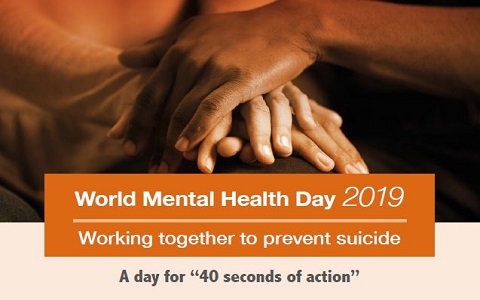
The World Mental
Health Day is celebrated on October 10 every year and the theme for
this year is “Suicide Prevention” which is coined to raise awareness on the
scale of suicide around the world and the role that each person can play to
help prevent it.
However, findings revealed that those who commit suicide
exhibit some signs before carrying out the act, but most of the time, people around
them, relatives and friends, do not pay adequate attention to these signs.
According to research by a clinical psychologist in suicide
prevention, Edwin Shneidmen, people who commit suicide often have a common
purpose which is to seek solution to a challenge before them and thus opt to
take their lives as a way to get themselves out of the dilemma.
The research further says the perpetrators go through
intolerable psychological pains and emotions including shame, guilt, anger,
fear and extreme sadness.
These people appear evidently hopeless and helpless and are often
times pessimistic about life and the future.
Again, they are unwilling to engage in effective problem-solving
behaviour and perceive death as the last resort.
Death is inevitable, but suicide is preventable provided the
society, government, Non-Governmental Organisations, NGOs and other
stakeholders pay attention to the signs of a suicide victim.
The society needs to brace up in ensuring that the environment
is conducive for all to live comfortably and conveniently.
The society should also pay attention and monitor the behaviour
of neighbours to quickly identify individuals with suicidal tendencies and
therefore provide a timely assistance to such.
There is need for government to embark on policies and
programmes that would make life more meaningful for the citizenry, revitalize
national economy and create more recreation outfits for citizens to relax, wine
and dine and catch fun.
Doing this, would definitely ease tension and frustration
that could lead to thinking about suicide.
Individuals on their part should not see suicide as the last
resort rather, they should attack and face every challenge of life as they come
with the belief that when there is life
there is hope.
Interestingly, the two major religions in Nigeria forbid
suicide.
Aside this, the Nigerian constitution also regards suicide
as a criminal act punishable under the law.
These are pointers to the fact that suicide is not only a crime to humanity but a sin to divinity.
Adedayo Adelowo