Foreign

President Joe Biden has issued a sweeping executive order aimed at curbing record migrant arrivals at the US-Mexico border that have left him politically vulnerable in an election year.

Under the order, which took effect at midnight, officials can quickly remove migrants entering the US illegally without processing their asylum requests.

That will happen once a daily threshold is met and the border is “overwhelmed”, the White House said in a statement.

Rival Republicans say Mr Biden has not gone far enough, while some of the president’s Democratic allies – and the United Nations have expressed concern.

A spokeswoman for the UN’s refugee agency said those fearing persecution should have access to safe territory.

Mr Biden spoke about the order at an event on Tuesday with several border town mayors. He said “this action will help us gain control of our border”.

The president criticized Republicans for not passing bipartisan immigration reform in Congress earlier this year – and asked progressive critics of the new executive action to “be patient”.

“We’re wearing thin right now,” he said. “Doing nothing is not an option.”

The order which also aims to speed up cases and ease pressure on overburdened US immigration courts – has met criticism from activists.

“It’s unfortunate that politics are driving the immigration conversation in an increasingly restrictive direction,” said Jennie Murray, president and the CEO of the National Immigration Forum.

More than 6.4 million migrants have been stopped crossing into the US illegally during Joe Biden’s administration.

The arrival numbers have plummeted this year, though experts believe that trend is unlikely to continue.

Mexican media have depicted the move as one of Mr Biden’s toughest policies, though President Andrés Manuel López Obrador sought to downplay the issue, arguing that economic and cultural exchange made a border closure “impossible”.

Authorities in Tijuana asked what would happen to asylum seekers denied entry to the US.

Shelters in the Mexican city could quickly get overcrowded, one local official warned. “We’d start seeing people on the streets, sleeping in tents”.

BBC/Adebukola Aluko

Foreign

Eight months ahead of the US presidential election, the campaign moves from the parties’ nominating contests to the trench warfare of what promises to be one of the longest, most brutal head-to-head showdowns in memory.

President Joe Biden and his predecessor Donald Trump, the oldest pair of nominees in history emerged this week from a primary season that has inflicted battle scars on both, raising questions over their judgment and mental acuity.

The 81-year-old incumbent Democrat and his Republican foe, 77, see their rematch on November 5 as an existential moment for America and have spent months trading deeply personal insults in a bruising start to the campaign.

Both are unpopular with large sections of a populace wary of handing the keys to the most powerful office in the world to men born closer to the inauguration of Civil War hero Ulysses S. Grant than to November’s election.

Trump who never left the political stage after defeat in 2020 and faces dozens of pending criminal charges is likely to be dividing his time between his signature rallies and court appearances.

“It’s clearly a different election this time around you could argue both Biden and Trump are weaker, and it’s a matter of relative weakness but with a long eight months of unknowns in the way,” said Joshua Darr, a political analyst and communications professor at Syracuse University in New York.

Vanguard / Titilayo Kupoliyi

Subscribe to our Telegram and YouTube Channels and also join our Whatsapp Update Group

Foreign

US President Joe Biden has again said the US would defend Taiwan in the event of an attack by China.

Asked in a CBS interview if US troops would defend the island, Mr Biden said: “Yes, if in fact, there was an unprecedented attack.”

The remarks prompted the White House to clarify that US policy had not changed.

Washington has long maintained a stance of “strategic ambiguity” – it does not commit to defending Taiwan, but also does not rule out the option.

Taiwan is a self-ruled island off the coast of eastern China that Beijing claims as part of its territory.

Washington has always walked a diplomatic tightrope over the issue.

On the one hand, it adheres to the One China policy, a cornerstone of its relationship with Beijing. Under this policy, the US acknowledges that there is only one Chinese government, and has formal ties with Beijing rather than Taiwan.

But it also maintains close relations with Taiwan and sells arms to it under the Taiwan Relations Act, which states that the US must provide the island with the means to defend itself.

Taiwan responded to Mr Biden’s remarks on Monday by welcoming the “US government’s rock-solid security commitment to Taiwan”. Taipei said it would continue to deepen its “close security partnership” with Washington.

Only earlier this month, the US agreed to sell $1.1bn (£955m) in weaponry and missile defence to Taiwan, provoking anger from China.

Beijing is yet to respond to Mr Biden’s latest remarks, broadcast in a CBS 60 Minutes interview on Sunday. But China has previously condemned such comments from Mr Biden pledging US military action.

“Taiwan is an inalienable part of China’s territory… The Taiwan question is purely China’s internal affair that brooks no foreign interference,” a foreign ministry spokesman had said in May.

That was in response to Mr Biden’s comments in Tokyo in May when he said “Yes” when asked if the US would defend Taiwan. The White House had quickly issued a follow-up saying there was no departure from long-standing US policy.

This time too the White House issued a statement, downplaying the president’s comments: “The President has said this before, including in Tokyo earlier this year. He also made clear then that our Taiwan policy hasn’t changed. That remains true.”

It’s the third time since October last year that President Biden has gone further than the official stance.

But in the interview on Sunday, Mr Biden reiterated that the US was not encouraging Taiwan’s independence.

“There’s a One China policy and Taiwan makes their own judgements on their independence. We are not moving, not encouraging their being independent – that’s their decision,” he said.

Tensions between US and China have ramped up after US House Speaker Nancy Pelosi made a controversial visit to the island in August – a trip Mr Biden had said was “not a good idea”.

Beijing responded with a five-day military blockade around Taiwan. The US claims China shot missiles over the island, but Beijing did not confirm this. Taiwan said the missiles China fired flew high into the atmosphere and posed no threat.

Elsewhere in the pre-recorded interview, Mr Biden also warned Russia not to use chemical or tactical nuclear weapons in the war in Ukraine.

BBC/Simeon Ugbodovon

Subscribe to our Telegram channel

Foreign

The most significant US gun control bill in nearly 30 years has been signed into law by President Joe Biden.

It imposes tougher checks on young buyers and encourages states to remove guns from people considered a threat.

Congress approved the legislation with bipartisan support this week, following a spate of mass shootings.

“While this bill doesn’t do everything I want, it does include actions I’ve long called for that are going to save lives,” Mr Biden admitted.

In May shootings at a supermarket in Buffalo, New York, and a primary school in Uvalde, Texas, left a total of 31 people dead.

As he signed the legislation on Saturday, Mr Biden said relatives of the victims expected the US government to do something. “Well today, we did,” he added.

The reforms include:

  • Tougher background checks for buyers younger than 21
  • $15bn (£12.2bn) in federal funding for mental health programs and school security upgrades
  • Funding to encourage states to implement “red flag” laws to remove firearms from people considered a threat
  • Closing the so-called “boyfriend loophole” by banning all those convicted of domestic abuse from owning a gun – not just those who are married to their victims or live with them.

President Biden, as well as gun safety groups, had pushed for bigger reforms – including banning assault weapons, which were used in the Texas and Buffalo shootings – or at least an increase in the age at which they can be purchased.

The gunman in the Texas shooting is believed to have bought two semi-automatic rifles days after turning 18.

The new legislation is also significant because it is the first time in decades that the reforms have received support from both Democrats and Republicans.

Historically, efforts to strengthen US gun laws have been blocked by the Republican party.

The National Rifle Association (NRA) opposed the bill, arguing that it would not stop the violence.

BBC/Simeon Ugbodovon

Environment

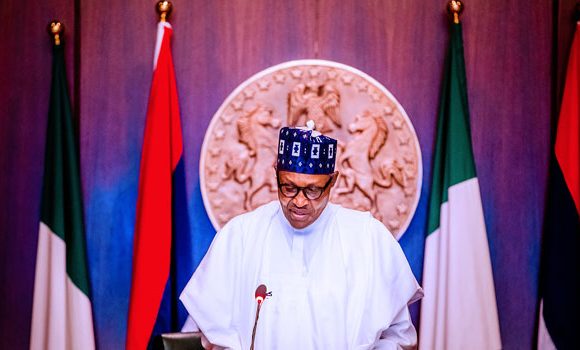
The Federal Government says eliminating kerosene lighting by 2030 is part of Nigeria’s updated Nationally Determined Contribution, NDC, towards a safer and healthier global climate.

President Muhammadu Buhari made this known during a virtual meeting, hosted by President Joe Biden of the United States, on Major Economies Forum, MEF, on Energy and Climate Change.

He listed other measures to include increase in use of buses for public transport and reduction in burning of crop residues.

The president said an updated NDC to the UN Framework Convention on Climate Change had been submitted to replace the interim contribution of May 27, 2021.

Our updated NDC includes the waste sector which is expected to contribute to the reduction of Nigeria’s greenhouse gas emissions.

And ratification of the Kigali Amendment to the Montreal Protocol to phase out Hydro-fluoro-carbon emissions,’’ he said.

President Buhari thanked President Biden for convening the important event which he said, had remained crucial to the wellbeing of national economies as well as continued existence of all people on the planet.

The virtual summit was addressed by about 20 presidents and prime ministers or their representatives.

Those who personally did so included the host, President Biden, President Buhari, the German Chancellor, the President of Turkey, Prime Ministers of Japan and Canada as well as the Secretary General of the United Nations and the President of the European Commission.

Vanguard/Maxwell Oyekunle

Foreign

President Joe Biden says the United States, US, will send Ukraine more advanced rocket systems to help it defend itself.

Mr Biden said the lethal aid would strengthen Ukraine’s negotiating position against Russia and make a diplomatic solution more likely.

The US president said: “That is why I’ve decided that we will provide the Ukrainians with more advanced rocket systems and munitions that will enable them to more precisely strike key targets on the battlefield in Ukraine.”

The weapons, long requested by Ukraine, are to help it strike enemy forces more precisely from a longer distance.

Until now, the US had refused the request out of fear the weapons could be used against targets in Russia.

The Russian government said it viewed the latest US weapons package to Ukraine including the new systems “extremely negatively”.

Separately, the German government has promised to send an air defense system to Ukraine.

German Chancellor Olaf Scholz told Members of Parliament that the IRIS-T system was the most modern Germany possessed and would enable Ukraine to defend an entire city against Russian air attacks.

He added that he would provide tracking radar capable of detecting enemy artillery, and multiple rocket launchers.

Analysts say the move is a fine balancing act for Mr Biden.

As providing more powerful weapons could provoke a reaction from Russia, risking direct conflict between the US and its Nato allies and Russia.

BBC/Maxwell Oyekunle

Foreign

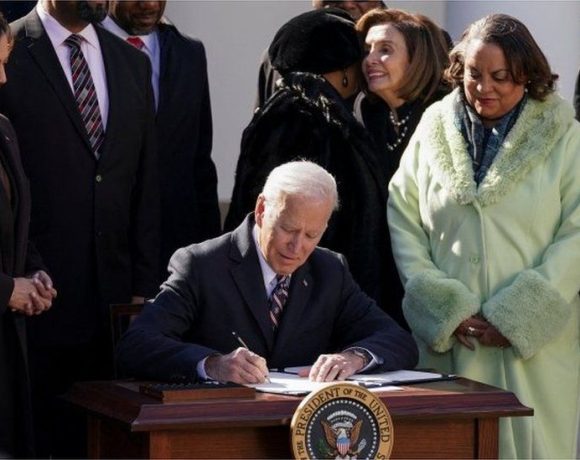
US President Joe Biden has signed legislation that designates lynching as a federal hate crime.

The law follows more than 100 years and 200 failed attempts by US lawmakers to pass anti-lynching legislation.

The Emmett Till Antilynching Act is named for the black teenager whose brutal murder in Mississippi in 1955 helped spark the civil rights movement.

Perpetrators of a lynching – death or injury resulting from a hate crime – will face up to 30 years in jail.

Mr Biden said: “Thank you for never giving up, never ever giving up.

“Lynching was pure terror to enforce the lie that not everyone, not everyone, belongs in America, not everyone is created equal.”

He added: “Racial hate isn’t an old problem – it’s a persistent problem. Hate never goes away. It only hides.”

The bill was passed unanimously in the Senate earlier this month. The House had voted overwhelmingly in support of the legislation last month. Three Republicans voted no: Thomas Massie of Kentucky, Chip Roy of Texas and Andrew Clyde of Georgia. They argued that it was already a hate crime to lynch people in the US.

Lynching is murder by a mob with no due process or rule of law. Across the US, thousands of people, mainly African Americans, were lynched by white mobs, often by hanging or torture, in the 19th and 20th Centuries.

Some 4,400 African Americans were lynched between 1877 and 1950, according to the Equal Justice Initiative. Those who participated in lynchings were often celebrated and acted with impunity.

“Lynching is a longstanding and uniquely American weapon of racial terror that has for decades been used to maintain the white hierarchy,” the bill’s sponsor, Illinois Congressman Bobby Rush, said ahead of its passage.

In 2020, following the murder of George Floyd by a police officer in Minneapolis, the House passed an earlier iteration of the bill, but it was blocked in the Senate.

Many racial justice advocates have described the death of Floyd, as well as the murder of Ahmaud Arbery – who was hunted down and shot by three white men in Georgia in 2020 – as modern-day lynchings.

BBC

Foreign

US President Joe Biden is expected to meet with Ukrainian refugees on Friday at a town near the Polish-Ukrainian border, on the final leg of his four-day Europe trip.

Air Force One will land in the Polish town of Rzeszow, a few kilometres from the Ukraine border.

During his visit, Mr Biden is expected to meet members of the US 82nd Airborne Division, part of NATO’s increasingly muscular deployment to its eastern flank.

He will also receive a briefing on the dire humanitarian situation in Ukraine. More than two million refugees have fled to Poland – the capital Warsaw hosts around 300,000 of them.

Mr Biden will meet Polish President Andrzej Duda to thank the country for its humanitarian efforts.

The US President’s trip comes as the West faces urgent questions about what more it will do to help Ukrainians still in the country withstanding the Russian onslaught.

As the war rages on, the UK’s Ministry of Defence has released its latest intelligence assessment of the war, saying that Ukraine has been able to re-take towns and defensive positions east of the capital, Kyiv.

The MoD says Ukraine has also had some success pushing Russian forces back from land they had taken northwest of Kyiv.

The UK’s analysis adds that Russia’s supply lines are over-extended.

BBC

Foreign

The US has started formally withdrawing troops from Afghanistan, beginning the end of what President Joe Biden called “the forever war”.

The US and Nato have had a presence in Afghanistan for almost 20 years.

But the withdrawal, which runs until 11 September, comes amid escalating violence, with Afghan security forces on high alert for reprisal attacks.

The Taliban have warned they are no longer bound by an agreement not to target international troops.

Under a deal signed last year between the militants and then-President Donald Trump, foreign forces were to have left by 1 May while the Taliban held off attacking international troops.

Officials told Reuters during this time the Taliban has been protecting western military bases from rival Islamist groups. That has not stopped Taliban attacks on Afghan forces and civilians.

US General Scott Miller warned against attacks on foreign troops as they start to withdraw.

“Make no mistake, we have the military means to respond forcefully to any type of attacks against the coalition and the military means to support the Afghan security forces,” he said in a video posted on Twitter.

US President Joe Biden last month pushed back the 1 May pullout, saying some troops would stay on until 11 September this year, the 20th anniversary of the 9/11 attacks, citing the security situation.

A Taliban spokesman said “this violation in principle has opened the way for [Taliban fighters] to take every counter-action it deems appropriate against the occupying forces”.

But he also said Taliban fighters would await instructions from leaders before mounting attacks. Some analysts suggested with a US deadline for withdrawal in place large-scale attacks could be averted.

Meanwhile the US faces the logistical challenge of packing up and leaving. The AP report the military has been taking inventory, deciding what will be shipped back and what will be sold as junk on Afghanistan’s markets.

Why are US forces in Afghanistan?

On 11 September 2001, attacks in America killed nearly 3,000 people. Osama Bin Laden, the head of Islamist terror group al-Qaeda, was quickly identified as the man responsible.

The Taliban, radical Islamists who ran Afghanistan and protected Bin Laden, refused to hand him over. So, a month after 9/11, the US launched air strikes against Afghanistan.

As other countries joined the war, the Taliban were quickly removed from power. But they didn’t just disappear – their influence grew back and they dug in.

Since then, the US and its allies have struggled to stop Afghanistan’s government collapsing, and to end deadly attacks by the Taliban.

‘Dark days of the Taliban era’

The withdrawal of US troops begins against a backdrop of fierce clashes between the Taliban and government forces, in the absence of a peace deal.

A flare up of violence in Ghazni province overnight left an unknown number of people dead.

And on Friday, a car bombing in Pul-e-Alam, Logar province, killed up to 30 people and wounded 110 – mostly school pupils.

US President Joe Biden says the US pull-out is justified as US forces have made sure the country cannot again become a base for foreign jihadists to plot against the West.

And Afghan President Ashraf Ghani says government forces are fully capable of keeping insurgents at bay.

He has argued that withdrawing US and Nato forces will remove the Taliban’s reason for fighting, saying to the Taliban: “Who are you killing? What are you destroying? Your pretext of fighting the foreigners is now over.”

But many do not share the optimism.

“Everyone is scared that we might go back to the dark days of the Taliban era,” Mena Nowrozi, who works at a private radio station in Kabul told news agency AFP.

“The Taliban are still the same; they have not changed. The US should have extended their presence by at least a year or two.”

BBC Pakistan and Afghanistan correspondent Secunder Kermani says that with peace talks between the militants and Afghan government stalled, despite the drawing down of international involvement, it seems inevitable the conflict will continue.

BBC

Foreign

President Joe Biden has said he is hopeful that America can “mark independence” from Covid-19 on 4 July if people get vaccinated.

In his first primetime address as president, Mr Biden said he would order states to make all adults eligible for vaccinations by 1 May.

Current measures prioritize people by age or health condition.

Mr Biden was speaking exactly a year to the day after the outbreak was classified a global pandemic.

Half a million Americans have since died – more than the death toll from World War One, World War Two, and the Vietnam War combined.

Schools have been closed, businesses shuttered and people kept apart.

In his speech, President Biden set a timetable for when small groups could potentially meet again.

“If we do this together, by 4 July, there is a good chance you, your family and friends can get together in your backyard or in your neighborhood and have a cookout or a barbecue and celebrate Independence Day,” Mr Biden said.

He predicted that the country would be able to not only celebrate Independence Day but also “independence from this virus”.

BBC/Net