Foreign

A deal aimed at ending the US government shutdown has passed the Senate, paving the way for the record-breaking impasse to be broken.

After a weekend of negotiations in Washington, a minority of Democrats joined with Republicans and voted in favour of an agreement.

The vote is a procedural first step towards passing a compromise to fund the government since it ran out of money 1 October.

It will need to clear several more hurdles – including a vote from the House of Representatives before federal employees and services return, but it is the first serious sign of progress after 40 days of deadlock.

The current shutdown is the longest on record in the US, and until this weekend it appeared that Republican and Democratic lawmakers were locked in a stalemate.

Many government services have been suspended since October, and around 1.4 million federal employees are on unpaid leave or working without pay.

The shutdown has had wide ranging impacts on a variety of services, including US air travel and food benefits for 41 million low-income Americans.

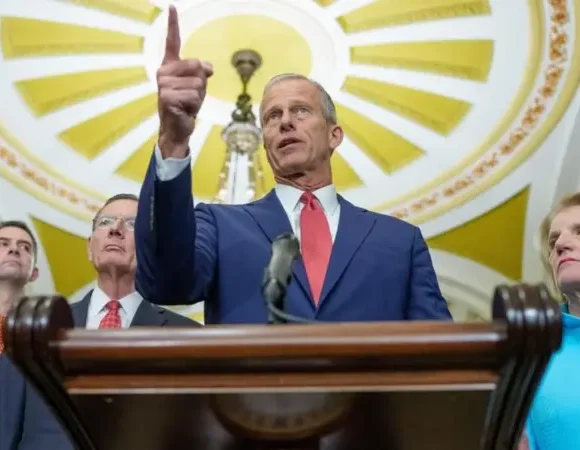
The agreement was negotiated between Senate Majority Leader John Thune and the White House, with Democratic senators Jeanne Shaheen and Maggie Hassan of New Hampshire, and Angus King of Maine, an independent who caucuses with the Democrats.

Republicans who hold a 53-47 majority in the Senate – needed the measure to clear a 60-vote minimum threshold.

They were able to attract eight votes from the other side of the aisle, while losing just one in Kentucky Senator Rand Paul, who voted against after saying the bill would increase national debt.

The deal includes an agreement for a vote in December on extending healthcare subsidies that are due to expire this year, a key issue Democrats had been holding out for concessions on.

Democratic Party leaders had said that they would not lend their support to new funding for government operations until Congress addressed the subsidies that help tens of millions of Americans pay for health insurance purchased through government-run exchanges.

“I’m thankful to be able to say we have senators, both Democrats and Republicans, who are eager to get to work to address that crisis in a bipartisan way,” Senate Majority Leader John Thune said ahead of the vote.

“We also have a president who is willing to sit down and get to work on this issue. So I’m looking forward to seeing what solutions might be brought forward.”

Thune did not say exactly what that bill would contain, which frustrated many Democrats in the House and the Senate, who argued that the Democrats who negotiated the deal did so without getting enough in return.

“For months and months Democrats have been fighting to get the Senate to address the healthcare crisis,” said Chuck Schumer, the party’s leader in the Senate.

“This bill does nothing to ensure that that crisis is addressed,” he said as he confirmed he would vote against the deal.

Some high-profile Democrats have been highly critical of colleagues who sided with Republicans to end the shutdown without concrete guarantees on healthcare, with California Governor Gavin Newsom calling the decision “pathetic”.

The measure also includes three appropriations bills to fund agencies like veterans affairs and agriculture, as well as a continuing resolution to finance the rest of the government until 30 January – meaning another government shutdown could be on the horizon early next year.

It also includes guarantees that all federal workers will be paid for time during the shutdown, and funding for the Supplemental Nutrition Assistance Program (Snap), an essential food safety net for one in eight Americans until next September.

A vote on the deal would only be the first procedural step in the new funding agreement and it would still need to be approved by the US House of Representatives, where it is likely to see its own challenges.

BBC / Titilayo Kupoliyi

Subscribe to our Telegram and YouTube Channels, and also join our WhatsApp Update Group.
Foreign

By the time the House of Representatives adjourned late on Wednesday after Republicans failed on their sixth attempt to elect a new speaker, tempers had flared, a chorus of booing had erupted, and gleeful Democrats munched popcorn as turmoil engulfed the other side of the aisle.

After two days of backroom dealings, Republicans and Democrats could not even agree on whether to call it a night – the knife-edge vote to adjourn prompted shouts and confusion. On CNN, an anchor pondered: “Is this normal?”

What should have been a straightforward vote for Republicans, who hold a majority in the lower chamber, has turned into a political drama that has paralysed the third branch of the American government.

Wednesday was day two of the chaotic saga, as a group of hard-line Republicans refused repeatedly to support party leader Kevin McCarthy, denying him his long-coveted speaker position and bringing all other House business screeching to a halt.

“Well, it’s Groundhog Day. Again,” Congresswoman Kat Cammack, a Florida Republican, said from the floor as she again nominated Mr McCarthy to lead the chamber.

Now the deadlock in the 118th Congress will drag on into Thursday – the longest vote for a speaker in a century.

Nappy changing

When the members of the House entered the chamber on Tuesday, there was a sense of celebration in the air.

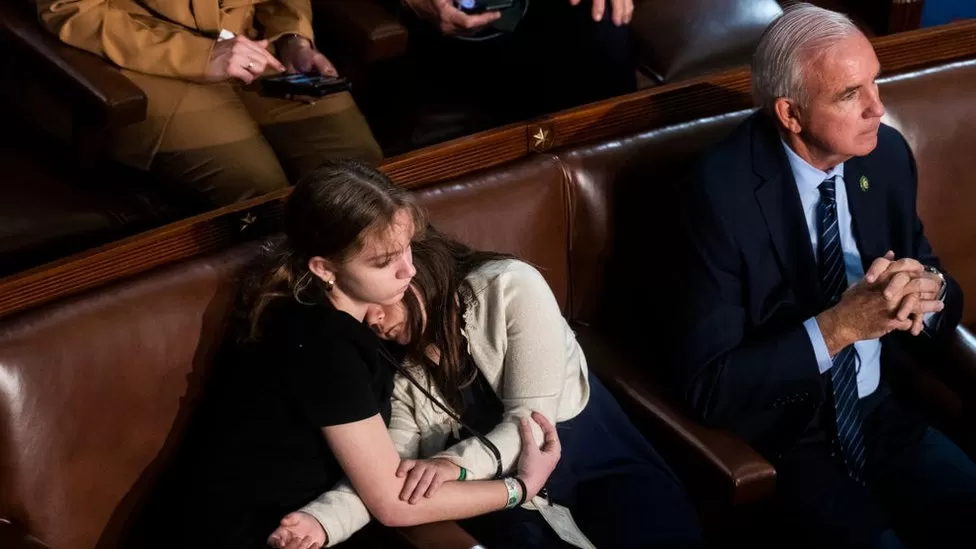
The first day of a new Congress is typically a family affair. Parents, spouses and children crowded the chamber and surrounding hallways, hoping to see their loved ones take the oath of office.

For four-month-old Hodge Gomez, that meant naps and nappy changes in the US Capitol while his father, California Representative Jimmy Gomez, a Democrat, took part in the first rounds of ballots. Network cameras at one point captured a chubby-cheeked Hodge wriggling in a sling strapped to his father’s chest as the congressman cast his vote.

“He loved it,” Mr Gomez said.

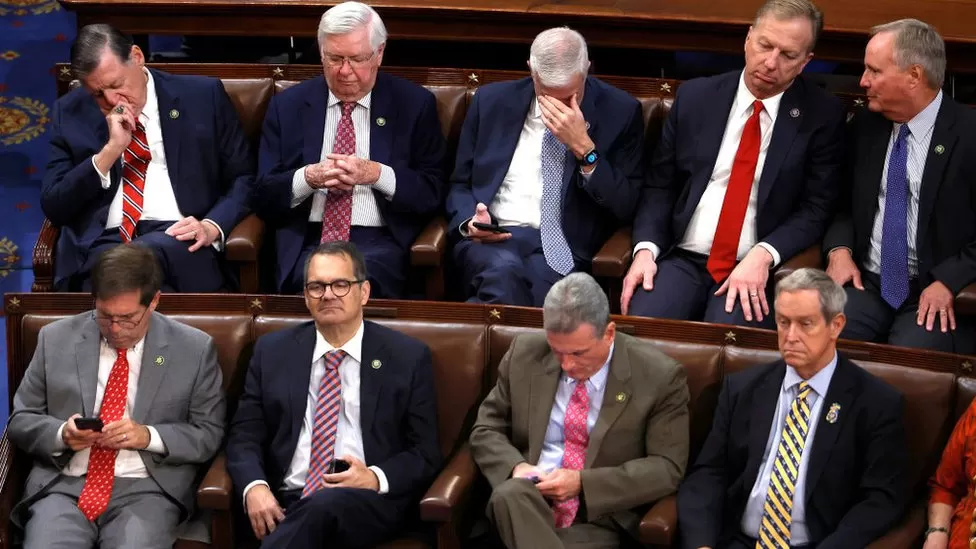
But as the first ballot became a second, then a third, that initial enthusiasm faded. Members paced back and forth in the chamber, some letting their heads loll back over their chairs. Pennsylvania Democrat Madeline Dean handed out chocolate to a bored-looking Representative Larry Nadler.

Mr McCarthy sat placidly in his chair, managing to laugh ruefully amid the dysfunction around him.

‘It looks messy’

After a long night of negotiations, the lawmakers returned on Wednesday.

Speaking from the House floor to nominate Mr McCarthy, Representative Mike Gallagher of Wisconsin attempted something of a pep talk, reminding his colleagues how lucky they were to be there.

“It looks messy,” he said. “But democracy is messy.”

Indeed, over the next nine hours and three roll-call votes, it kept looking messier.

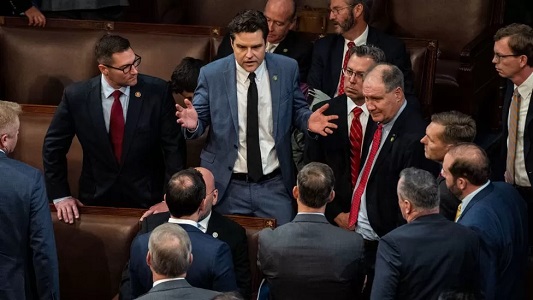
Throughout the day, increasingly weary-looking Republicans navigated the chamber, gathering for huddles and increasingly animated debate as Democrats looked on.

Florida’s Matt Gaetz – a leader of the anti-McCarthy group – held court with as many as 15 Republicans at one time, including some of Mr McCarthy’s allies. At one point, he cornered Steve Scalise, Mr McCarthy’s deputy, gesticulating animatedly while Mr Scalise simply shook his head, covering his face with his hands.

“He’s a desperate guy,” Mr Gaetz said of Mr McCarthy. “I’m ready to vote all night, all week, all month and never for that person.”

The calm exterior that Mr McCarthy had managed to present a day earlier slipped slightly on Wednesday. Looking increasingly agitated, the California Republican fidgeted with his glasses, stared at his phone and left his seat repeatedly for discussions outside the chamber.

With each passing vote, tension seemed to build. In a speech nominating Mr McCarthy for a sixth ballot, Ms Cammack, the Florida Republican, claimed that Democrats had been drinking alcohol on the House floor, a baseless allegation that drew furious boos and shouts from the other side of the aisle.

As Democrats, the minority party tried to put forward their leader, Hakeem Jeffries, for speaker, the Republican rebels countered by nominating another black congressman, Byron Donalds.

One of the Republican dissidents, Texas congressman Chip Roy, noted it was the first time in history that two African Americans had been nominated for the high office. Lawmakers from both parties rose to applaud.

But such flashes of bipartisanship were rare.

Some Democrats could not hide their delight at the Republican disarray, tweeting several pictures of themselves bringing buckets of popcorn to the chamber floor. President Joe Biden, departing the White House for an event in Kentucky, described the congressional deadlock as “really embarrassing”.

Increasingly, too, there was a feeling of disbelief that a typically ceremonial vote had come to this. Each time a rebel Republican rose to nominate a challenger to McCarthy the sound of groans grew louder, as members prepared for another futile round of voting.

Despite all the horse trading, little has changed. Mr McCarthy has vowed to keep fighting; meaning another day of political disarray is probably in store.

BBC/Simeon Ugbodovon

Subscribe to our Telegram and YouTubeChannels also join our Whatsapp Update Group

Foreign

Republican Senate leader Mitch McConnell vowed to put President Donald Trump’s Supreme Court nominee to a vote within hours of Justice Ruth Bader Ginsburg’s death being announced, sparking outrage among Democrats.

Mr McConnell said he would act swiftly, despite the election six weeks away.

In 2016, he blocked President Barack Obama’s pick for the court on the grounds it was an election year.

Joe Biden has insisted a replacement should only take place after the poll.

Ginsburg, 87, died on Friday of metastatic pancreatic cancer at her home in Washington, DC, surrounded by her family.

The second-ever woman to sit on the Supreme Court, she had become a figurehead for liberals in the US, and was an iconic champion of women’s rights.

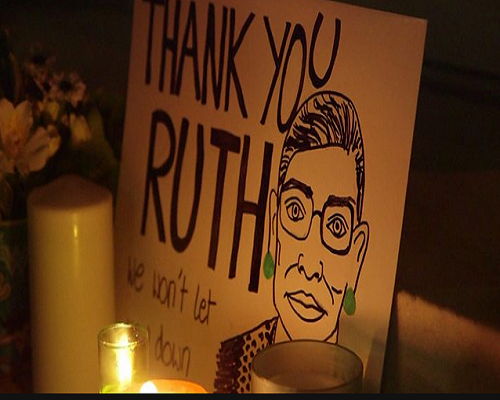
Supporters gathered outside the court on Friday night to pay tribute to the woman who had become affectionately known as “The Notorious RBG”.

What is the row about?

The appointment of judges in the US is a political one – which means the president gets to choose who is put forward. The Senate then votes to confirm – or reject – the choice.

Ginsburg, who served for 27 years, was one of only four liberals on the nine-seat bench. Her death means that, should the Republicans get the vote through, the balance of power would shift decisively towards the conservatives.

Mr Trump, who has already chosen two Supreme Court justices during his presidency, is well aware that getting his nominee in will mean conservatives will have control over key decisions for decades to come. Justices can serve for life, unless they decide to retire.

At a rally on Friday – before he learned of Ginsburg’s death – he told the crowd whoever won the election “will get one, two, three or four Supreme Court justices”, saying November’s vote was going to be “the most important” in US history.

Mr McConnell said in his statement – which included a tribute to Ginsburg – that “President Trump’s nominee will receive a vote on the floor of the United States Senate”.

The senator had argued in 2016 that “the American people should have a voice in the selection of their next Supreme Court Justice” which meant “this vacancy should not be filled until we have a new president”.

But now he says the Senate was within its rights to act because it was Republican-controlled, and Mr Trump is a Republican president.

Democrats, however, began echoing Mr McConnell’s words from 2016.

The Senate Democratic leader, Chuck Schumer, sent a tweet repeating his exact phrase, while Mr Biden told reporters: “There is no doubt – let me be clear – that the voters should pick the president and the president should pick the justice for the Senate to consider.”

Ginsburg had also made her feelings clear in the days before her death.

“My most fervent wish is that I will not be replaced until a new president is installed,” she wrote in a statement to her granddaughter, according to National Public Radio (NPR).

BBC