Foreign

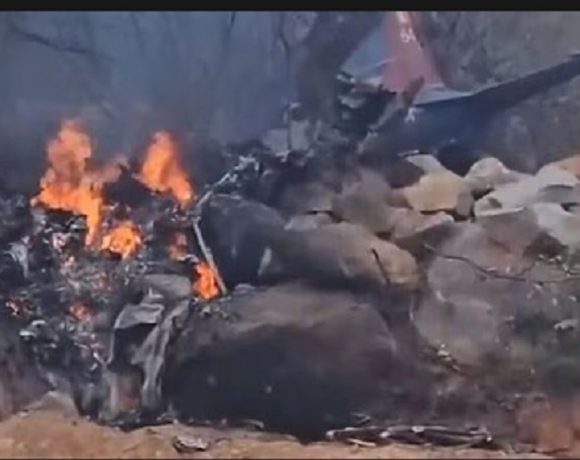
A Russian Ilyushin-76 military transport plane has crashed in the southern Belgorod region bordering Ukraine.

At least 65 Ukrainian prisoners of war were killed, according to Russia’s Ministry of Defence.

Ria Novosti news agency said another nine people were on board, including six crew.

None of the details surrounding those on board can be independently verified.

Reports from Kyiv say the Il-76 was downed by Ukrainian forces.

Ukraine’s general staff, quoted by the Ukrainska Pravda website, said the plane was transporting missiles for Russia’s S-300 air defence systems. It made no mention of prisoners of war.

Belgorod regional governor Vyacheslav Gladkov said he was aware of an “incident” but gave no further details.

Video shared on social media showed a plane going down followed by an explosion near the village of Yablonovo, 70km (44 miles) to the north-east of Belgorod, at around 11:00 local time (08:00 GMT).

According to Ria Novosti, the Ukrainian prisoners were “being transported to Belgorod region for exchange”, although that cannot be confirmed.

Russian presidential spokesman Dmitry Peskov said the Kremlin was aware of the crash but refused to go into details.

BBC/Adetutu Adetule

Subscribe to our Telegram and YouTube Channels and also join our Whatsapp Update Group 

Foreign

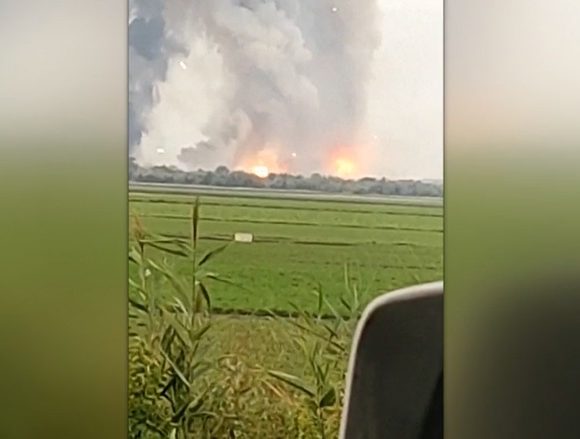
A week after an apparent Ukrainian attack on a Russian military base in occupied Crimea, an arms store on another depot has been hit by a series of explosions.

Russian officials said a fire triggered the blasts in the Dzhankoi area – before later blaming “sabotage”.

A separate fire broke out at a power substation and a railway was damaged.

A string of blasts last week destroyed Russian warplanes at a Black Sea base on the Crimean coast.

Ukraine has never publicly admitted that attack – but presidential office adviser Mykhailo Podolyak described the latest incident as “demilitarisation in action”, indicating that the explosions were not accidental.

A Crimean Tatar leader, Refat Chubarov, called the explosions a “hit” that could be heard “far across the steppe”.

Russia’s defence ministry said the fire broke out at a temporary ammunition storage site near the village of Maiske (or Mayskoye in Russian) at around 06:15 Moscow time (03:15 GMT) and that the cause was being investigated.

The defence ministry in Moscow said there had been no “serious” casualties, but Russian-appointed regional head Sergei Aksyonov visited the site and said 2,000 people had been moved from a nearby village and two people had been wounded.

“One man has a shrapnel wound, and one was crushed by a wall. Their lives are not in danger, fortunately,” he said.

Crimea was seized from Ukraine and then annexed by Russia in early 2014, and when Russian forces unleashed a new invasion in February they used their bases on the peninsula to capture large swathes of southern Ukraine.

Russian occupation has stretched across two southern regions in particular, Kherson and Zaporizhzhia, and Ukraine has vowed to launch a counter-offensive to recapture areas under Russian control.

After the Russian air base at Saky was hit last Tuesday, satellite images revealed significant damage, with at least eight warplanes destroyed. Although Russia said that incident was also accidental, there was little doubt the base had come under Ukrainian attack due to the precise nature of the destruction.

UK Ministry of Defence said the blasts had “significantly degraded” the aviation capability of the Russian navy’s Black Sea fleet.

The latest blasts at an ammunition depot are reminiscent of a string of recent attacks behind Russian lines in eastern Ukraine.

Since June, Ukrainian forces have used US Himars multiple rocket launchers to hit as many as 50 arms stores, according to the defence minister. Bridges in the south have also been hit, jeopardising vital supply lines from Crimea to Kherson.

Apparent ability of Ukraine’s military to reach so far behind enemy lines is of significant embarrassment to the Russians.

The explosions at Saky were visible from nearby beaches and videos posted afterwards on social media showed streams of tourists leaving Crimea, across a bridge built across the Kerch Strait after the Russian annexation.

BBC/Adetutu Adetule

Subscribe to our Telegram channel

Foreign

The UN has expressed concern that Malian authorities have denied its human rights investigators access to a village where hundreds of people were killed.

“We are extremely concerned that Malian authorities have still not granted UN human rights investigators access”, a statement by the UN Human Rights Office

said.

It says “time is of essence to ensure accountability and prompt, effective justice for victims”, noting that it first sought access to the site of the killings on 1 April.

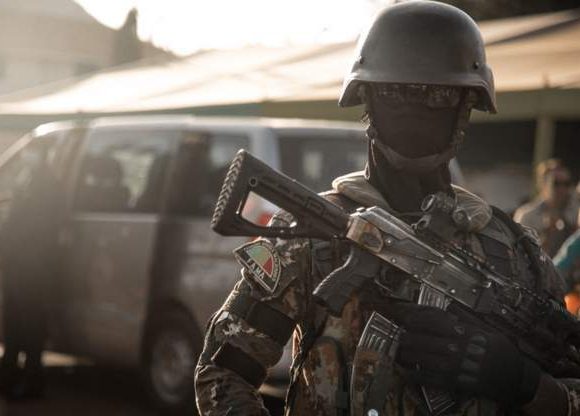
Malian troops and their Russian collaborators are accused of carrying out a massacre of civilians during an operation against militants last month.

At least 300 people are believed to have been executed during the 27-31 March raid in the village of Moura, which is in Mali’s central Mopti region.

The killings sparked calls by the Human Rights Watch, the US, the European Union and the UN for an independent investigation into the matter.

The Malian army insists that those killed were jihadist fighters and the allegation of a massacre is an attempt to tarnish its image.

A Russian foreign ministry spokeswoman said this had been a successful operation by Mali’s army alone.

The Mali junta denies that mercenaries from Russia’s Wagner group are helping it fight the insurgents.

The country has been battling a decade-long insurgency that has affected millions of people, and has also engulfed other countries in the region.

BBC

Mali is Preventing Access to Killings Site – UN

The UN has expressed concern that Malian authorities have denied its human rights investigators access to a village where hundreds of people were killed.

“We are extremely concerned that Malian authorities have still not granted UN human rights investigators access”, a statement by the UN Human Rights Office

said.

It says “time is of essence to ensure accountability and prompt, effective justice for victims”, noting that it first sought access to the site of the killings on 1 April.

Malian troops and their Russian collaborators are accused of carrying out a massacre of civilians during an operation against militants last month.

At least 300 people are believed to have been executed during the 27-31 March raid in the village of Moura, which is in Mali’s central Mopti region.

The killings sparked calls by the Human Rights Watch, the US, the European Union and the UN for an independent investigation into the matter.

The Malian army insists that those killed were jihadist fighters and the allegation of a massacre is an attempt to tarnish its image.

A Russian foreign ministry spokeswoman said this had been a successful operation by Mali’s army alone.

The Mali junta denies that mercenaries from Russia’s Wagner group are helping it fight the insurgents.

The country has been battling a decade-long insurgency that has affected millions of people, and has also engulfed other countries in the region.

BBC

Foreign

February 24, 2022, will ever remain etched in the annals of Ukraine, not for any memorable fanfare, pomp or pageantry but that of a long drawn out war foisted on it by the invasion of its territory on the orders of Valdimir Putin, the Russian strongman.

The invasion has not been a walkover as Putin had thought, with the war dragging into the second month amidst mounting death tolls on both sides.

Gory images emerged of the alleged gruesome killing of civilians in Bucha by Russian forces, some of the victims had bullet wounds to the head, which Bucha mayor Anatoliy Fedoruk described as execution-style killing, besides 410 bodies of victims of war atrocities were found in towns around Kyiv according to Ukraine’s prosecutor general Iryna Venediktova.

Moscow however denied its soldiers committed such atrocities, which if proven, are war crimes.

Ukraine also witnessed massive destruction of infrastructure and buildings from missiles fired from Moscow.

Russia has had its casualties and scratches too, figures from Ukraine and Western sources indicate that Russia has suffered significant losses in personnel, ranging between 7000 and 18000, though the Kremlin trims down the figure to over 1000.

The dead include generals as well as conscripts, who are not expected to be drafted to the frontline. Russia is equally counting its losses in military hardware if figures by Ukraine’s armed forces are anything to go by 123 aircraft, 127 helicopters, 856 tanks, 1694 armoured vehicles, 1150 vehicles, 66 UAVs, 73 fuel tankers and 7 boats.

The war has been described as one between David and Goliath, an allusion to the Biblical story of the fight between young David and Goliath of Gath, the champion of the Philistines.

 Obviously, Putin had strategized for the invasion with the deployment of forces to Belarus for a phantom joint military exercise, while at the same time massing hundreds of thousands of troops at its borders with Ukraine.

However, Russian forces found themselves bogged down by logistics, fuel and food shortages, while tanks got stuck in muddy terrains.

Amateurs talk strategy while professionals talk logistics, General Omar Bradley famously said. 

However, a big take from the war is the resilience of the Ukrainians against Russia’s war machines and huge personnel deployment, which numbered around 150,000.

 Ukraine’s military had its personnel buffered by citizens who submitted themselves to impromptu military training on the use of arms while others quickly got to learn about making Molotov.

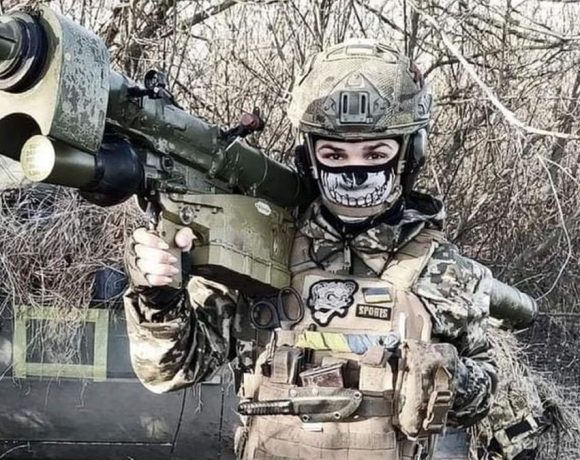
Perhaps, the most endearing face of Ukraine’s trained civilian resistant army was of a student, 22, an expert in the use of Igla missile launcher, who shot down two Russian fighter jets and a helicopter.

Other unarmed Ukrainians had dared Russian soldiers, confronting them and urging them to go back home.

This is an image of a nation, of the vast majority, speaking with one voice volubly against the perceived existential threat from a well-armed neighbour.

United we stand, divided we fall, goes a saying. Ukrainians have stood united, though there have been sprinkles of traitors, who have been caught by authorities.

  Bear Grylls said, ‘Survival requires us to leave our prejudices at home. It’s about doing whatever it takes and ultimately those with the biggest heart win’.

Ukrainians have shown big hearts!

What lessons for Nigeria and sister African nations confronted by extremists who have gone on killing sprees. In Nigeria in particular, Boko Haram had continued its atrocious attacks on citizens since 2011 with thousands dead in the Northeast and Northwest, and tens of thousands becoming internally displaced.

The horror has been aggravated by incessant attacks by bandits, with daring assaults on the nation’s defence academy, Kaduna airport, Kaduna-Abuja railway, taking many hostages as usual for ransom after killing some of the passengers in a bomb attack.

Politicians have been at the usual game of exploiting the unpleasant situation to sway public opinion while the government has kept its toga of blame trading and seeing any criticism as bad belle.

The issue at stake calls for collective efforts rather than polar blitzes and disparages on the political landscape.

The involvement of civilians in the formation of the Joint Task Force has been helpful. However, there is the need for government to unite the nation behind it as security forces battle to curtail vampires on the loose.

Divisive comments, ethnic colouration and politicization of the current invasion of socioeconomic order by bandits and insurgents will not matter.

Simeon Ugbodovon