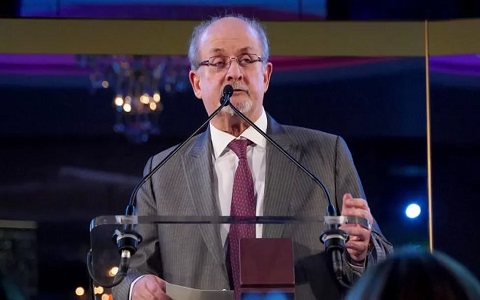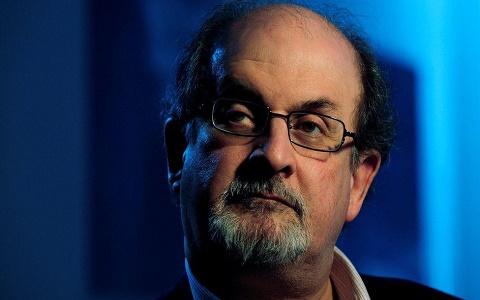
Author Salman Rushdie has been taken off a ventilator and is able to talk again, a day after being stabbed.
Mr Rushdie, 75, was attacked while speaking at an event in New York state and was in a critical condition.
He has faced years of death threats for his novel The Satanic Verses, which some Muslims see as blasphemous.
The man charged over Friday’s attack has pleaded not guilty to attempted murder and has been remanded in custody without bail.
Hadi Matar, 24, is accused of running onto the stage and stabbing Mr Rushdie at least 10 times in the face, neck and abdomen.
Following the attack, Mr Wylie said the novelist had suffered severed nerves in one arm, damage to his liver, and would likely lose an eye.
Henry Reese, who had been due to interview Mr Rushdie at the event, suffered a minor head injury. He is the co-founder of a non-profit organisation that provides sanctuary to writers exiled under threat of persecution.
Before the attack, Mr Rushdie was about to give a speech about how the US has served as a haven for such writers.
The novelist was forced into hiding for nearly 10 years after The Satanic Verses was published in 1988. Many Muslims reacted with fury to it, arguing that the portrayal of the Prophet Muhammad was a grave insult to their faith.
He faced death threats and the then-Iranian leader, Ayatollah Ruhollah Khomeini, issued a fatwa – or decree – calling for Mr Rushdie’s assassination, placing a $3m (£2.5m) bounty on the author’s head.
The fatwa remains active, and although Iran’s government has distanced itself from Mr Khomeini’s decree, a quasi-official Iranian religious foundation added a further $500,000 to the reward in 2012.
Little is known about the suspect who attacked the acclaimed author on Friday.
Mr Matar, from Fairview, New Jersey, was born in the US to parents who had emigrated from Lebanon, a Lebanese official has told the media.
A review of his social media accounts has suggested he is sympathetic to the causes of the Iran’s Islamic Revolutionary Guard Corps (IRG), NBC News reported.
Police have not disclosed his motive – or what an examination of a backpack and electronic devices found at the centre may have yielded.
However, no link has been definitively established with the IRG – a major military, political and economic force with close ties to Iran’s Supreme Leader, Ayatollah Ali Khamenei, and many other senior figures.
Mr Rushdie was born in Bombay, India in 1947. He was sent to boarding school in England before going on to study history at the University of Cambridge. In 2007, he was knighted for services to literature.
There has been an outpouring of support for him, with the attack widely condemned as an assault on freedom of expression.
BBC/Simeon Ugbodovon