Foreign

A Chinese influencer living in Taiwan must leave the island within days or be deported, Taiwanese authorities said, after she posted videos supporting the idea of China taking the island by force.

The move comes at a time of heightened cross-strait tensions and increasing suspicions of Chinese influence operations on the democratic island.

Taiwan’s National Immigration Agency (NIA), which revoked the influencer’s visa, said that her “behaviour advocates the elimination of Taiwan’s sovereignty and is not tolerated in Taiwanese society”.

The influencer, identified by authorities with her surname Liu, had relocated from mainland China to Taiwan on a dependent visa after marrying a Taiwanese man.

Liu has until 24 March to leave Taiwan before she is forcibly deported, local media reported.

She would not be able to apply for another dependent visa for five years, according to an NIA statement on Saturday.

It is extremely rare for the authorities to expel Chinese spouses of Taiwanese citizens.

Liu, better known on social media as Yaya in Taiwan, regularly posts pro-Beijing commentary videos with her young daughter.

In the videos, Liu refers to the island as “Taiwan province” and echoes China’s state narrative that Taiwan is “an inseparable part of China”.

China claims the self-governed Taiwan as part of its territory, and has not ruled out the use of force over it. Taiwan, however, sees itself as distinct from China.

“The complete unification of the motherland is a necessity, regardless of what the Taiwanese people want,” Liu said in one video on Douyin, the Chinese equivalent of TikTok, where she has 480,000 followers.

“Peaceful unification is much harder than unification by force,” she added. “It depends on what choices the Taiwanese people make.”

As criticism against her videos mounted, Liu posted on Douyin in February that she “would never back down”.

She later said that she was “trying to promote the good on both sides” through her videos and “eliminate the chasm between people”.

“I’m just analysing objectively and sharing my own views,” she said. “Those pushing for Taiwan independence … are the ones causing real harm to Taiwanese society.”

Her remarks have sparked condemnation from Taiwan’s leaders, with interior minister Liu Shyh-fang saying that freedom of speech was “not an excuse” to call for the invasion of Taiwan.

Liu is among 360,000 mainland Chinese spouses living in Taiwan, whose activities have been increasingly scrutinised amid heightening cross-strait tensions.

In a slate of measures announced last week to curb Chinese influence and infiltration on the island, Taiwanese president Lai Ching-te called for tighter control of cross-strait exchanges, which he said were seen by China as a way to “create internal divisions” in Taiwan.

BBC / Titilayo Kupoliyi

Subscribe to our Telegram and YouTube Channels and also join our WhatsApp Update Group.
Foreign

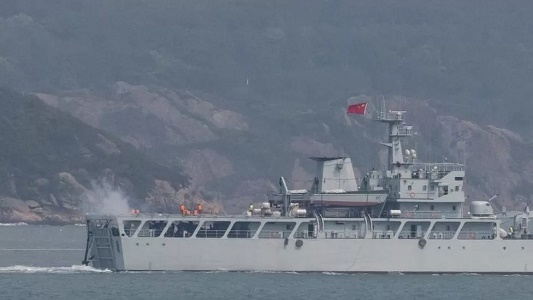
China has simulated precision strikes against key targets on Taiwan and its surrounding waters during a second day of military drills.

The drills – which Beijing has called a “stern warning” to the self-governing island – are a response to Taiwan’s president visiting the US last week.

As the Chinese military simulated an encirclement of the island, the US urged China to show restraint.

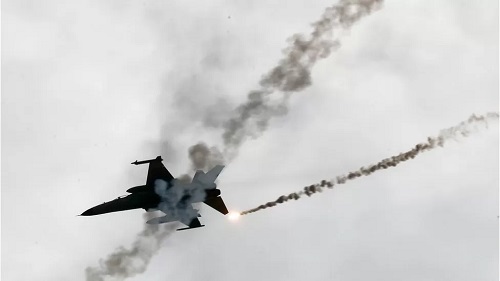
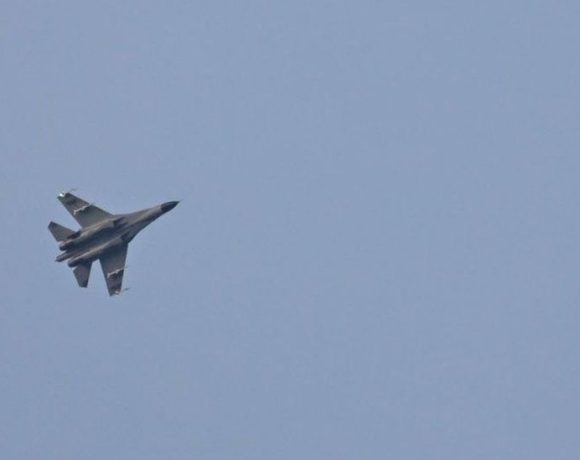
Taiwan said at least 71 Chinese jets flew around the island on Saturday.

Taiwan also said 45 warplanes either crossed the Taiwan Strait median line – the unofficial dividing line between Taiwanese and Chinese territory – or flew into the southwestern part of Taiwan’s air defence identification zone.

Nine Chinese ships were also spotted. The operation, dubbed “Joint Sword” by Beijing, will continue until Monday. Taiwanese officials have been enraged by the operation.

On Saturday defence officials in Taipei accused Beijing of using President Tsai’s US visit as an “excuse to conduct military exercises, which has seriously undermined peace, stability and security in the region”.

On day one of the drills, one of China’s ships fired a round as it sailed near Pingtan island, China’s closest point to Taiwan.

Taiwan’s Ocean Affairs Council, which runs the Coast Guard, issued video footage showing one of its ships shadowing a Chinese warship, though did not provide a location.

In the footage a sailor can be heard telling the Chinese ship through a radio: “You are seriously harming regional peace, stability and security. Please immediately turn around and leave. If you continue to proceed we will take expulsion measures.”

Other footage showed a Taiwanese warship, the Di Hua, accompanying the Coast Guard ship in what the Coast Guard officer calls a “standoff” with the Chinese vessel.

While the Chinese exercises ended by sundown on Saturday evening, defence officials in Taipei said fighter jet sorties started again early on Sunday morning.

US state department officials have urged China not to President Tsai’s US visit, and have called for “restraint and no change to the status quo”.

A state department spokesperson said the US was “monitoring Beijing’s actions closely” and insisted the US had “sufficient resources and capabilities in the region to ensure peace and stability and to meet our national security commitments”.

The US severed diplomatic ties with Taipei in favour of Beijing in 1979, but it is bound by law to provide Taiwan with the means to defend itself.

US President Joe Biden has said on several occasion that the US would intervene if China attacked the island, but US messaging has been murky.

At Wednesday’s meeting in California, Ms Tsai thanked US House Speaker Kevin McCarthy for America’s “unwavering support”, saying it helped “reassure the people of Taiwan that we are not isolated and we are not alone”.

Mr McCarthy had originally planned to go to Taiwan himself, but opted instead to hold the meeting in California to avoid inflaming tensions with China.

Chinese state media said the military drills, which are due to run until Monday, would “simultaneously organise patrols and advances around Taiwan island, shaping an all-round encirclement and deterrence posture”.

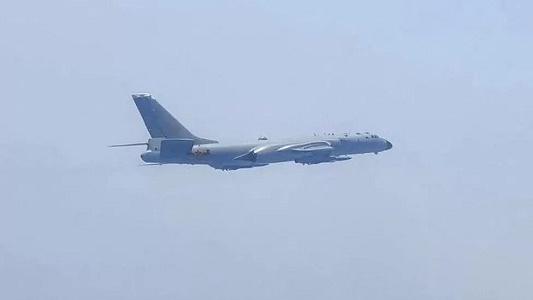
It added that “long-range rocket artillery, naval destroyers, missile boats, air force fighters, bombers, jammers and refuellers” had all been deployed by China’s military.

But in Taiwan’s capital Taipei, residents seemed unperturbed by China’s latest manoeuvres.

“I think many Taiwanese have gotten used to it by now, the feeling is like, here we go again!” Jim Tsai said on Saturday.

Meanwhile, Michael Chuang said: “They [China] seems to like doing it, circling Taiwan like it’s theirs. I am used to it now.

“If they invade we can’t escape anyway. We’ll see what the future holds and go from there.”

Taiwan’s status has been ambiguous since 1949, when the Chinese Civil War turned in favour of the Chinese Communist Party and the country’s old ruling government retreated to the island.

Taiwan has since considered itself a sovereign state, with its own constitution and leaders. China sees it as a breakaway province that will eventually be brought under Beijing’s control – by force if necessary.

China’s President Xi Jinping has said “reunification” with Taiwan “must be fulfilled”.

BBC/Simeon Ugbodovon

Subscribe to our Telegram and YouTube Channels also join our Whatsapp Update Group 

Foreign

China’s military has begun rehearsing the encirclement of Taiwan during three days of military drills.

Beijing – which views Taiwan as a breakaway province of China – called the operation a “stern warning” to the island’s government.

The exercises began hours after President Tsai Ing-wen returned from a trip to the United States.

The Taiwanese Defence Ministry said 42 Chinese military planes and eight ships crossed the Taiwan Strait median line.

The line is an unofficial dividing line between Chinese and Taiwanese territory.

Chinese state media said the military drills would “simultaneously organise patrols and advances around Taiwan island, shaping an all-round encirclement and deterrence posture”.

It added that “long-range rocket artillery, naval destroyers, missile boats, air force fighters, bombers, jammers and refuellers” had all been deployed by China’s military.

Taiwan considers itself a sovereign state, with its own constitution and leaders.

But China sees the island as a breakaway province that will eventually be brought under Beijing’s control – by force if necessary.

China’s President Xi Jinping has said “reunification” with Taiwan “must be fulfilled”.

Although China often holds drills around Taiwan, the “encirclement” is being seen as a response to Taiwan’s President Tsai meeting US House Speaker Kevin McCarthy on Wednesday.

President Tsai said on Saturday that her government would continue working with the US and other democracies as the island faces “continued authoritarian expansionism” from China.

She made the comments in a meeting with a US congressional delegation in Taipei led by House foreign affairs committee chairman Michael McCaul.

Mr McCaul said Washington was working to supply weapons to Taiwan, “not for war, but for peace”.

China’s three-day operation around Taiwan – dubbed “United Sharp Sword” – will run until Monday, the People’s Liberation Army’s (PLA) Eastern Theatre Command said.

Taiwan’s defence ministry said it would respond to China’s exercises “with a calm, rational, and serious attitude” based on the principle of “not escalating conflicts, nor causing disputes to defend our national sovereignty and security”.

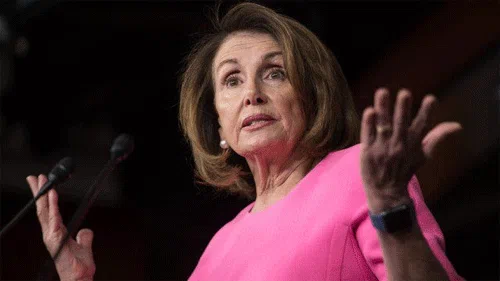
Last August, Beijing carried out almost a week of drills around Taiwan after Kevin McCarthy’s predecessor, Nancy Pelosi, visited Taipei.

The exercises, China’s largest show of force in years, included the deployment of fighter jets and warships, and the firing of ballistic missiles.

BBC/Simeon Ugbodovon

Subscribe to our Telegram and YouTube Channels also join our Whatsapp Update Group 

Foreign

Former Prime Minister Liz Truss has called for ties with Taiwan to be boosted to combat threats from China, ahead of May’s G7 summit in Hiroshima.

In a speech in Tokyo, she urged countries to send a message to Beijing that “military aggression towards Taiwan would be a strategic mistake”.

It was her first public speech since she resigned in October.

Her successor Rishi Sunak has said China should be dealt with through “robust pragmatism”.

Ms Truss, who was previously foreign secretary, put forward a number of policy recommendations for countries to support Taiwan, including reducing reliance on China in key industries, deepening economic ties with Taiwan, and accepting the self-ruled island into international organisations.

She also called for a more developed Pacific defence alliance so that Taiwan “is able to defend itself”, and closer cooperation with Nato, adding that, “countries should find a way to elevate Taiwan’s status”.

Her speech was organized by the Inter-Parliamentary Alliance on China, an international campaign group that focuses on how democratic countries approach China.

The Japanese government said this week it would review its defence policy in the wake of the alleged Chinese spy balloon episode in the US.

Asked about Ms Truss’s comments, Chinese foreign ministry spokesperson Wang Wenbin said: “I have yet to see the speech. But we are against distorting facts about China.”

He added: “The Taiwan question is China’s domestic affair. Allegations of economic coercion from China are unfounded.”

BBC/Taiwo Akinola

Subscribe to our Telegram and YouTube Channels also join our Whatsapp Update Group

Foreign

US President Joe Biden has again said the US would defend Taiwan in the event of an attack by China.

Asked in a CBS interview if US troops would defend the island, Mr Biden said: “Yes, if in fact, there was an unprecedented attack.”

The remarks prompted the White House to clarify that US policy had not changed.

Washington has long maintained a stance of “strategic ambiguity” – it does not commit to defending Taiwan, but also does not rule out the option.

Taiwan is a self-ruled island off the coast of eastern China that Beijing claims as part of its territory.

Washington has always walked a diplomatic tightrope over the issue.

On the one hand, it adheres to the One China policy, a cornerstone of its relationship with Beijing. Under this policy, the US acknowledges that there is only one Chinese government, and has formal ties with Beijing rather than Taiwan.

But it also maintains close relations with Taiwan and sells arms to it under the Taiwan Relations Act, which states that the US must provide the island with the means to defend itself.

Taiwan responded to Mr Biden’s remarks on Monday by welcoming the “US government’s rock-solid security commitment to Taiwan”. Taipei said it would continue to deepen its “close security partnership” with Washington.

Only earlier this month, the US agreed to sell $1.1bn (£955m) in weaponry and missile defence to Taiwan, provoking anger from China.

Beijing is yet to respond to Mr Biden’s latest remarks, broadcast in a CBS 60 Minutes interview on Sunday. But China has previously condemned such comments from Mr Biden pledging US military action.

“Taiwan is an inalienable part of China’s territory… The Taiwan question is purely China’s internal affair that brooks no foreign interference,” a foreign ministry spokesman had said in May.

That was in response to Mr Biden’s comments in Tokyo in May when he said “Yes” when asked if the US would defend Taiwan. The White House had quickly issued a follow-up saying there was no departure from long-standing US policy.

This time too the White House issued a statement, downplaying the president’s comments: “The President has said this before, including in Tokyo earlier this year. He also made clear then that our Taiwan policy hasn’t changed. That remains true.”

It’s the third time since October last year that President Biden has gone further than the official stance.

But in the interview on Sunday, Mr Biden reiterated that the US was not encouraging Taiwan’s independence.

“There’s a One China policy and Taiwan makes their own judgements on their independence. We are not moving, not encouraging their being independent – that’s their decision,” he said.

Tensions between US and China have ramped up after US House Speaker Nancy Pelosi made a controversial visit to the island in August – a trip Mr Biden had said was “not a good idea”.

Beijing responded with a five-day military blockade around Taiwan. The US claims China shot missiles over the island, but Beijing did not confirm this. Taiwan said the missiles China fired flew high into the atmosphere and posed no threat.

Elsewhere in the pre-recorded interview, Mr Biden also warned Russia not to use chemical or tactical nuclear weapons in the war in Ukraine.

BBC/Simeon Ugbodovon

Subscribe to our Telegram channel

Foreign

China’s military says it is continuing large-scale military drills around Taiwan after its previously announced live-fire exercises ended on Sunday.

The Chinese army’s Eastern Theatre Command said that it would practice anti-submarine attacks and sea raids.

The earlier four days of exercises were Beijing’s response to US House Speaker Nancy Pelosi’s visit to the island.

Taiwan has accused China of using these drills as practice for an invasion of the island.

The US, along with Australia and Japan, have condemned the drills, saying their objective is to change the status quo in the Taiwan Strait – the body of water between the mainland and the island.

Washington has also condemned Beijing for breaking off cooperation with the US in a number of areas including climate change in retaliation for Ms Pelosi’s visit.

Beijing sees Taiwan as a breakaway province that it can claim by force, if necessary.

But Taiwan is a self-ruled island that sees itself as distinct from China.

Any hint of recognition of this by world leaders, however, enrages China.

The renewed activity around Taiwan comes after Chinese maritime authorities announced that drills would also take place in other locations.

In the Yellow Sea – located between China and the Korean peninsula – new daily military drills were due to start from Saturday until the middle of August, and include live-fire exercises.

In addition, a month-long military operation in one area of the Bohai sea – north of the Yellow Sea – started on Saturday.

BBC/Simeon Ugbodovon

Subscribe to ourTelegram channel

Foreign

Chinese Foreign Ministry has announced Friday to sanction US House Speaker Nancy Pelosi and her immediate family members for ignoring China’s serious concern and firm opposition and insisted on visiting China’s Taiwan region.

According to the spokesperson, the decision seriously interferes in China’s internal affairs, undermines China’s sovereignty and territorial integrity, tramples on the one-China principle and threatens peace and stability in Taiwan Straits, Foreign Ministry .

Earlier on Wednesday, Chinese Foreign Minister, Wang Yi vowed that Beijing will punish Taiwan as Pelosi visited the island Asian country.

Pelosi met with Taiwan’s President, Tsai Ing-wen on Wednesday during the official visit to the island that had invited China fury.

The American lawmaker also called at the Taiwan parliament during the trip, which made her the highest-ranking US official to visit the nation in 25 years.

China regarded the self-governing island as a breakaway territory that would one day be reunited with the mainland and warned the US against allowing Pelosi to visit.

“This is a complete farce. The United States is violating China’s sovereignty under the guise of so-called ‘democracy’… those who offend China will be punished,” Wang said on the sidelines of a meeting of the Association of Southeast Asian Nations, ASEAN, in Phnom Penh.

But in reaction to the threat, Taiwanese President Tsai Ing-wen countered that the island of 23 million would not be intimidated.

“Facing deliberately heightened military threats, Taiwan will not back down. We will… continue to hold the line of defence for democracy,” Tsai said at an event with Pelosi in Taipei.

She also thanked the 82-year-old US lawmaker for “taking concrete actions to show your staunch support for Taiwan at this critical moment”.

China tries to keep Taiwan isolated on the world stage and opposes countries having official exchanges with Taipei.

Pelosi, second in line to the presidency, is the highest-profile elected US official to visit Taiwan in 25 years.

“Today, our delegation… came to Taiwan to make unequivocally clear we will not abandon our commitment to Taiwan,” Pelosi said at the event with Tsai.

Vanguard/Taiwo Akinola

Foreign

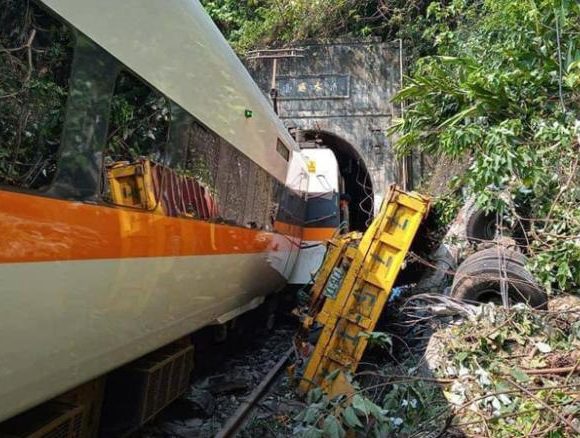
A busy passenger train carrying 490 people has derailed in a tunnel in eastern Taiwan, killing at least 48 and injuring dozens more, authorities said, as rescue efforts to free those trapped continue.

The eight car train, traveling to Taitung, came off the rails in a tunnel just north of Hualien Friday morning, causing several carriages to hit the wall of the tunnel, the government-run Central News Agency (CNA) reported, citing the fire department.

The train driver is among the 48 dead, the fire department told the country’s executive office. 66 survivors are being treated in at least six hospitals in the surrounding Hualien County, and rescue efforts are ongoing to free any passengers still stuck in carriages that were badly damaged in the accident.

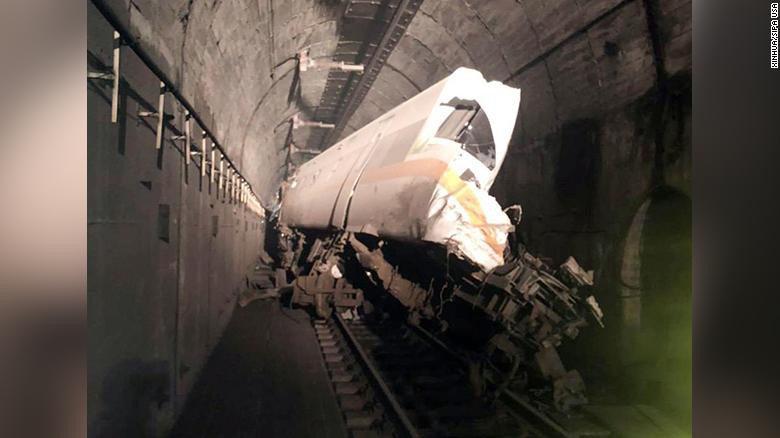
The inside of the tunnel where the train crashed on April 2, north of Hulien, Taiwan.

The derailment could have been caused by a vehicle which slipped from a slope near the tunnel and hit the moving train, according to CNA.

A video on social media showed parts of an industrial vehicle heavy equipment, along with what looks like a car door beside the derailed train. In the video, a man can be heard saying, “Our train hit the truck. Where is this place? Qingshui Tunnel, the accident happened at Qingshui Tunnel.

The train hit the truck, the truck fell off. It’s lucky that I was at the later carriage — I was at the fourth carriage.”

“Is everyone out in carriage four?” a woman is heard shouting from inside the tunnel, in videos provided by the fire department.

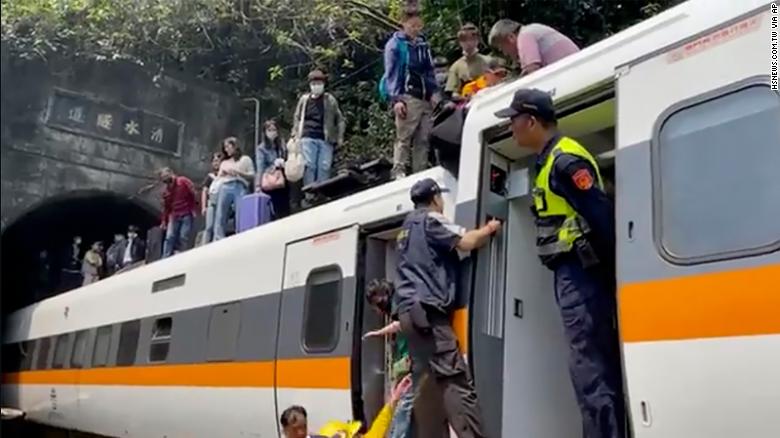
Passengers are helped to climb out of the train in Hualien County, Taiwan, on April 2.

Images of the crash scene show carriages inside the tunnel crumbled and ripped apart from the impact; passengers gathering suitcases and bags in a tilted, derailed carriage and others walking along the tracks littered with wreckage.

Photos show the rescue operation underway, with passengers walking on top of the train to leave the tunnel and being helped down.

At least 156 people were injured in the crash, a local government official said during a news conference.

The official said rescuers believed there was no one left in the train, but that rescue efforts would continue and authorities were checking to see if anyone was still unaccounted for.

“In response to a train derailment in Hualien, Taiwan, our emergency services have been fully mobilized to rescue & assist the passengers & railway staff affected,” Taiwan President Tsai Ing-wen said on Twitter.

“We will continue to do everything we can to ensure their safety in the wake of this heartbreaking incident.”

The accident coincided just as a long weekend kicked off for the Tomb Sweeping Day public holiday.

One couple who were on the train told CNA they were on their way to Taitung to sweep tombs and pay their respects to deceased family members, as is traditional for the event.

The train was so full that many people were standing.

The crash site is located just east of the picturesque Taroko National Park, a popular tourist destination on the country’s mountainous east coast.

In 2018, 18 people died and 175 were injured when a train derailed in northeastern Taiwan, in the island’s worst rail disaster in more than three decades.

CNN