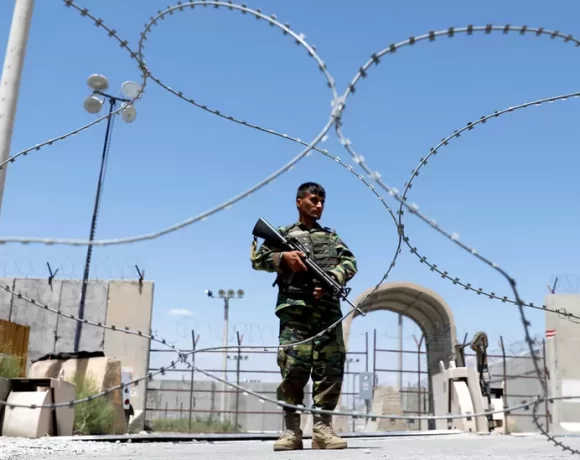
Afghanistan’s Taliban government says it will turn some former foreign military bases into economic zones for businesses.
Afghanistan has faced a deepening economic and humanitarian crisis since the Taliban regained control of the country in August 2021.
Foreign military forces had been in the country for two decades.
The decision was announced by the acting deputy prime minister for economic affairs Mullah Abdul Ghani Baradar.
“It was decided that the Ministry of Industry and Commerce should progressively take control of the remaining military bases of the foreign forces with the intention of converting them into special economic zones,” Mullah Baradar said in a statement on Sunday.
He added that the project will begin with sites in the capital of Kabul and the northern Balkh province but did not give further details.
“The Taliban desperately needs to boost its coffers if it is to govern better and attain some domestic legitimacy,” Muhammad Faizal Bin Abdul Rahman from the S Rajaratnam School of International Studies in Singapore told the BBC.
“More importantly, the Taliban needs to prove its commitment to economic planning. This includes establishing safe zones near the capital and borders for potential foreign investors such as the Chinese… and to revive regional trade with neighbouring countries,” he added.
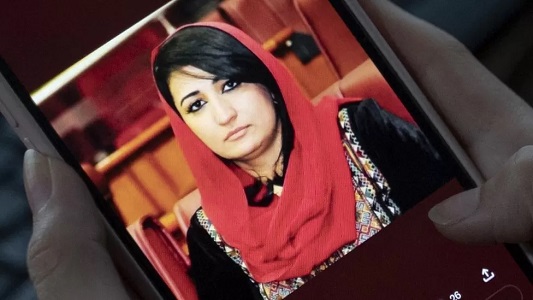
A former Afghan MP and her bodyguard have been shot dead at her home in the capital Kabul, Afghan police have said.
Mursal Nabizada, 32, was one of the few female MPs who stayed in Kabul after the Taliban seized power in August 2021.
Her brother and a second security guard were wounded in the attack on Sunday.
Former colleagues praised Ms Nabizada as a “fearless champion for Afghanistan” who turned down a chance to leave the country.
Since the Taliban returned to power in 2021, women have been removed from nearly all areas of public life.
Kabul police spokesman Khalid Zadran said security forces had started a serious investigation into the incident.
Former lawmaker Mariam Solaimankhil said Ms Nabizada was “a true trailblazer – a strong, outspoken woman who stood for what she believed in, even in the face of danger”.
“Despite being offered the chance to leave Afghanistan, she chose to stay and fight for her people,” she wrote on Twitter.
Ms Nabizada, from the eastern province of Nangarhar, was elected as a member of parliament from Kabul in 2018 and stayed in power until the Taliban takeover.
She was a member of the parliamentary defence commission and worked at the Institute for Human Resources Development and Research.
Hannah Neumann, a member of the European Parliament, said: “I am sad and angry and want the world to know!” in response to the killing.
“She was killed in darkness, but the Taliban build their system of gender apartheid in full daylight.”
Abdullah Abdullah, a former top official in Afghanistan’s former Western-backed government, said he was saddened by Ms Nabizada’s death and hoped the perpetrators would be punished.
He described her as a “representative and servant of the people”.
Many women who had prominent professional jobs in Afghanistan after the US-led invasion two decades ago fled the country after the Taliban returned to power.
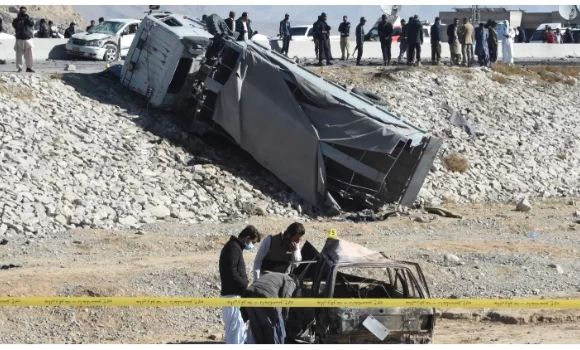
Three people were killed and 23 injured Wednesday when a suicide bomber targeted a police truck in western Pakistan, an attack claimed by the domestic chapter of the Taliban.
Tehreek–e-Taliban Pakistan (TTP), separate from the Afghan Taliban but sharing a common hardline Islamist ideology, earlier this week called off a shaky months-long ceasefire agreed upon with Islamabad and ordered its fighters to resume attacks across the nation.
Senior Police Official, Azhar Mehesar told AFP that Wednesday’s blast targeted security forces preparing to escort polio vaccinators in the city of Quetta, and those killed “include a policeman, a woman and a child”.
In a statement, the TTP said a “holy warrior” detonated a car bomb near a customs post to avenge the killing of founding member Umar Khalid Khurasani during the truce.
“Our revenge operations will continue,” the statement added.
The TTP was founded in 2007 by Pakistani jihadists who fought alongside the Taliban in Afghanistan in the 1990s before opposing Islamabad’s support for the US-led intervention there after 9/11.
For a time they held vast tracts of Pakistan’s rugged tribal belt, imposing a radical interpretation of Islamic law and patrolling territory just 140 kilometres (85 miles) from the Pakistan capital.
The Taliban in Afghanistan have appealed for international support, as the country deals with the aftermath of a devastating 6.1 magnitude earthquake.
More than 1,000 people have died and at least 1,500 were injured, a local official said.
Paktika province in the south-east has been the most affected. The UN is scrambling to provide emergency shelter and food aid.
The rescue efforts are being hampered by heavy rain and hail.
The earthquake struck about 44km, 27 miles, from the city of Khost and tremors were felt as far away as Pakistan and India. Witnesses reported feeling the quake in both Afghanistan’s capital, Kabul, and Pakistan’s capital, Islamabad.
“The government sadly is under sanctions so it is financially unable to assist the people to the extent that is needed,” said Abdul Qahar Balkhi, a senior Taliban official.
“International relief agencies are helping, neighbouring countries, regional countries, and world countries have offered their assistance which we appreciate and welcome.
“The assistance needs to be scaled up to a very large extent because this is a devastating earthquake which hasn’t been experienced in decades.”
The number of people stuck under rubble is unknown. Health and aid workers have said the rescue operation is particularly difficult because of the heavy rain.
In remote areas, helicopters have been ferrying victims to hospitals.
The UN and aid agencies in neighbouring Pakistan are assisting with the humanitarian effort, which includes deploying medical teams and providing medical supplies.
One humanitarian aid agency, Intersos, said it was ready to send an emergency medical team consisting of two surgeons, an anaesthetist and two nurses.
Most of the casualties so far have been in the Gayan and Barmal districts of Paktika, a local doctor. A whole village in Gayan has reportedly been destroyed.
“There was a rumbling and my bed began to shake”, one survivor, Shabbir said.
“The ceiling fell down. I was trapped, but I could see the sky. My shoulder was dislocated, my head was hurt but I got out. I am sure that seven or nine people from my family, who were in the same room as me, are dead”.
Report says, a doctor in Paktika said medical workers were among the victims.
“We didn’t have enough people and facilities before the earthquake, and now the earthquake has ruined the little we had,” they said. “I don’t know how many of our colleagues are still alive.”
According to report, communication following the quake is difficult because of damage to mobile phone towers and the death toll could rise further still.
“Many people are not aware of the well-being of their relatives because their phones are not working,” he said. “My brother and his family died, and I just learned it after many hours. Many villages have been destroyed.”
Afghanistan is prone to quakes, as it is located in a tectonically active region, over a number of fault lines including the Chaman fault, the Hari Rud fault, the Central Badakhshan fault and the Darvaz fault.
Over the past decade more than 7,000 people have been killed in earthquakes in the country, the UN’s Office for the Co-ordination of Humanitarian Affairs reports. There are an average of 560 deaths a year from earthquakes.
A powerful earthquake has killed one thousand people and left hundreds more injured in Afghanistan.
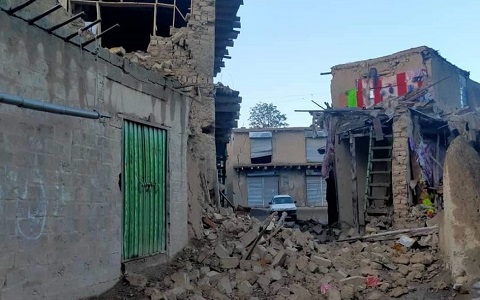
Pictures show landslides and ruined mud-built homes in eastern Paktika province, where rescuers have been scrambling to treat the injured.
Taliban leader Hibatullah Akhundzada said hundreds of houses were destroyed and the death toll was likely to rise.
It is the deadliest earthquake to strike Afghanistan in two decades.
The head of information for Paktika province, Mohammad Amin Hazifi, told the BBC that 1,000 people had died and 1,500 are injured.
Rescue teams are still searching for others buried under the ground, he added.
The earthquake struck about 44km (27 miles) from the south-eastern city of Khost shortly after 01:30 local time (21:00 Tuesday GMT), when many people were asleep at home.
“Every street you go, you hear people mourning the deaths of their beloved ones. Houses are ruined,” a local journalist in badly-hit Paktika province said to the BBC.
Earthquakes tend to cause significant damage in Afghanistan, where dwellings in many rural areas are unstable or poorly built.
Local farmer Alem Wafa cried as he told the BBC that official rescue teams are yet to reach the remote village of Gyan – one of the worst hit.
“There are no official aid workers, but people from neighbouring cities and villages came here to rescue people. I arrived this morning, and I – myself – found 40 dead bodies.”
He continued: “Most of them are young, very young children. There is a hospital here. But it can’t deal with this disaster. It doesn’t have the capacity.”
Taliban officials called for aid agencies to rush to the affected areas in the nation’s east.
Decades of conflict have made it difficult for the impoverished country to improve its protection against earthquakes and other natural disasters – despite efforts by aid agencies to reinforce some buildings over the years.
Even before the Taliban takeover, Afghanistan’s emergency services were stretched to deal with natural disasters – with few aircraft and helicopters available to rescuers.
Communication following the quake is difficult because of damage to mobile phone towers and the death toll could rise further still, another local journalist in the area told the BBC.
“Many people are not aware of the well-being of their relatives because their phones are not working,” he said. “My brother and his family died, and I just learned it after many hours. Many villages have been destroyed.”
In remote areas, helicopters have been ferrying victims to hospitals.
Speaking to the BBC, a doctor from one of the worst-hit districts in Paktika province said medical workers were among the victims.
“We didn’t have enough people and facilities before the earthquake, and now the earthquake has ruined the little we had,” they said. “I don’t know how many of our colleagues are still alive.”
Speaking to Reuters news agency, locals described horrific scenes of death and destruction in the aftermath of the late-night earthquake.
“The kids and I screamed. One of our rooms was destroyed. Our neighbours screamed and we saw everyone’s rooms,” said Fatima.
“It destroyed the houses of our neighbours,” local resident Faisal said. “When we arrived there were many dead and wounded. They sent us to the hospital. I also saw many dead bodies.”
Most of the casualties so far have been in the Gayan and Barmal districts in Paktika, a local doctor told the BBC. Local media site Etilaat-e Roz reported a whole village in Gayan had been destroyed.
The earthquake was magnitude 6.1 at a depth of some 51km, according to seismologists.
Tremors were felt across more than 500km of Afghanistan, Pakistan and India. Witnesses reported feeling the quake in Afghanistan’s capital, Kabul, as well as Pakistan’s capital, Islamabad.
However, there have been no immediate reports of casualties or significant damage in Pakistan, according to BBC Urdu.
Afghanistan is prone to quakes, as it’s located in a tectonically active region, over a number of fault lines including the Chaman fault, the Hari Rud fault, the Central Badakhshan fault and the Darvaz fault.
Over the past decade more than 7,000 people have been killed in earthquakes in the country, the UN’s Office for the Co-ordination of Humanitarian Affairs reports. There are an average of 560 deaths a year from earthquakes.
Most recently, back-to-back earthquakes in the country’s west in January killed more than 20 people and destroyed hundreds of houses.
Dozens of people have been killed or injured in four explosions across Afghanistan on Thursday, local officials and journalists have said.
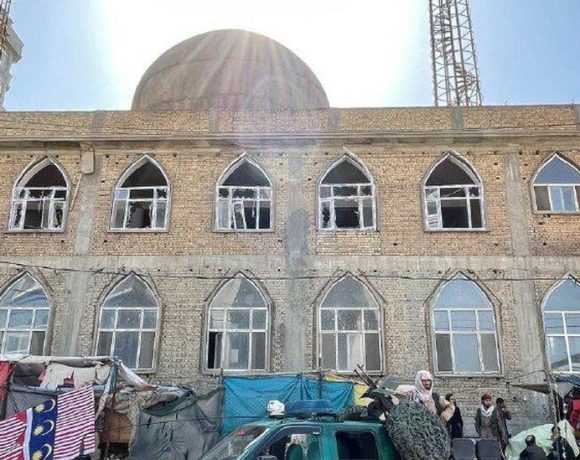
The first explosion tore through a Shia mosque in the city of Mazar-i-Sharif.
At least 31 people were killed, and 87 were wounded, the BBC has been told.
The Islamic State group (IS) admitted to carrying out the attack. The Taliban say they have defeated the IS but the group remains a serious security challenge to Afghanistan’s new rulers.
The attack on the Mazar-i-Sharif mosque was carried out using a remotely detonated booby-trapped bag when the building was packed with worshippers, the IS jihadists said.
The group called the attack part of an ongoing global campaign to “avenge” the deaths of its former leader and spokesman.
IS has not said it was behind the three other explosions, and it is not clear if they are connected.
The second blast saw a vehicle blown up near a police station in Kunduz, leaving four dead and 18 injured, a police spokesman said.
The BBC has also received reports of a Taliban vehicle being hit by a roadside mine in eastern Nangarhar province, killing four Taliban members and wounding a fifth.
A fourth blast was caused by a mine planted in the Niaz Beyk area of Kabul, Afghanistan’s capital, and wounded two children.
Thursday’s bloodshed comes days after two bomb blasts at Abdul Rahim Shahid high school in a mostly Shia area of the Afghan capital, Kabul. At least six people were killed and more than 20 wounded, officials said. IS militants have attacked the area in the past but did not say they were behind that incident.
‘Everyone started to run’
Local reports and witnesses say the explosion in Mazar-i-Sharif happened at Seh Dokan, one of the biggest mosques used locally by the Hazara minority group.
The number of casualties remains fluid at this stage and is liable to change.
Afghanistan’s Hazara community is often targeted by Sunni militant groups, including the Islamic State.
The blast is said to have happened while worshippers were preparing to perform prayers. Images shared on social media, which the BBC has not verified, showed the site littered with broken glass and victims being carried.
One Mazar-i-Sharif woman told news agency Reuters she had been shopping at a nearby market when she heard a large explosion near the mosque.
“The glass of the shops was broken and it was very crowded and everyone started to run,” she said, asking for her name not to be used.
Richard Bennett, the United Nation’s Special Rapporteur for Afghanistan on human rights, condemned the attacks.
“Today more explosions rocks Afghanistan […] and again the Hazara community is a victim. Systematic targeted attacks on crowded schools and mosques call for immediate investigation, accountability and end to human rights violations,” he wrote on Twitter.