It has been a week since a deadly earthquake struck Turkey and Syria, killing thousands. But amid the despair, there have been stories of “miracles”. This is one of them.
When Necla Camuz gave birth to her second son on 27 January, she named him Yagiz, meaning “brave one”.
Just 10 days later, at 04:17 local time, Necla was awake feeding her son at their home in southern Turkey’s Hatay province. Moments later, they were buried under mounds of rubble.
Necla and her family lived on the second floor of a modern five-storey building in the town of Samandag. It was a “nice building”, she says, and she had felt safe there.
She did not know that morning that the area would be torn apart by the earthquake, with buildings damaged and destroyed at every turn.
“When the earthquake started, I wanted to go to my husband who was in the other room, and he wanted to do the same thing,” she says.

“But as he tried to come to me with our other son, the wardrobe fell onto them and it was impossible for them to move.
“As the earthquake got bigger, the wall fell, the room was shaking, and the building was changing position. When it stopped, I didn’t realise that I had fallen one floor down. I shouted their names but there was no answer.”
The 33-year-old found herself lying down with her baby on her chest, still held in her arms. A fallen wardrobe next to her saved their lives by preventing a large slab of concrete from crushing them.
The pair would remain in this position for almost four days
Lying in her pyjamas beneath the rubble, Necla could see nothing but “pitch black”. She had to rely on her other senses to work out what was going on.
To her relief, she could tell immediately that Yagiz was still breathing.

Because of the dust, she struggled at first to breathe but said it soon settled. She was warm in the rubble.
She felt as though there were children’s toys beneath her but could not manoeuvre herself to check or make herself more comfortable.
Other than the wardrobe, the soft skin of her newborn son, and the clothes they wore, she could feel nothing but concrete and debris.
In the distance, she could hear voices. She tried to shout for help and banged on the wardrobe.
“Is there anyone there? Can anyone hear me?” she called.
When that didn’t work, she picked up the small bits of rubble that had fallen next to her. She banged them against the wardrobe, hoping it would be louder. She was scared to hit the surface above her in case it collapsed.
Still, no one replied.
Necla realised there was a possibility nobody would come.
“I was terrified,” she says.
In the darkness beneath the rubble, Necla lost all sense of time.
This wasn’t what life was supposed to be like.
“You plan lots of things when you have a new baby, and then… all of a sudden you’re under rubble,” she says.
Still, she knew she had to look after Yagiz, and was able to breastfeed him in a confined space.
There was no source of water or food that she could access for herself. In desperation, she tried unsuccessfully to drink her own breast milk.
Necla could feel the rumble of drills overhead and hear footsteps and voices, but the muffled sounds felt far away.
She decided to save her energy and remain quiet unless the noises from outside came closer.
She thought constantly of her family – the baby on her chest, and the husband and son lost somewhere in the debris.
She also worried about how other loved ones had fared in the earthquake.
Necla did not think she would make it out of the rubble, but Yagiz’s presence gave her a reason to remain hopeful.
He slept much of the time, and when he woke crying, she would silently feed him until he settled down.
After more than 90 hours underground, Necla heard the sound of dogs barking. She wondered if she was dreaming.
The barks were followed by the sound of voices.
“Are you OK? Knock once for yes,” one called into the rubble. “What apartment do you live in?”
She had been found.
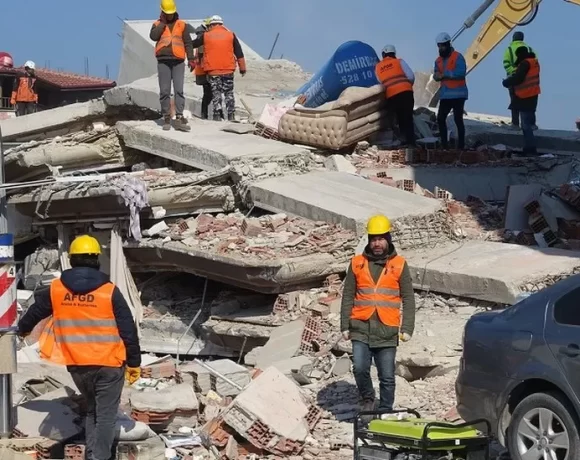
Rescuers carefully dug into the ground to locate her, as she held Yagiz.
The darkness was broken by a torchlight shining into her eyes.
When the rescue team from the Istanbul Municipality Fire Department asked how old Yagiz was, Necla couldn’t be sure. She only knew that he was 10 days old when the earthquake struck.
After handing Yagiz to the rescuers, Necla was then carried away on a stretcher in front of what seemed to be a large crowd. She couldn’t recognise any faces.
As she was moved to an ambulance, she sought confirmation that her other son had also been saved.
When she got to the hospital, Necla was greeted by family members who told her that her husband of six years, Irfan, and her three-year-old son, Yigit Kerim, had been rescued from the rubble.
But they had been transferred hours away to a hospital in Adana province, having sustained serious injuries to their legs and feet.
Remarkably, Necla and Yagiz had suffered no serious physical injuries. They were kept in the hospital for 24 hours for observation before being discharged.
Necla had no home to return to, but a family member brought her back to a makeshift blue tent crafted from wood and tarpaulin. There are 13 of them there in total – all have lost their homes.
In the tent, the families support each other, making pots of coffee over a small stove, playing chess and sharing stories.
Necla is “trying” to come to terms with what happened to her. She says she owes Yagiz for saving her life.
“I think if my baby hadn’t been strong enough to handle this, I wouldn’t have been either,” she explains.
Her only dream for her son is that he never experiences anything like this again.
BBC/ Oluwayemisi Owonikoko
Subscribe to our Telegram and YouTubeChannels also join our Whatsapp Update Group