Foreign

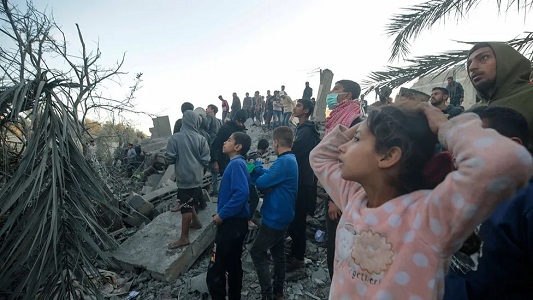
China has sharply criticised the US for vetoing a UN Security Council resolution demanding an immediate ceasefire in Gaza.

Beijing said the move sent the “wrong message” and effectively gave a “green light to the continued slaughter”.

The White House said the Algerian-proposed resolution would “jeopardise” talks to end the war.

The US has proposed its own temporary ceasefire resolution, which also warned Israel not to invade the city of Rafah.

There has been widespread condemnation of the US decision to block Algeria’s resolution as fighting continued in Gaza. It was backed by 13 of the 15 members of the UN Security Council – with the UK abstaining.

In response to the veto, China’s UN ambassador Zhang Jun said the claim the motion would interfere with ongoing diplomatic negotiations was “totally untenable”.

“Given the situation on the ground, the continued passive avoidance on an immediate ceasefire is nothing different from giving a green light to the continued slaughter,” he said.

“The spill-over of the conflict is destabilising the entire Middle East region leading to rising risk of a wider war,” he added.

“Only by extinguishing the flames of war in Gaza can we prevent the fires of hell from engulfing the entire region.”

Algeria’s top UN diplomat declared that “unfortunately the Security Council failed once again”. “Examine your conscience, how will history judge you,” Amar Bendjama added.

US allies were also critical of the move. France’s UN envoy Nicolas de Rivière expressed regret that the resolution had not been adopted “given the disastrous situation on the ground”.

Linda Thomas-Greenfield, Washington’s ambassador to the UN, said it was not the right time to call for an immediate ceasefire while negotiations between Hamas and Israel were continuing.

Her UK counterpart, Barbara Woodward, said the plan could “actually make a ceasefire less likely” by endangering talks.

Israel launched its operations in Gaza following an attack by Hamas on southern Israel on 7 October, during which about 1,200 people were killed and more than 240 others taken hostage.

The Israeli military campaign has left more than 29,000 people dead in Gaza, according to the Palestinian territory’s Hamas-run health ministry.

The draft resolution proposed by the US calls for a temporary ceasefire “as soon as practicable” and on the condition that all hostages are released, as well as urging barriers on aid reaching Gaza to be lifted.

The White House has previously avoided the word “ceasefire” during UN votes on the war, but it is unclear if or when the Security Council will vote on the proposal.

It also states a major ground offensive in Rafah would result in more harm to civilians and their further displacement, including potentially into neighbouring countries – a reference to Egypt.

But Israel’s Prime Minister Benjamin Netanyahu said on Tuesday he was “committed to continuing the war until we achieve all of its goals” and no pressure could change it.

BBC/Adetutu Adetule

Subscribe to our Telegram and YouTube Channels and also join our Whatsapp Update Group
Foreign News

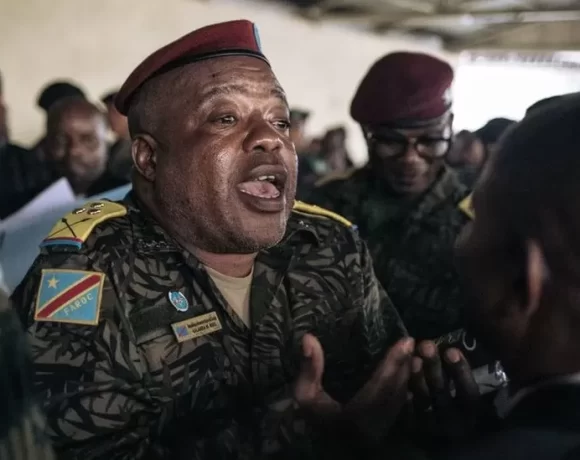
An army colonel has been sentenced to death in the Democratic Republic of Congo for his role in the killing of more than 50 demonstrators in August.

 Col Mike Mikombe, the ex-commander of the elite Republican Guard in Goma city, was accused of giving orders to open fire on anti-UN protesters.

 His lawyers said he would appeal against the military court’s ruling.

 According to report, this was the highest number of deaths in a crackdown on protests against UN peacekeepers in eastern DR Congo.

 The protesters were demanding the withdrawal of UN troops, accusing them of failing to protect civilians who have been under decades-long attacks by rebel groups in the region.

 The UN has almost 18,000 personnel in the country, including more than 12,000 soldiers, making it the second-largest UN mission globally.

 The August protests were organised by a Christian sect known as Wazalendo, Patriots, to demand the departure of UN troops from the region, as protesters also wanted Governor Ndima Kongba, who had earlier banned the demonstrations, to resign. The governor has since been replaced.

  According to the state prosecutor, 56 civilians were killed and dozens others wounded during the demonstrations, sparking international condemnation.

 More than 150 people were arrested during the crackdown by the security forces.

 The court heard how amid chaotic scenes troops opened fire at the protesters, allegedly on the instruction of Col Mikombe.

 He had suggested that he had been misled by an operational order identifying the sect members as proxies of the M23 rebel group, which had captured large swathes of territory in North Kivu province last year.

 The death sentence is often handed down in DR Congo but no executions have taken place in more than 20 years. The sentences tend to be commuted to life imprisonment.

 Col Mikombe was tried along with five other soldiers.

 Three of them were sentenced to 10 years in prison, while two others, including Col Mikombe’s deputy, were acquitted.

 An anti-UN protest in July 2022 led to more than 15 deaths, including three peacekeepers.

 DR Congo’s President  Félix Tshisekedi, who is seeking re-election in December, has called on the UN force to begin leaving this year instead of next year as initially planned.

 Last year, an East African force was deployed to eastern DR Congo to aid the Congolese military quell fighting – though it too has faced criticism of not doing enough to bring about stability.

BBC/TaiwoAkinola

Subscribe to our Telegram and YouTube Channels also join our Whatsapp Update Group
Crime

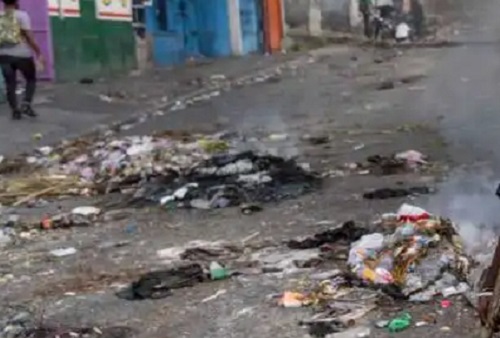
A gang in Haiti has shot and killed at least seven people who were marching in a big protest organised by a church leader.

Hundreds of parishioners, some armed with machetes, marched through a suburb of the capital, Port-au-Prince, in a bid to rid the area of gang members.

The gang is said to have opened fire on them with machine guns.

Soaring gang violence in Haiti has left more than 2,400 people dead in 2023 alone.

There are fears the death toll from Saturday’s shooting could increase, with several people wounded and others kidnapped.

Reuters news agency says unverified videos on social media showed people being shot at in the street, bodies lying on the ground and people who appeared to be hostages saying they thought the march was peaceful and had no idea it was about taking on the gang.

The protest happened in the suburb of Canaan, which was founded by survivors of the devastating 2010 earthquake.

Canaan is controlled by a gang led by a man identified only as “Jeff”, who is believed to be allied with the 5 Segonn “5 Seconds” gang.

Gédéon Jean, director of Haiti’s Center for Analysis and Research in Human Rights, told the Associated Press news agency that he watched the event unfold online and planned to ask the Ministry of Justice to investigate.

He accused the pastor who organised the march of being irresponsible because he “engaged a group of people and put them in a situation like this”.

“Police should have stopped them from going,” Mr Jean said. “It’s extremely horrible for the state to let something like this happen.”

Decades of instability, disasters and economic woes have left Haiti one of the poorest and most violent countries in the world.

Gang violence has soared since the assassination of President Jovenel Moïse in 2021, which led to much of the Caribbean country’s territory falling out of government control, so now around 80% of the capital is controlled by gangs.

Turf wars have since driven a surge in refugees, severe food shortages, murders, kidnappings and sexual violence.

UN rights office spokeswoman Ravina Shamdasani said that in the year to 15 August, at least 2,439 Haitians had been killed, 902 injured and 951 kidnapped.

Amid the soaring violence Haitians have organised a violent movement known as “bwa kale” that targets suspected gang members. More than 350 people have been killed since that uprising began in April, according to the UN.

BBC/Simeon Ugbodovon

Subscribe to our Telegram and YouTube Channels also join our Whatsapp Update Group

Foreign

North Korea has confirmed custody of Travis King in its first response to requests for information on the US soldier’s whereabouts, the UN Command has said.

The 23-year-old private dashed across the border from South Korea on 18 July while on a guided tour.

The UN Command said it would not give more details about Pyongyang’s response at this time.

It said it “did not want to interfere with the efforts to bring him home”.

However, the reply indicates Pyongyang could be ready to start negotiating.

The UN Command, which polices the Demilitarised Zone (DMZ), had sought information on Private 2nd Class (PV2) King using its direct phone line to the North Korean Army [KPA] in the Joint Security Area.

“KPA has responded to the United Nations Command with regards to PV2 King. In order not to interfere with our efforts to get him home, we will not go into details at this time,” a statement said.

The North Koreans had previously acknowledged the request but this is the first time they have responded, confirming the US solider is in their custody.

North Korea has not publicly acknowledged custody of PV2 King.

Before he crossed the border, PV2 King served two months in detention in South Korea for assault charges. He was released on 10 July.

He was supposed to fly back to the US to face disciplinary proceedings but managed to leave the airport and join the DMZ tour.

He is a reconnaissance specialist who had been in the army since January 2021 and was in South Korea as part of his rotation.

BBC / Titilayo Kupoliyi

Subscribe to our Telegram and YouTube Channels also join our Whatsapp Update Group
Economy

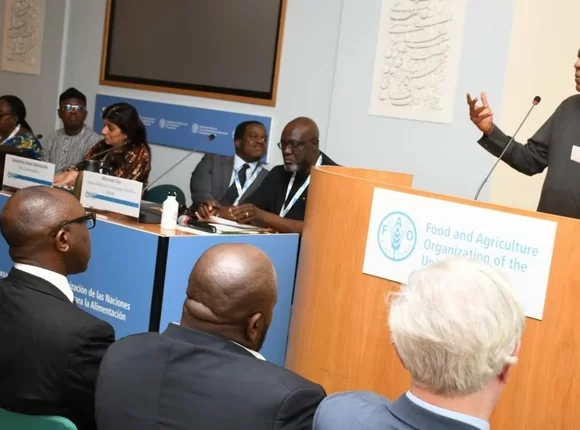
Vice President Kashim Shettima has urged foreign investors to take advantage of the opportunities in Nigeria as the country is ready for business.

A statement by the Director, Information, Office of the Vice President, Mr Olusola Abiola said Shettima made the call in his remarks at a side event of the ongoing UN Food Systems Summit.

The theme of the summit is, “Scaling up of multi-stakeholder collaboration and investments in the implementation of the food systems pathways in Nigeria.”

The vice president noted that the combination of Nigeria’s young, energetic population and the agenda of the new administration placed the country far ahead of others in the region.

” We have the capacity of transforming the demographic bulge into demographic dividends or it will be the demographic disaster that will consume all of us. He said.

“Nigeria will surpass the United States as the third most populous nation on earth and the population is young. The median age is 19.”

“With determined leadership and the support of the global community, we believe, as eternal optimists do, that there is hope on the horizon,” the Vice President added.

The vice president expressed hope that the expected transformation could take place on the back of what he described as “building blocks that already exist in Nigeria.

On improving collaboration between government and the private sector, Shettima said focusing on agribusiness and the understanding that investment that would transform the food system would come from the private sector, with the government providing the enabling environment would scale up investment.

”Nigerian government, together with domestic and international finance institutions, scaled up the Value Chain Development Programme approach for the Special Agro Processing Zones Programme with an impressive investment of 521 million dollars from the IFAD, from the IsDB, and from the AfDB. He assured.

Present at the event were Nigeria’s Permanent Representative to FAO/IFAD/WFP in Rome; Mr Yaya Olaniran, Nigerian Ambassador to Italy, Mr Mfawa Abam; Deputy Chief of Staff to the President in the Office of the Vice President, Ambassador Ibrahim Hadejia, among other senior government officials.

FRCN Abuja/Adetutu Adetule

Subscribe to our Telegram and YouTube Channels also join our Whatsapp Update Group
Foreign

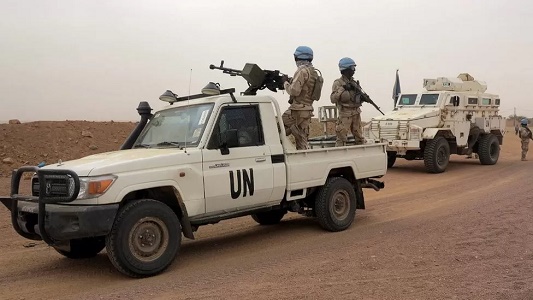
Mali’s foreign minister has called on the UN to withdraw its peacekeeping force from his country “without delay”.

Abdoulaye Diop accused the force, Minusma, of having “become a part of the problem in fuelling intercommunal tensions”. He was addressing the UN Security Council.

Minusma has more than 13,000 troops. Its decade-old mission has failed to stop the spread of jihadist violence.

Russian Wagner mercenaries are now assisting Mali’s military rulers.

Western officials have accused Wagner of human rights abuses in Ukraine and parts of Africa, and last month the US announced sanctions on Ivan Maslov, whom it described as Wagner’s top official in Mali.

Wagner has not commented on the Western allegations and its activities in Mali and other parts of Africa remain shrouded in secrecy.

Minister Diop’s criticism of Minusma followed earlier Malian objections to France’s long-standing involvement in Mali. The alliance with France, the former colonial power, collapsed last year.

Mr Diop spoke of a “crisis of confidence between the Malian authorities and Minusma” and said “the Malian government asks for the withdrawal without delay of Minusma”.

Minusma’s mandate is due to end on 29 June, but UN chief Antonio Guterres has recommended that the mission be reconfigured to focus on a few limited priorities.

The UN currently lists military contingents from Chad, Bangladesh and Egypt as the biggest in the force.

When asked about Mr Diop’s remarks on Friday the UN special envoy to Mali, El-Ghassim Wane, said “we stand to be guided by whatever decision the [Security] Council may take”.

But he added that without the host country’s consent “operating in a specific country would be extremely challenging, if not impossible”.

A report by the UN high commissioner for human rights accused the Malian armed forces and “foreign security personnel” of having killed more than 500 people during an operation in the village of Moura, in central Mali, in March last year. The governments of Mali and Russia both condemned that report.

BBC/Simeon Ugbodovon

Subscribe to our Telegram and YouTube Channels also join our Whatsapp Update Group

Health

The President of United Nations General Assembly (UNGA), Professor Tijjani Bande, says the world body is pushing for equal access to Covid-19 vaccines by all countries once the vaccines are available.

He made this known while addressing a virtual press conference, stressing that developing countries have done better than developed countries as regards the management of the pandemic.

The UNGA president explained that COVID-19 has spread rapidly and extensively to most countries in the world, resulting in considerable mortality in Europe and the United States, as well as in numerous upper-middle-income countries in South America and Asia.

According to him, experts predicted millions of COVID-19 deaths in Africa because many countries in the continent rank poorly on the United Nations Development Programme’s Human Development Index, adding that more than five months after the first cases in Africa were detected, prevalence and mortality are still low.

He said Covid-19 has reminded the world that no nation can have peace when it neighbours are having no peace, adding that the pandemic has brought this to bear directly.

On Mali crisis, the UNGA President noted that the region has a very strong body Economic Community of West Africa States (ECOWAS) that the leadership has been given to to handle the issue. 

HAMZA Alkali