Foreign

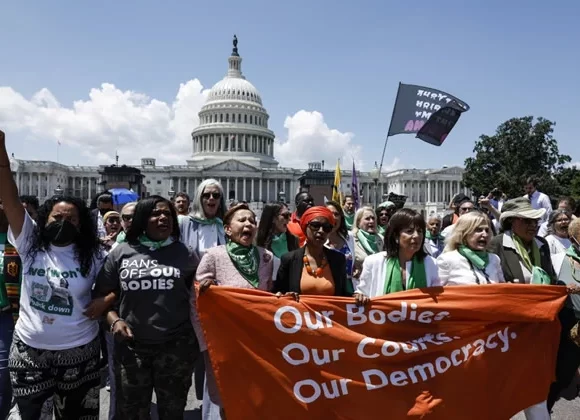
At least 17 Democratic lawmakers, including prominent Progressives Alexandria Ocasio-Cortez and Ilhan Omar, were arrested at an abortion rights protest outside the Supreme Court in Washington on Tuesday.

The US Capitol police said on Twitter that the demonstrators had blocked traffic on a nearby road and have been given three warnings before officers made the arrests.

“We made a total of 35 arrests for Crowding, Obstructing or Incommoding,” the police said. “That arrest number includes 17 Members of Congress.”

The small demonstration came three weeks after a controversial ruling by the Supreme Court that overturned the 1973 landmark decision of Roe v. Wade, which had guaranteed women’s access to abortion.

“Today I was arrested while participating in a civil disobedience action with my fellow Members of Congress outside the Supreme Court,” Omar, a representative from Minnesota, said on Twitter.

“I will continue to do everything in my power to raise the alarm about the assault on our reproductive rights!” she tweeted.

Representative Carolyn Maloney of New York was also arrested, and issued a statement saying, “There is no democracy if women do not have control over their own bodies and decisions about their own health, including reproductive care.”

“The Republican Party and the right-wing extremists behind this decision are not pro-life, but pro-controlling the bodies of women, girls, and any person who can become pregnant.”

Footage from the protest showed Ocasio-Cortez, Omar and others being led away, not in handcuffs, and waving to supporters.

Bbc/Adebukola Aluko

Foreign

Clinics have begun closing in some US states after a Supreme Court ruling on Friday removed American women’s constitutional right to abortion.

About half of states are expected to introduce new restrictions or bans after the court overturned its 50-year-old Roe v Wade decision. Of these 13 have outlawed abortion instantly.

President Joe Biden described the ruling as “a tragic error”.

Protests are under way in cities across the US.

At an abortion clinic in Little Rock, Arkansas , a state with a so-called trigger law allowing an instant ban , the doors to the patient area shut as soon as the court’s opinion was posted online and sobbing could be heard. Staff made calls to tell women that their appointments were cancelled.

“No matter how hard we prepare for bad news, when it finally hits, it hits hard. Having to call these patients and tell them Roe v Wade was overturned is heartbreaking,” nurse Ashli Hunt told the BBC.

Escorts at the clinic, who stood in the Arkansas heat day in and day out to accompany patients through the throng of protesters, held a group hug. “I thought that this country would still care about people. Would still care about women,” said Miss Karen, the lead escort.

Outside, anti-abortion protesters celebrated.

“You are on notice!” shouted a protester at people still parking their cars at the clinic who had not heard about the decision yet. “My suggestion is for you turn around and leave this place of sin, this place of inequity, this evil place.”

In New Orleans, Louisiana – another trigger law state , the Women’s Health Care Centre, one of only three abortion providers in the state, was closed and its staff had gone home.

Outside the clinic, volunteer escort Linda Kocher said that rich women would still be able to access abortions in other states but “poor women will end up in a back alley” for illegal procedures. But anti-abortion campaigner Pastor Bill Shanks said it was a “day for celebration”.

Overall, the Supreme Court ruling is expected to mean about 36 million women of reproductive age will lose access to abortion in their states, according to research from Planned Parenthood, a healthcare organisation that provides abortions.

Bbc/Adebukola Aluko