Uganda’s President, Yoweri Museveni has said he has contracted Covid-19 after one of three tests conducted on him turned out positive.
Mr Museveni, who gave a State of the Nation the address earlier on Wednesday, said he had developed a slight cold, prompting him to get tested.
The Permanent Secretary at the Health Ministry, Diana Atwine, said the president had developed mild flu-like symptoms but was in good health and would continue his duties.
She said the president would adhere to standard operating procedures for Covid cases while performing his role.
Uganda had some of the strictest measures in Africa to limit the spread of the virus at the height of the pandemic, including long curfews and the closure of schools and businesses.
The country fully reopened in February 2022.
BBC / Titilayo Kupoliyi
Subscribe to our Telegram and YouTube Channels also join our Whatsapp
Ugandan President Yoweri Museveni has assented to the controversial anti-homosexuality bill, despite condemnation of Western countries and human rights activists.
The bill was first passed by MPs in March but was returned to the parliament for amendment.
In the new law, the offence of homosexuality is now limited to gay sexual acts. People convicted under this clause face life imprisonment.
The legislation also prescribes death penalty for aggravated offences, in cases of sexual abuse against a minor, a disabled person or where a victim of abuse is infected with a life-long illness.
Members of the public will also be required to report to the authorities any form of homosexual abuse against children or other vulnerable people.
The law initially criminalised identifying as a sexual minority but Mr Museveni argued that this would have led to the arrest and prosecution of people for just their physical appearance.
This clause was removed when the the president returned the bill to the parliament.
It is likely that the law will be challenged in court.
A similar one was struck down by the Ugandan constitutional court in 2014.
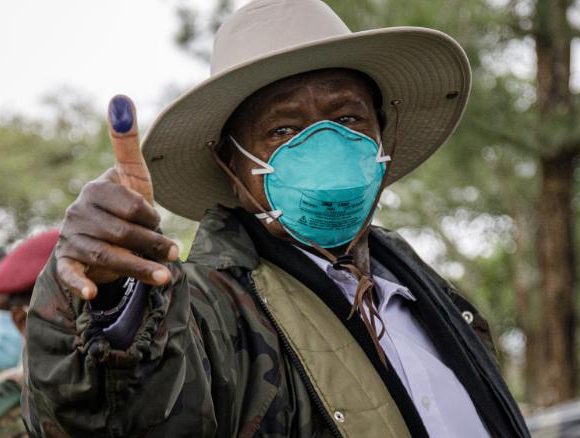
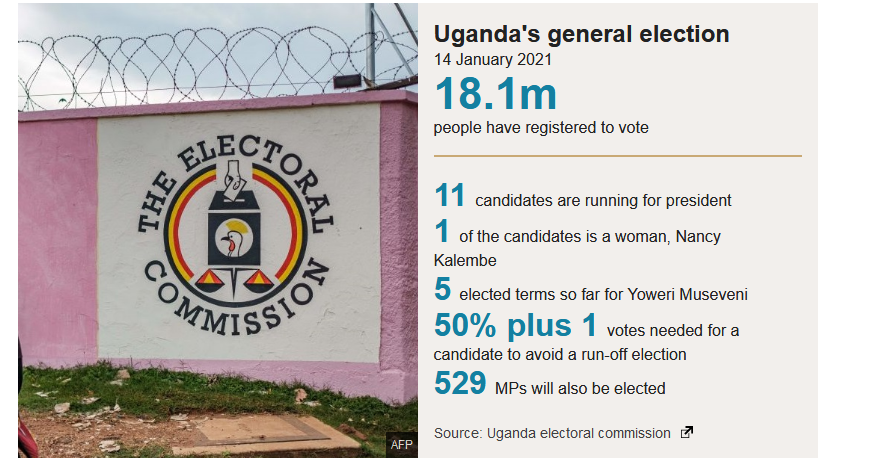
Uganda’s long-time President Yoweri Museveni has been re-elected, electoral officials say, amid accusations of vote rigging by his main rival Bobi Wine.
Mr Museveni won almost 59% of the vote, with Bobi Wine trailing with about 35%, the Electoral Commission said.
Bobi Wine, a former pop star, earlier vowed to provide evidence of fraud. The Electoral Commission denies there was vote-rigging in Thursday’s poll.
Poll monitors have criticised the government closure of internet access.
The say this undermined confidence. Bobi Wine said he would provide evidence of fraud once the internet was restored.
Dozens of people were killed during violence in the run-up to the election. Opposition politicians have also accused the government of harassment.
The result gives President Museveni a sixth term in office.
The 76 year old, in power since 1986, says he represents stability in the country.
Meanwhile, Bobi Wine – the stage name for 38-year-old Robert Kyagulanyi – says he has the backing of the youth in one of the world’s youngest nations, where the median age is 16.
On Friday, as the results came in, Bobi Wine said that Ugandan soldiers had surrounded and breached his home.
But a government spokesman accused him of “dramatising” the incident “to seek sympathy”.
What’s the latest on the election results?
“The electoral commission declares Yoweri Museveni… elected President of the Republic of Uganda,” election commission chairman Justice Simon Mugenyi Byabakama said on Saturday.
He said turnout was 57% of the almost 18 million registered voters.
Earlier, Mr Byabakama said the vote had been peaceful, and called on Bobi Wine, who said some of his polling agents were arrested on Thursday, to make public the evidence for his fraud allegations.
The opposition candidate believes the internet shutdown is being used to block communication and as a way of compromising the vote.
“I will be happy to share the videos of all the fraud and irregularities as soon as the internet is restored,” Bobi Wine said.
Meanwhile, Mr Wanyama, who is a spokesperson for President Museveni, hit back at Bobi Wine’s claims of vote rigging.
“He came short of the expectation of Ugandans,” he said in an earlier interview with the BBC. “He had no message and Ugandans have told him he has to wait a little longer.”
Mr Wanyama added: “We have challenged him to provide proof for his claims, he has not a single iota of evidence.”
The EU, United Nations and several rights groups have previously raised concerns about the integrity of Uganda’s election.
But, aside from an African Union mission, there is currently no major international group monitoring the vote. Earlier this week the US – a major aid donor to Uganda – cancelled its diplomatic observer mission to the country, saying that the majority of its staff had been denied permission to monitor polling sites.