Foreign

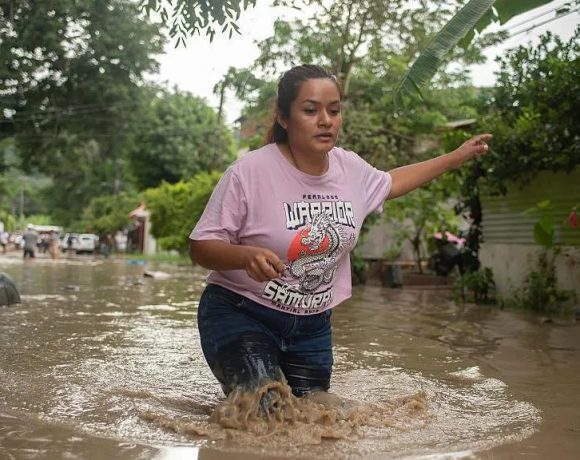
Philippines President Ferdinand Marcos Jr. has declared a national state of calamity after Typhoon Kalmaegi caused severe flooding and killed at least 114 people.

The storm, one of the year’s strongest, flooded entire towns on the populous island of Cebu, which reported 71 fatalities.

Officials confirmed an additional 127 people are missing and 82 are injured.

President Marcos Jr. stated the declaration was due to the extensive damage and in anticipation of another incoming storm.

The decree grants government agencies expanded powers to access emergency funds and accelerate relief efforts.

The national disaster agency reported that over 400,000 people were displaced.

Local officials and rescuers described the flooding as “unprecedented” and “overwhelming,” noting that most deaths were due to drowning.

BBC/Maxwell Oyekunle

Subscribe to our Telegram and YouTube Channels, and also join our WhatsApp Update Group.

Foreign

34-year-old Ugandan-born Indian, Mr Zohran Mamdani, has been elected New York City’s first Muslim and socialist mayor.

Born in Kampala in 1991, he moved to New York at age seven and once interned at Uganda’s Daily Monitor, where mentor Angelo Izama remembers him as “shy but boundlessly curious.”

Mr Mamdani’s campaign focused on New York’s soaring cost of living, promising rent freezes, free buses, and universal childcare funded by new taxes on the wealthy.

His populist message and charisma helped him overcome religious bias and secure 50.4% of the vote — the city’s highest turnout since 1969.

In his victory speech, he quoted India’s first Prime Minister Jawaharlal Nehru — “a moment comes but rarely in history when we step out from the old to the new” — signaling a new chapter in New York politics.

Supporters liken his grassroots movement to Barack Obama’s 2008 campaign, while critics warn his progressive agenda could test the city’s limits.

Either way, Mr Mamdani’s victory has already reshaped America’s political conversation.

BBC/Maxwell Oyekunle

Foreign

The death toll from a week of flooding and record rains in central Vietnam rose to 40 on Tuesday, authorities said, as another powerful storm bore down on the battered region.

Vietnam’s central belt has been deluged by torrential rains, turning streets into canals, bursting riverbanks and inundating some of the country’s most-visited historic sites.

Up to 1.7 metres (5 feet 6 inches) fell over one 24-hour period in a downpour, breaking national records.

The fatalities occurred in Hue, Da Nang, Lam Dong, and Quang Tri provinces, according to the environment ministry’s disaster management agency, which said six people remained missing.

The onslaught of extreme weather is set to continue, with Typhoon Kalmaegi forecast to make landfall in the early hours of Friday morning, according to the national weather bureau.

Vietnam is prone to heavy rains between June and September, but scientific evidence has identified a pattern of human-driven climate change making extreme weather more frequent and destructive.

Ten typhoons or tropical storms usually affect Vietnam, directly or offshore, in a given year, but Typhoon Kalmaegi is set to be the 13th of 2025.

The storm is currently lashing the Philippines, where it has killed at least two people and displaced hundreds of thousands.

It could hit Vietnam’s coast with winds of up to 166 kilometres per hour (100 miles per hour) as it approaches on Thursday, the national weather bureau said.

On Tuesday, the region was reeling from the past week’s extreme weather — with some remote areas still isolated by road-blocking landslides.

Nearly 80,000 houses remain flooded, according to the disaster agency, while more than 10,000 hectares (25,000 acres) of crops have been destroyed and more than 68,000 cattle killed.

AFP/Adebukola Aluko

Foreign

Expedition agency Seven Summit Treks has said at least seven climbers, including five foreigners and two Nepalis, have died after being hit by an avalanche on a Himalayan peak in north-eastern Nepal.

The incident happened at 09:00 local time (03:15 GMT) on Monday near the base camp of the Yalung Ri mountain in Dolakha district.

Rescuers located two bodies, and are still searching for the remaining five, who are believed to have been buried by snow. Eight others have been rescued and are in the capital Kathmandu getting treatment for their injuries.

All these climbers were part of a group that set out over an hour before the avalanche hit, the district police chief told BBC Nepali.

The bodies of the other five deceased climbers “may be 10-15 feet below the snow”, said Mingma Sherpa, Chairman of Seven Summit Treks. “It will take time to find them.”

Those killed include two Italians, a Canadian, a German, a French, and two Nepalis who served as guides.

Local deputy superintendent of Police Gyan Kumar Mahato told the BBC on Monday that a rescue helicopter had landed in the Na Gaun area of Dolakha – a five-hour walk from the Yalung Ri base camp.

One of the injured climbers told The Kathmandu Post that they had repeatedly called for help, to no avail. “Had the rescue arrived on time, more lives could have been saved,” he told the Nepali newspaper.

Separately, attempts to rescue two Italian climbers who went missing while attempting to scale the Panbari mountain in western Nepal are continuing.

Stefano Farronato and Alessandro Caputo were part of a three-man group that became stranded along with three local guides last week. The third member of the group, named in media reports as Velter Perlino, 65, has since been rescued.

Autumn is a popular season for trekkers and mountaineers in Nepal as weather conditions and visibility have tended to be better. However, the risk of severe weather and avalanches remains.

Last week, Cyclone Montha triggered heavy rain and snowfall across Nepal, stranding people in the Himalayas.

Two British and one Irish woman were among a group that had to be rescued after being trapped for several days in the western Mustang region.

Severe weather also left hundreds of hikers stranded near Mount Everest in October.

BBC/Adebukola Aluko

Foreign

China will begin easing an export ban on automotive computer chips vital to production of cars across the world as part of a trade deal struck between the US and China, the White House has said.

The White House confirmed details of the deal in a new fact sheet after Xi Jinping and Donald Trump met in South Korea this week.

The nations also reached agreements on US soybean exports, the supply of rare earth minerals, and the materials used in production of the drug fentanyl.

The deal de-escalates a trade war between the world’s two largest economies after Trump hit China with tariffs after he entered office this year, leading to rounds of retaliatory tariffs and global business uncertainty.

A spokesman for the Chinese Embassy in Washington told the BBC that details of the agreements reached had been shared by “competent authorities”.

“China-US economic and trade relations are mutually beneficial in nature,” he said.

“As President Xi Jinping noted, the business relationship should continue to serve as the anchor and driving force for China-US relations, not a stumbling block or a point of friction.”

Speaking on Sunday following the release of the deal details, Treasury Secretary Scott Bessent told CNN: “We don’t want to decouple from China… (But) they’ve shown themselves to be an unreliable partner.”

Much of what is in Saturday’s fact sheet was announced by Trump and other officials following the meeting between the two leaders.

Trump had described the talks, held in South Korea, as “amazing”, while Beijing had said they had reached a consensus to resolve “major trade issues”.

One of the issues addressed in the deal was the export of automotive computer chips. There had been concern that a lack of chips from Nexperia, which has production facilities in China, could create global supply chain issues.

Nexperia is a Chinese-owned company, but is based in the Netherlands. About 70% of Nexperia chips made in Europe are sent to China to be completed and re-exported to other countries.

The fact sheet states that China will “take appropriate measures to ensure the resumption of trade from Nexperia’s facilities in China, allowing production of critical legacy chips to flow to the rest of the world”.

It follows Beijing saying on Saturday that it was considering exempting some firms from the ban.

Firms are still scrambling to find out what it means for them, said Sigrid De Vries, director general of the European Automobile Manufacturers’ Association.

“The Chinese authorities have said they would start exporting eligible chips again, that they’re investigating and making lists of companies …but the scope and the conditions are as yet unclear,” she told the BBC’s Today programme.

She added that China easing the automotive chip ban was positive news because “supply shortages were imminent”.

But she warns “they are still looming” because of the interruption so far, adding that it’s hard to tell if vehicle prices will be affected.

Last month, the likes of Volvo Cars and Volkswagen warned a chip shortage could lead to temporary shutdowns at their plants, and Jaguar Land Rover said the lack of chips posed a threat to their business.

On other key issues, Beijing will now pause export controls it brought in last month on rare earth minerals – vital in the production of cars, planes and weapons – for a year.

The White House also said it would lower tariffs brought in to curb the import of fentanyl into the US, with China agreeing to take “significant measures” to deal with the issue.

Fentanyl is a synthetic drug manufactured from a combination of chemicals, and while it is approved for medical use in the US, the powerful and highly-addictive substance has since become the main drug responsible for opioid overdose deaths in the US.

The chemicals used in its manufacturing, some of which have legitimate uses, are mostly sourced from China.

On soybeans, China has committed to buying 12 million tonnes of US soybeans in the last two months of 2025, and 25 million metric tonnes in each of the following three years – which is roughly the level they were previously at.

China’s decision to stop purchasing soybeans from the US earlier this year denied American farmers access to their largest export market.

In response, Trump revived a bailout for farmers which was in place during his first term in office.

BBC / Titilayo Kupoliyi

Subscribe to our Telegram and YouTube Channels, and also join our WhatsApp Update Group.

Foreign

The sole survivor of the Air India plane crash that killed 241 people has said he feels like the “luckiest man alive” but continues to struggle with physical and mental trauma.

Mr Viswashkumar Ramesh, 39, walked away from the wreckage of the London-bound flight that crashed in Ahmedabad, western India, in June.

The Boeing 787 burst into flames shortly after take-off, killing 169 Indian nationals, 52 Britons, and 19 people on the ground.

Mr Ramesh called his survival a “miracle” but said his life has been shattered by the loss of his younger brother, Mr Ajay Ramesh, who was sitting only a few seats away.

“I’m the only survivor. Still, I can’t believe it. It’s a miracle,” “I lost my brother as well. My brother is my backbone. He was always supporting me.” Mr Ramesh.

After returning to his home in Leicester, Mr Ramesh has been diagnosed with post-traumatic stress disorder (PTSD).

“Now I’m alone. I just sit in my room, not talking with my wife or my son. I just like to be alone,” he said.

Air India said its “absolute priority” remains the care and support of Mr Ramesh and the families of those killed in the disaster.

This is the first time Mr Ramesh has spoken publicly since returning to the UK.

BBC/Maxwell Oyekunle

Subscribe to our Telegram and YouTube Channels, and also join our WhatsApp Update Group.

Foreign

Gunmen shot dead the mayor of a Mexican city during a public event on Saturday, authorities said, in an area plagued by violence and organized crime.

Carlos Manzo, the mayor of Uruapan in the western state of Michoacan, was killed in an attack in the city center, the national public security agency said in a statement.

“Two people involved in the incident were arrested, and one of the assailants had lost his life,” it added.

Michoacan state has for years suffered violence from powerful drug cartels operating in the agricultural region seeking to extort farmers.

Manzo was shot during an event marking the Day of the Dead.
Videos shared online showed people fleeing the crowded event after gunshots were heard.

Manzo became mayor in September 2024 and occasionally joined security patrols on the streets wearing a bulletproof vest.

In a video on his social media of one such patrol in June, he urged the federal government to do more to tackle violent crime.

His killing came days after Michoacan farmer representative Bernardo Bravo, who often spoke out against extortion by crime gangs, was also shot dead.
Mexico, plagued by drug-related violence for nearly two decades, has seen numerous local politicians assassinated in recent years.

Last month, armed assailants gunned down the mayor of Pisaflores in central Mexico.

In June, armed men stormed a mayor’s office in southern Mexico, killing her and a staff member. The following day, another mayor was murdered in the country’s west along with her husband.

AFP / Titilayo Kupoliyi

Subscribe to our Telegram and YouTube Channels, and also join our WhatsApp Update Group.

Foreign

UK police have ruled out terrorism in relation to Saturday’s mass stabbing attack on a train in central England, as two people remain in a life-threatening condition in hospital.

Two British-born men were arrested in connection to the attack, that saw 10 people taken to the hospital by ambulance while another person later self-presented that evening. As of Sunday morning, two victims remain in a life-threatening condition, British Transport Police Superintendent John Loveless told reporters.

“At this stage, there is nothing to suggest that this is a terrorist incident,” Loveless said during a press statement. “At this stage, it would not be appropriate to speculate on the cause of this incident,” he said, adding that officers are working to a establish full motivation. Police had earlier said that counter-terrorism officers were supporting the investigation.

One suspect is a 32-year-old, Black British national, while the other is a 35-year-old British national of Caribbean descent, according to Loveless. Both suspects were born in the UK, he added.

The two suspects were arrested within eight minutes of police receiving their first emergency call at approximately 7.42 p.m. local time on Saturday evening.

The incident which British Defense Secretary John Healey has described as an “isolated attack” in a Sky News interview – saw officers respond to an emergency call as the train was traveling from the northern city of Doncaster to London’s King’s Cross.

Armed officers were deployed to Huntingdon station, where the train made an unplanned stop and the two people were arrested.
Eyewitnesses described scenes of chaos with train seats covered in blood as the attack took place. Passenger Wren Chambers told the BBC she initially “heard some screaming and shouting” coming from a carriage or two down.
“A minute or so later a man… was running down with a very clear wound, bleeding quite badly on his arm. And I thought it was like some sort of Halloween prank at first. But then he’s shouting that someone’s got a knife, he was stabbed,” she said.

UK police have ruled out terrorism in relation to Saturday’s mass stabbing attack on a train in central England, as two people remain in a life-threatening condition in hospital.

Two British-born men were arrested in connection to the attack, that saw 10 people taken to the hospital by ambulance while another person later self-presented that evening. As of Sunday morning, two victims remain in a life-threatening condition, British Transport Police Superintendent John Loveless told reporters.

“At this stage, there is nothing to suggest that this is a terrorist incident,” Loveless said during a press statement. “At this stage, it would not be appropriate to speculate on the cause of this incident,” he said, adding that officers are working to a establish full motivation. Police had earlier said that counter-terrorism officers were supporting the investigation.

One suspect is a 32-year-old, Black British national, while the other is a 35-year-old British national of Caribbean descent, according to Loveless. Both suspects were born in the UK, he added.

The two suspects were arrested within eight minutes of police receiving their first emergency call at approximately 7.42 p.m. local time on Saturday evening.

The incident which British Defense Secretary John Healey has described as an “isolated attack” in a Sky News interview – saw officers respond to an emergency call as the train was traveling from the northern city of Doncaster to London’s King’s Cross.

Armed officers were deployed to Huntingdon station, where the train made an unplanned stop and the two people were arrested.

Eyewitnesses described scenes of chaos with train seats covered in blood as the attack took place. Passenger Wren Chambers told the BBC she initially “heard some screaming and shouting” coming from a carriage or two down.

“A minute or so later a manwas running down with a very clear wound, bleeding quite badly on his arm. And I thought it was like some sort of Halloween prank at first. But then he’s shouting that someone’s got a knife, he was stabbed,” she said.

After seeing more people running down the train, Chambers grabbed her bag and coat. “I got up and moved forward down the train after them, trying to get far down the train as they can.”

Another witness who was traveling on the train said he saw an “extremely bloodied” victim. The man, who gave his name as Gavin, told Sky News he believed he saw a suspect tasered before he was arrested.

Britain’s King Charles offered his “deepest sympathies” to those affected by the attack, in a statement on Sunday. He said he was “truly appalled and shocked to hear of the dreadful knife attack” in Huntingdon, offering “deepest sympathy and thoughts” with those affected.

Prime Minister Keir Starmer added that his “thoughts are with all those affected” after the “appalling incident.”

The East Coast Main Line is one of the UK’s busiest and most important railway routes. It connects major cities, running from London King’s Cross to Edinburgh Waverly in Scotland.

Nine Persons Sustain ‘life-threatening injuries’ in UK Train Attack

Ten people are in hospital, with nine believed to have life-threatening injuries, after a stabbing attack on a train in Cambridgeshire.

Police said two people had been arrested in connection with the attack on Saturday evening after a “significant” number of officers were called to Huntingdon Station, where the train had made an unscheduled stop.

Authorities have not commented on the identities of those injured or arrested, or any potential motive.

British Transport Police (BTP) have declared a “major incident” and are investigating the stabbing with support from counter-terrorism officers.

At 19:42 on Saturday, British Transport Police (BTP) received reports of multiple stabbings aboard the 18:25 LNER service from Doncaster to King’s Cross.

BTP have confirmed to the BBC that those responding to the mass stabbing at one point declared “Plato”, which is the national code word used by police and emergency services when responding to a “marauding terror attack”.

This declaration was later rescinded, police said.

After boarding the train at Huntingdon, armed officers arrested two people, who have been taken to police custody.

Chief Superintendent Chris Casey called the stabbing attack a “shocking incident”, but said he would not speculate on any details.

“It could take some time before we are in a position to confirm anything further,” the chief superintendent said, before thanking the public for their “patience and co-operation”.

LNER has warned that rail disruption will continue throughout Sunday, and said passengers would be able to defer any train travel until 4 November free of charge.

Wren Chambers told the BBC that that they first became aware that something was amiss when a man bolted down the carriage with a bloody arm, saying “they’ve got a knife, run”.

Wren and their friend ran to the front of the train and saw a man who had collapsed on the floor. Wren said they felt “stressed and pretty scared” once they knew what was happening.

Another eyewitness, Olly Foster, described “pure panic” aboard the train, and said that when he initially heard people shouting “run, run, there’s a guy literally stabbing everyone”, he believed it might have been a Halloween prank.

He estimated the attack lasted for about 10 to 15 minutes, but said it had felt like “felt like forever”.

Passengers told Sky News that the stabbing started 10 minutes after the train left Peterborough, and that wounded people were seen running through the train away from somebody with a knife.

A man holding a large knife was later seen on the train platform with armed police pointing their weapons at him, one witness added – saying the man was then tasered and restrained.

BBC / Titilayo Kupoliyi

Subscribe to our Telegram and YouTube Channels, and also join our WhatsApp Update Group.

Foreign

French authorities have charged a 38-year-old woman in connection with a multi-million-euro theft at the Louvre Museum in Paris last month.

According to French media reports, the woman, who has not been publicly named, faces charges of complicity in organized theft and criminal conspiracy with a view to committing a crime.

A magistrate will determine whether she will be detained pending further investigation.

Police arrested the woman earlier this week alongside four other suspects.

Two male suspects arrested previously were already charged with theft and criminal conspiracy after officials said they had “partially recognized” their involvement in the heist.

The theft occurred on October 19, when jewels valued at approximately 88 million Euros were stolen from the world’s most-visited museum.

BBC/Maxwell Oyekunle

Foreign

At least 19 people have died in Jamaica as a result of Hurricane Melissa, Information Minister Dana Morris Dixon has said, as search and rescue efforts continue and authorities try to get aid to hard-hit areas.

The hurricane, one of the most powerful to strike the Caribbean, has also killed at least 30 people in Haiti, officials said.

In Jamaica, “there are entire communities that seem to be marooned and areas that seem to be flattened”, Dixon said, adding there are “devastating” scenes in western regions.

Electricity remains out to most of the island and as people try to salvage damaged homes and belongings from flood water and mud, many thousands are growing increasingly desperate for aid.

There are parts of the country that have been without water for several days and food is growing increasingly scarce.

Aid supplies are starting to arrive more rapidly with the main airport in the Jamaican capital, Kingston, largely back to normal.

But smaller regional airports, some of which are located near to where humanitarian assistance is most needed, remain only partly operational.

As such, aid agencies and the military are bringing in the urgently needed supplies from Kingston via road, many of which remain unpassable in places.

A journey from Mandeville, in the centre of the country, to Black River normally an hour is taking eight hours because the roads are so torn up.

Army vehicles and relief convoys are struggling to get past fallen trees and poles, leaving many who live in western areas very much without the aid they need.

Satellite imagery shows nearly all buildings in some Jamaican villages have been destroyed by the hurricane.

Residents of towns in western Jamaica told the BBC on Thursday that “words can’t explain how devastating” the storm has been for the country.

“No-one is able to get through to their loved ones,” Trevor ‘Zyanigh’ Whyte told the BBC from the town of White House in Westmoreland parish.

“Everyone is just, you know, completely disconnected… Every tree is on the road, right, so you can’t get too far with the cars, not even a bicycle,” he said.

On the drive from Kingston to Falmouth towards Montego Bay, the scene worsens. Walking around, there are buildings with half a roof and people drying their mattresses by the sides of the road.

People are struggling to get their lives back together and trying to clear the streets, as the power company is trying to get poles moved.

Jamaica, a very green and mountainous country, has been stripped – leaving what looks like twigs and matchsticks.

In Haiti, many of the victims in the storm died when a river overflowed in Petit-Goave. A full assessment is ongoing, as there are still areas that authorities have not been able to access.

Around 15,000 people were staying in more than 120 shelters in Haiti, interim UN co-ordinator for the country Gregoire Goodstein said.

In Cuba, more than 3 million people were “exposed to life-threatening conditions” during the hurricane, with 735,000 people “safely evacuated”, according to the UN’s resident co-ordinator for Cuba Francisco Pichon.

No fatalities have been reported so far in Cuba, but almost 240 communities have been cut off due to flooding and landslides, Cuban authorities said.

Hurricane Melissa made landfall on Tuesday in Jamaica as a category five storm, packing winds of up to 185 mph (295 km/h), before impacting other countries in the Caribbean.

Governments, humanitarian organisations and individuals around the world are pledging support for the nations hardest hit by the storm.

The World Food Programme said it is collaborating with partners to coordinate logistics, cash and emergency supplies across Jamaica, Cuba, Haiti and the Dominican Republic.

The US State Department said it is deploying a disaster response team to the region to help with search and rescue operations, and assisting in efforts to provide food, water, medical supplies, hygiene kits and temporary shelters.

The UK government on Friday said it is mobilising an additional £5m ($6m) to send humanitarian supplies, including shelter kits and solar powered lanterns, to help people without power and whose homes have been damaged.

That is on top of £2.5m ($3.36m) already announced in emergency humanitarian funding to support recovery in the Caribbean.

The Foreign Office is also preparing flights to evacuate British nationals unable to come home on commercial flights.

While Jamaica, Cuba and Haiti assessed the damage left in Melissa’s wake, Bermuda braced for impact.

The Bermuda Weather Service expected Melissa to be a category two hurricane when it passed the British overseas territory on Thursday night.

Government offices in Bermuda will close until Friday afternoon and all schools will shut on Friday.

“Until the official ‘All Clear’ is issued, residents are urged to stay off the roads so Government work crews can safely assess and clear debris,” a public alert from the government said.

BBC / Titilayo Kupoliyi

Subscribe to our Telegram and YouTube Channels, and also join our WhatsApp Update Group.

Foreign

The Japanese government plans to recruit hunters to cull bears, as anxiety grows in the country over a sharp rise in bear attacks.

The environment ministry said on Thursday that it would set aside funds to hire licenced hunters and other personnel to tackle bears that have been wandering into residential areas and attacking people.

The move is among measures proposed on Thursday, after the country held a high-level meeting to address the country’s growing bear problem.

Twelve people have died in bear attacks this year, the highest the country has recorded since it started tracking cases in the 2000s.

They include a man who had been delivering newspapers in Hokkaido and a 67-year-old man found dead in his garden in Iwate.

The government, which have described bears as a serious threat to public safety, is also considering allowing police officers to shoot bears with their rifles. Officials have until mid-November to finalise the slate of counter-measures to the rising bear attacks.

Bears have been spotted breaking into supermarkets and high schools, and attacking residents going about their daily lives.

There are two types of bears in Japan: the Japanese black bear and the larger, typically more aggressive, brown bear found on the island of Hokkaido.

More than 100 people have been injured by bears this year, including at least one foreigner who was attacked near a bus-stop at a popular tourist site.

The problem is especially pronounced in Akita prefecture, home to large mountain ranges in northern Japan, which have the highest number of casualties.

Authorities announced this week that Japan’s self-defence forces would be deployed help the Akita government capture and repel bears.

“The lives and livelihoods of people are under threat,” defence minister Shinjiro Koizumi said on Tuesday, Kyodo reported.

Under current laws the troops are prohibited from shooting bears but they can help bear hunters with trapping and transporting dead bears.

Akita governor Kenta Suzuki said that the people tackling the bear problem on the ground have become “exhausted”.

Japan’s hunters are ageing, and their numbers are declining in line with the dwindling popularity of hunting the mammal, once sought-after for their fur and bile.

This has left populations more vulnerable to attacks as bears increasingly wander into human habitats. Experts say the scarcity of beech nuts because of climate change could be driving hungry animals into people’s residences.

Declining populations in residential areas have also been cited as a factor.

In September, Japan relaxed its gun rules to make it easier for people to shoot bears in residential areas.

BBC / Titilayo Kupoliyi

Subscribe to our Telegram and YouTube Channels, and also join our WhatsApp Update Group.

Foreign

Hurricane Melissa has continued its devastating sweep across the Caribbean, destroying homes and infrastructure, flooding neighbourhoods and leaving dozens dead.

The impact in Jamaica was clearer on Wednesday, after the island nation was hit squarely by the category five storm – one of the most powerful hurricanes ever measured in the region. At least five people have been confirmed dead there.

At least another 20 died during flooding in Haiti as Melissa, now a category two storm, tore through the region.

In Jamaica, people remain stranded on roofs and without power. Prime Minister Andrew Holness noted the “total devastation” across the island-nation.

He added that “80-90% of roofs were destroyed”, along with hospitals, libraries, police stations, port houses and other urban infrastructure.

King Charles, who is the head of state in Jamaica, said in a statement that he was “deeply concerned” and “profoundly saddened” at the damage caused by Melissa in Jamaica and across the Caribbean.

“This most dreadful of record-breaking storms reminds us of the increasingly urgent need to restore the balance and harmony of Nature for the sake of all those whose lives and livelihoods may have been shattered by this heartbreaking disaster,” he said.

From Jamaica, where the storm also caused mudslides, and palm trees to be tossed like toothpicks, Melissa moved north to Cuba as a category three storm, bringing 115 mph winds and heavy rain, and battering the south-east of the island.

Cuban President Miguel Díaz-Canel asked residents to “not let their guard down” and said that the country had prepared for a worst-case scenario, which helped its response.On Wednesday night, the storm was 105 miles (170km) from the central Bahamas and expected to reach the Bahamas region overnight. Hurricane Melissa was moving north-east with wind speeds at 100 mph (155 km/h). A dangerous storm surge is expected there before it moves further north toward Bermuda.A tropical storm warning is in place for the Turks and Caicos Islands and the speed of the slow-moving hurricane is expected to increase in the coming days.

In Jamaica, three men and a woman were confirmed dead. They were discovered after being washed up by the flood waters in the storm, said Desmond McKenzie, Jamaica’s minister of Local Government and Community Development.

About three-quarters of the country lost electricity overnight.

Richard Vernon, mayor of Montego Bay, told the BBC that half of the city had been cut off from the other by floods. He said the priority was to “check if everybody is alive”.

In Haiti, at least 20 people – including 10 children – died in river floods, local authorities told AFP news agency.

The island, which the country shares with the Dominican Republic, was struck by catastrophic flash flooding and landslides, which forced 3,000 people into shelters.

“Many homes have been washed away on the coast,” said Pascal Bimenyimana from the Christian NGO, World Relief, in Port-au-Prince. Structures also lost their roofing and people were clearing the debris with their bare hands, he said.

Torrential winds, violent rain and flooding destroyed crops across the country’s south.

The US is sending a disaster response team to Jamaica to assess the scale of need in the hurricane’s aftermath. Formal requests for help came from Haiti and The Bahamas, according to senior State Department officials.

BBC/Adebukola Aluko

Foreign

At least four people have been killed during protests in Cameroon’s economic capital of Douala, authorities say, ahead of the official announcement of results in a highly-contested presidential election.

The Regional governor, Samuel Dieudonné Diboua, said police posts had come under attack and security forces had defended themselves.

Hundreds of supporters of opposition presidential candidate, Issa Tchiroma Bakary, defied a ban to hold protests in several cities, clashing with security forces.

Tchiroma Bakary has insisted he won the presidential election held on 12 October, challenging incumbent President Paul Biya’s 43-year-old hold on power. The ruling CPDM party has dismissed the claims.

Diboua condemned the deadly protests that he described as “premeditated acts of violence” and a serious attack on public order and national security.

“Four people unfortunately lost their lives,” he said, adding that several members of the security forces were also injured.

“Investigations have been opened, so that light can be shed on these unfortunate incidents,” he added, while threatening to take action against the instigators.

In Tchiroma Bakary’s stronghold of Garoua, a city in the north of the country, police fired tear gas and water cannons at his supporters.

The protesters were denouncing what they said was a plan by the ruling party, the Cameroon People’s Democratic Movement (CPDM), to “steal the victory” from the opposition leader.

The demonstrations came after Tchiroma Bakary called on his supporters in the country and the diaspora to march peacefully to “liberate Cameroon”.

Authorities have banned gatherings until Monday, when Cameroon’s constitutional council is set to announce the results.

In Garoua, the demonstrations began peacefully but quickly turned rowdy when security forces threw teargas on the streets to disperse the hundreds of people that had gathered in support of Tchiroma Bakary.

“We are not here for disorder. We’re demanding the truth of the ballot,” a placard read.

One protester was seen carrying a banner urging US President Donald Trump to help them.

“We are here to claim our victory. We are making a peaceful march, which is a civil right for all Cameroonians – for everyone,” another protester said.

Supporters also took to the streets in the south-western city of Douala. “We want Tchiroma, we want Tchiroma,” protesters chanted, Reuters news agency reports.

BBC/Adebukola Aluko

Foreign

Hurricane Melissa is forecast to become a rare category five storm as it turns towards Jamaica, bringing life-threatening flash flooding and landslides.

The cyclone, which had winds of up to 120 mph (195 km/h) as of 06:00 GMT, is currently turning north-west in the Caribbean and is expected to make landfall by Tuesday, according to the US National Hurricane Center (NHC).

It warns of power cuts and damage to infrastructure as Melissa brings up to 30 inches (76cm) of rain and sea level surges as high as 13ft (4m) above ground. “Seek shelter now,” residents have been told.

Melissa is the 13th hurricane in this year’s Atlantic season, which typically ends in November. A category five hurricane is the strongest type, with winds of at least 157mph.

While Melissa is set to weaken to a category four before reaching Jamaica, the NHC said there was “very little practical difference in the overall impacts” upon landfall, and that the hurricane will be “at least that intensity” when it hits the island.

“A multi-day period of damaging winds and heavy rainfall have begun and will cause catastrophic and life-threatening flash flooding and numerous landslides,” the meteorological agency urged residents.

Jamaican Prime Minister Andrew Holness said: “I know that there are many Jamaicans who are anxious, who are very concerned, and rightfully so: you should be concerned.”But the best way to address anxiety and any nervousness and concern is to be prepared.”

Residents are being told to secure their homes with sandbags and wooden boards, and to stock up on essentials.

Landslides already being caused by the hurricane have already killed two in Haiti, the nation’s Civil Protection agency has said.

Melissa is forecast to pass over Cuba by Wednesday before moving through the Antillas Mayores and out into the Atlantic.

By the time it reaches Cuba, it is predicted to have weakened to a category three storm.

While it is hard to link individual weather events to climate change, scientists say it is making weather phenomena more common and more severe.

Ahead of the start of this year’s Atlantic hurricane season, the US National Oceanic and Atmospheric Administration predicted above-normal activity, citing warmer seas and potential stronger monsoon activity around West Africa – where Atlantic storms often form.

BBC/Adebukola Aluko

Foreign

The Sudanese paramilitary Rapid Support Forces (RSF) says it has captured the army headquarters in the besieged city of El-Fasher, marking a turning point in the nation’s civil war.

The group said in a statement on social media that it had destroyed “huge military vehicles” and seized military equipment at the army’s 6th Division Headquarters.

BBC Verify has confirmed the authenticity of videos circulating on social media that show RSF fighters inside the army base.

The loss of the headquarters is a huge blow to government forces as El-Fasher is its last remaining foothold in the Darfur region, leaving the RSF effectively in control of the area. The army has yet to comment.

The RSF has surrounded el-Fasher for the last 18 months, with army positions and civilians under frequent bombardment. An estimated 300,000 people have been trapped by the fighting.

In August, satellite imagery showed a series of extensive earthen walls being constructed around the city, aimed at trapping people inside.

The RSF have been steadily advancing towards the 6th Infantry Division command – widely regarded as the army headquarters in the city – from several directions for weeks.

There are still some parts of el-Fasher under the control of the army and allied armed groups but those are not expected to hold out for long now.

Hunger and disease has spread across the city as residents contend with constant bombardment and dwindling food and medical supplies.

UN investigators have accused the RSF of committing numerous crimes against humanity during the siege. The US has said the RSF has committed genocide against Darfur’s non-Arab population.

Sudan has been ravished by conflict since 2023, after top commanders of the RSF and Sudanese army fell out and a vicious power struggle ensued.

More than 150,000 people have died across the country and about 12 million have fled their homes, creating one of the worst humanitarian crises.

The army controls most of the north and the east, with el-Fasher being until now the last major urban centre in Darfur still held by government forces and its allies.

The RSF controls almost all of Darfur and much of the neighbouring Kordofan region, When the RSF assumes complete control of el-Fasher, it hopes to form a rival government there.

BBC/Adebukola Aluko

Foreign

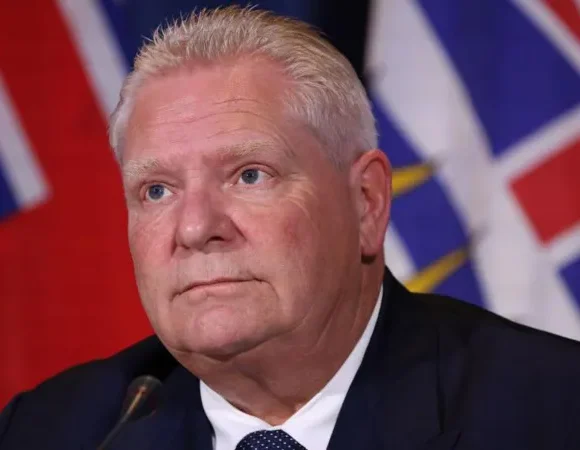
Ontario Premier, Doug Ford says he will pause his province’s anti-tariff advertisement campaign in the US, after it prompted President Donald Trump to terminate trade talks.

Ford, one of Canada’s most vocal critics of US levies on Canadian goods said he made the decision after speaking to Prime Minister Mark Carney on Friday, adding that the TV spot will be paused on Monday “so that trade talks can resume”.

It will still run over the weekend on US networks, he said, including during the Major League Baseball World Series games.

Carney told reporters earlier on Friday that Canada was prepared to resume trade talks with the US “when the Americans are ready”.

Trump criticised the advert late on Thursday night in a Truth Social post, calling it “FAKE” and “egregious”. He said trade talks were “HEREBY TERMINATED”.

The advert, which was sponsored by the Ontario government, quotes former US President, Ronald Reagan, a Republican and icon of US conservatism, saying tariffs “hurt every American”.

The video takes excerpts from a 1987 national radio address that focused on foreign trade.

Trump’s termination of trade talks came after the Ronald Reagan Foundation, which is charged with preserving Reagan’s legacy, released a statement saying the advert had used “selective” audio and video of the former president’s remarks.

It accused the advert of misrepresenting Reagan’s address, and said the Ontario government had not sought permission to use it.

On Friday, Ford said the intention of the advert was “to initiate a conversation about the kind of economy that Americans want to build” and the impact of tariffs.

“We’ve achieved our goal, having reached US audiences at the highest levels,” he said.

Trump’s reaction to the advert has ignited debate in Canada over whether Ford’s combative approach to US trade talks was the right one, or whether the country would be better served by striking a friendlier chord with its neighbour and closest trade ally.

Subscribe to our Telegram and YouTube Channels, and also join our WhatsApp Update Group.

Foreign

President Volodymyr Zelensky says intense Russian drone and missile strikes on cities in Ukraine have left at least six people dead, including two children.

Another 21 people were wounded, in another night of attacks that he said proved Moscow had not come under enough pressure for its continued war.

Hours earlier, US President Donald Trump said his plans for an imminent summit in Budapest with Russia’s Vladimir Putin had been shelved as he did not want a “wasted meeting”.

The Kremlin has rejected calls for a ceasefire along the current front lines made both Trump and European leaders.

Meanwhile, Ukraine’s military said it had attacked a Russian chemical plant in the Bryansk border region late on Tuesday with UK-supplied Storm Shadow missiles.

Calling the strike “a successful hit” that penetrated the Russian air defence system, military officials said the Bryansk plant “produces gunpowder, explosives and rocket fuel components used in ammunition and missiles employed by the enemy to shell the territory of Ukraine”.

Zelensky, who was due to visit Swedish defence contractor Saab on Wednesday, returned from talks with Trump last Friday, having failed to persuade the US president to provide long-range Tomahawk missiles.

“As soon as the issue of long-range missiles became a little further away for us, for Ukraine, then almost automatically Russia became less interested in diplomacy,” Zelensky said.

The Ukrainian capital came under a wave of attacks overnight, the first such strikes since 28 September.

A couple in their 60s were killed when a drone hit their high-rise building in the city, and four people were killed in the wider Kyiv region. Among the victims were a woman, a six-month-old baby and a girl aged 12.

The capital was under a ballistic missile warning for most of the night, and echoed to the sound of explosions. By morning, rescue teams fought fires in residential buildings.

Across Ukraine, Russian attacks once again targeted energy infrastructure and emergency power outages were imposed in several areas.

BBC/Ttilayo Kupoliyi

Subscribe to our Telegram and YouTube Channels, and also join our WhatsApp Update Group.

Foreign

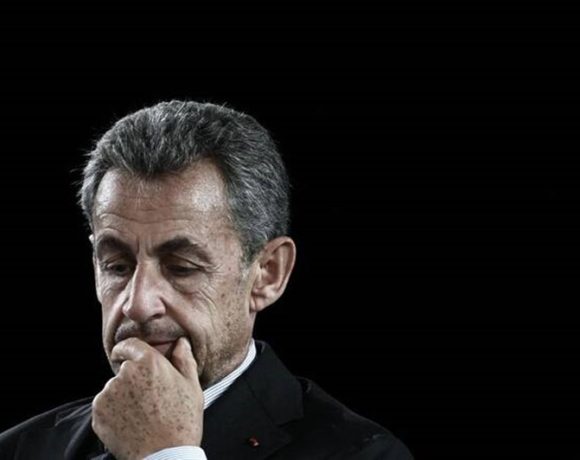
Nicolas Sarkozy has become the first French ex-president to go to jail, as he starts a five-year sentence for conspiring to fund his election campaign with money from late Libyan dictator Muammar Gaddafi.

Not since World War Two Nazi collaborationist leader Philippe Pétain was jailed for treason in 1945 has any French ex-leader gone behind bars.

Sarkozy, who was president from 2007-2012, has appealed against his jail term at La Santé prison, where he will occupy a cell roughly measuring 9 sq m (95 sq ft) in the jail’s isolation wing.

More than 100 people applauded Sarkozy as he left his villa in the exclusive 16th district of Paris, holding his wife Carla Bruni-Sarkozy by the hand.

His son Louis, 28, had appealed to supporters for a show of support, while another son, Pierre, called for a message of love – “nothing else, please“.

Nicolas Sarkozy, 70, was driven through the entrance of the notorious 19th-Century prison in the Montparnasse district south of the River Seine at 09:40 (07:40 GMT), while dozens of police officers cordoned off most of the surrounding streets.

He continues to protest his innocence in the highly controversial Libyan money affair and posted a message on X as he was driven to the jail, saying “I have no doubt. Truth will prevail. But how crushing the price will have been”.

“With unwavering strength I tell [the French people] it is not a former president they are locking up this morning – it is an innocent man,” he wrote. “Do not feel sorry for me because my wife and my children are by my side… but this morning I feel deep sorrow for a France humiliated by a will for revenge.”

Sarkozy has said he wants no special treatment at La Santé prison, although he has been put in the isolation section for his own safety as other inmates are infamous drugs dealers or have been convicted for terror offences.

Inside his cell on the prison’s isolation wing, he will have a toilet, shower, desk and small TV. He will be allowed one hour a day for exercise, by himself.

At the end of last week he was received at the Élysée Palace by President Emmanuel Macron, who told reporters on Monday “it was normal that on a human level I should receive one of my predecessors in that context”.

In a further measure of official support for the ex-president, Justice Minister Gérald Darmanin said he would go to visit him in prison as part of his role in ensuring Sarkozy’s safety and the proper functioning of the jail.

“I cannot be insensitive to a man’s distress,” he added.

Ahead of his arrival at La Santé prison, Sarkozy gave a series of media interviews, telling La Tribune: “I’m not afraid of prison. I’ll keep my head held high, including at the prison gates.”

Sarkozy has always denied doing anything wrong in a case involving allegations that his 2007 presidential campaign was funded by millions of euros in Libyan cash.

The former centre-right leader was cleared of personally receiving the money but convicted of criminal association with two close aides, Brice Hortefeux and Claude Guéant, for their role in secret campaign financing from the Libyans.

The two men both had talks with Gadaffi’s intelligence chief and brother-in-law in 2005, in a meeting arranged by a Franco-Lebanese intermediary called Ziad Tiakeddine, who died in Lebanon shortly before Sarkozy’s conviction.

As he lodged an appeal, Sarkozy is still considered innocent but he has been told he must go to jail in view of the “exceptional seriousness of the facts”.

Sarkozy said he would take two books with him into prison, a life of Jesus by Jean-Christian Petitfils and the Count of Monte Cristo, Alexandre Dumas’s classic story of a man wrongly imprisoned who escapes to wreak vengeance on his prosecutors.

BBC/Adetutu Adetule

Subscribe to our Telegram and YouTube Channels, and also join our WhatsApp Update Group.

Foreign

A mother who murdered her five-year-old son while suffering a mental health crisis has been jailed for a minimum of nine years.

Claire Button, 35, attempted to take her own life after she killed her son, Lincoln, at the family home in South Ockendon, Essex, on 15 December.

She had been suffering from a mental disorder due to the “relentless demands” of the youngster, who was autistic and non-verbal, Basildon Crown Court heard.

Imposing the life sentence, Judge Samantha Leigh said Lincoln’s death was avoidable and there had been “missed opportunities” for intervention.

The judge described the case as “one of the hardest I have heard in the last 30 years”, branding it “truly heartbreaking”.

Jurors heard Button called the emergency services for help prior to the murder, but was told there was a 10-hour wait for help.

“She became so desperate, the lack of help and no 999 response was the final straw,” Judge Leigh said.

“We all know resources are scarce, but that isn’t good enough.”

The court heard Button’s mental state “spiralled” due to the “relentless demands” of her son.

She claimed to have started hearing voices in her head after a series of “meltdowns” Lincoln had in public.”I accept she was desperate and couldn’t see a way out of what was going on,” Judge Leigh added.

However, she said Lincoln was especially vulnerable and there had been a clear abuse of trust.

Prosecutors also made the case that Button’s level of mental illness did not substantially impair her judgement and rationality.

Lincoln’s body was discovered by his father, Nicky, when he arrived at the family home in Windstar Drive after work.

He had been fatally smothered by Button, who claimed to have been hearing a “dark, deep, scary, demanding” voice instructing her to kill him. “If it hadn’t been for her husband returning home when he did, she would have died as well,” Judge Leigh continued.

Button admitted killing Lincoln by manslaughter, but wept in the dock as jurors found her guilty of murder on Thursday.

Mark Cotter, mitigating, said a lack of help for Button created a “terrifying crisis for her”. “She undertook a huge amount for [Lincoln] and tried to make the best of a situation so challenging it was beyond the understanding and comprehension for most of us,” he added.

During the trial, Lincoln was described by his dad and grandmother as having a love of trains and being attached to his mother.

Jamie Warren, a member of the family, told the BBC earlier this year he was an “all-round happy kid, who loved his toys”.

BBC/Adebukola Aluko

Subscribe to our Telegram and YouTube Channels, and also join our WhatsApp Update Group.

Foreign

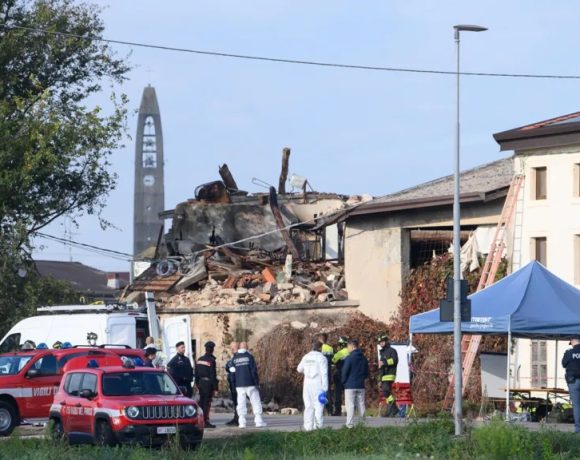
Three police officers have been killed and at least 15 other people injured in an apparently deliberate gas explosion at a farmhouse in northern Italy.

The blast was triggered as police and firefighters went into the house near Verona to carry out an eviction order for two brothers and a sister in their late 50s and mid-60s.

The three victims who died were members of the Carabinieri military police.

A man and a woman were arrested at the scene and another man who fled after the explosion was located soon after. All three have been taken to hospital.

The blast could be heard some 5km (3 miles) away and images from the scene showed the building reduced to a pile of rubble.

The head of the Veneto region, Luca Zaia, said the farmhouse was subject to an eviction order due to debts accrued by the three owners.

Interior Minister Matteo Piantedosi said “This is a time for grieving,” , who added that attempts had been made to evict the three siblings in the past.

“It was clear we were dealing with people who would resist in some way,” he said.

Mediators had been sent to speak to the siblings who had barricaded themselves into the house. When the Carabinieri arrived shortly after 03:00 (01:00 GMT), officials believe one of the siblings triggered the blast.

“Upon entering the house, we were confronted with an act of absolute madness,” provincial police commander Claudio Papagno told the Ansa news agency.

“A gas cylinder had been ignited, and the explosion directly hit our officers,” he said.

Petrol bombs were also found at the property, the interior minister said.

Those injured by the blast included 11 other members of the Carabinieri and well as three members of Italy’s state police and a firefighter, Ansa reported.

“We all knew the situation was dire,” neighbours told Italian media, adding that the three had previously threatened to “blow themselves up” rather than leave the house.

Piantedosi said the explosion had left a “terrible, very painful and dramatic toll”.

Defence Minister Guido Crosetto joined other political leaders in paying tribute to the three men who had lost their lives in the service of their country.

BBC/Adebukola Aluko

Foreign

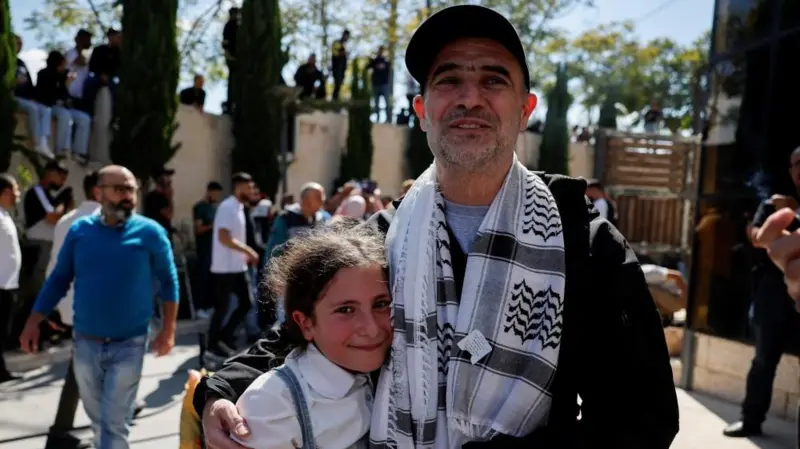
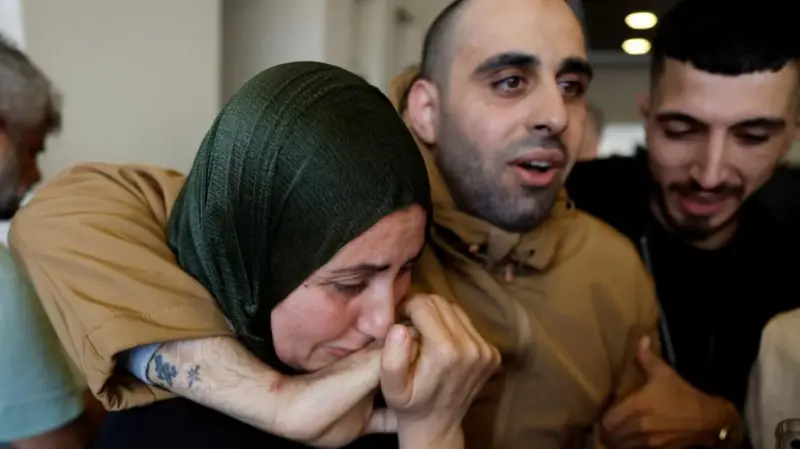
Israeli military has confirmed that the last twenty living hostages held by Hamas in Gaza are now back in Israel after more than two years’ captivity.

The hostages were kidnapped by Hamas during the 7 October attacks in 2023.

They include twin brothers, Ziv and Gali Berman and Omri Miran, who was pictured reuniting with his wife Lishay.

The remains of up to 28 deceased hostages are yet to be handed over.

In exchange for the hostages, Israeli is reported to be releasing two hundred and fifty Palestinian prisoners and more than one thousand, seven hundred detainees.

The first groups have begun arriving in Ramallah in the occupied West Bank and Gaza.

Trump had earlier declared the “war is over” in Gaza but was reported to have avoided the bigger questions about the next stages of his peace.

BBC/Olaitan Oye-Adeitan

Foreign

At least 27 people have died and others are missing, according to authorities, after floods in Mexico triggered landslides and swept away homes, vehicles and bridges.

Heavy rainfall on Thursday and Friday caused rivers to burst their banks. Hidalgo in East Mexico was one of the worst affected areas, with 16 deaths reported.

Thousands of houses have been damaged or destroyed as fast-running water careered down streets, carrying cars, while highways were blocked with debris and electricity cut off.

Mexico’s President, Claudia Sheinbaum said the government has deployed 5,400 personnel to help communities, clear roads and hand out aid.

She wrote on social media: “We are working to support the population, open roads and restore electrical service.”

In addition, 3,300 naval troops are helping with evacuations as well as clearing up the aftereffects of the floods.

In Puebla, state governor Alejandro Armenta said at least nine people had died while five others had been reported missing. An estimated 80,000 people have been impacted by the weather in Puebla alone, the state’s government said.

An additional two people died in Veracruz. “No one was prepared for this,” Jose Cervantes, owner of a coffee shop in one of the affected areas, told Reuters news agency.

“The flood reached a height of one and a half meters. Everything was flooded, the dining room and the entire restaurant, the kitchen, the bathroom, the games room, the private area. Everything is in terrible condition.”

BBC/Adebukola Aluko

Foreign

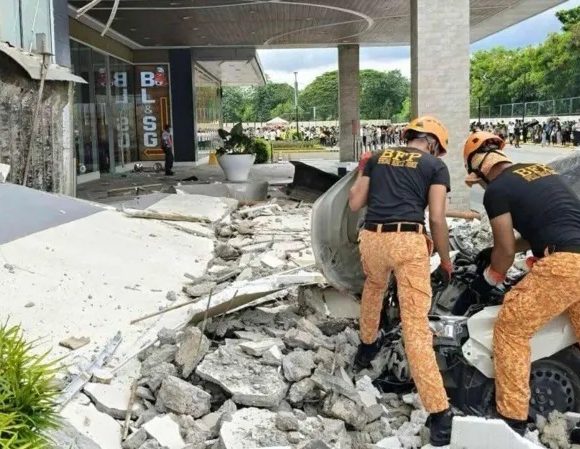
A 7.4 magnitude earthquake struck off the southern coast of Philippines, prompting tsunami warnings from Philippine and Indonesian authorities.

Residents in coastal towns in central and southern Philippines were asked to evacuate as authorities warned of waves over a metre (3.3ft) above normal tide levels.

At least one person was killed in the earthquake on Friday morning, which also led to power cuts and classes being suspended in parts of the country.

The latest tremor comes just over a week after a 6.9 magnitude quake hit Philippine’s central Cebu province, killing 74 people and injuring hundreds.

Footage on local media show overhead network cables swaying as vehicles come to a standstill the moment the 7.5 magnitude quake struck.

Reporters observed a frenzy outside a hospital in Davao City, near the quake’s epicentre, as patients were being treated outdoors in a carpark and crowds thronged the corridors.

Richie Diuyen, who works at the local disaster agency in the town of Manay, said some students fainted after the quake and that it left her feeling dizzy.

“I am still scared and shook. We couldn’t believe how strong the earthquake was. This was the first time I have experienced that,” Ms Diuyen told the BBC.

The Philippines, which sits on the geologically unstable “Ring of Fire”, has been reeling from a string of devastating natural disasters.

“Filipinos are now experiencing disaster fatigue from typhoons, volcanic minor eruptions and earthquakes,” Dr Teresito Bacolcol, Director of the Philippine volcanic agency Phivolcs, said in a media conference on Friday.

Dr Bacolcol called on Filipinos to “accept our reality” that “every now and then we will be jolted by earthquakes, volcanic eruptions and tsunamis”. “Instead of panicking, we have to prepare,” he said.

Last month, a super typhoon pummelled through the country’s north, killing 11 people.

Students on the Talaud Islands, an archipelago close to the Philippine border, have been sent home, but the situation remains calm, a local official told the BBC.

Indonesians urged people to “remain calm” and to stay away from buildings damaged by the earthquake.

BBC/Adebukola Aluko

Foreign

Peru’s Congress has voted to remove President Dina Boluarte from office, hours after a late-night session was called to debate her impeachment.

An overwhelming majority of lawmakers from across the political spectrum approved her ousting on grounds of “permanent moral incapacity”.

In an address on National television following the vote, Boluarte questioned the implications it would have on the stability of Peru’s democracy.

One of the world’s most unpopular leaders, with an approval rating of 2-4%, Boluarte’s tenure has been plagued by frequent protests, scandals and investigations, as well as a surge in gang violence.

Anti-government protests have escalated in recent months amid soaring crime. There was renewed anger earlier on Thursday following a shooting at a concert in the capital, Lima.

A total of 122 out of 130 lawmakers voted for Boluarte’s removal early on Friday, following votes resoundingly in favour of four motions of impeachment.

Congress leader Jose Jeri was sworn in as interim president early on Friday. Peru does not currently have a vice-president. Boluarte did not appear before Congress for the overnight hearing.

“At all times I have called for unity,” she told Peruvians after being removed, adding: “In this context, I had not thought of myself but of the more than 34 million Peruvians who deserve better.”

Protests have punctuated the 63-year-old leader’s less than three years in office, which followed the impeachment and imprisonment of her predecessor, Pedro Castillo.

Her presidency was overshadowed by several investigations, including a corruption inquiry dubbed “Rolexgate” over allegations she accepted Rolex watches as bribes.

Another probed whether she abandoned her post when she failed to appoint a caretaker president during an absence for nose surgery. She has denied any wrongdoing.

In July, her decision to double her salary to almost 35 times that of the monthly minimum wage in Peru was met with scorn and derision. Her economy minister noted at the time her salary had been the second lowest of 12 countries in South America.

Among the lawmakers who voted to remove Boluarte from office were factions once loyal to the president, including conservative parties that had previously supported her.

Boluarte rose to power in December 2022, when former President Castillo was impeached after attempting to dissolve Congress to avert his removal. She was elevated to the post as she was vice-president at the time.

Peru’s first female president, Boluarte was the Andean nation’s sixth leader since 2018. Three former leaders are behind bars. In the first three months of her presidency, there were more than 500 protests over her rule.

It followed the death of more than 50 Castillo supporters in a government crackdown on demonstrations calling for her resignation and fresh elections.

BBC/Adebukola Aluko

Subscribe to our Telegram and YouTube Channels, and also join our WhatsApp Update Group

Foreign

Six critically ill patients have been killed in a fire that broke out at an intensive care unit (ICU) of a hospital in the western Indian city of Jaipur.

The fire, suspected to be caused by a short circuit, started late on Sunday night in the storage area of the ICU of the Sawai Man Singh Hospital. Eleven patients were in the ICU at the time.

The victims include two women and four men. Relatives of the victims have accused staff of negligence, which hospital authorities have denied.

The government of Rajasthan state, of which Jaipur is the capital, has announced an investigation into the incident.

The state’s Chief Minister Bhajanlal Sharma said on Sunday. “Every possible step is being taken to ensure patient safety, treatment, and care for those affected, and the situation is being continuously monitored,”

The Sawai Man Singh hospital, run by the state government, is one of the largest in Rajasthan, where thousands of patients are treated every day.

The fire broke out just before midnight in the trauma centre of the hospital and soon spread through the building.

Fourteen patients were evacuated from a nearby ICU ward as thick plumes of smoke engulfed the room.

Firefighters broke open windows and battled the blaze for nearly two hours before bringing it under control, news agency PTI reported.

“We noticed smoke and immediately informed the staff, but they did not pay any heed. When the fire broke out, they were the first to run,” one of them told PTI.

Another relative, who lost his mum in the accident, alleged the hospital also did not have any emergency equipment. “There were no fire extinguishers, cylinders or even water to douse the fire,” he told ANI news agency.

The deputy superintendent of the hospital,Jagdish Modi, has dismissed the allegations.

“I can understand people’s sentiments in such a situation, but the allegations are untrue. Several hospital staff members risked their own lives to protect the patients and evacuated ICUs and wards,” he told the BBC.

Meanwhile, Prime Minister Narendra Modi expressed his sadness over the incident. “Condolences to those who have lost their loved ones. May the injured recover soon,” he wrote on X.

BBC/Adebukola Aluko