Foreign

A huge ancient city has been found in the Amazon, hidden for thousands of years by lush vegetation.

The discovery changes what we know about the history of people living in the Amazon.

The houses and plazas in the Upano area in eastern Ecuador were connected by an astounding network of roads and canals.

The area lies in the shadow of a volcano that created rich local soils but also may have led to the destruction of the society.

While we knew about cities in the highlands of South America, like Machu Picchu in Peru, it was believed that people only lived nomadically or in tiny settlements in the Amazon.

“This is older than any other site we know in the Amazon. We have a Eurocentric view of civilisation, but this shows we have to change our idea about what is culture and civilisation,” says Prof Stephen Rostain, director of investigation at the National Centre for Scientific Research in France, who led the research.

“It changes the way we see Amazonian cultures. Most people picture small groups, probably naked, living in huts and clearing land – this shows ancient people lived in complicated urban societies,” says co-author Antoine Dorison.

The city was built around 2,500 years ago, and people lived there for up to 1,000 years, according to archaeologists.

It is difficult to accurately estimate how many people lived there at any one time, but scientists say it is certainly in the 10,000s if not 100,000s.

The archaeologists combined ground excavations with a survey of a 300 sq km (116 sq mile) area using laser sensors flown on a plane that could identify remains of the city beneath the dense plants and trees.

This LiDAR technology found 6,000 rectangular platforms measuring about 20m (66 ft) by 10m (33 ft) and 2-3m high.

They were arranged in groups of three to six units around a plaza with a central platform.

The scientists believe many were homes, but some were for ceremonial purposes. One complex, at Kilamope, included a 140m (459 ft) by 40m (131 ft) platform.

They were built by cutting into hills and creating a platform of earth on top.
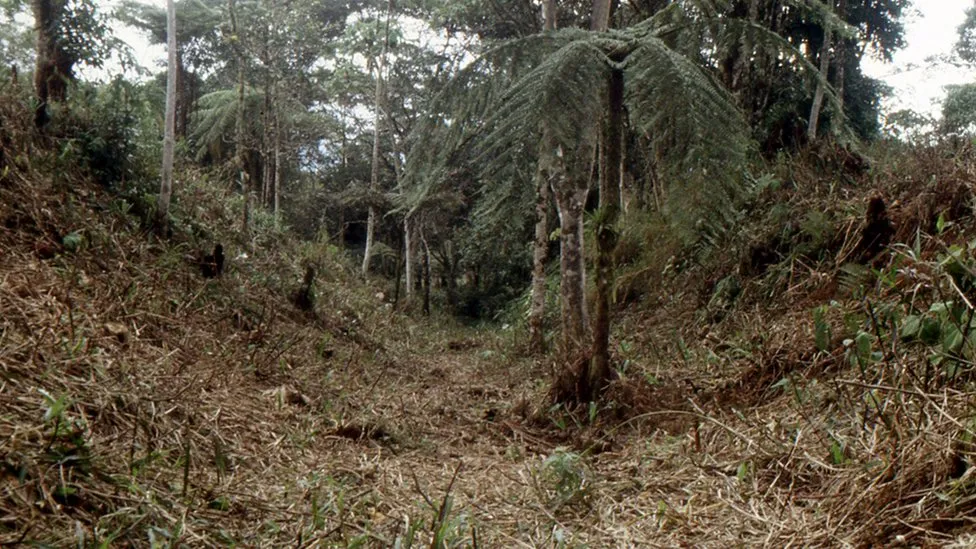
A network of straight roads and paths connected many of the platforms, including one that extended 25km (16 miles).

Dr Dorison said these roads were the most striking part of the research.

“The road network is very sophisticated. It extends over a vast distance, everything is connected. And there are right angles, which is very impressive,” he says, explaining that it is much harder to build a straight road than one that fits in with the landscape.

He believes some had a “very powerful meaning”, perhaps linked to a ceremony or belief.

The scientists also identified causeways with ditches on either side which they believe were canals that helped manage the abundant water in the region.

There were signs of threats to the cities – some ditches blocked entrances to the settlements, and may be evidence of threats from nearby people.

Researchers first found evidence of a city in the 1970s, but this is the first time a comprehensive survey has been completed, after 25 years of research.

It reveals a large, complex society that appears to be even bigger than the well-known Mayan societies in Mexico and Central America.

“Imagine that you discovered another civilisation like the Maya, but with completely different architecture, land use, ceramics,” says José Iriarte, a professor of archaeology at University of Exeter, who was not involved in this research.

Some of the findings are “unique” for South America, he explains, pointing to the octagonal and rectangular platforms arranged together.

The societies were clearly well-organised and interconnected, he says, highlighting the long sunken roads between settlements.

Not a huge amount is known about the people who lived there and what their societies were like.

Pits and hearths were found in the platforms, as well as jars, stones to grind plants and burnt seeds.

The Kilamope and Upano people living there probably mostly focussed on agriculture. People ate maize and sweet potato, and probably drank “chicha”, a type of sweet beer.

Prof Rostain says he was warned against this research at the start of his career because scientists believed no ancient groups had lived in the Amazon.

“But I’m very stubborn, so I did it anyway. Now I must admit I am quite happy to have made such a big discovery,” he says.

The next step for the researchers is understanding what lies in an adjoining 300 sq km (116 sq mile) area not yet surveyed.

BBC/Simeon Ugbodovon

Subscribe to our Telegram and YouTube Channels and also join our Whatsapp Update Group 
Foreign

Four children have been found alive after surviving a plane crash and spending weeks fending for themselves in Colombia’s Amazon jungle.

Colombia’s president said the rescue of the siblings, aged 13, nine, four and one, was “a joy for the whole country”.

The children’s mother and two pilots were killed when their light aircraft crashed in the jungle on 1 May.

The missing children became the focus of a huge rescue operation involving dozens of soldiers and local people.

President Gustavo Petro said finding the group was a “magical day”, adding: “They were alone, they themselves achieved an example of total survival which will remain in history.

“These children are today the children of peace and the children of Colombia.”

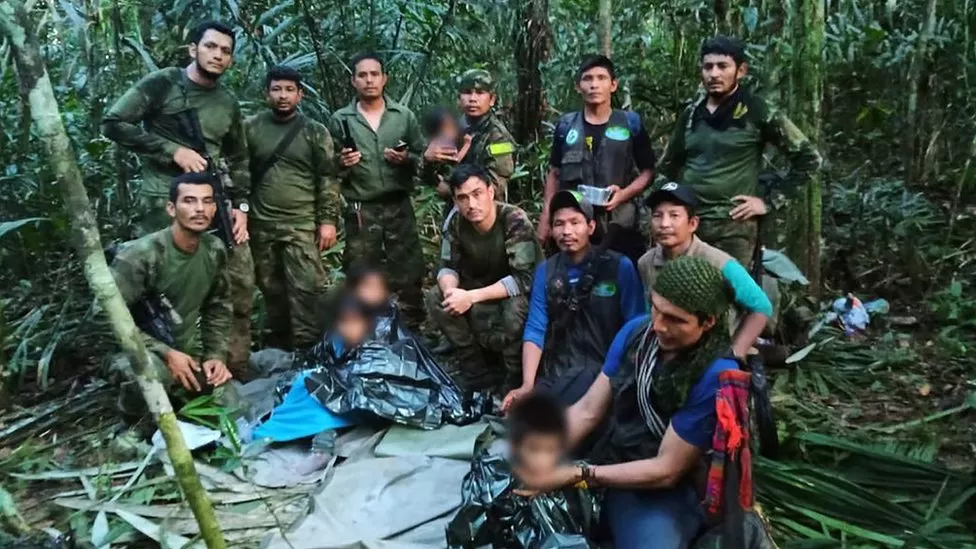
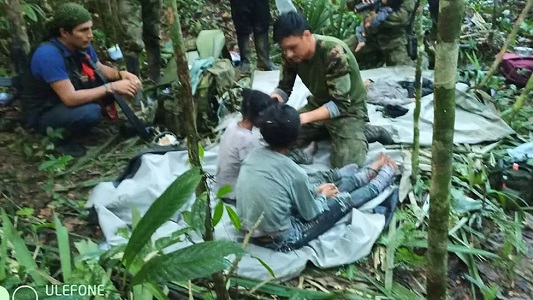
Mr Petro shared a photograph of several members of the military and Indigenous community caring for the siblings, who had been missing for 40 days. One of the rescuers held a bottle up to the mouth of the smallest child, while another fed one of the other children from a mug with a spoon.

A video shared by Colombia’s ministry of defence showed the children being air-lifted into a helicopter in the dark above the tall trees of the jungle.

Mr Petro said the siblings were receiving medical attention – and that he had spoken to their grandfather, who told him “the mother jungle returned them”.

The children have been flown to the nation’s capital Bogota, where ambulances have taken them to hospital for further medical treatment.

The Cessna 206 aircraft the children and their mother had been travelling on before the crash was flying from Araracuara, in Amazonas province, to San José del Guaviare, when it issued a mayday alert due to engine failure.

The bodies of the three adults were found at the crash site by the army, but it appeared that the children had escaped the wreckage and wandered into the rainforest to find help.

A massive search began and in May, rescuers recovered items left behind by the children, including a child’s drinking bottle, a pair of scissors, a hair tie and a makeshift shelter.

Small footprints were also discovered, which led search teams to believe the children were still alive in the rainforest, which is home to jaguars, snakes and other predators.

The children belong to the Huitoto indigenous group and members of their community hoped that their knowledge of fruits and jungle survival skills would give them a better chance of remaining alive.

Indigenous people joined the search and helicopters broadcast a message from the children’s grandmother, recorded in the Huitoto language, urging them to stop moving to make them easier to locate.

Colombia’s president came under criticism last month when a tweet published on his account mistakenly announced that the children had been found.

He erased the tweet the next day saying that the information – which his office had been given by Colombia’s child welfare agency – could not be confirmed.

BBC/Simeon Ugbodovon

Subscribe to our Telegram and YouTube Channels also join our Whatsapp

Lifestyle

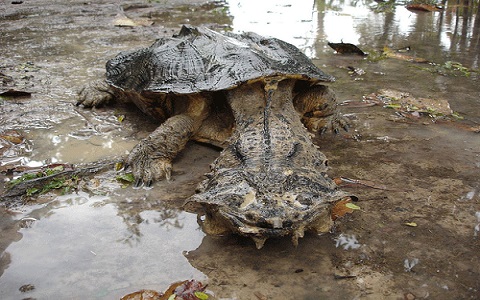
The mata mata, mata-mata, or matamata is a freshwater turtle found in South America, primarily in the Amazon and Orinoco basins.

It is the only extant species in the genus chelus.

The mata mata was described for the first time by French naturalist Pierre Barrère in 1741 as a “large land turtle with spiky and ridged scales” (translation).

It was first classified as Testudo fimbriata by German naturalist Johann Gottlob Schneider in 1783.

It was renamed 14 different times in two centuries, finally being renamed Chelus fimbriata in 1992

The mata mata is a large, sedentary turtle with a large, triangular, flattened head with many tubercles and flaps of skin, and a “horn” on its long and tubular snout.

Three barbels occur on the chin and four additional filamentous barbels at the upper jaw, which is neither hooked nor notched.

The mata mata’s brown or black, oblong carapace can measure up to 45 cm (18 in) at adult age.

The full adult weight is 15 kg (33 lb).

The mata mata’s plastron is reduced, narrowed, hingeless, shortened towards the front, and deeply notched at the rear with narrow bridges.

These may be meant to allow the turtle to resemble a piece of bark, camouflaging it from possible predators.

The plastron and bridges are creams to yellow or brown.

The head, neck, tail, and limbs are greyish brown on adults. The neck is longer than the vertebra under its carapace and is fringed with small skin flaps along both sides.

Hatchlings show a pink to reddish tinge in the underside edge of their carapaces and plastrons that gradually disappear as they grow.

Each forefoot has five webbed claws.

Males have concave plastrons and longer, thicker tails than females.

The mata mata inhabits slow-moving, blackwater streams, stagnant pools, marshes, and swamps ranging into northern Bolivia, eastern Peru, Ecuador, eastern Colombia, Venezuela, the Guianas, and northern and central Brazil.

The mata mata is strictly an aquatic species but it prefers standing in shallow water where its snout can reach the surface to breathe.

The appearance of the mata mata’s shell resembles a piece of bark, and its head resembles fallen leaves.

As it remains motionless in the water, its skin flaps enable it to blend into the surrounding vegetation until a fish comes close.

The mata mata thrusts out its head and opens its large mouth as wide as possible, creating a low-pressure vacuum that sucks the prey into its mouth, known as suction feeding.

The mata mata snaps its mouth shut, the water is slowly expelled, and the fish is swallowed whole; the mata mata cannot chew due to the way its mouth is constructed.

Males display for females by extending their limbs, lunging their heads toward the females with mouths agape, and moving the lateral flaps on their heads.

Nesting occurs from October through December in the Upper Amazon.

The 12 to 28 brittle, spherical, 35 mm-diameter eggs are deposited in a clutch.

Wikipedia