Politics

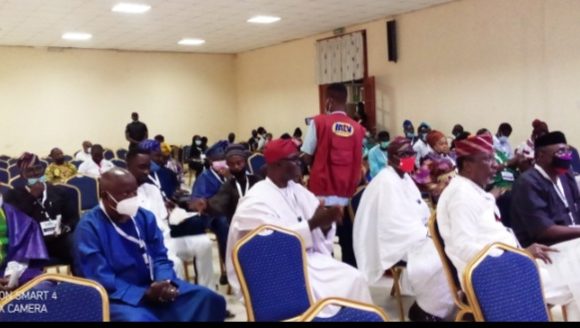
The need to restructure the current federal system of government in Nigeria through the creation of new constitution formed the basis of a day seminar organized by Yoruba leadership and Peace Initiative.
The event held at the Aganga hall of the International conference centre, University of Ibadan attracted discussants who are for pro regionalism, federalism, and good governance.
In his presentation, the Director of Research and Strategies, Afenifere Organization, Dr Akin Fapohunda, said the people should be considered when restructuring.
Dr Fapounda pointed out that restructuring could be realized through referendum and creation of a new constitution.


He noted that peace could not be achieved when imbalance existed in access to political power and economic resources.
While speaking on the Inevitability of Devolution: Devolve or Die, the Executive Director, Enough is Enough, Ms Yemi Adamolekun explained that many Nigerians were voiceless, invisible and powerless.
Ms Adamolekun explained that the time was now for the Yoruba region to act in view of 53 percent rate of youth unemployment and 41percent youth involvement in drug abuse and insecurity.
A Doctor of Intellectual History, Dr Usman Bugaje and a Senator who is also former deputy governor of Ogun state, Adegbenga Kaka attributed the current crises in the country to bad leadership.
They advocated justice and restructuring as the options for Nigeria to move forward.
President, the Yoruba Leadership and Peace Initiative, Mr Olusegun Ahmad said Nigeria had huge resources , adding that the country must pursue the strategy that would drive development in the Yoruba region.
Leader, Afenifere Pan Yoruba socio cultural group, Chief Ayo Adebanjo who took audience down the memory lane of various pre and post independence constitutional conferences that underscored true federalism in Nigeria said it was time to act rather talking.

Rotimi Famakin

Politics

Former member, House of Representatives, Chief Festus Adegoke says there is need to amend the nation’s constitution.

Chief Adegoke said this in Ibadan while speaking with Radio Nigeria correspondent.

The former lawmaker, who represented Egbeda/Ona Ara Federal Constituency from 2003 to 2011, said the amendment of the nation’s Constitution should be seen as a gradual process.

He said this became imperative in order to meet up with various challenges confronting the nation’s democracy.

The former governorship aspirant under the African Democratic Congress, ADC at the last general election, who is now a PDP chieftain appealed to politicians for the need to always fulfill the promises made to their constituents when voted into power. 

Olaolu Fawole

News

Wilful, deliberate or suspension of constitution or laid down set of rules and regulations by an individual to stay long in power outside a specific tenure of office either as president or head of state of a country is referred to as sit-tight syndrome. 

The trend is illegal and unconstitutional, but ironically, it is attractive, fanciful and too tempting to ignore by some people who finds themselves in positions of authority.

It is instructive to note that some leaders nowadays tinker with constitutions that brought them to power for selfish gains

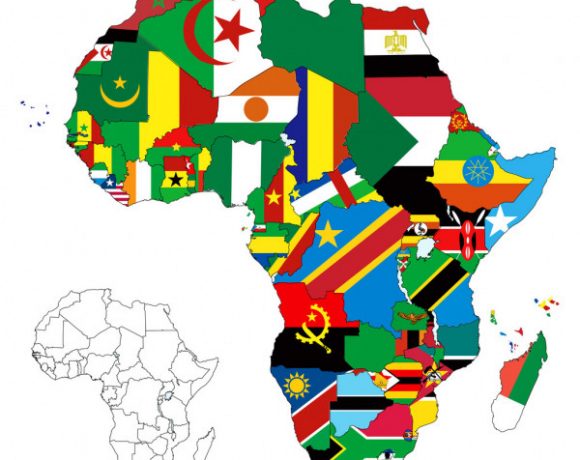
Notably, African leaders past and present who indulged in this self-serving and ungodly adventure include Robert Mugabe of Zimbabwe, Mobutu Seseseko of Zaire, Kamuzu Banda of Malawi, Samuel Doe of Liberia, Hosni Mubarak of Egypt, Ben Ali of Tunisia, Yoweri Museveni of Uganda and Joseph Kabila of Democratic Republic of Congo.

Others are Matthew Kerekou of Benin Republic Omar Bongo of Gabon, Yahyah Jahmeh of Gambia, Gadafi of Libya, Nguema of Equitorial Guinea, Paul Biya of Cameroon and Gnasingbe Eyadema of Togo among others.

And perhaps, worried by the negative impact of sit tight syndrome on governance in Africa, President Muhammadu Buhari recently warned his colleagues at an ECOWAS extra- ordinary summit in Niamey, Niger Republic against spending more than their constitutional terms in office. 

Apart from this long overdue advise, African leaders must be ready and willing at all times to subject and surrender themselves to the dictates of the constitution they swore to uphold upon assumption of power and office.

A continent in a hurry to develop and carve a niche for itself among developed and civilized people can definitely not afford to continue in a perilous way.

The recent military coup and takeover of power from Ibrahim Keita of Mali is a pointer to this assertion.

Major driving force behind this subversion of the will of the people by these leaders is lust for power, greed, selfishness, ethnicity, religion and fear of the unknown after leaving power.

The obvious implication of their sit tight syndrome is instability usually brought about by civil wars, retarded socio-economic growth absence of peaceful transfer of power from one government to another, lack of democratic culture, authoritarianism, endemic corruption, isolation by world powers due to poor image, human rights abuses, restiveness, extra judicial killings and dictatorship. 

The cumulative impact of this dangerous trend of sit tight syndrome is the unending underdevelopment of Africa by Africans.

Concerted efforts must be made to strengthen democratic institutions, freedom of expression, freedom of the press, promotion of civil and human rights advocacy as well as citizens and civic obligations and duties to the state.

Above all, there must be a change of orientation and attitude to leadership in Africa, bearing in mind the age long dictum that, “no condition is permanent.

Tayo Sanni