Foreign

Ecuador’s presidential election will go to a second round after a closely contested first-round result failed to produce an outright winner.

The electoral authorities called it a “technical tie” after the incumbent centre-right Daniel Noboa and his main left-wing challenger Luisa Gonzalez received nearly identical percentages of the vote.

The pair will now face a run-off in April.

The result is far narrower than opinion polls predicted, indicating the second round could be harder to call.

The narrow result also dashed the hopes of Noboa’s supporters, who had been buoyed by an early exit poll suggesting he might clinch victory outright.

The president’s supporters gathered in Quito, waving flags, donning T-shirts with his image and holding life-size cardboard cut-outs of the incumbent president.

These cut-outs, depicting Noboa in various outfits from suits to tank tops and sunglasses have become ubiquitous symbols across the country decorating front doors, apartment windows, and even car rooftops.

Noboa’s presidency has been defined by his focus on tackling severe gang violence.

He implemented emergency measures to deploy the military to streets and prisons to curb rising crime.

Many of his supporters hope he will secure a mandate in the run-off to continue his security policies.

“He’s helped us a lot, from when there was gang violence so bad that we couldn’t even go out,” said Fernanda Iza.

The 45-year-old added: “The support of the military he’s introduced their presence is already helping.

“He has brought us a certain stability. There are many problems still pending, but I hope he continues with his plan.”

BBC/Titilayo Kupoliyi

Subscribe to our Telegram and YouTube Channels and also join our Whatsapp Update Group.

Foreign

A huge ancient city has been found in the Amazon, hidden for thousands of years by lush vegetation.

The discovery changes what we know about the history of people living in the Amazon.

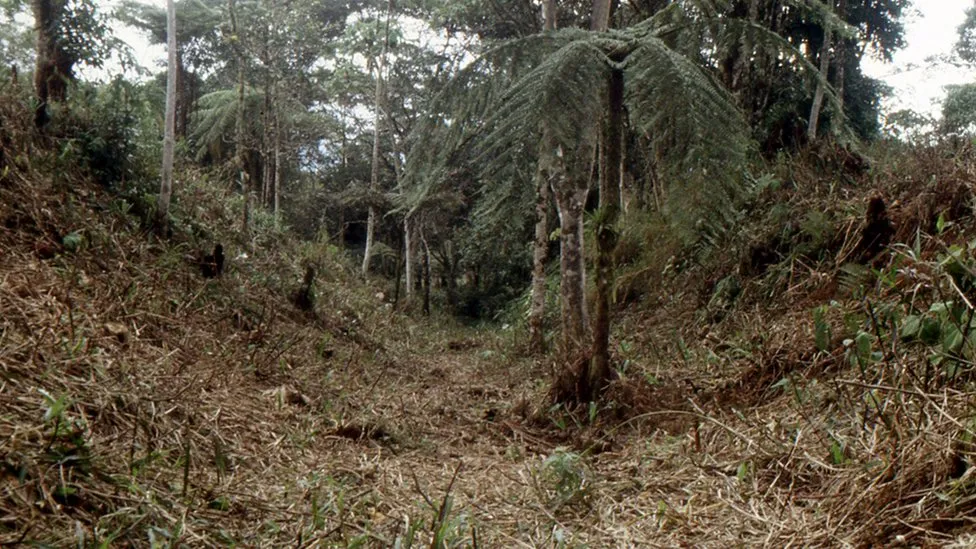
The houses and plazas in the Upano area in eastern Ecuador were connected by an astounding network of roads and canals.

The area lies in the shadow of a volcano that created rich local soils but also may have led to the destruction of the society.

While we knew about cities in the highlands of South America, like Machu Picchu in Peru, it was believed that people only lived nomadically or in tiny settlements in the Amazon.

“This is older than any other site we know in the Amazon. We have a Eurocentric view of civilisation, but this shows we have to change our idea about what is culture and civilisation,” says Prof Stephen Rostain, director of investigation at the National Centre for Scientific Research in France, who led the research.

“It changes the way we see Amazonian cultures. Most people picture small groups, probably naked, living in huts and clearing land – this shows ancient people lived in complicated urban societies,” says co-author Antoine Dorison.

The city was built around 2,500 years ago, and people lived there for up to 1,000 years, according to archaeologists.

It is difficult to accurately estimate how many people lived there at any one time, but scientists say it is certainly in the 10,000s if not 100,000s.

The archaeologists combined ground excavations with a survey of a 300 sq km (116 sq mile) area using laser sensors flown on a plane that could identify remains of the city beneath the dense plants and trees.

This LiDAR technology found 6,000 rectangular platforms measuring about 20m (66 ft) by 10m (33 ft) and 2-3m high.

They were arranged in groups of three to six units around a plaza with a central platform.

The scientists believe many were homes, but some were for ceremonial purposes. One complex, at Kilamope, included a 140m (459 ft) by 40m (131 ft) platform.

They were built by cutting into hills and creating a platform of earth on top.

A network of straight roads and paths connected many of the platforms, including one that extended 25km (16 miles).

Dr Dorison said these roads were the most striking part of the research.

“The road network is very sophisticated. It extends over a vast distance, everything is connected. And there are right angles, which is very impressive,” he says, explaining that it is much harder to build a straight road than one that fits in with the landscape.

He believes some had a “very powerful meaning”, perhaps linked to a ceremony or belief.

The scientists also identified causeways with ditches on either side which they believe were canals that helped manage the abundant water in the region.

There were signs of threats to the cities – some ditches blocked entrances to the settlements, and may be evidence of threats from nearby people.

Researchers first found evidence of a city in the 1970s, but this is the first time a comprehensive survey has been completed, after 25 years of research.

It reveals a large, complex society that appears to be even bigger than the well-known Mayan societies in Mexico and Central America.

“Imagine that you discovered another civilisation like the Maya, but with completely different architecture, land use, ceramics,” says José Iriarte, a professor of archaeology at University of Exeter, who was not involved in this research.

Some of the findings are “unique” for South America, he explains, pointing to the octagonal and rectangular platforms arranged together.

The societies were clearly well-organised and interconnected, he says, highlighting the long sunken roads between settlements.

Not a huge amount is known about the people who lived there and what their societies were like.

Pits and hearths were found in the platforms, as well as jars, stones to grind plants and burnt seeds.

The Kilamope and Upano people living there probably mostly focussed on agriculture. People ate maize and sweet potato, and probably drank “chicha”, a type of sweet beer.

Prof Rostain says he was warned against this research at the start of his career because scientists believed no ancient groups had lived in the Amazon.

“But I’m very stubborn, so I did it anyway. Now I must admit I am quite happy to have made such a big discovery,” he says.

The next step for the researchers is understanding what lies in an adjoining 300 sq km (116 sq mile) area not yet surveyed.

BBC/Simeon Ugbodovon

Subscribe to our Telegram and YouTube Channels and also join our Whatsapp Update Group 

Foreign

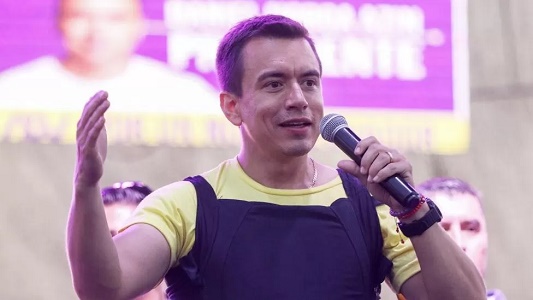
Businessman Daniel Noboa is to become the youngest president in Ecuador’s history, at 35 years old.

Mr Noboa won Sunday’s election with 52.3% of the vote, ahead of Luisa González’s 47.7%. She conceded defeat and congratulated her rival.

The 35-year-old, of the National Democratic Action party, is the son of Álvaro Noboa, who ran unsuccessfully for the presidency five times.

Mr Noboa will only have 17 months in office.

He will govern only to May 2025, due to the fact that the current election was triggered early when outgoing President Guillermo Lasso dissolved parliament amid an impeachment trial.

He can run again for the 2025-29 presidential term if he wishes to.

Following his win in the second round of voting, Mr Noboa told supporters: “Tomorrow we start work for this new Ecuador, we start working to rebuild a country seriously battered by violence, by corruption and by hate.”

Ecuador has suffered an increase in gang violence in recent years and the presidential campaign was marred by the assassination in August of candidate Fernando Villavicencio. As a journalist he had campaigned against corruption.

Violent crime has also risen dramatically and Ecuador has become a hub for drugs gangs due to its location between Colombia and Peru, the top two producers of cocaine in the world.

Mr Noboa has suggested moving some of Ecuador’s most hardened criminals to prison ships off the Ecuadorean coast, in order to break up the prison gangs which have engaged in deadly warfare inside the country’s jails.

He also wants to boost security at Ecuador’s borders and ports to disrupt key drug-trafficking routes, suggesting installing scanners to ensure more shipments of cocaine are intercepted.

He has also tried to appeal to voters by promising to boost employment opportunities.

BBC/Simeon Ugbodovon

Subscribe to our Telegram and YouTube Channels also join our Whatsapp Update Group
Feature

By Titilayo Kupoliyi

Something unique about Ecuador! Want to know it? Then stream along. First let’s get to know where Ecuador is. The country is located in the western corner at the top of the South American continent.

Ecuador is named after the Equator, an imaginary line that demarcates and separates the earth into two: northern hemisphere and the southern hemisphere, the earth is divided into two. That line equally splits Ecuador in two.

During Equinox, something takes place in Ecuador. Equinox is the time or date (twice each year) at which the sun crosses the celestial equator, when day and night are of approximately equal length (about 22 September and 20 March), termed solar equinox.

That means the sun appears directly above the equator, rather than north or south of the equator. Another term for Equinox is equinoctial point.

That strange thing is the feature of eggs. Eggs don’t fall down even when left on any sloped area at the imaginary line that divides the earth.

Balancing when eggs fall in Ecuador during spring

The Equator line has been a place for experiments with the eggs. Redline which demarcates the separation of the Northern and Southern Hemispheres, shows the strange reaction of balancing. While in other parts of the planets the eggs rolls if not placed on trays, balancing eggs is impossible, the equinoctial point is the only point that can balance even standing at the top of the nail top.

Why is this possible? It is because it is the period when the celestial bodies do not have any influence on material. Celestial bodies are considered to be responsible for movement and balance. The factors do not allow stability which leads to falling down.

An egg is one of the items that are highly influenced by electromagnetic and gravitational forces. Egg balancing is almost a harder task due to the attraction of the celestial bodies.

But the period of the Vernal Equinox makes a massive change in the behavior of the celestial bodies. It is because the sun travels from the southern to the northern hemisphere

At the end of the Vernal Equinox, the gravity is entirely balanced with the reduced magnetic effects on earth. The celestial bodies also do not force attraction that could cause the eggs to fall. Just on the tip of a nail head, the eggs are balanced.

Quite unique, you will agree, quite worth seeing!

www.youngisthan.in

Subscribe to our Telegram and YouTube Channels also join our Whatsapp Update Group

Foreign

A candidate in Ecuador’s forthcoming presidential election who has campaigned against corruption and gangs has been shot dead at a campaign rally.

Fernando Villavicencio, a member of the country’s national assembly, was attacked as he left the event in the capital, Quito, on Wednesday.

He is one of the few candidates to allege links between organised crime and government officials in Ecuador.

A state of emergency has been declared following the assassination.

Ecuador has historically been a relatively safe and stable country in Latin America, but a recent rise in violent crime fuelled by the growing presence of drug cartels has been a central issue in this year’s presidential campaign.

Witnesses said Mr Villavicencio, a serving congressman and former journalist, was shot three times.

A member of his campaign team told local media the 59-year-old was getting into a car when a man stepped forward and shot him in the head.

Video from inside the building shows panicked supporters diving for cover and campaign leaflets littered across a blood-stained floor.

The suspect was also shot in an exchange of bullets with security and later died from his injuries, the country’s attorney general said on social media.

In the chaos, nine other people were injured, including a candidate for the country’s assembly and two police officers, prosecutors said.

Six people have been detained by police in connection with the assassination after raids in Quito, they added.

The first round of the presidential election is scheduled to take place on 20 August.

Mr Villavicencio, who was married and had five children, was one of eight candidates in the first round of the election, although he was not the frontrunner and was polling around the middle of the pack.

As well as security, Mr Villavicencio’s campaign had focused on tackling corruption, a topic he had covered in an earlier career as a journalist, and reducing environmental destruction.

Last week, he said he and his team had been threatened by the leader of a gang linked to drug-trafficking.

BBC / Titilayo Kupoliyi

Subscribe to our Telegram and YouTube Channels also join our Whatsapp Update Group

Foreign

An Ecuadorean woman has died days after mourners at her funeral were shocked to find her alive in her coffin.

Bella Montoya, 76, was first declared dead by a doctor at a hospital in the city of Babahoyo last week.

But when mourners attending her wake heard her knocking on her coffin, she was immediately rushed back to the same hospital for treatment.

After seven days in intensive care, Ecuador’s health ministry confirmed she died on Friday from an ischemic stroke.

The ministry’s statement added that she had remained under “permanent surveillance” while at the hospital.

Speaking to a local newspaper, her son,Gilbert Barbera said, “This time my mother really did die. My life will not be the same.”

Following her death on 16 June, Ms Montoya was taken back to the same funeral home ahead of her burial at a public cemetery, local media is reporting.

Local media reported Ms Montaya had a condition called catalepsy – where a person experiences seizure, loss of consciousness, and the body becomes rigid.

A commission of experts has been assembled by the Ecuadorian health ministry to review her case.

Ms Montoya was placed in a coffin and taken to the funeral parlour in Babahoyo, south-west of capital Quito, after being declared dead on 9 June.

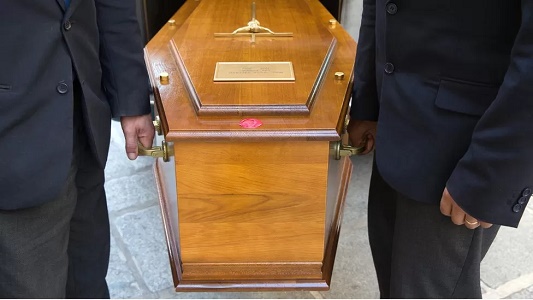
But after almost five hours inside, the woman gasped for air after her relatives opened the coffin to change her clothes for the funeral.

Minutes later, she was stretchered out by fire fighters and transferred back to the same hospital.

Bella Montoya is not the only person to “come alive” after being officially declared dead.

In February, an 82-year-old woman was found to be breathing while lying in a funeral home in New York State. She had been pronounced dead three hours earlier at a nursing home.

BBC/Simeon Ugbodovon

Subscribe to our Telegram and YouTube Channels also join our Whatsapp Update Group

Human Angle

Mourners at the wake of an elderly Ecuadorean woman were startled to discover she was still alive.

A hospital doctor in the city of Babahoyo declared Bella Montoya, 76, dead following a suspected stroke.

She was placed in a coffin and taken to a funeral parlour, where relatives held a vigil before her planned burial.

When, after almost five hours, they opened the coffin to change her clothes ahead of the funeral, the woman gasped for air.

“My mum started to move her left hand, to open her eyes, her mouth; she struggled to breathe,” her son Gilbert Balberán described the moment he realised his mother was still alive.

Video taken by one of the mourners shows her lying in an open casket struggling to breathe, while another complains that an ambulance they called has not yet arrived.

Minutes later, firefighters arrive and lift Bella Montoya from the coffin onto a stretcher and take her back to the same hospital where she had been declared dead.

Her son told Ecuadorean media that she was in intensive care, but was responsive.

“My mum is on oxygen, her heart is stable. The doctor pinched her hand and she reacted, they tell me that’s good because it means she is reacting little by little,” newspaper El Universo quoted him as saying.

Ecuador’s health ministry has set up a committee to investigate the incident.

Mr Balberán said he had taken his mother to hospital at about 09:00 “and at noon a doctor told me [she] died”.

He said he had even been issued with a death certificate, which stated that she had died of cardiopulmonary arrest after suffering a stroke.

Bella Montoya is not the only person to “come alive” after being officially declared dead.

In February, an 82-year-old woman was found to be breathing while lying in a funeral home in New York state. She had been pronounced dead three hours earlier at a nursing home.

BBC/Simeon Ugbodovon

Subscribe to our Telegram and YouTube Channels also join our Whatsapp Update Group

Foreign

At least 43 inmates have been killed in Ecuador’s latest deadly prison riot.

Report says, a fight broke out between rival gangs Los Lobos and R7 at a prison in Santo Domingo, some 80km, east of the capital Quito.

Ecuador is battling a wave of gang violence, and has recently seen its most deadly prison riots in history.

Parts of Ecuador are under a state of emergency because of the rising crime that has shocked the country.

According to the local police chief, a total of 108 inmates escaped the prison during the riot and remain missing, as an additional 112 prisoners made it out before being recaptured.

Scores were injured in the riot, but the exact number is still unclear.

Ecuadorian newspaper El Universo reported that, according to the National Police Commander Fausto Salinas, the incident was triggered by a brawl involving the transfer of an inmate known as Anchundia into the prison. He had been one of the ringleaders who had caused a previous prison riot in April.

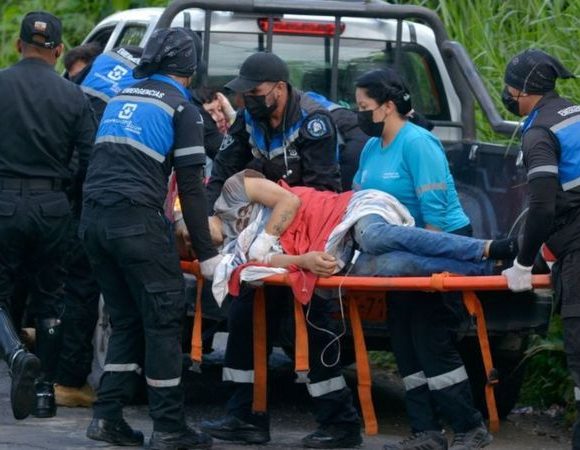
Pictures from outside the prison show bloodied inmates being carried from trucks to waiting ambulances. As news of the riot spread throughout the community, many relatives gathered outside the facility, distraught and desperate for news.

Deadly riots are becoming more commonplace in Ecuador, leaving distraught relatives desperate for information

President Guillermo Lasso sent his condolences to the families of those who died, and said it was the “unfortunate result of gang violence”.

Ecuador’s Interior Minister, Patricio Carrillo, wrote on Twitter that the government is working “to overcome the problems of the prison system, but it is complex to find quick solutions in an environment of… violence”.

Nearly 400 inmates have now been killed in six separate riots since February 2021.

One of the worst was in September, when 119 inmates were killed at a prison in Guayaquil in western Ecuador. Less than two months later, at least 68 prisoners died in fresh fighting at the same prison. The riots are particularly brutal, with some prisoners hacked to death, or beheaded with machetes.

Last month a 60-day state of emergency was declared in three western provinces – Guayas, Manabí and Esmeraldas – in response to the violence. Bellavista Prison is not in these areas.

BBC /Taiwo Akinola