Turks are voting in a momentous presidential run-off to decide whether or not Recep Tayyip Erdogan should remain in power after 20 years.
His challenger Kemal Kilicdaroglu, backed by a broad opposition alliance, has billed the vote as a referendum on Turkey’s future direction.
The president, who is favourite to win, promises a new era uniting the country around a “Turkish century”.
But the more pressing issue is rampant inflation and a cost-of-living crisis.
Polling stations close at 17:00 local time (14:00 GMT). Turkish expats in Europe and the US have already cast their vote.
Turnout in the first round was an impressive 88.8%, and Mr Erdogan’s lead was 2.5 million votes. That is why both candidates have their eye on the eight million who did not vote – but could this time.
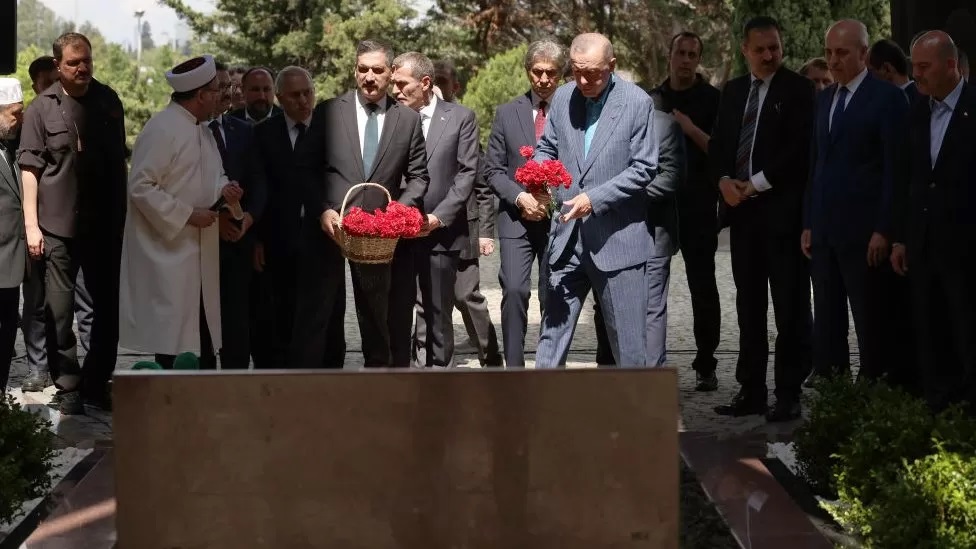
One of President Erdogan’s final acts before the vote was to lay carnations at a mausoleum
Ahead of the run-off Mr Kilicdaroglu accused his rival of foul play, by blocking his text messages to voters while the president’s messages went through.
Opposition parties are deploying an army of volunteers in a bid to ensure no vote-rigging takes place.
International observers spoke of an uneven playing field after the first round. But there was no suggestion that any irregularities in voting would have changed the result.
Mr Kilicdaroglu promised a very different style of presidency on his final day of campaigning: “I have no interest in living in palaces. I will live like you, modestly… and solve your problems.”
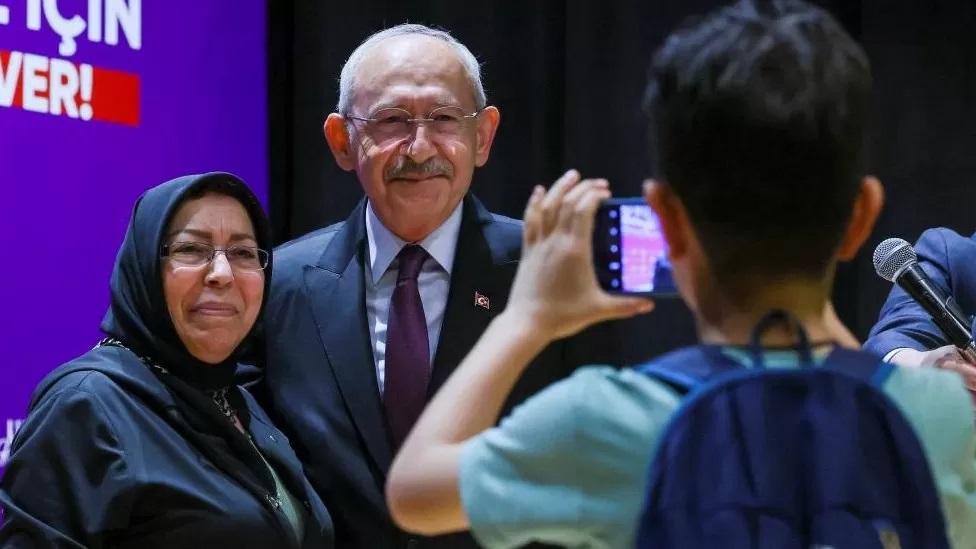
A boy takes a picture of his grandmother, 59, with Kemal Kilicdaroglu
It was a swipe at Mr Erdogan’s enormous palatial complex on the edge of Ankara which he moved to when he switched from prime minister to president in 2014. After surviving a failed coup in 2016 he took on extensive powers, detained tens of thousands of people and took control of the media.
So it was laden with symbolism when he paid a campaign visit on Saturday to the mausoleum of a prime minister executed by the military after a coup in 1960.
“The era of coups and juntas is over,” he declared, linking Turkey’s current stability to his own authoritarian rule.
Turkey, however, is deeply polarised, with the president reliant on a support base of religious conservatives and nationalists, while his opposite number’s supporters are mainly secular – but many of them are nationalist too.
For days the two men traded insults. Mr Kilicdaroglu accused the president of cowardice and hiding from a fair election; Mr Erdogan said his rival was on the side of “terrorists”, referring to Kurdish militants.
But after days of inflammatory rhetoric about sending millions of Syrian refugees home, the opposition candidate returned to Turkey’s number-one issue – the economic crisis, and in particular its effect on poorer households.
Turks are voting in the most pivotal elections in their modern history, to decide if Recep Tayyip Erdogan remains president after 20 years in power.
His main rival, Kemal Kilicdaroglu, promises to scrap many of the powers acquired by President Erdogan after he survived a failed coup in 2016.
Buoyed by a broad opposition alliance, he has a real chance of winning.
But this race has become so intense and the stakes so high that campaigning went up to the wire.
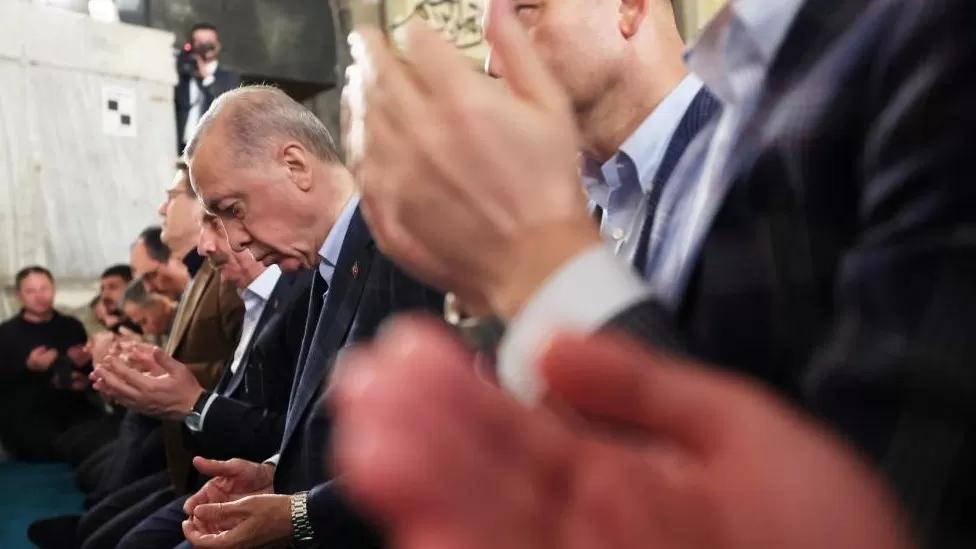
President Erdogan was filmed stretching election rules by addressing worshippers at Saturday evening prayers in Istanbul.
To secure outright victory on Sunday, the winner needs more than 50% of the vote. Otherwise, it goes to a run-off in two weeks’ time.
Turkey’s 64 million voters go to the polls in particularly hard times.
Rampant inflation is officially almost 44%, but many Turks believe it is far higher, while 11 of the country’s provinces have been affected by twin earthquakes that left more than 50,000 people dead.
At an optician’s in Ankara, Burak Onder complained that hardly anyone was buying glasses anymore: “People don’t even ask for discounts, they can’t afford it.”
Inflation soared as President Erdogan abandoned orthodox economics, cutting interest rates while most other countries raised theirs.
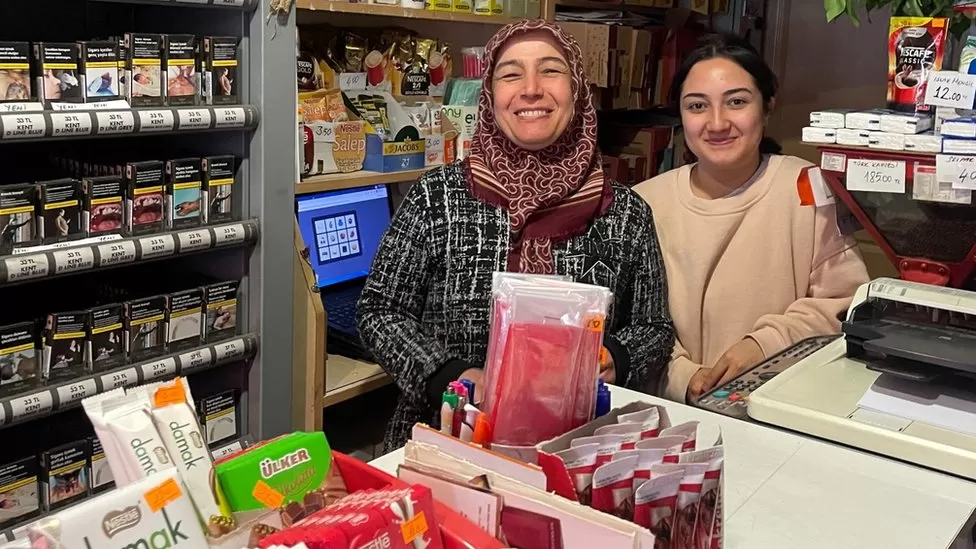
A few doors down the street, shopkeeper Rahime revealed layers of price labels that she stuck on top of each other almost daily because of soaring costs.
“People come in and ask why are prices rising all the time, and they leave without buying anything,” she said.
Rahime’s daughter, Sudenur, (R) is one of five million first-time voters in Sunday’s election
Rahime’s 19-year-old daughter Sudenur feels anxious about the future and is worried she may not be able to fulfill her ambition of studying sports science.
As a first-time voter, she and five million others like her are expected to make a big difference in the election result.
Turks have from 08:00 to 17:00 (05:00-14:00 GMT) to vote, although 1.76 million have already cast their ballots abroad in Germany, France and other countries – a record 53% turnout.
For survivors affected by the 6 February earthquakes, voting will prove far harder, because many have left their homes and can only vote where they are registered.
The aftermath of the disaster has overshadowed the election campaign and become second only to the economy as a key issue.
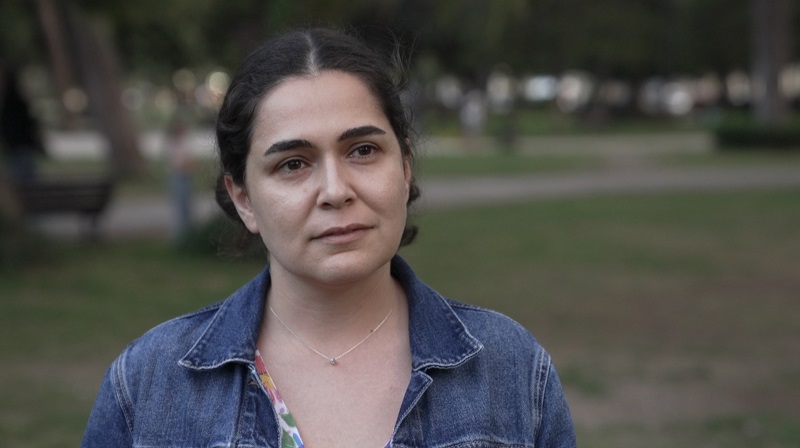
In Adana, where hundreds of people died in collapsed buildings, there is still palpable anger about the response.
“I think the earthquake will affect the outcome of the elections seriously, because people feel resentful to the government, if not the state,” said Ezgi Karaher as she walked with her young daughter in the park.
Political parties have laid on buses for thousands of survivors from across Turkey to travel back to vote in some of the worst-hit provinces where they are still registered.
On the sunny platform at Iskenderun station, people were arriving by train too.
“It was standing room only this morning,” said one arrival on an early morning service.
Staff said some 300 extra passengers were aboard, heading to stay with family or friends for the night. They were braced for even more voters to come on the late train.
Not everyone is able to go back. Two women at an Ankara supermarket told the BBC they would miss out on voting because they were having medical treatment following the earthquake.
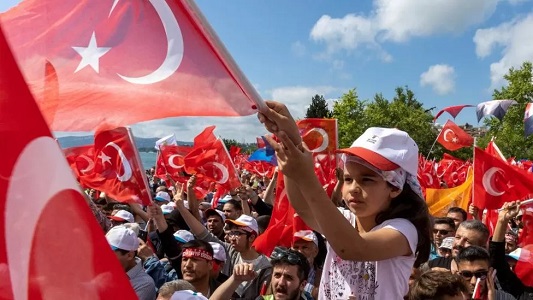
Party strongholds across the country are ablaze with their respective party colours and slogans.
And tensions have increased in the run-up to polling day.
Opposition parties are deploying volunteers to ensure the 192,000 ballot boxes and results are properly scrutinised to avoid the risk of fraud.
One of the four presidential candidates, Muharrem Ince, pulled out of the race three days ago, citing a smear campaign of “character assassination”. But it was too late to remove his name from the ballot.
Mr Kilicdaroglu visited Anitkabir – Ataturk’s mausoleum – on the eve of the vote
In the final hours of the campaign on Saturday, Mr Kilicdaroglu, 74, laid carnations at the mausoleum of Turkey’s modern-day secular founder Ataturk.
And President Erdogan, who is 69, ended his election push by leading evening prayers at Hagia Sophia mosque in Istanbul, but then he went further. Video shared on social media showed him telling worshippers the Muslim world was closely following events in Turkey.
His choice of venue and his decision to give a political speech after campaigning had officially ended was controversial and highly symbolic to his supporters.
Hagia Sophia, originally built as an Orthodox Christian cathedral, was a mosque under the Ottomans. But Ataturk turned it into a museum and it was President Erdogan who defied secular Turkey’s founder and made it a mosque once more in 2020.
Mr Erdogan ended his election push with Saturday prayers at Hagia Sophia mosque in Istanbul
Ultra-nationalist Sinan Ogan is the only other presidential candidate.
But Turks are also voting for parliament and its 600 MPs. Although they have lost powers to Mr Erdogan’s executive presidency since 2018, control of parliament remains key for passing legislation.
Under Turkey’s proportional voting system, parties form alliances so they can reach the 7% threshold required to enter parliament.
The president’s AK Party, which has Islamist roots, is part of the People’s Alliance with the nationalist MHP and two other parties, while Mr Kilicdaroglu’s centre-left Republican People’s Party is working with the nationalist Good Party and four smaller parties under the Nation Alliance.
The pro-Kurdish HDP, Turkey’s second biggest opposition party, is part of another alliance but has campaigned under a different name, the Green Left.