To achieve food security, poverty alleviation as well as job and wealth creation, Nigerians have been advised to be at the forefront of attaining good quality water for safe crop production.
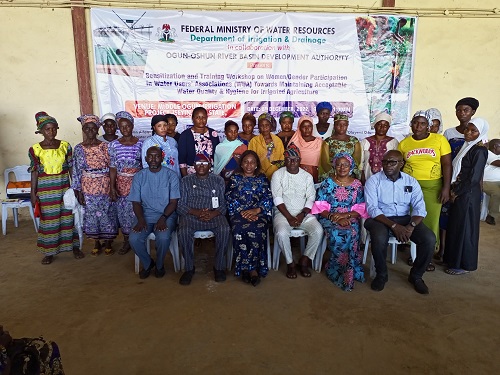
The advice was given by the Director, Irrigation and Drainage Department, Federal Ministry of Water Resources, Mrs Esther Oluniyi at a sensitization and training workshop on women and youths’ participation in irrigated agriculture.
The one-day sensitization workshop was held at the Middle Ogun Irrigation Project site, Iseyin, Oyo State.

It was organized by the Federal Ministry of Water Resources in collaboration with the Ogun Osun River Basin Development Authority.
Addressing the participants, who were mainly women and youths, the Director, Irrigation and Drainage department, Federal Ministry of Water Resources, Mrs Esther Oluniyi said the aim of the workshop was to enlighten and encourage Nigerians on the need to adopt appropriate and safe practices while discharging waste products.
Mrs Oluniyi explained that where practices such as indiscriminate dumping of solid wastes and open defecation in irrigated structures existed, the resultant effect would be unsuitable water for irrigated agriculture.

Mrs Oluniyi also called on community leaders to discourage their subordinates from inappropriate practices in order not to compromise the quality and suitability of water for irrigation.
She added that if irrigated agriculture was allowed to thrive, farming activities in the country would not be limited to only rainy seasons.
“Women and Youths are hugely involved directly or indirectly in the use of water in homes for domestic purposes such as cooking, bathing and washing. Women and Youths also get engaged in irrigated agriculture either for commercial or subsistence purposes.”
“Once again, in our strong efforts to achieve food security, poverty alleviation, job and wealth creation through sustainable irrigated agriculture, I call on everyone particularly the women and the youth to be at the forefront of promoting the attainment of good quality water in our canals and reservoirs for safe Crop Production through irrigation.
I also enjoin all Community Leaders to encourage all community members to desist from inappropriate practices when using water for various purposes. They need to stop washing, defecating, bathing and dumping of solid wastes in irrigation structures, including, rivers, streams, lakes, ponds and other water bodies”.
“It is expected that you will all participate actively in this workshop and grasp more knowledge on the needs, appropriate and safe practices to adopt while discharging wastes in order not to compromise the quality and suitability of water meant for irrigation”.
In separate interviews, two of the participants, Magaji Hummu and Adewoyin Victoria commended the Federal Ministry of Water Resources for the workshop and promised to champion the cause for safe water for their farming exploits.
The workshop also featured a technical session on the role of gender participation in sustainable irrigation water management.
Oluwakayode Banjo
Subscribe to our Telegram and YouTubeChannels also join our Whatsapp Update Group