Sport

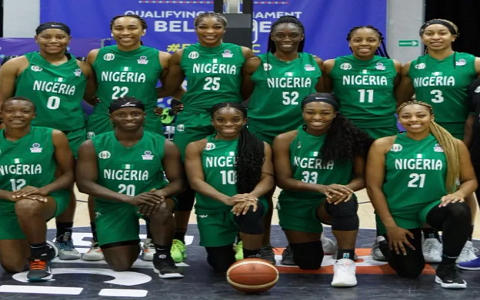
The world governing body for basketball, FIBA, has replaced Nigeria’s female basketball team, the D’Tigress, with Mali for the FIBA Women’s Basketball World Cup 2022 in Belgrade.

A statement by FIBA on Thursday reads: was informed about the decision of the President of the Federal Republic of Nigeria to withdraw the Nigeria Basketball Federation (NBBF) from all international basketball competitions and activities for a period of two years.

In subsequent communications with the NBBF, and despite FIBA’s request, it has become clear that against the circumstances created by the government’s decision, the NBBF is unable to confirm its participation in the FIBA Women’s Basketball World Cup 2022.

Given the multiple strict deadlines that cannot be postponed in order to ensure the successful staging of a major international event (visa procedures, schedules, ticket sales, accommodations, friendly games, preliminary rosters, flight tickets, accreditations, etc.) and to protect the integrity of the competition, the FIBA Executive Committee has decided as follows:

Nigeria’s withdrawal from the FIBA Women’s Basketball World Cup 2022 is confirmed mali, as the next ranked team from Group B of the FIBA Women’s Basketball World Cup 2022 Qualifying Tournament in Belgrade, is invited to participate in the FIBA Women’s Basketball World Cup 2022.

FIBA will announce whether there will be any other decisions related to the NBBF’s participation in other FIBA competitions and any potential disciplinary measures in due course.

Nigeria was disqualified after President Muhammadu Buhari suspended the country from participating in all international basketball competitions and activities for a period of two years.

The President’s withdrawal is said to be aimed at revamping the sports from the grassroots in Nigeria.

Tina Oyinsan
Sport

FIBA and the International Wheelchair Basketball Federation ,IWBF, have strengthened their partnership with the renewal of the Memorandum of Understanding until the end of 2023.

The two world governing bodies for the sports of basketball and wheelchair basketball have extended the agreement that will see them continue to work closely with the same goal: to make basketball, in whatever version, the most popular sports community.

This newly signed agreement will enhance the collaboration between IWBF and FIBA, with a special focus on 3×3, broadcast initiatives, and marketing concepts in the wheelchair game, which IWBF hopes to develop with the support of FIBA, a true leader in the world of sport, particularly within those facets.

FIBA Secretary General, Andreas Zagklis said FIBA had been working closely with IWBF for numerous years.

“We are delighted to continue this collaboration. Our experience and knowledge gained in developing a new discipline within our sport and the excellent broadcasting standards achieved at the FIBA Basketball World Cup 2019 in China last year can only help the IWBF in their vision for the future. We look forward to supporting the IWBF over the next four years in their new developments and initiatives.” Zagklis noted.

On his part,the IWBF President, Ulf Mehrens explained that the federation was extremely honored to be considered part of the FIBA family and thrilled to be able to continue to develop further links between the two formats and promote inclusion throughout the basketball community.

“As a federation, IWBF is relatively small and young, therefore, to be able to have the support and guidance from FIBA’s extensive knowledge and experience is imperative and invaluable to be able to help grow the federation and establish a sustainable and independent future for the sport.”Mehrens said.

The beneficial working relationship was established in 1992, by the then IWBF President, Sir Philip Craven MBE and the former FIBA Secretary General Borislav Stankovic following the creation of an independent wheelchair basketball federation. IWBF is recognized as a basketball organization under the FIBA General Statutes.

Adedayo Adelowo

Sport

The Executive Committee of FIBA has confirmed that FIBA U17 Basketball World Cups 2020 cannot take place this year. Options will be examined for the possibility to play the events in 2021. 

This was the resolution of FIBA’s Executive Committee meeting convened by video conference for their third ordinary meeting of the 2019-2023 cycle.

 FIBA President Hamane Niang commenced the meeting with an open letter addressing racism, calling on the global basketball community to be part of the change in society. 

 The meeting said the decision was made after a thorough analysis and based on the recommendations from the FIBA Medical and Competitions Commissions.

The meeting also agreed that a FIBA U17 Skills Challenge will be organized in August 2020, with the purpose of encouraging the National Federations to bring their teams together for a training camp and allow players to enjoy a competitive activity without traveling internationally. 

The meeting also submitted that the number of participating teams in the FIBA U17 Skills Challenge will be increased from 16 to 20, with 4 additional spots qualifying from each FIBA Region.

Update of FIBA Competitions for 2021-2022

New dates have been confirmed for the FIBA U19 Basketball World Cup 2021, now set to take place from July 3 to 11, 2021, and the FIBA U19 Women’s Basketball World Cup 2021, set to be played from August 7 to 15, 2021. 

FIBA, the world governing body for basketball, is an independent association formed by 213 National Basketball Federations throughout the world. It is recognized as the sole competent authority in basketball by the International Olympic Committee (IOC).

Adedayo Adelowo

News Sport

International Basketball Federation, FIBA, has published recommendations on returning to basketball, with new guidelines for National Federations, in the wake of the COVID-19 pandemic.

The guidelines were developed by FIBA Medical Commission Chairman, Dr Peter Harcourt following his consultation with the FIBA COVID-19 Medical Advisory Group, MAG, and also both the FIBA Medical and Players Commissions. 

To this end, a Basketball-Specific Risk Assessment Tool has also been produced in collaboration with the World Health Organization, WHO.

FIBA’s guidelines are primarily for National Federations that are seeking direction and advice on the restart of basketball activities and competitions, with the vast majority around the world having been halted in mid-March due to the pandemic. 

The guidelines and risk assessment tool will serve as a checklist to ensure any decisions on basketball events are based on an assessment of risks and the best chance of a successful restart. 

This publication is not intended to replace the guidelines and restrictions of governments and public health authorities. The risk assessment tool is a live document and will be updated regularly. 

Adedayo Adelowo