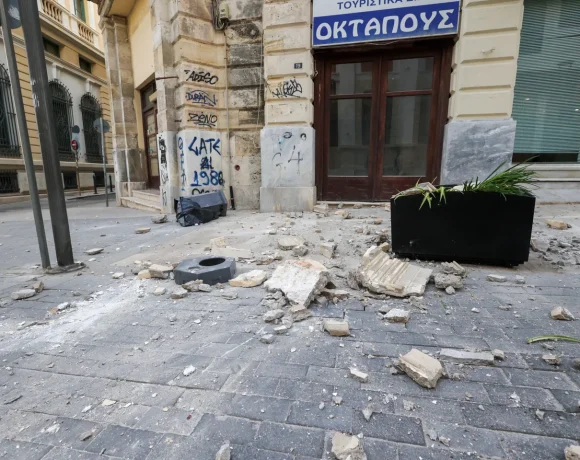
A magnitude 5.4 earthquake struck off the Greek island of Evia early on Tuesday and was felt in Athens, authorities said.
The National Observatory of Athens says the quake hit around half past midnight local time (2130 GMT), 45 kilometres (28 miles) northeast of the Greek capital,
According to reports, the epicentre was four kilometres off the resort of Nea Styra in southwest Greece’s second-largest island, Evia, also known as Euboea.
There were no reports of casualties or damage.The observatory had initially reported the magnitude at 5.3 but later revised its reading.
The mayor of the nearby city of Marathon, Stergios Tsirkas, described the quake as “very intense”, in comments on ERT television.
In May, a strong earthquake of magnitude 6.1 struck off the Greek island of Crete and was felt as far as Egypt as well as in the Greek capital.
In January and February, the island of Santorini in the Aegean Sea, a major Greek tourist destination, suffered exceptional seismic activity.
Thousands of tremors there caused several thousand residents to flee, but they have since returned home. Situated on several fault lines in the southeastern Mediterranean, Greece is regularly hit by earthquakes.
The last deadly quake there struck in October 2020 on the island of Samos, in the Aegean Sea, with a magnitude of seven, killing two people in Samos and over 100 in the Turkish port city of Izmir.
One of Italy’s most dangerous fugitives has been caught in Greece after a photo of him cheering on his football team gave away his whereabouts.
Vincenzo La Porta, 60, is thought to have close ties to the Camorra organised crime gang in Naples.
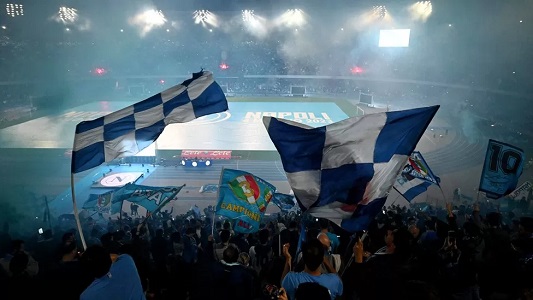
He has been on the run for 11 years – but earlier this year was spotted in a photo of fans celebrating in Greece.
The Naples Carabinieri police said: “What betrayed him was his passion for football and for the Napoli.”
Officers said the photos were taken after Napoli won its first Italian championship in over three decades earlier this year.
“With the championship victory, La Porta couldn’t resist celebrating,” police said.
La Porta has already been convicted in absentia in Italy for criminal association, tax evasion and fraud.
Police finally arrested him on Friday while he was riding his moped on the Greek island of Corfu and he is now currently in a jail awaiting extradition to Italy.
If he is extradited to Italy, he is due serve a prison sentence of 14 years and four months.
La Porta’s lawyer told AP news agency: “He has started a new family in Greece… He has a nine-year-old boy and is working as a cook to get by. He suffers from heart ailments. If he’s extradited, he and his family will be ruined.”
The authorities were relentless in their pursuit of La Porta, tracking his financial and online movements closely and “waited for him to make a misstep”.
Back in May, La Porta could not contain his excitement when Napoli won its first Serie A title after 33 years.
The police spotted him in a photo outside a Corfu restaurant among Napoli fans donning a baseball cap and waving the team’s sky blue and white colours.
The investigators knew they had their man and followed him to Greece.
With a little help from their Greek colleagues, they arrested him on Friday, the Greek police said.
In January, this year, an Italian mafia boss who was on the run for decades was arrested after a Google Maps sighting.
Evacuation orders have been issued for areas close to two central Greek cities threatened by new outbreaks of wildfires.
Citizens in areas around Volos and Lamia have been told to move to safety as the country remains in the grip of a severe heat wave.
Meanwhile, fires continue to rage on the islands of Rhodes, Corfu and Evia.
Greece is one of a number of countries currently grappling with wildfires, in which more than 40 people have died.
Two people have died in the fires near Volos, the fire service has confirmed a farmer who died after he went to release his sheep to protect them, and a woman who was in a mobile home in Chorostasi.
Kostas Agorastos, Mayor of Greece’s Thessaly region, which includes Volos, has accused “brainless workers” of starting the fire, according to the Ellada 24 news channel.
He added that it had broken out on four simultaneous fronts.
In Rhodes, where a state of emergency is in place and from where thousands of tourists have been forced to flee, high winds have continued to fan the flames and villages remain at risk.
Some firefighters, who have been battling the blazes for days, have begun to lose hope.
“Every day, every night, we are here and we achieve nothing,” Savas Filaderis, who is from Rhodes, told the Reuters news agency.
“We can’t stop it,” he said.
“Everybody, all the people, they fight. The civil people, the government, they are but… for nothing. I believe we fight for nothing.”
In Southern Italy, fires in Sicily and Puglia have also been fuelled by high winds and tinder-dry vegetation, meaning firefighters have been struggling in many areas to douse the flames and create firebreaks.
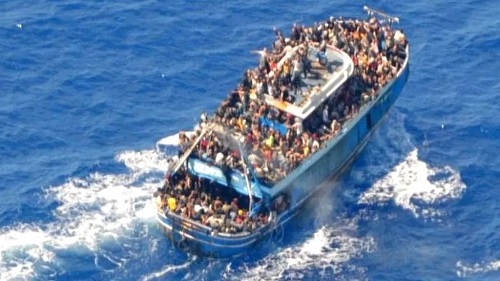
At least 79 people have died and more than 100 have been rescued after their fishing boat sank off southern Greece.
But survivors have suggested as many as 750 people may have been packed on to the boat, with reports of 100 children in the hold.
Greece says it is one of its biggest ever migrant tragedies, and has declared three days of mourning.
Authorities say their offers of aid were refused but they are facing claims of not doing enough to help.
The boat went down about 80 km (50 miles) south-west of Pylos after 02:04 on Wednesday morning local time, according to the Greek coastguard.
The EU’s border agency Frontex said it had spotted the boat early on Tuesday afternoon and immediately told Greek and Italian authorities. The coastguard said later that no-one on board was wearing life jackets.
In a timeline provided by the coastguard, it said that initial contact was made with the fishing boat at 14:00 (11:00 GMT) and no request for help had been made.
It said the Greek shipping ministry had made repeated contact with the boat and was told repeatedly it simply wanted to sail on to Italy. A Maltese-flagged ship provided food and water at around 18:00, and another boat provided water three hours after that, it added.
Then at around 01:40 on Wednesday someone on the boat is said to have notified the Greek coastguard that the vessel’s engine had malfunctioned.
Shortly afterwards, the boat capsized, taking only ten to fifteen minutes to sink completely. A search and rescue operation was triggered but complicated by strong winds.
Alarm Phone, an emergency helpline for migrants in trouble at sea, complained that the coastguard was “aware of the ship being in distress for hours before any help was sent”, adding that authorities “had been informed by different sources” that the boat was in trouble.
It added that people may have been scared to encounter Greek authorities because they were aware of the country’s “horrible and systematic pushback practices”.
Jérôme Tubiana of Médecins Sans Frontières told French radio that European and Greek authorities should both have intervened earlier. “It’s really shocking to hear that Frontex flew over the boat and no-one intervened because the boat refused all offers of help… an overloaded boat is a boat in distress.”
The boat is thought to have been going from Libya to Italy, with most of those on board believed to be men in their 20s.
They had been travelling for days, according to local media reports, which added that the boat had been approached by a Maltese cargo ship on Tuesday afternoon that supplied food and water.
Survivors spoke of as many as 500 to 750 people on board and regional health director Yiannis Karvelis warned of an unprecedented tragedy: “The number of the people on board was much higher than the capacity that should be allowed for this boat.”
One survivor told a hospital doctor in Kalamata that he had seen 100 children in the hold.
Coastguard Cpt Nikolaos Alexiou told public TV that the boat had sunk in one of the deepest parts of the Mediterranean.
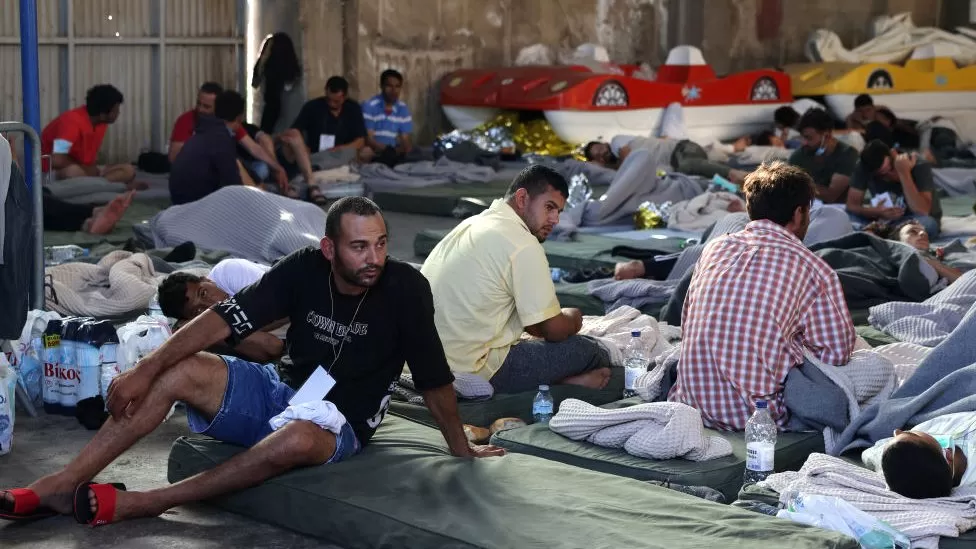
Survivors were taken to hospital and a depot in Kalamata that was being used as a temporary shelter
The nationalities of the victims have not yet been announced.
Survivors have been taken to Kalamata, and many were treated in hospital for hypothermia or minor injuries.
Public broadcaster ERT said that three people suspected of being the traffickers had been taken to the central port authority in Kalamata and were being interrogated.
Greek President Katerina Sakellaropoulou visited some of those rescued and expressed her sorrow for those who had drowned.
Each year, hundreds of people die trying to cross the Mediterranean. In February, a boat carrying migrants capsized near Cutro, in the region of Calabria in southern Italy, killing at least 94 people – one of the deadliest incidents recorded.
Greek migration ministry official Yiorgos Michaelidis said Greece had repeatedly called for a “solid” EU migration policy “in order to accept people who are really in need and not just the people who have the money to pay the smugglers”.
“Right now, the smugglers are the ones who decide who comes to Europe,” he told the BBC.
“The case is for the EU to provide asylum, help and safety for those who are really in need. It’s not a problem of Greece, Italy or Cyprus… The EU is the one that must conclude on a solid migration policy.”
Greece is one of the main routes into the European Union for refugees and migrants from the Middle East, Asia and Africa.
Last month the Greek government came under international criticism over video footage reportedly showing the forceful expulsion of migrants who were set adrift at sea.
More than 70,000 refugees and migrants have arrived in Europe’s frontline countries this year, with the majority landing in Italy, according to UN data.
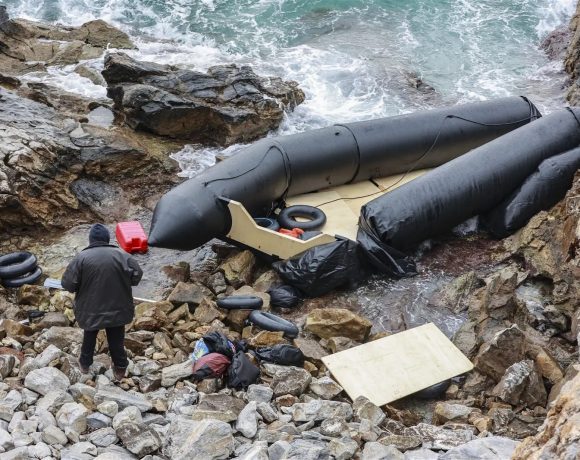
Three migrants died and more than 20 were feared missing after a second boat sank off the coast of Greece in just days, the coastguard said on Tuesday.
The two women and one man who drowned are believed to have been part of a group of 41 people whose dinghy sank after hitting a reef near the island of Lesbos, a coastguard spokeswoman told AFP.
Sixteen people have been rescued so far amid an ongoing search by land, sea and air that’s being hampered by strong winds, she added.
On Sunday, four children and a woman died when a boat carrying another group from neighbouring Turkey sank off the Greek island of Leros.
The coastguard managed to rescue 41 people, including six children and two adults.
The number of migrants requiring rescue has risen in recent weeks as more people attempt to reach Greece from Turkish shores on shoddy and overcrowded vessels despite the rough winter seas.
In December, a two-month-old baby died in a shipwreck off Lesbos.
Some 2,246 people fleeing wars and poverty are known to have lost their lives in the eastern Mediterranean since 2014, according to statistics from the International Organization for Migration (IOM).
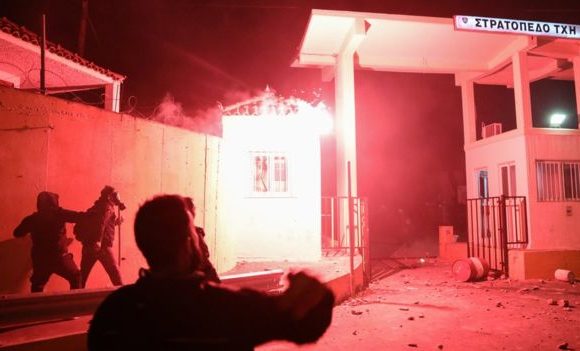
More
than 60 people have been hurt, many of them riot police, in clashes with
protesters on Lesbos and Chios over plans to build new migrant camps in Greece.
Stones
were hurled at police as protests intensified at three Lesbos sites where the
centres are to be built.
Greek
Prime Minister Kyriakos Mitsotakis has called for calm and is due to meet the
regional governor and local mayors to discuss the crisis.
Several police officers were also hurt on Chios.
Authorities
in Athens have pledged to build new centres to replace overcrowded facilities
on Lesbos, Samos, Chios, Leros and Kos while the government plans to bring down
the number of migrants on the islands from 42,000 to 20,000, but there has been
intense local opposition to the new centres.
All five islands lie off the coast of Turkey, on a route where hundreds of thousands of migrants have tried to cross the sea on the way to Europe in recent years.