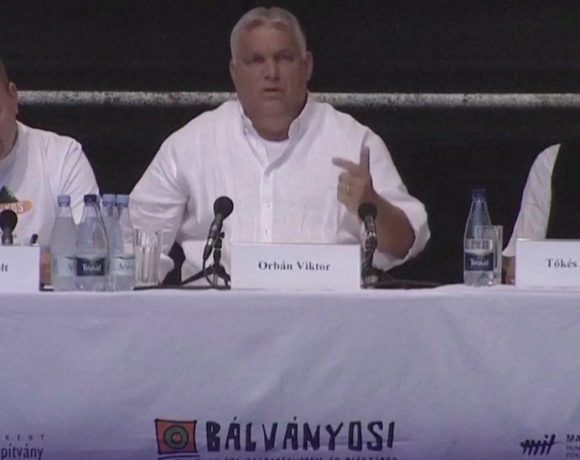
A member of Viktor Orban’s inner circle has resigned after the Hungarian prime minister spoke out against becoming “peoples of mixed race”.
Zsuzsa Hegedus, who has known the nationalist Mr Orban for 20 years, described the speech as a “pure Nazi text”, according to Hungarian media.
The International Auschwitz Committee of Holocaust survivors called the speech “stupid and dangerous”.
Mr Orban’s spokesman said the media had misrepresented the comments.
The speech took place on Saturday in a region of Romania which has a large Hungarian community.
In it, Mr Orban said European peoples should be free to mix with one another, but that mixing with non-Europeans created a “mixed-race world”.
“We are willing to mix with one another, but we do not want to become peoples of mixed race,” he said.
Mr Orban’s anti-migration views are well known, but for Ms Hegedus, Saturday’s speech crossed a line.
“I don’t know how you didn’t notice that the speech you delivered is a purely Nazi diatribe worthy of Joseph Goebbels,” she wrote in her resignation letter, according to the Hungarian hvg.hu news website.
Goebbels was the head of Adolf Hitler’s propaganda ministry.
Mr Orban’s remarks on race have been bitterly criticised by some in Hungary and equally vehemently defended by others.
“Only one race inhabits this earth, Homo Sapiens. And it is unique and undivided,” chief rabbi Robert Fröhlich commented.
Opposition politicians, decisively defeated by Mr Orban’s Fidesz party in the April elections, said his remarks were “beyond the pale… unworthy of a European statesman”.
Government spokesman Zoltan Kovacs tried to dampen the growing chorus of condemnation, arguing that the prime minister had been outspoken on the topics of immigration and assimilation for years.
In the government flagship daily, Magyar Nemzet, an article praised Mr Orban for defending the idea of nationhood against a drive to mix all nations “into a grey, indistinguishable mass”.
At best, Mr Orban appears confused, sometimes speaking of the Hungarians as “the most mixed society”, at other times, appearing to suggest he believes in ethnic purity.
Zsuzsa Hegedus’s resignation is unlikely to have further repercussions in Hungary. Party discipline is tight and resignations are almost unheard of.
During his speech, the Hungarian leader also appeared to make light of the Nazi gas chambers in World War Two when he criticised the EU’s plan to cut gas demand by 15% by pointing out that “the past shows us German know-how on that”.
Hungary’s largest Jewish group condemned the speech and called for a meeting with Mr Orban. More than half a million Hungarian Jews were murdered in the final months of World War Two, many of them at Auschwitz.
The International Auschwitz Committee said his words were “grist to the mill to all racist and far-right forces in Europe” and they reminded Holocaust survivors of the dark times of their persecution.
Romania’s foreign minister said the remarks were unacceptable and it was regrettable they were spoken on Romanian territory.
Responding by letter to his long-standing adviser, Mr Orban defended his words.
“You know better than anyone that in Hungary, my government follows a zero-tolerance policy on both anti-Semitism and racism,” he wrote.
His spokesman, Zoltan Kovacs, said the mainstream media was “hyperventilating about a couple of tough lines about immigration and assimilation”, but had stayed silent on the main points of the speech.
Addressing the war in Ukraine in his speech, Mr Orban argued that the West’s support of the country had failed, sanctions against Russia were not working and a negotiated peace deal should be the priority.
Viktor Orban won a historic fourth term in office in April, but his stance on Russia’s war has been out of step with every other EU country. He has maintained good relations with Russia’s President Vladimir Putin and is the only EU leader to openly criticise Ukraine’s President Volodymyr Zelensky.
While the rest of the EU was agreeing to cut its reliance on Russian gas, Hungary’s foreign minister visited Moscow last week to discuss buying more of it. Budapest currently imports 80% of its gas from Russia.
Despite receiving large amounts of EU funds, the Hungarian government has frequently clashed with the EU over rule-of-law issues such as press freedom and migration.
BBC/Taiwo Akinola
Subscribe to ourTelegram channel