Economy

The Director in Charge of the Integrated Personnel Payroll and Information System, IPPIS, Mr Emma Deko says they are not responsible for the payment of salaries or workers.

Mr Deko said the system is only responsible for the process of payment.

Mr Deko who spoke at the resumed hearing of the House of Representatives adhoc committee investigating non-remittance of deductions from workers’ salaries for the National House Fund, explained that in most cases, deductions from workers are not remitted because of a shortage of cash backing for approvals for wages.

According to him, while IPPIS prepares the salaries for only federal workers, the government appointed four gateways that are responsible for the payment of the salaries to workers.

He gave the names of the gateways which he said are not situated within the IPPIS as Nigeria Interbank Payment System, NIPS, E-Transact, Remita and GIFMIS.

Mr Deko explained that since the money is in the Central Bank of Nigeria CBN, when the remittances are done, the CBN was supposed to give IPPIS statements, after which they ask for the breakdown to do reconciliation as accountants.

According to him, it is becoming difficult not only in IPPIS but the entire accounting cadre, because the apex bank only gives them bulk figures.

Responding, the committee summoned the CBN and the Accountant General of the Federation to appear before the committee on Thursday to explain the delays in remitting deductions from workers’ salaries to the Federal Mortgage Bank.

FRCN Abuja/Adetutu Adetule

Subscribe to our Telegram and YouTube Channels also join our Whatsapp Update Group

Crime

There was mild drama on Monday when a former Integrated Payroll and Personnel Information System desk officer at the Federal Character Commission, Haruna Kolo, accused of collecting bribes from job seekers in exchange for employment, owned up to the allegation.

This was just as he admitted to having received over N75m from desperate jobseekers on the instructions of the Chairman of the FCC.

Not done, Kolo claimed that the FCC boss instructed him to transfer the money to his (Kolo) personal account and pay her in cash which he did a couple of times in her house.

Kolo made the revelation at the ongoing investigative hearing by the House of Representatives ad hoc committee investigating federal ministries, departments and agencies, parastatals and tertiary institutions on mismanagement of the IPPIS.

The ex-IPPIS desk officer told the lawmakers that he resigned from FCC on November 2, 2022 to join the Asset Management Corporation of Nigeria but ended up getting salaries twice from FCC.

He added that the anomaly was reported to the Human Resource Officer who told him that the issue would be addressed.

He said, “When she came to FCC as the Executive Chairman, she appointed me as a protocol officer and I carried out my duty diligently.

“On the allegations of job racketeering, the FCC Chairman instructed me to liaise with one Mr Shehu, who is a personal driver and Personal Assistant to the Taraba State Commissioner. As a desk officer, I was responsible to take whoever was employed to IPPIS for capturing. No one could go there without a letter from the Chairman or Human Resource Officer of the FCC.

“When she came, she wrote a letter to the Accountant General of the Federation, instructing that no letter from the FCC should be honoured except she signs the letter. So, whenever there was new employment, she signs, gives to me and I take it to the Accountant General’s office for capturing.

“Shehu is the one that brought those who paid money to my account for job, some paid N1m, others N1.5m, all to my personal account, my Ecobank account. She asked me to give cash to her, which I did through POS. So, there is no evidence of transfer or anything.

“On the allegation of working at seven places, I was never at any time involved in seven jobs. They are making the allegation based on assumption.”

 He continued, “The second allegation on my subsequent employment at AMCON was a result of her personal favour to me. We were four in number, and she gave the appointment letter to me, Kadijah, and Olushola. We all proceeded for an interview at AMCON headquarters in Abuja after which we were called upon for training on the 16th January 2023,

“After the training,  Olushola and I were called to Lagos. Unfortunately, Kadijah, who is the chairman’s biological sister, was rejected. The Chairman accused me of being responsible for her rejection.

“I see no reason why (sic) the chairperson would make allegations of such magnitude against me. I have been threatened even at gunpoint and had to leave Abuja.

“Sir, I want this committee to know that after this sitting if anything happens to me, the FCC chairperson should be held responsible, ” Kolo added.

Responding, the chairman of the committee, Yusuf Gagdi, promised to do every possible to unravel the truth and make the same available to Nigerians.

“This committee will not sit down and watch taxpayers’ money being embezzled.

 “I know why we were asking Kolo to give us evidence and we know why we were deferring this sitting for other witnesses alleged to have had financial dealings with the FCC.

“Kolo will appear here tomorrow (Tuesday). We are calling the other witnesses. We will allow you to do your work. Whoever is found wanting will answer his father’s name, including Kolo Haruna,” he said.

The committee adjourned sitting till Tuesday (today).

Punch/Simeon Ugbodovon

Subscribe to our Telegram and YouTube Channels also join our Whatsapp Update Group

Education

By Kayode Joseph

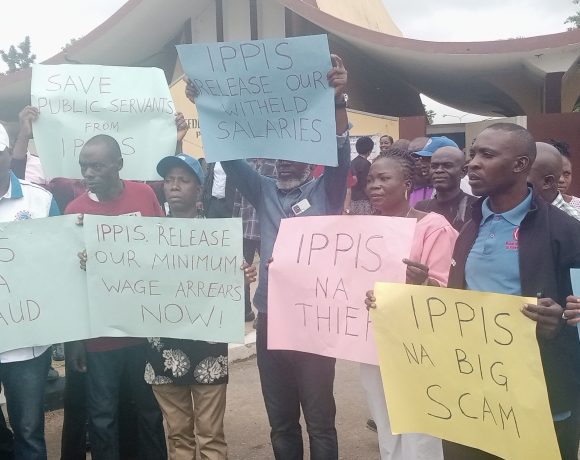
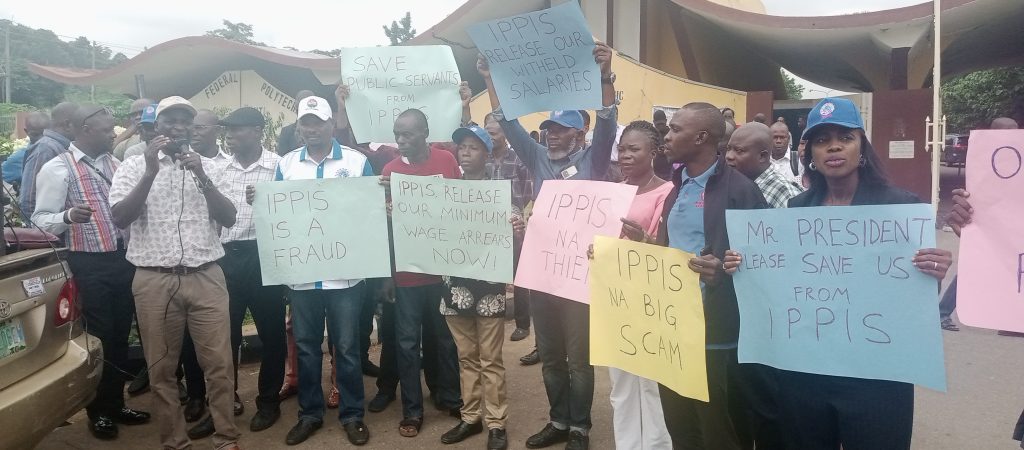
Senior Staff Association of Nigerian Polytechnics, SSANIP, Federal Polytechnic Ado-Ekiti chapter has called on President Bola Tinubu to scrap the Integrated Payroll and Personnel Information System, IPPIS citing irregularities, incompetence, corruption and fraud.

Chairman of SSANIP in the institution, Comrade Sunday Akomolafe made the call while addressing journalists during a peaceful protest by members of the union at the Polytechnic premises.

According to him, the scheme has become a conduit pipe used by some personalities to steal government fund and salaries of workers urging government to probe the organization.

He alleged that the Polytechnic workers have suffered untold hardship due to irregularities in the payments of their salaries, non-remittance of their various deductions by IPPIS despite government’s approval.

Akomolafe alleged that the arrears of minimum wage approved for them, as well as other benefits approved by government since 2009 has not been paid by the scheme.

He called on President Tinubu to address the issues holistically by probing the activities of IPPIS and carry out a cursory investigation and bring culprits to book

Subscribe to our Telegram and YouTube Channels also join our Whatsapp Update Group

News

The Federal Government has detected over 1,500 workers who joined the Federal civil service with fake appointment letters in the past year.

The Head of the Civil Service of the Federation, Dr Folasade Yemi-Esan, made this known in her keynote address at the ‘National Policy Dialogue on Entrenching Transparency in Public Office Recruitment in Nigeria,’ organised by the Independent Corrupt Practices and Other Related Offences Commission, in Abuja on Tuesday.

Dr. Yemi-Esan said over 1,000 culprits were discovered in one ministry while 500 others found in other ministries, departments and agencies during a service-wide verification exercise and they would be delisted from the Integrated Personnel and Payroll Information System.

The HoS explained that her administration has taken decisive steps to nip in the bud the alarming sharp practices and acts of impunity being perpetrated on the IPPIS, as well as to purge the system of all infiltrations.

She stated, “It would be recalled that in March last year, the office informed of the detection of fake letters of employment presented in some ministries. For instance, in the past year, in one ministry alone, over 1,000 individuals bearing fake letters of appointment were detected.

“In the light of the aforementioned, it is disheartening to point out that the office recently received a report from the Federal Civil Service Commission forwarding the names of over 500 persons in various MDAs in possession of fake letters of appointment and which are to be delisted from the IPPIS platform.

“Similarly, following the outcome of the Service-Wide Verification Exercise for officers recruited from 2013 – 2020, the Federal Civil Service Commission has also requested the suspension of the salaries of over 3,000 officers across the MDAs who failed to appear for the exercise pending further clearance.”

According to her, the government’s effort to stop financial leakages in the civil service had created a gap leading to a series of implementation issues, adding that as of March 2022, over 380,000 officers had been captured on the IPPIS payroll comprising 66,000 and 320,000 for core and non-core MDAs, respectively.

Dr. Yemi-Esan further said that her office is carrying out a mop-up exercise in the core and non-core MDAs which would be rounded off in September.

Speaking on global best practices in public service recruitment, Dr. Yemi-Esan noted that the Indian public service recruits only competent workers, compared to the Nigerian system which is based on federal character principles and nepotism.

PUNCH/Olaolu Fawole

Education

The Academic Staff Union of Universities has extended its ongoing industrial action by eight weeks.

A high ranking official of the Union, Professor Abdulkadir Danbazau made this known to newsmen on Monday.

By this development, the Federal government now has two months to make good its initial promise to the leadership of ASUU.

Prof. Danbazau, who confirmed the report to The Guardian, said the union’s latest decision was influenced by the need to allow it and the federal government to reach a solid agreement to avoid further strikes in the future.

Danbazau added that the two months were enough for the government to do the needful.

Before this, there were indications that ASUU might declare a total strike on Monday following the government’s refusal to meet its demands.

A member of ASUU’s National Executive Council who spoke on condition of anonymity stated that this may be the fallout of a planned meeting to be held in the University of Abuja on Monday.

The ASUU NEC member added that the majority of ASUU chapters had earlier voted to continue the strike since the government was yet to meet a significant number of the demands.

He said: “Yes, we are meeting today on the ongoing strike and other matters.” Asked if the strike could be called off after the meeting, he replied: “Not likely. There is no positive development that I know of.”

ASUU had begun four weeks nationwide Strike on February,14,2022.

ASUU President, Professor Emmanuel Osodeke had lamented that the union’s demands on the revitalization of public universities, earned academic allowances, University Transparency Accountability Solution (UTAS) promotion arrears, renegotiation of 2009 ASUU-FGN agreement, and inconsistencies in Integrated Payroll and Personnel information system (IPPIS) payments have been neglected after meetings with Minister of Labour and Employment, Dr. Chris Ngige.

Olaolu Fawole

News

Labour leaders and federal civil servants have expressed worry over challenges posed by the integrated payroll and personnel Information System, IPPIS initiated by the federal government to centralize payment of salaries of public servants.

 Our correspondent Oriola Afolabi takes a look at factors responsible for the dissatisfaction and plights of workers on issues of IPPIS and other related matters.

Integrated Payroll and Personnel Information System IPPIS was introduced in 2007 by the federal government to cover 506 Agencies, commissioners, parastatals and all ministries with the mandate of ensuring a centralized payment of salaries’ case, staff remuneration, promote accountability and prevent corrupt practices in the system.

Some of those who spoke with Radio Nigeria on the scheme, listed challenges posed by the IPPIS to workers to include challenge of under payment, none payment of salaries arrears from 2 to 15 months and none recognition of labour law by the managers of the scheme.

In his own submission, the Chairman, Academic Staff Union of Universities, ASUU, Obafemi Awolowo university, OAU, Dr Adeola Egbetokun said that the introduction of IPPIS was good at the beginning but the reverse was the case, as the system had dropped in quality while workers now faced untold hardship before they could be paid.

Dr. Egbetokun maintained that the efforts by the ASUU to address the problem did not yield positive result.

The chairman, Non Academic Staff Union of Universities, NASU, Federal University Oye Ekiti, FUOYE, Mr Ayodele Ojumo-Ola who lamented the suffering some of their workers were going through due to ineffectiveness of the IPPIS, said federal government needed to take urgent steps to correct problems  that the scheme posed on federal workers nationwide.

Mr Ojumo-Ola maintained that the system created to fight corruption and ease remuneration had turned to hardship.

Vice President, Trade Union Congress TUC, Dr Tom Etimmy who commended the initiative and initiator of IPPIS for a job weldone towards eliminating corruption in the system however blamed most of the problems recorded so far in the system on management of various institutions by not showing interest in the system.

Dr Etimmy called on federal government to decentralise IPPIS and make it more effective, by ensuring proper monitoring and allocation of enough funds to settle the backlogs of salary arrears.

The Vice President ‘B” zone  of the Nigeria Union of Journalists Mrs Ronke Samo advised federal government to as a matter of urgency look into some of the grey areas associated with the scheme for possible remedy.

Mrs Samo suggested that those who were not skillful enough should not be allowed to work with the scheme to guard against errors and other forms of miscalculation.

Oriola Afolabi

Health

Resident doctors at the University College Hospital, UCH, Ibadan, have embarked on an indefinite strike.

President, Association of Resident Doctors, UCH, Dr Zakariyau Hussein confirmed this in an interview with Radio Nigeria.

Dr Hussein noted that the strike was in solidarity for colleagues who were yet to be paid salaries since January.

The UCH NARD President maintained that the industrial action was total, urging the government to include the names of the affected doctors in the Integrated Payroll and Personnel Information System, IPPIS platform.

Titilayo Kupoliyi

News Analysis

2020 would ever remain indelible in the mind of Nigerian Universities Students for a long time to come as they spent most part of the year at home.

The long spell was the consequence of an intractable dispute between the Federal Government and Academic Staff Union of Nigerian Universities, ASUU, between March and December.

ASUU and Federal Government had spent the period squabbling on existing unfulfilled agreements, and issue of enrolment into IPPIS payroll, which ASUU declined, insisting instead that the government implement the union’s locally-developed University Transparency Account System, UTAS.

The duration of the 2020 standoff between ASUU and the Federal Gvernment was the longest in the history of industrial dispute between the two sides.

An analysis of strikes in the nation’s ivory towers since the advent of democratic governance shows that lecturers had down tools on fifteen occasions, tallying to a period of fifty months, or four years and two months altogether.

However, last year’s strike situation was further compounded by the coronavirus outbreak, which would have brought an enforced stay-at-home even if ASUU and government had resolved their dispute through dialogue.

be that as it may, it is a great relief that both government and ASUU sheath swords on December 24 last year, and the latter agreed to get back to classes yesterday  going by the directive of the National Universities Commission, NUC.

The present pact as stated by ASUU National President, Dr. Biodun Ogunyemi that both parties had signed a memorandum of understanding on  how to expedite action on the test processes for deployment of UTAS, must be sustained as academic activities commence..

It is not an understatement to say Nigerian education remains poorly funded, falling below the United Nations Educational, Scientific and Cultural Organization’s, UNESCO, recommendation of fifteen percent to twenty percent of annual budgets for education.

As things stand now, with ASUU calling off its strike, undergraduates have nine months extension to the duration of their courses while some Universities are yet to hold post UTME for 2019/2020 session.

In the same vein, candidates, who passed Unified Tertiary Matriculation Examination, UTME, conducted by the Joint Admission Matriculation Board, Jamb, are also waiting in the wings.

In view of this, it becomes imperative for ASUU and Federal Government to work assiduously to ensure the success of the renegotiation exercise.

As the saying goes that it is the grass that bears the brunt when two elephants tango, government and ASUU should give all it takes to ensure that students and parents are not subjected to another trauma of strike this academic session.

Where expectations remain to be fully met within the timeline set in the existing pact, such should be resolved with mutual understanding and patience, while government on its part should sufficiently exhibit openness to win the trust of ASUU.

Similarly, the Federal Government should give all it takes to resolve the agitations of the Non-Academic Staff Union of Universities, NASU, and Senior Staff Union of Universities, SSANU, as their body language poise for eventual full blown industrial action.

State Governments across the country should also avoid actions that could trigger industrial actions by tertiary institutions in their domains while staff in the ivory towers should explore all avenues for dialogue.

The education sector cannot afford more seasons of protracted strikes as it amounts to mortgaging the future of the students, and by extension clogging the nation’s wheel of progress.

Simeon Ugbodovon

Education

Members of the Senior Staff Association of Nigeria Universities, SSANU of the Federal University of Agriculture, Abeokuta, FUNAAB, have embarked on a three-day industrial action over alleged non-implementation of the Memorandum of Understanding (MoU) signed with the Federal government last year.

The union members protested the discrepancy in the payment of salaries through the Integrated Personnel and Payroll Information System (IPPIS), non-payment of the 13th-month arrears of the new minimum wage, non-payment of Earned Allowances (EA), non-payment of full salaries and non-implementation of the Federal government NASU and SSANU 2009 agreements, among others.

Addressing journalists at the institution’s campus, the chairman of FUNAAB SSANU, Comrade Fasunwon Williams accused the federal government of insincerity and failure to keep its promises.

Comrade Fasunwon also alleged the federal government of treating the non-teaching staff of universities like slaves, depriving them of their legitimate entitlements.

He also accused lecturers of leaving their responsibilities and usurping positions that are by statutory belong to non-teaching staff.

Also speaking, the Vice Chairman of FUNAAB SSANU, Comrade Adewale Ojoye described the IPPIS as contentious and fraudulent.

Wale Oluokun

News Analysis

Ghost workers are individuals who receive salary from an organization without showing up for work or who may not exist but their salaries are appropriated by someone else. 

Federal, state and local governments in the country pay hundreds of millions of naira monthly to thousands of non-existent workers captured in their respective payrolls, thereby draining the governments of resources that could have been channeled into other productive ventures.

In 2011, for example, several state governments reported that they discovered six hundred to twenty thousand ghost workers on their payrolls.

The ghost worker phenomenon remains a menace troubling successive administrations at the federal and state levels.

For instance, former president, Goodluck Jonathan identified a solution to the scourge by setting up the Integrated Payroll and Personnel Information System, IPPIS, thus saving the federal government billions of naira paid annually to imaginary workers.

In February last year, President Muhammadu Buhari revealed that nearly five hundred and fifty million dollars has been saved from identifying ghost workers on the federal government’s payroll in the past four years.

Other states which recently uncovered the scourge include Kogi, Bauchi and Ekiti.

As a way of checking the recurring menace, some states have had to conduct biometric capturing of workers now and then to track the actual number of workers on their payroll.

No doubt, ghost workers increase the wage bill of government workforce above the wage budget which leads to budget overruns.

This phenomenon is worrisome as there would have been tremendous progress if the national wealth looted by those involved over the years had been channeled into education, health, power, agriculture, transportation and other sectors of the economy.

It is worth pointing out that, while the federal and state governments have always unraveled ghost workers, they have not recorded the same success in unmasking the architects of the economic crime, who must be people within the system, and apparently highly placed officials.

To nip the problem in the bud, government should not just engage in forensic auditing of the workforce but also go the long stretch of fishing out the culprits through thorough investigation by the police and other relevant agencies.

It is also imperative that periodic census of public service personnel and the maintenance of records of all official personnel including sacks, retirements and deaths, be strengthened. 

The achievement recorded through the use of the Integrated Payroll and Personnel Information System, IPPIS, initiated by the federal government in April 2007, which is saddled with the responsibility of payment of salaries and wages directly to government employee’s bank account with appropriate deductions and remittances has been notable.

States need to consider employing the milestone initiative for tracking financial flow to workers in agencies and departments in order to block leakages arising from phantom workers.

Above all, transparency and accountability remain essential to solving ghost workers challenges and nipping the menace in the bud.

Olusola Otunuga