Economy

By Olaolu Fawole

The World Bank has advised the federal government on the need to ensure accountability in the disbursement of proceeds from the fuel subsidy removal.

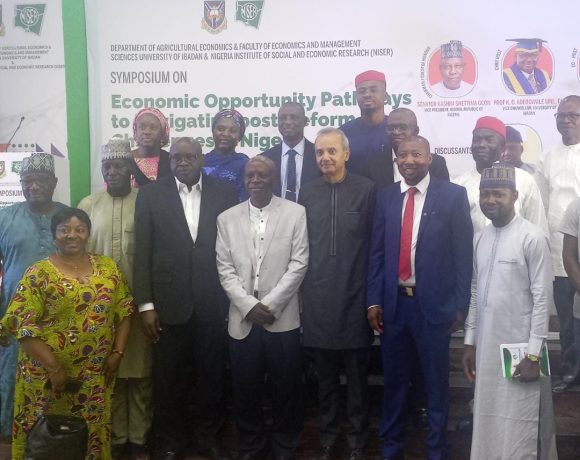
Country Director, World Bank, Nigeria Office, Professor Shubham Chaudhuri, said this in Ibadan at a Symposium on “Economic Opportunity Pathways to Navigating Post-reform Challenges in Nigeria”.

He stated that Nigerians must benefit from the proceeds through various poverty alleviation programmes such as cash transfer scheme, provision of Mass transit buses, assistance to farmers and free education, while the federal government should sustain the removal of the fuel subsidy and also curb commercial malpractices.

Professor Chaudhuri enjoined state governments that have benefitted from the World Bank projects like NG-CARES programme, to complement the federal government in the post subsidy removal regime.

On the issue of rising inflation in the country, Professor Chaudhuri advised the President Bola Tinubu led administration to end borrowing from the Central Bank of Nigeria, CBN and create more friendly environment for private investments to thrive.

Also speaking, Director General, Nigeria Institute of Social and Economic Research, NISER, Professor Anthonia Simbine, reiterated the need for the nation’s economy to be diversified in a genuine and value adding ways.

In a message to the programme, Vice Chancellor, University of Ibadan, Professor Kayode Adebowale, who spoke through the Dean, Faculty of Economics and Management Sciences, Professor Olanrewaju Olaniyan, pointed out that the University would continue to embark on researches on ways to navigate Post reforms era in Nigeria.

Other speakers at the Symposium while appealing to Nigerians to exercise more patient as a result of the effects of the fuel subsidy removal, equally called on governments to ensure upward review of workers salaries and also improve the security situation of the country.

Subscribe to our Telegram and YouTube Channels also join our Whatsapp Update Group

Agriculture

Farmers should always get adequate information from relevant agencies before they begin planting.

This became necessary in order not to be deceived by the early rains of the year.

An official of the Nigerian Metrological Agency, NIMET, Mr Oyegade Adeleke gave the advice in Ibadan at a training organized by the Nigerian Institute of Social and Economic Research, NISER for agricultural stakeholders on weather and climate change.

Mr Adeleke explained that the weather and climate change were determinants for farming activities hence the need for farmers to always take them into consideration for a bountiful harvest.

I want to urge you to get weather forecast on a daily and weekly basis to guide you in avoiding wasted efforts”.

On his part, the Executive Secretary of Human Environment Development Agency, HEDA, Mr Arigbabu Sulaiman stressed the need for farmers to acquaint themselves with up till date information particularly, on the planting season.

“There is the need for you to be conversant with the weather forecast. This is to avoid losses that could arise from early rains that could stop abruptly resulting in planted crops being destroyed”

Some of the participants at the programme implored government at all levels to subsidise farms inputs and ensure proper dissemination of information to farmers to enhance food sufficiency.

Biyi Fadahunsi

Subscribe to our Telegram Channel and join our Whatsapp Update Group

Education

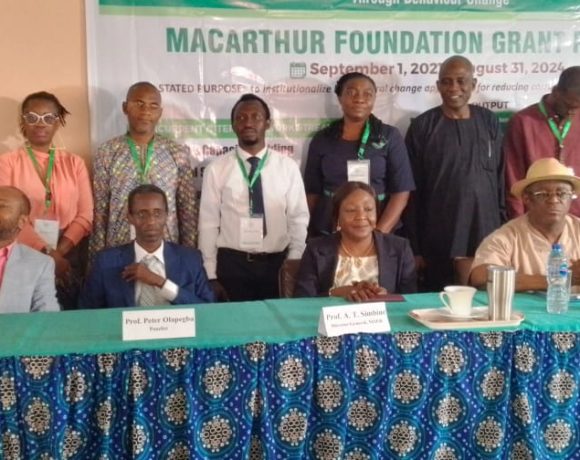
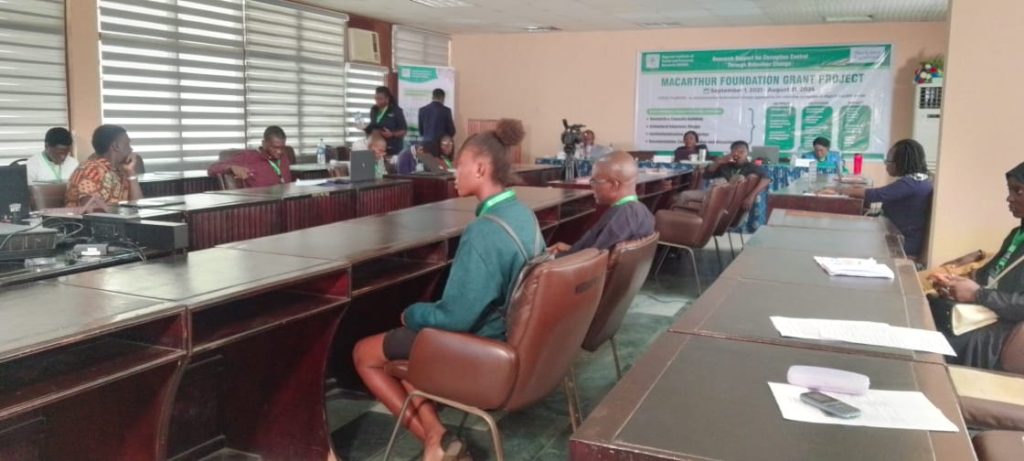
The need to tackle Nigeria’s corruption through a bottom up approach in attitude change took a centre stage at an event held at the Nigeria Institute of Social and Economic Research, seminar room, NISER, Ibadan.

  The new research approach which attempt to investigate people’s disposition to corruption among the low once earners and government functionaries in selected parastatals was a four years project in conjuction with McCarthur Foundation.

    In their seperate explanations on the new approach, the two leading field  reaseachers, Dr Oluwatosin Ilevbare and Dr Oluwafemi Famakinde said a number of academic theories  and reasoned action provided evidence of people’s deliberate intension to perpetrate corruption despite it’s wide condemnation.

   The scholars said there was the need to probe such attitude formation which they claimed manifest in peoples outward behaviours.

    In an interview, a principal investigator at NISER Dr Abubarka Oladeji who is also an associate professor said the new approach was not only targeting the Low class but also actor in political institutions.

     Dr Oladeji expressed optimism that Nigeria would soon overcome the challenge posed by the monster.

   Earlier in a welcome remark, the Director General, NISER, Professor A.T Simbine said NISER through the grants provided the institutes has the mandate of conducting research on socio economic issues affecting the country.

   Professor Simbine said corruption in Nigeria is a complex phenomenon that had long found its deep root in country since independence, hence, the need for the current research approach.

  “Consequently, we are dealing with a system that has morphed over time, and remains dynamic still. Given the foregoing foundational fault lines, Nigeria’s bureaucracy, its institutions and actors present complex challenges, one of which is corrupt behaviour. Our research thus far, provides us with some understanding of why traditional approaches to stemming corrupt practices, including detection based technical fixes, investigation, prosecution and sanctions have recorded little success. We now understand corruption to be a complex-adaptive problem, hence our leaning towards Behavioural Solutions.”

    Professor Simbine said the survey harvested experiences from 2,560 citizens and also collected stories from over 600 public officials in various government offices to balance out the narratives.

  She added that outcome of the findings would later form part of the research series of the institute in the nearest future.

Rotimi Famakin