Foreign

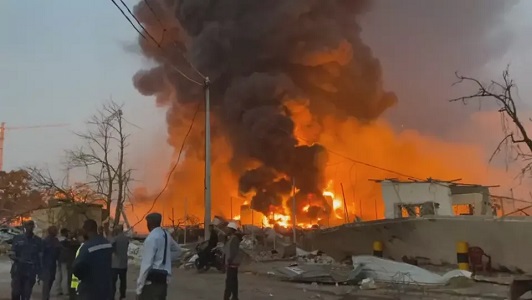
A huge explosion at the main oil refinery in Guinea’s capital Conakry has killed at least eight people and wounded dozens, officials say.

The explosion blew out the windows of nearby houses in downtown Conakry, and hundreds of residents fled the area, eyewitnesses said.

The authorities have ordered schools in the city to close and urged workers to stay at home.

The explosion was caused by a fire. It is unclear what started the blaze.

“Eight charred bodies were brought to the morgue of the Ignace Deen hospital,” a senior official at the facility told AFP news agency.

Media reports of the number of people injured vary from 84 to 100.

The fire broke out at around midnight local time and was still raging hours later.

The blaze and billowing black smoke could be seen miles away, Reuters news agency reports.

Government spokesman Ousmane Gaoual Diallo told the BBC that he could not confirm casualty figures because “we still haven’t finished counting the number of victims”.

A crisis unit has been set up under the prime minister to deal with the fire, and its aftermath, Mr Diallo said.

BBC/Simeon Ugbodovon

Subscribe to our Telegram and YouTube Channels and also join our Whatsapp Update Group 

Energy

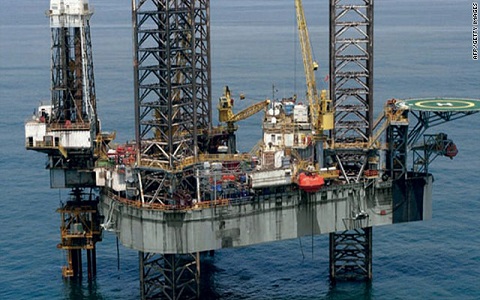
The Nigerian National Petroleum Company Limited has announced the discovery of oil in Nasarawa State, saying it will spud the first oil well in March 2023.

It said the discovery was in continuation of its oil exploration activities in the country’s inland basins.

NNPC’s Group Chief Executive Officer, Mele Kyari, announced the discovery and the planned spud-in when the Governor of the state, Abdullahi Sule, led a delegation of prominent indigenes on a courtesy visit to Company’s offices in Abuja.

Mallam Kyari, in a statement issued in Abuja by the corporation’s spokesperson, Garba-Deen Mohammad, said the results of exploratory activities confirmed the presence of substantial hydrocarbon resources in the state.

He called for “prompt action” on the project as the global energy transition had led to a reduction in investment in fossil fuels.

“This work must be done very fast because the whole world is walking away from fossil fuel due to energy transition, the earlier you go to market, the better for you,” Mallam Kyari stated.

He added: “Otherwise, 10 years from now, no one will agree to put money in the petroleum business except it comes from your cash flow.”

He said community support and a conducive environment were key to a successful operation in the area, in order to avoid the experience of the Niger Delta.

In his response, Governor Sule of Nasarawa State congratulated the NNPC boss on the successful commencement of oil production and the Kolmani Integrated Development Project, which was inaugurated in November last year by President Muhammadu Buhari.

He also applauded the President for his support and assured NNPC of a “conducive environment”.

Abdullahi Lamino

Subscribe to our Telegram and YouTube Channels also join our Whatsapp Update Group

Economy

Foreign Minister Annalena Baerbock says  Germany will end oil imports by the end of the year, with gas following.

Ukraine’s president Volodymyr Zelensky has criticised Germany for failing to curb Russian energy imports.

He described energy payments as “blood money”.

Proceeds from the sale of Russian oil and gas amount to around $1bn, £770m, a day, undermining international efforts to put economic pressure on President Vladimir Putin to end the war.

The US has already banned Russian oil imports and the UK plans to phase them out by the end of the year.

But according to report, European Union Countries are more heavily dependent on Russian energy, with Germany currently buying around 25% of its oil and 40% of its gas from Russia.

Mr Lindner told the newsmen that his country was working to implement an embargo on Russian energy but that he preferred using sanctions.

He said a sudden halt to Russian energy imports could see the physical shutdown of German producers such as manufacturers and carmakers.

Mr Lindner insisted that any calculation on Vladimir Putin’s part that Germany would continue to rely on Russian energy was “wrong”.
“In the end, we don’t want to have any further business with Putin,” he said.

Earlier this week, German economic institutes warned that immediately halting Russian imports would spark a sharp recession in Europe’s biggest economy by 2023.

However his stance was at odds with statements made by Germany’s foreign minister, Ms Baerbock, who is Green Party co-leader.

Ms Baerbock said Germany would halve Russian oil imports by the summer and eliminate them altogether by the end of the year, to be followed quickly by a reduction in Russian gas imports.

Germany’s finance minister was keen to sound tough on Russia and appears acutely aware of the criticism levelled at his country for dragging its feet over a full energy embargo on the Kremlin.

His basic message was – it is coming, but not quite yet, because it is impossible to enact immediately and would probably lead to shutdowns of large swathes of the German economy.

Mr Lindner said Germany would move as fast as possible, but did not confirm that would be within a year.

In Berlin this issue appears to be putting some stress on the three-party governing coalition.

Mr Lindner leads the free market FDP, not the normal bedfellows for the Social Democrats and Greens.

Meanwhile Green Party leader Annalena Baerbock, also the foreign minister, said dependence on Russian oil would definitely finish by the end of the year. The Chancellery under Olaf Scholz appears to be the most cautious on this issue.

BBC /Taiwo Akinola