Foreign

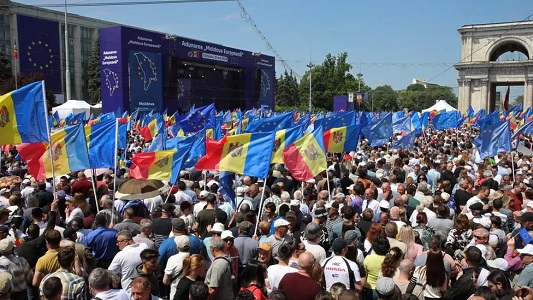
A huge pro-EU rally has taken place in Moldova’s capital Chisinau, organised by the country’s President Maia Sandu.

An estimated 75,000 people turned out to support Moldova’s push to join the European Union.

Her pro-Western government has accused Russia of stoking tensions by supporting Moldova’s pro-Russian opposition Sor party. Moscow denies meddling in the country’s affairs.

Ms Sandu told demonstrators her country no longer wanted to be an outlier.

“We don’t want to be on the outskirts of Europe anymore,” she said, pledging that Moldova would become a European Union member nation by 2030.

Moldova also “does not want to be blackmailed by the Kremlin,” she told the rally, where crowds waved EU flags and chanted pro-European slogans.

In February, Ms Sandu accused Russia of plotting to use foreign “saboteurs” to overthrow her government, saying the plot would involve “protests by the so-called opposition”, aiming to “overthrow the constitutional order”.

Russia’s foreign ministry dismissed the accusations, branding them “completely unfounded and unsubstantiated”.

Moldova, a former Soviet republic which has a population of about 2.6 million, applied last year to join the EU and in June 2022 became a candidate country, alongside Ukraine.

Russia’s invasion of Ukraine has accelerated both countries’ attempts to join the 27-nation bloc – not least because of the protection it offers against any Russian threat.

Moldova has been badly affected by the war, with Russian missiles reported to have crossed into Moldovan airspace on their way to Ukraine, on multiple occasions.

The country, which sits between Ukraine and Romania, is also dependant on Russian gas – something Moscow exploited last year by cutting its supply to Moldova by half.

This sparked protests over the rising price of gas and electricity, which contributed to the resignation of Moldova’s former prime minister Natalia Gavrilita earlier this year.

At the rally on Sunday, European Parliament President Roberta Metsola addressed the crowds, praising them for defying Russian threats to come out in their thousands.

She told the BBC the EU would welcome Moldova “with open arms and open hearts” and that a “Europe with Moldova can be stronger”.

She added that the Moldovan government was “slowly implementing reforms” that the EU wants in place before accession negotiations begin – which include amendments to the justice system and a commitment to “fight corruption at all levels”.

“We’re very impressed, frankly speaking, by the progress so far,” Ms Metsola said.

Analysis by the Pew Research Centre think-tank shows that current EU members were granted candidacy status, on average, 3.5 years after applying.

Ukraine and Moldova’s applications were approved much faster than that, taking less than four months, but it could still take some time for them to get full member status.

BBC/Simeon Ugbodovon

Subscribe to our Telegram and YouTube Channels also join our Whatsapp
Foreign

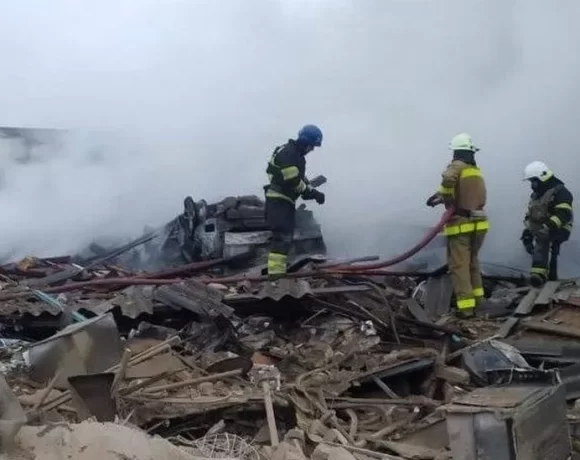
Russia has launched a series of missile and artillery attacks on Ukraine, the second pre-dawn attack in three days.

One person died in the Kherson region and 25 people – including three children – were injured in Dnipropetrovsk.

Ukraine’s armed forces said 15 of 18 missiles fired were intercepted by the country’s air defence.

One of the main targets was the city of Pavlohrad near Dnipro – a Russian-installed official said resources for a Ukrainian offensive were hit.

Writing on Telegram with a thumbs-up gesture, Vladimir Rogov said missiles targeted railway infrastructure and fuel depots.

Nineteen high-rise apartment blocks, 25 private houses, six schools and kindergartens, and five shops were also damaged.

Pavlohrad is in Ukrainian-held territory, around 70 miles (110km) from the frontline.

Ukraine’s Dnipropetrovsk military administration described it as a “tragic night and morning”.

In Kyiv, the air raid alert sounded at around 04:00 local time (02:00 GMT) and lasted for about three hours. The military administration said all missiles and drones directed at the capital were destroyed.

In the Kherson region – which is still partly controlled by Russia – Ukrainian regional authorities said Russia had carried out 39 shellings.

They came from ground-based weapons, as well as drones and planes, the authorities said.

Recent days have seen an increase in attacks in Ukraine, with places away from the front lines being targeted. On Friday, 23 people were killed in the central city of Usman.

Ukraine says it is finishing plans for a long-awaited offensive against Russian forces, supported by Western-supplied weapons and military equipment.

Russia, meanwhile, is also preparing for a Ukrainian push and has fortified its positions in occupied territory.

In the latest change at the country’s military leadership, Cl Gen Mikhail Mizintsev – the Russian deputy defence minister who oversaw armed forces logistics – has been sacked, after being appointed to the role only last September.

There have been longstanding complaints that front-line troops are not getting sufficient military equipment, and suffer shortages of food and uniforms.

Meanwhile, a Ukrainian official on Monday said the army had ousted Russian forces from some positions in Bakhmut, an eastern city that has been under siege for months.

General Oleksandr Syrskyi, the commander of ground forces, said on Telegram the situation remained “quite difficult” – but “the enemy is unable to take control of the city”.

BBC/Adetutu Adetule

Subscribe to our Telegram and YouTube Channels also join our Whatsapp Update Group 
Foreign

At least four persons have been killed in a fresh Russian attack on several Ukrainian cities.

Upper floors of two student dormitories were hit early on Wednesday in a drone strike in the city of Rzhyshchiv, on the outskirts of the capital.

A rescue service said an 11-year-old was among the wounded.

Separately, officials in Russian-annexed Crimea said a Ukrainian drone attack on their fleet were repulsed.

Explosions were reported by residents in the port city of Sevastopol.

The head of Russia’s occupation authority Mikhail Razvozhaev said three objects targeting the Black Sea Fleet had been destroyed and Russian warships were not damaged.

BBC noted that there was no comment from Ukraine’s military, which said earlier this week it had destroyed missiles destined for the fleet at a rail hub in Dzhankoi in northern Crimea.

FRCN Abuja / Titilayo Kupoliyi

Subscribe to our Telegram and YouTube Channels also join our Whatsapp Update Group 
Foreign

The US has accused Russia of reckless behaviour after an American surveillance drone crashed into the Black Sea following an encounter with Russian fighter jets.

The US says the drone was on a routine mission in international airspace when two Russian jets tried to intercept it.

The incident highlights the increasing risk of direct confrontation between Russia and the US over the Ukraine war.

The Russian defence ministry said the drone crashed after a “sharp manoeuvre” and that the MQ-9 Reaper drone was flying with its transponders turned off. Transponders are communications devices that allow the aircraft to be tracked.

Reaper drones are surveillance aircraft with a 20m, wingspan.

According to the US military, the incident happened at about 07:03 Central European Time on Tuesday.

“Our MQ-9 aircraft was conducting routine operations in international airspace when it was intercepted and hit by a Russian aircraft, resulting in a crash and complete loss of the MQ-9,” the statement said.

Several times before the collision the Su-27 fighter jets dumped fuel on the drone in a “reckless, environmentally unsound and unprofessional manner”, it said.

The US summoned the Russian ambassador in Washington, Anatoly Antonov, to protest against the move.

Following the meeting, Russian state media quoted Mr Antonov as saying that Moscow saw the drone incident as “a provocation” and that “the unacceptable activity of the US military in the close proximity to our borders is a cause for concern”.

BBC/Taiwo Akinola

Subscribe to our Telegram and YouTubeChannels also join our Whatsapp Update Group

Foreign

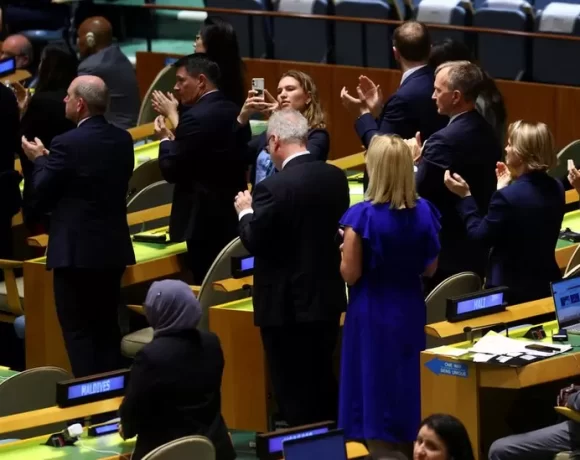
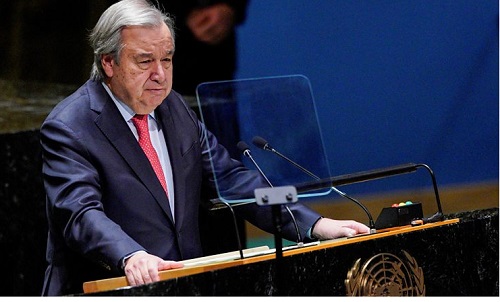
UN head António Guterres has condemned Russia’s invasion of Ukraine as an “affront” to the world’s collective conscience at a meeting of the General Assembly nearly one year on.

The meeting was debating a motion backed by Ukraine and its allies demanding Russia pull out immediately and unconditionally.

Ukraine hopes that by supporting the motion countries will show solidarity.

The Kremlin has accused the West of wanting to defeat Russia at any cost.

Vasily Nebenzya, the Kremlin’s ambassador to the UN, said the US and its allies were prepared to plunge the entire world into war.

Russian President Vladimir Putin sent up to 200,000 soldiers into Ukraine on 24 February 2022 in the biggest European invasion since the end of World War Two.

The devastating war that ensued has left at least 7,199 civilians dead and thousands of others injured, according to a UN estimate, but that number is likely to be much higher.

The mayor of the Ukrainian city of Mariupol, where mass executions are alleged to have taken place, estimated in April that 21,000 people had died there alone.

Russia and Ukraine have each seen at least 100,000 of their soldiers killed or injured, according to the US military.

More than 13 million people were made refugees abroad or displaced inside Ukraine.

Mr Putin’s claim that his operation was needed to “demilitarise and denazify” Ukraine, a country with historic ties to Russia, was dismissed by Ukraine and its allies as a ruse for an unprovoked attack.

“That invasion is an affront to our collective conscience,” Mr Guterres told the General Assembly. “It is a violation of the United Nations Charter and international law.”

The possible consequences of a “spiralling conflict” were, he said, a “clear and present danger”.

Mr Guterres said the war was “fanning regional instability and fuelling global tensions and divisions while diverting attention and resources from other crises and pressing global issues”.

There had, he said, been “implicit threats to use nuclear weapons”.

“It is high time to step back from the brink,” he said.

“Complacency will only deepen the crisis, while further eroding our shared principles proclaimed in the Charter. War is not the solution. War is the problem. People in Ukraine are suffering enormously. Ukrainians, Russians and people far beyond need peace.”

Sixty countries have sponsored the resolution, which stresses “the need to reach, as soon as possible, a comprehensive, just and lasting peace in Ukraine in line with the principles of the Charter of the United Nations.”

The UN is likely to approve the resolution, which is not legally binding but carries political weight. However, it is unlikely that the vote will have much influence on Russia’s actions in Ukraine.

Voting will take place later on Thursday, the eve of the invasion’s first anniversary.

Over the past year, the General Assembly has voted on similar resolutions opposing Russia’s invasion. In October 143 member states voted to condemn Moscow’s illegal annexation of parts of Ukraine. Russia, Belarus, Syria, and North Korea opposed the motion, while India and China were among the 35 states that abstained.

Mr Guterres was speaking after Russia’s President Vladimir Putin gave a speech blaming the West for the war.

In his address to the nation on Tuesday, Mr Putin also announced Russia’s decision to suspend a key nuclear arms treaty after US President Joe Biden, fresh from a surprise visit to Kyiv, praised Western democracy for standing up to Russian aggression.

Mr Biden has called the decision to suspend the treaty, designed by the US and Russia in 2010 to prevent nuclear war, a big mistake.

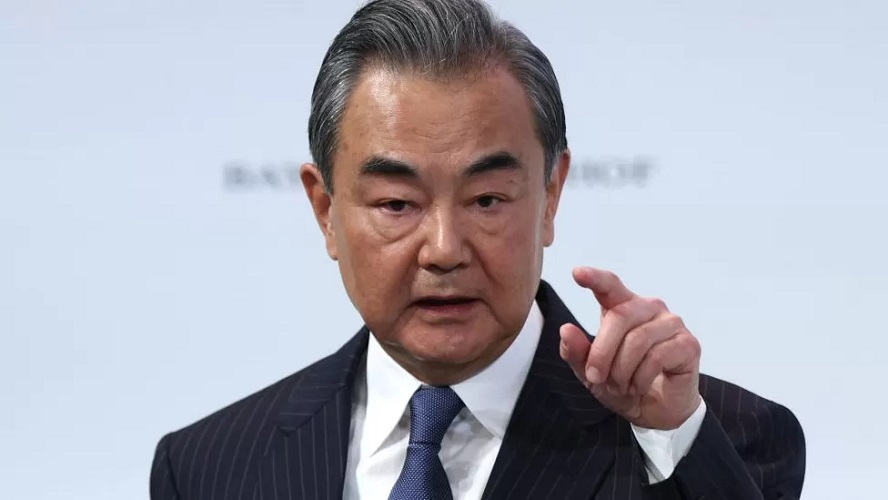
On Wednesday, Mr Putin met China’s top foreign policy official, Wang Yi, in Moscow and said cooperation with Beijing was “very important to stabilise the international situation”. The visit marked an end to China’s claim to neutrality regarding the war in Ukraine.

BBC/Simeon Ugbodovon

Subscribe to our Telegram and YouTube Channels also join our Whatsapp Update Group
Foreign

China is considering giving Russia weapons and ammunition for the Ukraine war, US Secretary of State Anthony Blinken has said.

Mr Blinken told CBS News that Chinese companies were already providing “non-lethal support” to Russia – and new information suggested Beijing could provide “lethal support”.

This escalation would mean “serious consequences” for China, he warned.

China has denied reports that Moscow has requested military equipment.

Chinese President Xi Jinping is an ally of Russian President Vladimir Putin and is yet to condemn Russia’s invasion – but he has sought to remain neutral in the conflict and has called for peace.

Mr Blinken was speaking to CBS after he met China’s top diplomat, Wang Yi, on Saturday at the Munich Security Conference.

He said that during the meeting he expressed “deep concerns” about the “possibility that China will provide lethal material support to Russia”.

“To date, we have seen Chinese companies… provide non-lethal support to Russia for use in Ukraine. The concern that we have now is based on information we have that they’re considering providing lethal support,” he said.

He did not elaborate on what information the US had received about China’s potential plans. When pressed on what the US believed China might give to Russia, he said it would be primarily weapons as well as ammunition.

The US has sanctioned a Chinese company for allegedly providing satellite imagery of Ukraine to the mercenary Wagner Group, which supplies Russia with thousands of fighters.

Mr Blinken told CBS that “of course, in China, there’s really no distinction between private companies and the state”.

If China provided Russia with weapons, that would cause a “serious problem for us and in our relationship”, he added.

Relations between Washington and Beijing were already poor after the US shot down an alleged Chinese spy balloon in early February. Both sides exchanged angry words, but equally both sides appeared embarrassed by the incident and seemed ready to move on.

But if China were to deliver weapons to help Russian forces in Ukraine, then US-Chinese relations would deteriorate much more severely.

Mr Blinken’s warning seems to be clearly designed to deter China from doing that.

Mr Blinken also said the US was worried about China helping Russia evade Western sanctions designed to cripple Russia’s economy. China’s trade with Russia has been growing, and it is one of the biggest markets for Russian oil, gas, and coal.

Nato members, including the US, are sending a variety of weapons, ammunition and equipment to Ukraine, including tanks. They have stopped short of sending fighter jets, and Mr Blinken would not be drawn on whether the US would help other countries supply jets.

“We’ve been very clear that we shouldn’t fixate or focus on any particular weapons system,” he said.

He did, however, say that the West must ensure Ukraine had what it needed for a potential counter-offensive against Russia “in the months ahead”. Russia is currently trying to advance in eastern regions of Ukraine, where some of the fiercest fightings of the war has taken place.

Mr Wang said in Munich yesterday that China had “neither stood by idly nor thrown fuel on the fire” for the Ukraine war, Reuters reported.

China would publish a document that laid out its position on settling the conflict, Mr Wang said. The document would state that the territorial integrity of all countries must be respected, he said.

“I suggest that everybody starts to think calmly, especially friends in Europe, about what kind of efforts we can make to stop this war,” Mr Wang said.

He added that there were “some forces that seemingly don’t want negotiations to succeed, or for the war to end soon”, but did not say who he meant.

The Chinese President, Mr Xi, is scheduled to deliver a “peace speech” on the anniversary of Russia’s invasion of Ukraine on Friday, 24 February, according to Italy’s foreign minister Antonio Tajani.

Mr Tajani told Italian radio that Mr Xi’s speech would call for peace without condemning Russia, Reuters reported.

During their meeting, Mr Blinken and Mr Wang also exchanged strong words on the deepening row over an alleged Chinese spy balloon that was shot down over the US.

Mr Blinken said during the meeting that the US would not “stand for any violation of our sovereignty” and said, “this irresponsible act must never again occur”.

Mr Blinken told CBS that other nations were concerned about what he called China’s “surveillance balloon program” across five continents.

Mr Wang, meanwhile, called the episode a “political farce manufactured by the US” and accused them of “using all means to block and suppress China”. China has denied sending a spy balloon.

And on Sunday morning, Beijing warned that the US would “bear all the consequences” if it escalated the argument over the balloon. China would “follow through to the end” in the event “the US insists on taking advantage of the issue”, it said in a foreign ministry statement reported by Reuters.

BBC/Simeon Ugbodovon

Subscribe to our Telegram and YouTubeChannels also join our Whatsapp Update Group

Foreign

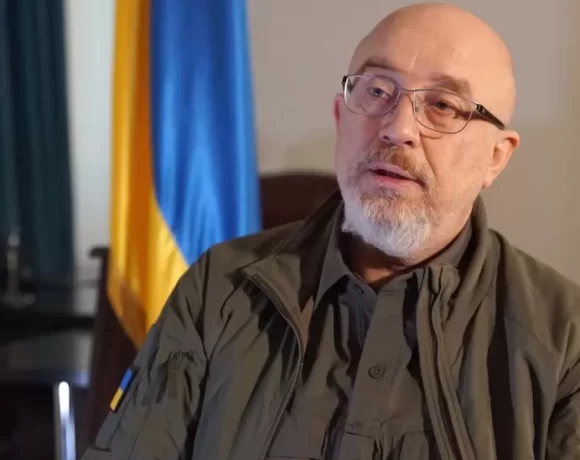
Ukrainian defence minister says, as Western countries, once concerned that military assistance could be seen as an escalation by Russia, change their “thinking approach”.

In an interview with BBC, Oleksii Reznikov said he was sure that, Ukraine would receive long-sought weapons, including tanks and fighter jets, as both Ukraine and Russia seemed to be preparing for new offensives in the spring.

“This concern about the next level of escalation, for me, is some kind of protocol,” Mr Reznikov said.

“Ukraine as a country, and the armed forces of Ukraine, became [a] member of Nato. De facto, not de jure (by law). Because, we have weaponry and the understanding of how to use it.”

Russian President Vladimir Putin has framed his invasion of Ukraine as an existential battle against Western countries that want to weaken Russia.

Russian figures have argued they are fighting Nato in Ukraine, as the West has supplied the country with weapons in what they call a war of aggression.

Ukraine, for years, has sought to join the military alliance between the US, Canada and 28 European countries, something President Vladimir Putin has described as a security threat for Russia.

Ukrainian President Volodymyr Zelensky has pushed for fast-track accession, but it is unclear whether full membership is something the alliance members will seriously consider even after the war is over, despite pledges of support.

Article 5 of the Nato Treaty says an armed attack against any member should be considered an attack against all.

Mr Reznikov, however, denied that his comments would be seen as controversial, not only by Russia but, perhaps, by Nato itself, as the alliance has taken steps not to be seen as a party to the conflict.

“Why [would it be]  controversial? It’s true. It’s a fact,” Mr Reznikov said. “I’m sure that in the near future, we’ll become member of Nato, de jure.”

The defence minister spoke in the capital, Kyiv, as Ukrainian and Russian forces continued to fight for the small town of Soledar, in the eastern Donetsk region, in some of the most intense battles in the nearly 11-month-old war.

The Russian offensive is led by the mercenary Wagner Group, whose founder Yevgeny Prigozhin, a long-time Putin ally, has become a vocal critic of the Russian army’s performance in Ukraine.

On Tuesday, Mr Prigozhin claimed that his fighters had seized control of the town, an allegation that was dismissed by Ukraine and, remarkably, by the Kremlin, in what was considered a rebuff to Mr Prigozhin.

The situation in Soledar was “very difficult”, Mr Reznikov said, but “under control”. He said Wagner fighters were being used in “wave after wave after wave” of attacks, leading to a high number of deaths, and that Mr Prigozhin was interested in the possible economic benefits of seizing the town, home to Europe’s largest salt mines.

“They’ll earn money from blood,” he said.

Soledar is about 10km (six miles) from Bakhmut, a strategic city where Ukrainian and Russian forces have been engaged in a months-long war of attrition that has caused widespread destruction and heavy losses on both sides. There, Wagner mercenaries have also been deployed in large numbers, and Mr Prigozhin is believed to have made the capture of Bakhmut a personal goal.

The group, Mr Reznikov said, “need to deliver some kind of proof to declare they’re better than the regular armed forces of the Russian Federation”. If seized, Bakhmut could pave the way for a Russian push towards Kramatorsk and Slovyansk, two Ukrainian strongholds in Donetsk, a region that has been a key target for President Putin.

BBC/Taiwo Akinola

Subscribe to our Telegram and YouTubeChannels also join our Whatsapp Update Group

Foreign

Russia has said a New Year’s Day missile attack which killed at least 89 Russian soldiers happened because troops were using their mobile phones.

Use of banned phones allowed the enemy to locate its target, officials said. An investigation has already begun.

Ukraine says 400 soldiers were killed – and another 300 wounded – in the attack on a college for conscripts in Makiivka, in the occupied Donetsk area.

It is the largest number of deaths Russia has acknowledged in the war.

Russia said that at 00:01 local time on New Year’s Day, six rockets were fired from a US-made Himars rocket system at a vocational college, two of which were shot down.

The deputy commander of the regiment, Lt Col Bachurin, was among those killed, the ministry of defence said in a statement on Wednesday.

A commission is investigating the circumstances of the incident, the statement said.

But it is “already obvious” that the main cause of the attack was the presence and “mass use” of mobile phones by troops in range of Ukrainian weapons, despite this being banned, it added.

“This factor allowed the enemy to locate and determine the coordinates of the location of military personnel for a missile strike.”

Officials found guilty in the investigation will be brought to justice, the statement added, and steps were being taken to prevent similar events in future.

Russia also raised the number of Russian soldiers killed in the attack to 89 – up from 63 – although there is no way of verifying how many soldiers were killed. It is extremely rare for Moscow to confirm any battlefield casualties.

The vocational college was packed with conscripts at the time – men who were among the 300,000 called up in President Vladimir Putin’s partial mobilisation in September. Ammunition was also being stored close to the site, which was reduced to rubble.

BBC/Taiwo Akinola

Subscribe to our Telegram and YouTube Channels also join our Whatsapp Update Group

Foreign

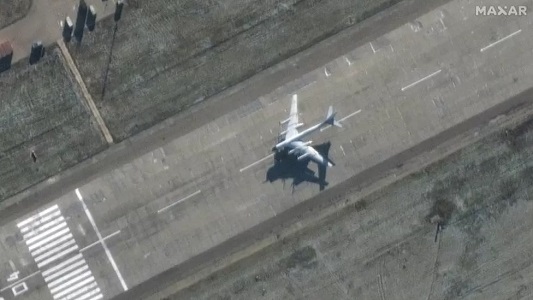
A Ukrainian drone attack on Engels bomber base in south Russia has left three people dead, Moscow says.

Air defences reportedly shot down the drone but falling debris caused the casualties in the overnight attack.

Russia accuses Ukraine of carrying out a similar attack on the airfield, home to strategic bombers, on 5 December. The base lies about 500km (310 miles) northeast of the border with Ukraine.

The Ukrainian military has not officially commented on those attacks.

Russia’s defence ministry says its air defences shot down the Ukrainian drone flying at low altitude at about 01:35 local time on Monday (22:35 GMT Sunday).

Three Russian servicemen died of injuries caused by drone debris, it adds.

Earlier, social media users posted videos where what sound like blasts and air sirens can be heard at the Engels airfield.

The governor of Saratov region said there was “no threat to residents” of the town of Engels itself.

In the previous reported attack on 5 December on the airfield and another air base in the Ryazan region, three servicemen were also killed by debris from a downed Ukrainian drone, Moscow said at the time. Two aircraft were lightly damaged.

The Ukrainian military made no comment on the reported attacks.

The Engels air base has been repeatedly used by Russia to carry out missile strikes on various targets in Ukraine since Moscow launched its full-scale invasion on 24 February.

The Kremlin has accused Ukraine of attacking its territory before, but the alleged attacks in December are deeper into Russia than previous ones.

A number of military experts in Ukraine and the West have described the reported strikes as embarrassing for the Russian military.

BBC/Simeon Ugbodovon

Subscribe to our Telegram and YouTube Channels also join our Whatsapp Update Group
Foreign

The US and Russia have exchanged jailed US basketball star Brittney Griner for notorious arms dealer Viktor Bout, held in an American prison for 12 years.

The swap was approved by President Joe Biden in recent days, sources told CBS.

Griner was arrested at a Moscow airport in February for possessing cannabis oil and last month sent to a penal colony.

President Biden tweeted that he had spoken to Griner, that she was safe and was on her way home.

The Biden administration proposed a prisoner exchange last July, aware Moscow had long sought Bout’s release.

Russia’s foreign ministry confirmed the swap and Russian media reported that it had taken place in Abu Dhabi.

President Biden signed the order for Bout’s release, commuting his 25-year jail term.

Viktor Bout sold arms to warlords and rogue governments, becoming one of the world’s most wanted men.

Dubbed the “merchant of death” for gun-running in the years after the fall of the Soviet Union, the Russian’s exploits inspired the 2005 Hollywood film Lord of War, which was loosely based on his life.

His secretive career was brought to an end by an elaborate US sting in 2008, when he was arrested at a hotel in the Thai capital Bangkok, to the anger of the Russian government.

He was extradited two years later and has spent the past 12 years languishing in an American jail for conspiring to support terrorists and kill Americans.

BBC/Simeon Ugbodovon

Subscribe to our Telegram and YouTubeChannels also join our Whatsapp Update Group
News

Russia has launched massive missile strikes across Ukraine, including the capital Kyiv, causing power and water outages.

At least two blasts were reported in Kyiv.

According to the report, one resident said his district was without electricity.

In the northeastern city of Kharkiv, critical infrastructure facilities were hit.

The strikes come after Russia blamed Ukraine for a drone attack on its Black Sea Fleet in the annexed Crimea.

On Monday morning, missile strikes were also reported in the central Vinnytsia region, as well as Dnipropetrovsk and Zaporizhzhia in the southeast, and Lviv in western Ukraine.

A facility at the Dnipro hydroelectric power plant in the Zaporizhzhia region was also reportedly hit.

In Kyiv, a facility which powers 350,000 apartments was damaged, with engineers urgently deployed to restore the supply.

It was not immediately known if there were any casualties.

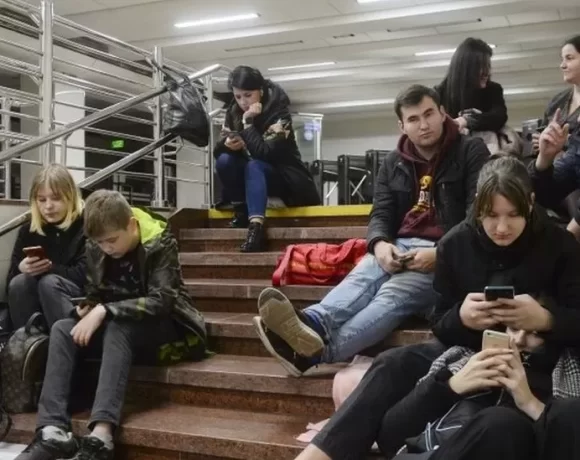
Residents in the regions under attack were urged to remain in shelters, amid fears more strikes could follow.

Ukraine’s Air Force spokesman Yuriy Ihnat told Ukrainian TV that Russia had used its strategic bombers to carry out its “massive” strikes.

The report says, a number of Russian missiles were shot down.

Andriy Yermak, the head of President Volodymyr Zelensky’s office, said that “Russian losers are continuing to fight against peaceful objects”.

Ukrainian Foreign Minister Dmytro Kuleba said that “instead of fighting on the battlefield, Russia fights civilians”.

Meanwhile, the US ambassador to Ukraine, Bridget Brink, tweeted: “Like millions of Ukrainians, our @USEmbassyKyiv team is once again taking shelter as Russia continues its callous and barbaric missile strikes on the people of Ukraine in an effort to leave the country cold and dark as we approach winter.”

BBC/Taiwo Akinola

Subscribe to our Telegram Channel and join our Whatsapp Update Group
Foreign

Russia has hit the Ukrainian capital, Kyiv, with a wave of Iranian-made kamikaze drones – killing at least one person, says Mayor Vitali Klitschko.

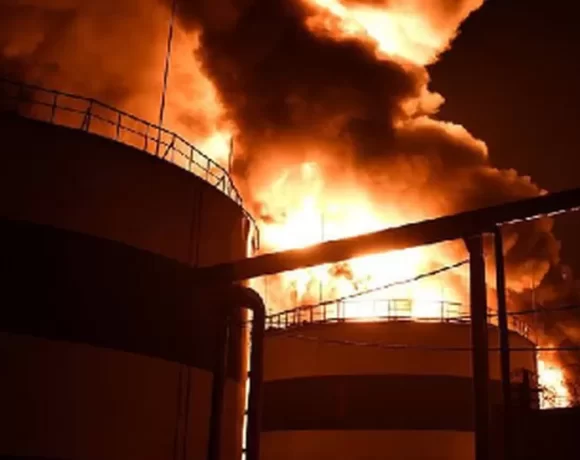
“It shows their desperation,” said Andriy Yermak, head of Ukrainian President Volodymyr Zelensky’s staff, and in the port city of Mykolaiv, sunflower oil tanks were set on fire by similar drones, said the city’s mayor.

According to a report, a week ago, the capital was hit by Russian missiles at rush hour, part of nationwide attacks which left 19 dead.

A Ukrainian air force official said all the drones had flown into the country from the south, as Oleksandr Senkevich said three drones ignited the tanks at Mykolaiv late on Sunday evening, hours before the attack in Kyiv.

Monday morning’s attacks in Kyiv were from drones – the low buzzing of these slow-moving weapons is becoming familiar across the country.

The city reverberated to the rattle of gunfire as anti-aircraft batteries frantically tried to shoot them down.

The explosions on Monday began at about 06:30 local time. The most recent was at about 08:10 local time, two were close to the city centre, with sirens and car alarms heard across the area.

“The enemy can attack our cities, but it won’t be able to break us,” said President Zelensky, describing the attacks as “terrorising the civilian population”.

What is being targeted is hard to determine. The mayor’s office says residential and non-residential buildings have been hit. Railway officials say explosions were seen close to Kyiv’s main station.

The newsmen saw fragments of a drone used in the attack that bore the words, “For Belgorod”, the Kremlin had accused Ukraine of launching missile attacks on the Russian border city of Belgorod, but, Ukraine had denied this.

Two gunmen – who had volunteered to fight in Ukraine – killed 11 people on Saturday at a Russian military training camp in the Belgorod region.

Recent attacks in Ukraine have targeted the country’s energy infrastructure.

Writing on the Telegram social media site, Mr Klitschko said, there were four strikes in Kyiv, although residents heard five or six explosions. He also told people to stay in air raid shelters.

But despite the warnings, the streets are far from deserted. Between the first and second set of strikes, plenty of people seemed to be going about their Monday morning business.

Mr Yermak described the kamikaze attacks as Russia’s “death throes” and said Ukraine needed more air defence systems “as soon as possible”.

BBC/Taiwo Akinola

Subscribe to our Telegram Channel and join our Whatsapp Update Group
Foreign

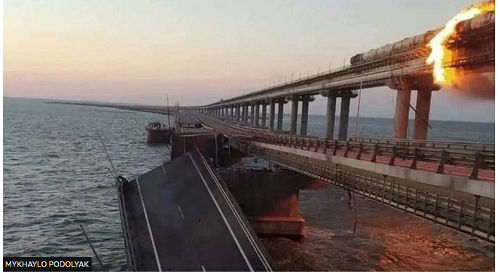
Light traffic has resumed on Russia’s only bridge to Crimea, hours after a huge blast brought down sections of the roadway.

According to investigations, the blast on Europe’s longest bridge – a symbol of Russia’s annexation of the peninsula from Ukraine in 2014 – killed three people.

Russian officials claimed that, the victims were in a nearby car when a lorry blew up,as the railway part of the bridge – where oil tankers caught fire – has also apparently reopened.

On Saturday evening, Russia’s foreign ministry published a video, seemingly showing cars using the bridge.

The rail and road crossing was opened in 2018 and is a key supply route for Russia’s invasion of Ukraine.

An adviser to Ukraine’s President Volodymyr Zelensky, Mykhailo Podolyak, did not directly claim Ukrainian responsibility but wrote: “Crimea, the bridge, the beginning.

“Everything illegal must be destroyed, everything stolen must be returned to Ukraine, everything occupied by Russia must be expelled.”

Ukraine’s defence ministry compared the bridge explosion to the sinking of Russia’s Moskva missile cruiser in April.

“Two notorious symbols of Russian power in Ukrainian Crimea have gone down,” it tweeted. “What’s next in line?”

The Ukrainian government itself simply tweeted: “Sick burn.”

Russia’s foreign ministry said: “The Kiev regime’s reaction towards destruction of civilian infrastructure is a testament to its terrorist nature.”It is hard to exaggerate the significance, and symbolism, of seeing the bridge – which was opened by President Putin – on fire.

Russia has used the bridge to move military equipment, ammunition, and personnel from Russia to battlefields in southern Ukraine.

As such, Ukrainian authorities said it was a legitimate target, as they vow to retake the peninsula.

Any attack on Crimea, where the Russian army has a massive presence, will be seen as another massive humiliation for the Kremlin.

The bridge is particularly hated by Ukrainians. Social media in Ukraine erupted in celebration on seeing the fire – one day after Russian President Vladimir Putin turned 70.

Local authorities in Crimea organised a ferry service between the Russian mainland and the peninsula, for heavier vehicles that can’t use the partially-reopened bridge.

Russia’s National Anti-Terrorism Committee said: “At 06:07 Moscow time today [03:07 GMT], an explosion was set off at a cargo vehicle on the motorway part of the Crimean bridge on the side of the Taman peninsula, which set fire to seven fuel tanks of a train that was en route to the Crimean peninsula.

“Two motorway sections of the bridge partially collapsed.”

Crimean parliamentary speaker Vladimir Konstantinov blamed the explosion on “Ukrainian vandals, who have finally managed to reach their bloody hands to the Crimean bridge”.

Russian President Vladimir Putin was briefed about the “emergency” on the bridge and ordered a government inquiry, Kremlin spokesman Dmitry Peskov said. A criminal investigation is also under way.

The 19km, 12-miles bridge across the Kerch Strait, which cost £2.7bn to build, was opened four years after Moscow illegally annexed Crimea.

It was hailed by Russian media as “the construction of the century”. Russian officials previously claimed it was well protected from threats from air, land or water.

The crossing is more than 100 miles from Ukrainian-held territory. One explosives expert said, the fire was probably not caused by a missile.

Putin said, “The lack of obvious blast / fragmentation damage on the road surface suggests that, an air-delivered weapon was not used” .

He said it was possible that “a well-planned attack from below may have been the cause”.

“I suspect explosives on the road bridge and train deck were initiated near simultaneously using coded radio command,” he added.

Kyiv has the momentum in this conflict. The army has reclaimed large swathes of territory, forcing Russian troops to abandon long-held positions.

Amid the losses, Moscow has begun a chaotic military mobilisation – which led to rare anti-war protests in Russia, and a huge exodus of military-age men.

Last month, Ukraine claimed responsibility for a series of air strikes on Crimea – including an attack on Russia’s Saky military base.

Culled /Taiwo Akinola

Foreign

A large fire on the only crossing between the occupied Crimean peninsula and Russia was caused by a lorry explosion, Russian officials say.

A blast on the road section led to oil tankers on the rail section catching fire, before the road collapsed.

Crimea was annexed in 2014 by Russia, which now uses the bridge to move military equipment into Ukraine.

The official Twitter account of the Ukraine government responded to the fire by tweeting: “Sick burn.”

An adviser to Ukraine’s President Zelensky, Mykhailo Podolyak, called the damage a “beginning” – but did not directly claim Ukrainian responsibility.

“Everything illegal must be destroyed, everything stolen must be returned to Ukraine, everything occupied by Russia must be expelled,” he tweeted.

Meanwhile, the Ukraine defence ministry compared the bridge explosion to the sinking of Russia’s Moskva missile cruiser in April.

“Two notorious symbols of Russian power in Ukrainian Crimea have gone down,” it tweeted. “What’s next in line?”

It is hard to exaggerate the significance, and symbolism, of seeing the bridge on fire. Opened by President Putin in 2018, it was meant to symbolise that Crimea was Russian.

Russia has used the bridge to move military equipment, ammunition, and personnel from Russia to battlefields in southern Ukraine.

As such, Ukrainian authorities said it was a legitimate target, as they vow to retake the peninsula.

Any attack on Crimea, where the Russian army has a massive presence, will be seen as another massive humiliation for the Kremlin.

The bridge is particularly hated by Ukrainians. Social media in Ukraine erupted in celebration on seeing the fire – one day after Russian President Vladimir Putin turned 70.

Road and rail traffic across the bridge has been suspended. Local authorities in Crimea say they will organise a ferry service between the Russian mainland and the peninsula.

Russia’s National Anti-Terrorism Committee said: “At 06:07 Moscow time today [03:07 GMT], an explosion was set off at a cargo vehicle on the motorway part of the Crimean bridge on the side of the Taman peninsula, which set fire to seven fuel tanks of a train that was en route to the Crimean peninsula.

“Two motorway sections of the bridge partially collapsed.”

Crimean parliamentary speaker Vladimir Konstantinov blamed the explosion on “Ukrainian vandals, who have finally managed to reach their bloody hands to the Crimean bridge”.

He added the damage to the bridge would be “promptly restored since it is not of a serious nature”.

President Putin has been briefed about the “emergency” on the bridge and has ordered a government inquiry, Kremlin spokesman Dmitry Peskov said, in comments quoted by Interfax news agency.

A criminal investigation is also underway.

The 19km (12-mile) bridge across the Kerch Strait, which cost £2.7bn to build, was opened by President Putin four years after Moscow illegally annexed Crimea.

It is the longest bridge in Europe, and was hailed by Russian media as “the construction of the century”. Russian officials previously claimed it was well protected from threats from air, land or water.

The crossing is more than 100 miles from Ukrainian-held territory. One explosives expert told the BBC the fire was probably not caused by a missile.

“The lack of obvious blast/fragmentation damage on the road surface suggests that an air-delivered weapon was not used,” he said.

He said it was possible that “a well-planned attack from below may have been the cause”.

“I suspect explosives on the road bridge and train deck were initiated near simultaneously using coded radio command,” he added.

Ukraine claimed responsibility last month for a series of air strikes on Crimea over the summer, including an attack on Russia’s Saky military base.

Kyiv has momentum in this conflict. The army has reclaimed large swathes of territory, forcing Russian troops to abandon long-held positions.

Amid the losses, Moscow has begun a chaotic military mobilisation – which led to rare anti-war protests in Russia, and a huge exodus of military-age men.

On Russian TV talk shows, presenters and studio guests have been expressing increasing doom and gloom about the situation.

BBC/Simeon Ugbodovon

Foreign

Russia’s Vladimir Putin will hold a signing ceremony on Friday formally annexing four more areas of Ukraine after self-styled referendums condemned by Ukraine and the West as a sham.

Russian-backed officials had earlier claimed the five-day exercise secured almost total popular support.

So-called votes were held in Luhansk and Donetsk in the east, and in Zaporizhzhia and Kherson in the south.

The Russian president will make a major speech at the Kremlin.

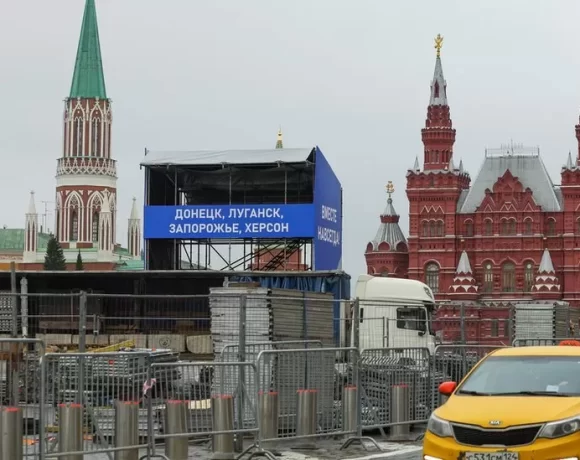
A stage has already been set up in Moscow’s Red Square, with billboards proclaiming the four regions as part of Russia. There were echoes of Russia’s annexation of Crimea in 2014, which also followed a discredited referendum and was heralded by a presidential victory speech from a stage.

However, no independent monitoring of the process took place and there were accounts of election officials going from door to door escorted by armed soldiers.

The US has said it will impose sanctions on Russia because of the referendums and EU member states are considering an eighth round of measures.

German Foreign Minister Annalena Baerbock said on Thursday that people in occupied regions of Ukraine had been taken from their homes and workplaces by threat and sometimes at gunpoint. “This is the opposite of free and fair elections. And this is the opposite of peace, it is a dictated peace,” she said.

The exercise began across 15% of Ukraine last Friday with only a few days’ notice. Russian state media argued that the use of armed guards was for security purposes but it was clear that it had the added effect of intimidating residents.

“You have to answer verbally and the soldier marks the answer on the sheet and keeps it,” one woman in Enerhodar told the BBC.

Russia does not fully control any of the four regions it has decided to annex. Although most of Luhansk remains in Russian hands, Moscow only controls 60% of Donetsk.

Seven months after Russian forces invaded Ukraine from the north, east and south, war is still raging on front lines in all four areas. The capital of the southern region of Zaporizhzhia is firmly under the control of Ukraine’s government, and a counter-offensive is underway in Kherson.

BBC/ Titilayo Kupoliyi

Subscribe to our Telegram Channel and join our Whatsapp Update Group
Foreign

The EU says, leaks in two major gas pipelines from Russia to Europe have been  caused by sabotage – but stopped short of directly accusing Russia.

According to report, European Commission head Ursula von der Leyen said deliberate disruption would meet the “strongest possible response”. Meanwhile, the EU has previously accused Russia of using gas supplies as a weapon against the West over its support for Ukraine.

But Kremlin spokesman Dmitry Peskov dismissed accusations of sabotage as “predictable, stupid and absurd”.

The US Secretary of State Antony Blinken said he thought the leaks would “not have a significant impact on Europe’s energy resilience”. Neither pipeline is transporting gas at the moment, although they both contain gas.

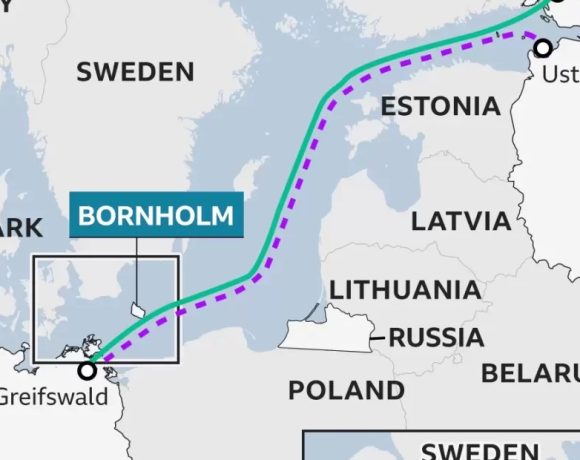
The operators of Nord Stream 2 warned of a loss of pressure in the pipeline on Monday afternoon. That led to Danish authorities saying ships should avoid the area near the island of Bornholm.

Then on Tuesday, the operator of Nord Stream 1 said the undersea lines had simultaneously sustained “unprecedented” damage in one day.

The Nord Stream 1 pipeline – which consists of two parallel branches – has not transported any gas since August when Russia closed it down, saying it needed maintenance.

It stretches 745 miles, 1,200km, under the Baltic Sea from the Russian coast near St Petersburg to north-eastern Germany.

Its twin pipeline, Nord Stream 2, was halted after Russia invaded Ukraine in February.

Mike Fulwood, a senior research fellow at the independent Oxford Institute for Energy Studies told the BBC sabotage was, indeed, the most likely cause of the leaks.

“To rupture an offshore pipeline is a rare occurrence, so three in 18 hours would be a big coincidence,” he said.

If the sabotage was indeed committed by Russia, this was a “bizarre” move, he said, as it had already shut supplies off.

He estimated that repairs could take between three and six months, as the damaged sections would need to be replaced. Similar damage to a different pipeline in the past took nine months.

Dmitry Peskov said he was “extremely concerned” about the leaks, adding that the possibility of a deliberate attack could not be ruled out.

Greenpeace raised concerns over the leaks, saying they could have the same detrimental impact on the environment as 30 million tonnes of carbon dioxide.

But the German environment ministry said the leaks would not pose a significant threat to marine life.

BBC/Taiwo Akinola


Subscribe to our Telegram Channel and join our Whatsapp Update Group
Foreign

President Volodymyr tells the UN General Assembly in New York Russia must face “just punishment” over its invasion of Ukraine.

In a pre-recorded video, the Ukrainian leader called for the creation of a special war tribunal and detailed alleged war crimes by Russia.

He also set out a “formula”, including more military support and punishing Russia on the world stage.

Russia’s Vladimir Putin had earlier called up 300,000 reservists for duty.

The move prompted rare protests in dozens of Russian cities and Mr Zelensky said the partial mobilisation showed his enemy was not serious about peace talks. Monitoring group OVD-Info said 1,315 Russians had been arrested.

According to the report, the Ukrainian leader said creating a special tribunal would help hold Moscow to account for stealing territory and murdering thousands of people. His address on Wednesday received a standing ovation from many of the session’s attendees.

Despite Russia’s decision to bolster its military campaign, the two sides took part in the biggest exchange of prisoners since the start of the war.

In a deal brokered by Saudi Arabia, 215 fighters were returned to the Ukrainian side, including 10 foreigners – while Russia took back 55 soldiers. Pro-Russian politician Viktor Medvechuk was also part of the swap. He has been seen as President Putin’s closest ally in Ukraine and faced treason charges.

Ukraine said that among those released were 108 members of the Azov battalion who for weeks defied Russia’s bombardment of Mariupol and the city’s steel plant. Battalion commander Denys Prokopenko and his deputy were among five senior officers freed.

Ten foreign prisoners held by Russian-backed forces were also released, including five British nationals and two Americans.

In his UN address, Mr Zelensky condemned Russian plans to stage so-called referendums on joining Russia in occupied areas of Ukraine. The vote which is due to start on Friday has been widely condemned as a sham by Western leaders.

He addressed the discovery of 445 new graves in Izyum, a northeastern city recently retaken from Russian forces during a sweeping Ukrainian counter-offensive.

Mr Zelensky detailed allegations of war crimes in the city, including against one man said to have been castrated and murdered.

“Why are the Russian military so obsessed with castration?” he asked.

The word “punishment” cropped up some 15 times in Mr Zelensky’s speech and was the first of his five non-negotiable conditions for peace.

Russia must face consequences for its aggression, he said, through further sanctions and by the UN stripping Moscow of its powerful role as a permanent Security Council member.

He also called for Ukrainian lives to be protected, and for the country’s internationally-recognised borders to be respected.

As his fourth and fifth conditions, he called for new security guarantees for Kyiv, and for the world to unite in calling out Moscow’s armed aggression.

Later on Wednesday, the European Union’s foreign policy chief said EU countries had agreed to hit Russia with new sanctions.

Josep Borrell told reporters the new restrictions would target Russian individuals and the country’s economic sectors.

Sporting his signature green T-shirt in his video, Mr Zelensky thanked the 101 countries at the UN which voted to allow him to address the assembly in a video rather than in person.

He blasted the seven countries including Russia which voted against his video appearance and criticized those which have remained neutral during the conflict.

BBC/Taiwo Akinola

Foreign

Ukraine’s recent counter-offensive will not change Russia’s plans, President Vladimir Putin has said in his first public comments on the matter.

In a rapid counter-attack, Ukrainian forces say they captured over 8,000 sq km (3,000 sq miles) in six days in the north-eastern Kharkiv region but Mr Putin said he was not in a hurry, and the offensive in Ukraine’s Donbas region remains on track.

He also noted that Russia had so far not deployed its full forces.

“Our offensive operation in the Donbas is not stopping. They’re moving forward – not at a very fast pace – but they are gradually taking more and more territory,” he said after a summit in Uzbekistan.

The industrial Donbas region in east Ukraine is the focus of Russia’s invasion, which Mr Putin falsely claims is necessary to save Russian speakers from genocide.

Parts of the Donbas have been occupied by Russian-backed separatists since 2014 and the Kharkiv region, where Ukraine’s recent counter-attack was launched, is not part of the Donbas.

In Friday’s comments, Mr Putin threatened a “more serious” response if Ukrainian attacks continue.

“I remind you that the Russian army isn’t fighting in its entirety… Only the professional army is fighting.”

Russia initially denied sending conscript soldiers to Ukraine, but several officers were disciplined after cases came to light of conscripts being forced to sign contracts and in some instances being taken prisoner.

So far, Russia has not officially declared war on Ukraine and only refers to its invasion as a “special military operation”.

President Putin put the country’s nuclear forces on “special” alert following its invasion of Ukraine in February and he has rarely left his country since then.

This week’s visit to the Shanghai Co-operation Organisation summit in Uzbekistan – where he met the Chinese leader Xi Jinping – highlights his need to foster ties with Asian countries after being sidelined by the West.

But even there, leaders have expressed concern over the invasion.

“Today’s time is not a time for war,” Indian Prime Minister Narendra Modi told Mr Putin.

It would be recalled that on Friday, US President Joe Biden reiterated his call on Russia to refrain from using chemical or tactical nuclear weapons.

Mr Biden said such action would “change the face of war unlike anything since World War Two”.

BBC/Maxwell Oyekunle

Subscribe to our Telegram channel

Foreign

Ukrainian officials say as many as eight Russian missiles hit the dam on Wednesday.

Officials say Russian missiles have hit a reservoir dam near the southern Ukrainian city of Kryvyi Rih.

City head, Oleksandr Vilkul said residents in some areas were told to evacuate but added the situation was under control.

Ukraine said the strike was revenge by Russia for its recent counter-attack.

President Volodymyr Zelensky – who was born in the city – described Russia as a “terrorist state” after the attack on the Karachunivske reservoir.

“You are weaklings who fight civilians,” Mr Zelensky said in his late-night address on Wednesday.

“Scoundrels who, having escaped from the battlefield, are trying to do harm from somewhere far away.”

This was an apparent reference to Ukraine’s recent military successes in a swift counter-offensive in the country’s north-eastern Kharkiv region.

It has seen Ukraine’s army reclaim swathes of occupied territory, forcing Russian troops to retreat.

In his speech, Mr Zelensky said the reservoir had “no military value at all”.

However, Russia has not publicly commented on the reported missile strikes but has repeatedly denied targeting civilians.

BBC/Maxwell Oyekunle

Subscribe to our Telegram channel

Foreign

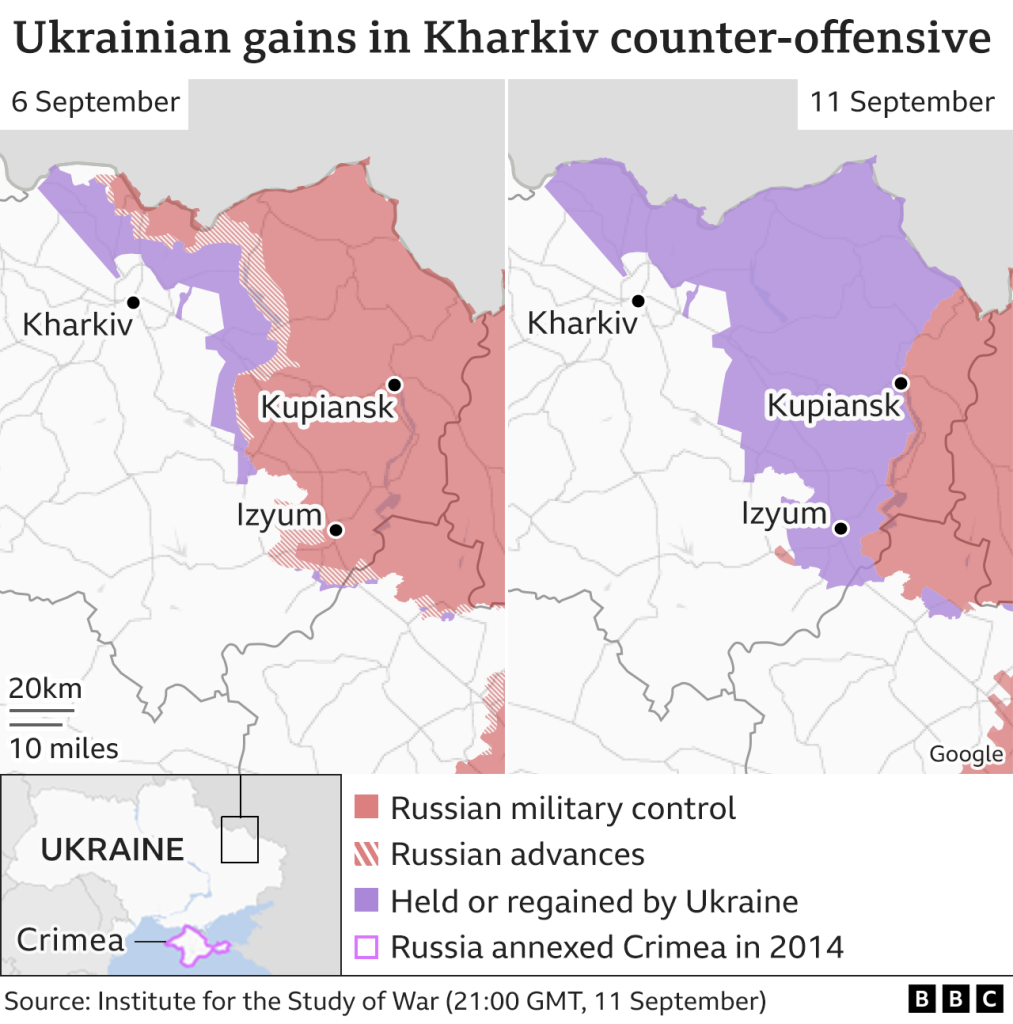
Ukrainian forces have seized even more territory from Russia as they continue their counter-offensive, the country’s president has said.

Volodymyr Zelensky said troops have now retaken more than 6,000 sq km (2,317 sq miles) from Russian control in September, in the east and the south.

The BBC cannot verify these figures.

Russia has admitted to losing key cities in the north-eastern Kharkiv region, in what is seen by some military experts as a potential breakthrough in the war.

Moscow describes its troop withdrawal from the region in recent days as a “regrouping” with the aim of focusing on the Luhansk and Donetsk regions in Ukraine’s east.

That claim has been ridiculed even in Russia, with many social media users there describing the stated pull-out as “shameful”.

Speaking later on Monday, US Secretary of State Antony Blinken said Ukrainian forces had made “significant progress” in their counter-offensive, but added that it was too early to predict the outcome.

“The Russians maintain very significant forces in Ukraine as well as equipment and arms and munitions. They continue to use it indiscriminately against not just the Ukrainian armed forces but civilians and civilian infrastructure as we’ve seen,” Mr Blinken said.

Russian President Vladimir Putin ordered a full-scale invasion of Ukraine on 24 February. Russia still holds about a fifth of the country.

In his late video address on Monday, President Zelensky said: “From the beginning of September until today, our warriors have already liberated more than 6,000 sq km of the territory of Ukraine – in the east and south”.

“The movement of our troops continues,” he said.

The counter-offensive appears to have been rapid. Last Thursday, President Zelensky said Ukrainian forces had retaken 1,000 sq km, but by Sunday that stated figure had tripled to 3,000 sq km.

Mr Zelensky thanked several of Ukraine’s brigades involved in the counter-offensive, describing their fighters as “true heroes”.

He did not reveal which Ukrainian cities and villages had been liberated.

Russia’s military earlier admitted that its troops had to leave the key cities of Balakliya, Izyum and Kupiansk in the Kharkiv region. Russia now controls only a small eastern part of the region.

Significant – albeit slower – advances by Ukrainian troops have also been reported in the southern Kherson region, which borders with Crimea – a Ukrainian peninsula annexed by Russia in 2014.

UK defence officials say the Ukrainian army’s recent successes will have “significant implications” for Russia’s overall operational design.

However, Kremlin spokesman Dmitry Peskov has insisted that military operations in Ukraine will continue “until all the tasks that were initially set” have been fulfilled.

Russia says its forces have been carrying out strikes in those areas retaken by Ukraine in recent days.

Valerii Marchenko, mayor of Izyum, told the BBC the Ukrainian army was in his city and the state flag had been raised.

The military is now engaged in cleaning up the war-torn city and Ukrainian forces are searching for Russian soldiers potentially hiding in people’s houses.

Mr Marchenko said that after “about 10 days”, residents who had to flee the city would be able to return “safely”.

Russia has been accused of targeting civilian infrastructure in revenge for setbacks on the battlefield.

A wave of missile strikes on Sunday caused massive power cuts across north-eastern Ukraine, leaving tens of thousands of people without electricity and running water for several hours.

BBC/Simeon Ugbodovon

Subscribe to our Telegram channel

Foreign

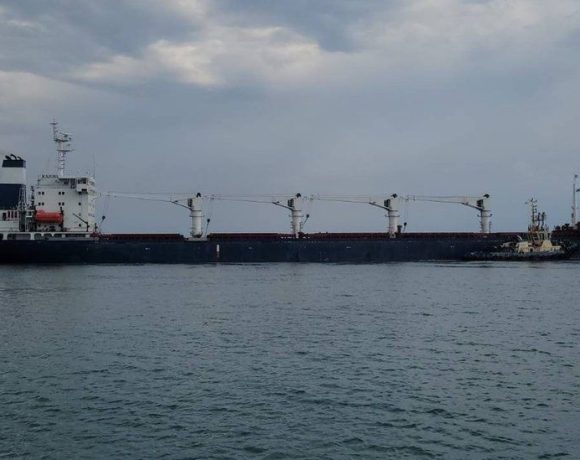
The first ship carrying grain has left a Ukrainian port under a landmark deal with Russia.

Turkish and Ukrainian officials say the ship left the southern port of Odesa early on Monday morning local time.

Russia has been blockading Ukrainian ports since February, but the two sides agreed on a deal to resume shipments.

It is hoped the deal will ease the global food crisis and lower the price of grain.

Turkey said the Sierra Leone-flagged vessel, the Razoni, would dock in Lebanon, adding that further shipments were planned over the coming weeks.

The Joint Co-ordination Centre, set up in Istanbul under the deal, said the ship was carrying some 26,000 tonnes of corn and was expected to arrive in Turkish waters for inspection on Tuesday.

“Today Ukraine, together with partners, takes another step to prevent world hunger,” Ukraine’s Infrastructure Minister Alexander Kubrakov wrote on Facebook.

“Unlocking ports will provide at least $1 billion in foreign exchange revenue to the economy and an opportunity for the agricultural sector to plan for next year.”

Mr Kubrakov added that 16 other ships were waiting to depart in the ports of Odesa Region in the coming weeks.

UN Secretary-General Antonio Guterres welcomed the departure of the ship and hailed Turkey for its role in working to implement the agreement.

Last month’s deal – brokered by the UN and Turkey – took two months to reach and is set to last for 120 days. It can be renewed if both parties agree.

The blockade of Ukraine’s grain has contributed to a global food crisis with wheat-based products like bread and pasta becoming more expensive and cooking oils and fertilizer also increasing in price.

Russia and Ukraine jointly account for nearly a third of global wheat supplies. In 2019 Ukraine accounted for 16% of the world’s corn supplies and 42% of sunflower oil, according to UN data.

Ukraine’s Foreign Minister Dmytro Kuleba called the shipment a “relief for the world” and urged Moscow to “respect its part of the deal”.

Under the terms of the deal, Russia has agreed not to target ports while shipments are in transit and Ukraine has agreed that its naval vessels will guide cargo ships through waters that have been mined.

Turkey – supported by the United Nations – will inspect ships, to allay Russian fears of weapons smuggling.

Three ports in southern Ukraine – Odesa, Chornomorsk and Pivdenny – are expected to be the focal point of the exports.

The deal was thrown into chaos less than 24 hours after it was announced that Russia had launched two missiles at Odesa port.

Ukraine’s President Volodymyr Zelensky said the strike showed that Moscow could not be trusted to stick to the deal.

But the Kremlin said the attack was aimed at a Ukrainian naval ship docked at the port and insisted that the strike did not affect the agreement.

BBC/Taiwo Akinola

Subscribe to ourTelegram channel

Foreign

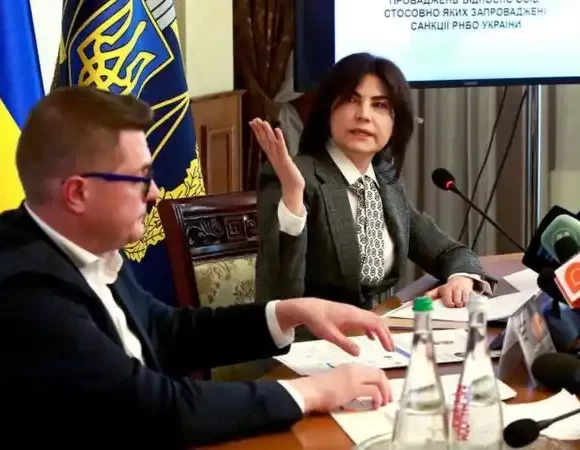
President Volodymyr Zelensky has fired the head of Ukraine’s security agency (SBU) and the prosecutor general, citing many cases of treason in the two powerful organisations.

He said more than 60 former employees were now working against Ukraine in Russian-occupied areas.

A total of 651 collaboration and treason cases had been opened against law enforcement officials, he added.

The sacked officials, Ivan Bakanov and Iryna Venediktova, have not commented.

In his video address late on Sunday, Mr Zelensky said: “Such an array of crimes against the foundations of the national security of the state… pose very serious questions to the relevant heads [of the two organisations].

“Each of these questions will receive a proper answer,” the Ukrainian president added.

The sacking of SBU chief Ivan Bakanov, a childhood friend of Mr Zelensky’s, follows the high-profile arrest of a former SBU regional head in Crimea, annexed by Russia in 2014. Oleh Kulinych is suspected of treason.

In other developments on Sunday:

  • Ukraine says a significant number of Russian warships in the Black Sea were moved from Crimea further east to the port of Novorossiysk. This comes as Kyiv has received further deliveries of longer-range missile systems from its Western allies
  • Dozens of distraught relatives and local residents attended the funeral of four-year-old Liza, who was one of 24 people killed when Russian missiles hit the central Ukrainian city of Vinnytsia on 14 July
  • Russia’s former President Dmitry Medvedev, now deputy head of the Security Council, warned Ukraine of a “Judgement Day” if it were to attack Crimea

BBC/Simeon Ugbodovon

Foreign

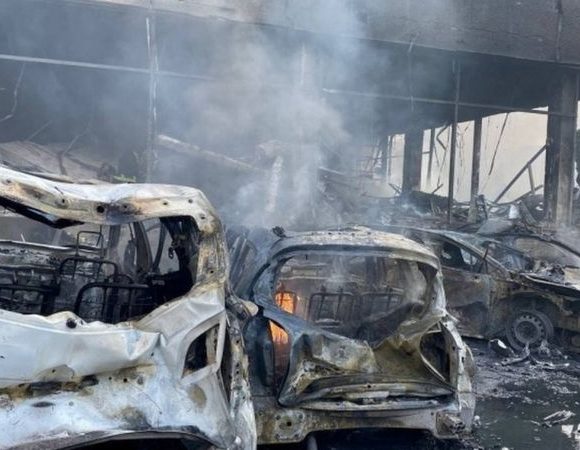
Russian missiles have struck a city far from the eastern front-line, killing at least 23 people including three children.

More than 100 were reported injured in the attack in Vinnytsia, which is south-west of Kyiv and a long way from the heart of the fighting in Donbas.

Three Russian missiles hit an office block and damaged residential buildings.

Ukrainian President Volodymyr Zelensky called it “an open act of terrorism”.

The missiles hit the car park of the nine-storey office block at around 10:50, 07:50 GMT, Ukraine’s State Emergency Service said. Residential buildings were also hit in the centre of Vinnytsia, which has a population of around 370,000.

The Russian defence ministry, which denies targeting civilians, has yet to comment on the strike.

The Ukrainian presidency said the attack had come from Kalibr cruise missiles launched from a submarine in the Black Sea.

Several dozen people were detained following the attack, Ukraine’s minister of internal affairs said, adding that they were being interrogated by the police and Ukraine’s security service.

A senior regional emergency service official told local TV that there was “probably no chance of finding anyone who survived” the attack.

“Every day, Russia kills civilians, kills Ukrainian children, carries out missile attacks on the civilian facilities where there is no military target. What is this, if not an open act of terrorism?” Mr Zelensky said in a statement on social media.

Ukrainian officials said one of the three children who died in the attack was a young girl called Liza, who was returning from a speech therapy session with her mother when the rocket strike hit.

Social media footage reposted by Ukraine’s defence ministry appeared to show Liza pushing a pink pram as she walked alongside her mother earlier in the day.

A pram that resembled the little girl was later photographed on its side outside the building hit by the rocket strike. Other images showed what appeared to be the same pram with a child’s body lying beside it.

According to report, Liza’s mother, who was hospitalised after the attack, later died from her injuries.

BBC /Taiwo Akinola

Foreign

Russian  President, Vladimir Putin says, the country will send nuclear capable short-range missile systems to its ally Belarus in the coming months.

He said Iskander-M systems “can fire ballistic and cruise missiles, both conventional and nuclear types”.

The systems have a range of up to 500km (310 miles).

Report says, tensions between Russia and the West have escalated, following President Putin’s decision to invade Ukraine on 24 February.

Mr Putin has made several references to nuclear weapons since then, which some have interpreted as a warning to Western countries not to intervene.

Speaking in St Petersburg, Mr Putin said Russia would help to modify Belarusian SU-25 warplanes so that they could carry nuclear weapons, in response to a query from Mr Lukashenko.

Meanwhile several explosions were reported in Kyiv on Sunday morning, the city’s Mayor Vitali Klitschko said.

“Ambulances and rescuers are on site. In two buildings, the rescue and evacuation of residents is under way,” he added.

According to report, a residential complex in the city had been hit.

Taking the city means Russia now controls nearly all of Luhansk region and much of neighbouring Donetsk – the two regions that form the vast industrial Donbas.

In his video address late on Saturday, Ukrainian President Volodymyr Zelensky pledged to take back “all our cities” occupied by Russia.

But he said the war with Russia had entered an emotionally difficult stage and he did not know how many more blows and losses there would be.

On Friday night Russia launched a barrage of missiles at targets in the north and west of Ukraine. At least three people were killed and more may be buried under rubble in the town of Sarny west of Kyiv, a local official said.

Some of the rockets were fired from Belarus, Ukraine said. Belarus has provided logistical support to Russia but its army is not officially taking part in the conflict.

Ukraine’s intelligence service said the missile strikes were part of Kremlin efforts to draw Belarus into the war.

Russia’s capture of Severodonetsk comes ahead of a week of Western diplomacy, with US President Joe Biden flying to Germany for a G7 summit followed by Nato talks.

In recent months, the Western alliance has shown signs of strain and fatigue but on Saturday UK Prime Minister Boris Johnson said Ukraine could win its battle with Russia.

“Now is not the time to give up on Ukraine,” he said.

On Sunday Indonesian President Joko Widodo, who is due to attend the G7, said he would urge the Ukrainian and Russian leaders to restart dialogue.

“War has to stop and global food chains need to be reactivated,” he said.

At Saturday’s televised meeting with his Belarusian counterpart Alexander Lukashenko in St Petersburg, Mr Putin said: “We have made a decision: within the next few months we will hand over to Belarus the Iskander-M tactical missile systems.”

He said all the details of the transfer would be worked out by the ministries of defence of the two countries.

Iskander missiles have already been deployed in Kaliningrad, a small Russian Baltic exclave between Nato members Lithuania and Poland.

The Belarusian leader said Lithuania’s move was “a sort of declaration of war” and “unacceptable”.

Steel and some other Russian goods come under the EU sanctions imposed over Russia’s invasion of Ukraine. Lithuania says its measures affect only 1% of the normal Russian goods transit on the route, dismissing Russian talk of a “blockade” of Kaliningrad.

BBC /Taiwo Akinola

Foreign

The West must prepare to continue supporting Ukraine in a war lasting for years, Nato’s chief has warned.

Secretary-General Jens Stoltenberg said the costs of war were high, but the price of letting Moscow achieve its military goals was even greater.

UK Prime Minister Boris Johnson has also warned of a longer-term conflict.

And in a stark warning, the newly appointed head of the British Army said the UK and allies needed to be capable of winning a ground war with Russia.

Gen Sir Patrick Sanders, who started the job last week, said in an internal message seen by the BBC: “Russia’s invasion of Ukraine underlines our core purpose – to protect the UK and to be ready to fight and win wars on land – and reinforces the requirement to deter Russian aggression with the threat of force.”

Mr Stoltenberg and Mr Johnson said sending more weapons would make a victory for Ukraine more likely.

“We must prepare for the fact that it could take years. We must not let up in supporting Ukraine,” the Nato chief said in an interview with German newspaper Bild.

“Even if the costs are high, not only for military support, also because of rising energy and food prices.”

The Western military alliance chief said that supplying Ukraine with more modern weapons would increase its chances of being able to liberate the country’s eastern Donbas region, much of which is currently under Russian control.

For the last few months Russian and Ukrainian forces have battled for control of territory in the country’s east – with Moscow making slow advances in recent weeks.

Writing in the Sunday Times, British Prime Minister Boris Johnson accused Russia’s Vladimir Putin of resorting to a “campaign of attrition” and “trying to grind down Ukraine by sheer brutality.”

“I’m afraid we need to steel ourselves for a long war,” he wrote. “Time is the vital factor. Everything will depend on whether Ukraine can strengthen its ability to defend its soil faster than Russia can renew its capacity to attack.”

The prime minister, who visited Ukraine’s capital on Friday, said supplies of weapons, equipment, ammunition, and training to Kyiv needed to outpace Moscow’s efforts to rearm itself.

BBC /Simeon Ugbodovon