Foreign

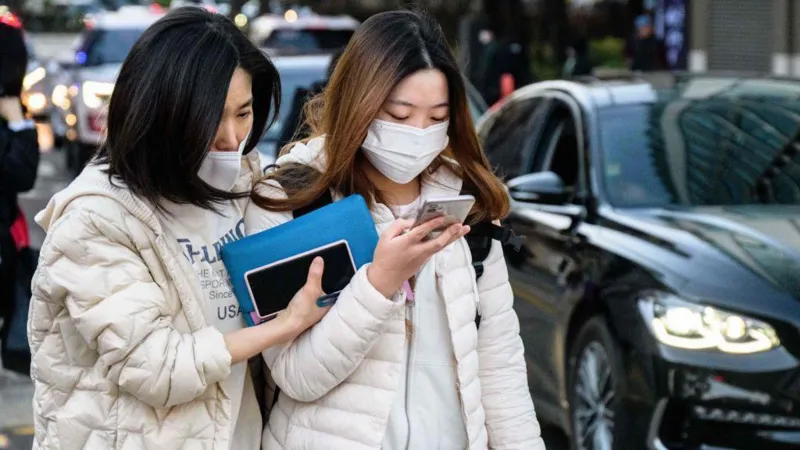
South Korea has passed a bill banning the use of mobile phones and smart devices during class hours in schools, becoming the latest country to restrict phone use among children and teens.

The law, which comes into effect from the next school year in March 2026, is the result of a bi-partisan effort to curb smartphone addiction, as more research points to its harmful effects.

Lawmakers, parents and teachers argue that smartphone use is affecting students’ academic performance and takes away time they could have spent studying.

The ban has its sceptics, including students, who question how it would work, its wider implications and whether it is addressing the root cause of addiction.

The bill passed convincingly on Wednesday afternoon, with 115 votes in favour out of 163 members present.

Most South Korean schools have already implemented some form of a smartphone ban. And they are not the first to do so.

Some countries like Finland and France have banned phones on a smaller scale, applying the restriction only to schools for younger children. Others like Italy, the Netherlands and China have restricted phone use in all schools.

But South Korea is among the few to enshrine such a ban in law.

Children these days “just can’t seem to put their smartphones down,” says Choi Eun-young, mother of a 14-year-old in Seoul.

It’s not just children though. Nearly a quarter of the country’s 51 million people depend on their phones too much, according to a 2024 government survey. But that figure more than doubles – to 43% – for those between the ages of 10 and 19. And it has been rising over the years.

More than a third of teens also say they struggle to control the amount of time they spend scrolling through videos on social media. And parents fear that this is getting in the way of everything else they could be doing with their time.

“When they go to school, they’re supposed to study, but also build friendships and take part in various activities. Yet they’re unable to focus on those things,” says Ms Choi. “Even when they’re chatting with friends, they quickly go back to their phones, and naturally this interferes with learning as well.”

Some parents, like Kim Sun, whose two daughters are in primary school, are also worried about bullying on social media, where “kids throw around unthinkably harsh insults” at each other.

Cho Jung-hun, an MP from the opposition People Power Party who introduced the bill, says he was encouraged to act as other countries made similar moves. He says there is “significant scientific and medical proof” that smartphone addiction has “extremely harmful effects on students’ brain development and emotional growth”.

Although it only bans phone use during class hours, the law gives teachers the power to stop students from using their phones on school premises. It also asks schools to educate students about the proper use of smart devices.

There are some exemptions. The bill allows students with disabilities or special educational needs to use assistive devices, and permits use for educational purposes or during emergencies.

Teachers, however, appear to be divided over the ban. Of the two major teachers’ groups in the country, only the conservative Korean Federation of Teachers’ Association backed the bill, saying it provides “a much firmer legal basis” for restricting phones in classrooms.

BBC / Titilayo Kupoliyi

Subscribe to our Telegram and YouTube Channels, and also join our WhatsApp Update Group.

Foreign

South Korea has confirmed it fired warning shots earlier in the week at North Korean soldiers who briefly crossed the heavily-fortified border between the two countries.

North Korean state media called the shots a “deliberate provocation” and Pyongyang has accused Seoul of risking “uncontrollable” tensions.

The incident was made public as new South Korean President Lee Jae Myung departed Seoul on Saturday for a visit to Tokyo and Washington.

Pyongyang has upped the ante in recent weeks, with leader Kim Jong Un’s sister rebuffing efforts towards reconciliation made by Lee’s government.

The incident took place amid continuing work by North Korea since last year to permanently seal its border with the South.

A strip of no-man’s land called the Demilitarised Zone (DMZ) separates the north and south, with intrusions often increasing tensions. The DMZ border is not fenced and the signposts are obscured by dense vegetation.

South Korea’s Joint Chiefs of Staff (JCS) said in a statement that some North Korean troops working in the border region crossed the military demarcation line between the two countries at about 15:00 local time in Seoul on Tuesday (07:00 BST).

The soldiers later moved back to the north of the line, the JCS added.

North Korean Army Lt Gen Ko Jong Chol said Seoul’s military used a machine gun to fire more than 10 warning shots towards its soldiers, according to state media.

“This is a very serious prelude that would inevitably drive the situation in the southern border area where a huge number of forces are stationing in confrontation with each other to the uncontrollable phase,” state media said he added.

Pyongyang has been dismissive of Seoul despite the June election victory of Lee, who had campaigned on improving inter-Korean ties.

South Korea’s military said later that month that it had suspended its loudspeaker propaganda broadcasts across the border to North Korea, as part of a bid to “restore trust” between the two sides.

Pyongyang considers the loudspeaker propaganda broadcasts an act of war and has threatened to blow them up in the past.

The two Koreas have been divided since the Korean War ended in 1953.

They did not sign a peace treaty and therefore have remained technically still at war ever since, although it has been years since either side shelled the other.

BBC / Titilayo Kupoliyi

Subscribe to our Telegram and YouTube Channels, and also join our WhatsApp Update Group.
Foreign

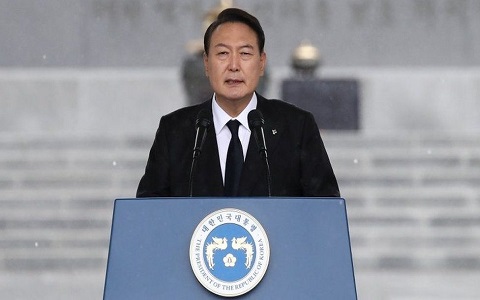
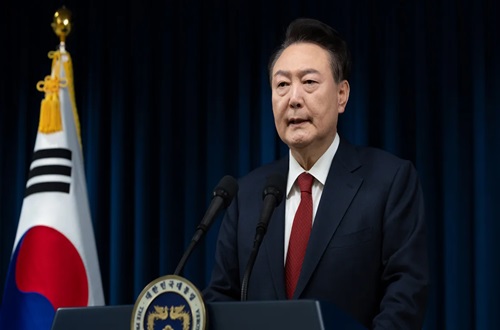
South Korea’s parliament voted to impeach President Yoon Suk Yeol on Saturday in an extraordinary rebuke that came about after his own ruling party turned on him following his refusal to resign over his short-lived martial law attempt.

It is the second time in less than a decade that a South Korean leader has faced impeachment proceedings in office and means Yoon is suspended from exercising his powers until the decision is finally adjudicated by the country’s Constitutional Court.

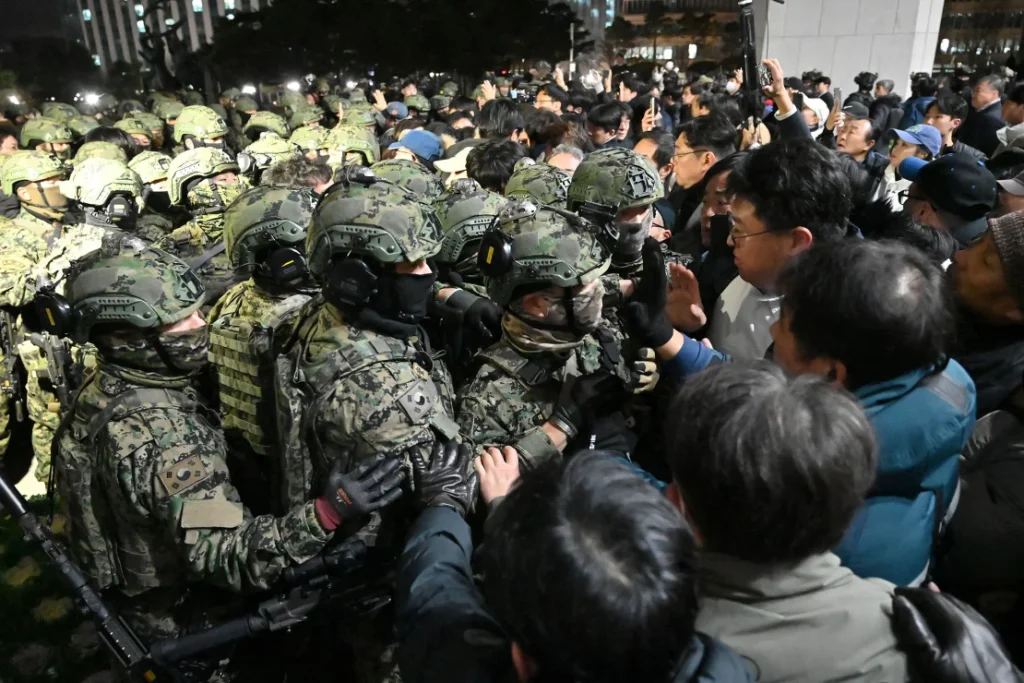
The dramatic decision marks the culmination of a stunning political showdown after Yoon briefly declared martial law on December 3 and sent soldiers to parliament, where lawmakers fought past troops to enter the building and vote down the decree.

Yoon’s gamble backfired spectacularly, galvanizing many in the vibrant Asian democracy to call for his removal.

Opposition parties tried impeaching him a week ago – but Yoon survived after members of his ruling People Power Party boycotted the vote, saying they hoped the president would voluntarily resign instead.

Yoon then doubled down – giving a defiant speech on Thursday in which he defended his martial law decision, lambasted the opposition, claimed he was trying to save the country and vowed to “fight until the last moment with the people.”

Yet moments before that speech, the leader of Yoon’s party withdrew his support for the president and backed impeachment as the “only way… to defend democracy”, instructing lawmakers to vote with their conscience.

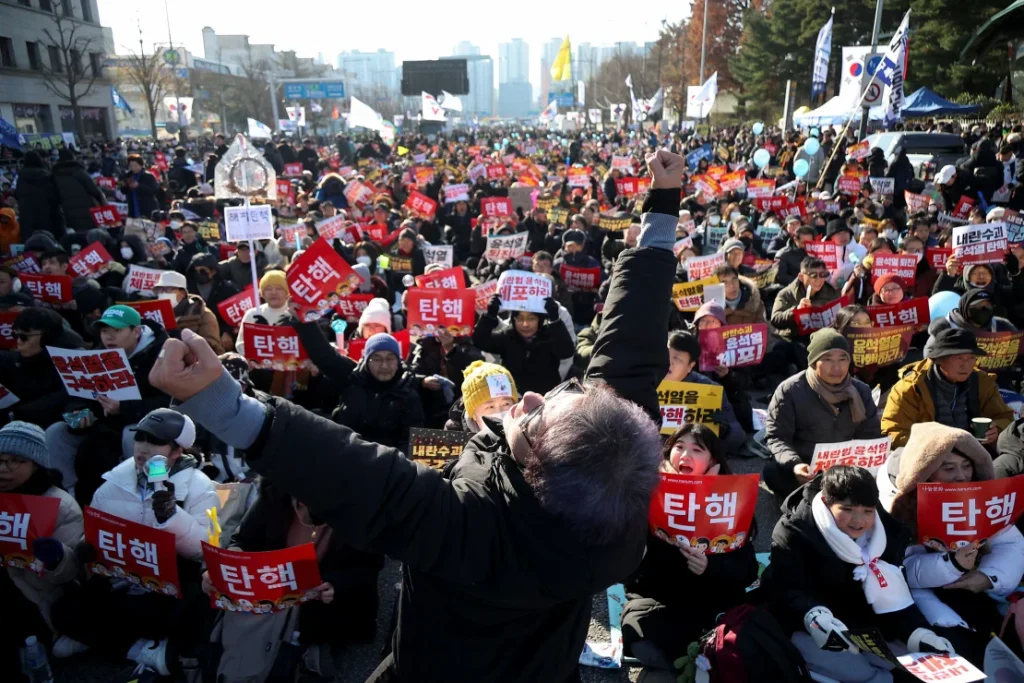
Thousands of protesters gathered in Seoul on Saturday, braving the cold to call for Yoon to resign ahead of the vote, which was passed by 204 lawmakers with 85 voting against it.

Meanwhile, thousands of the president’s supporters gathered in downtown Seoul, with many waving US and South Korean flags, chanting slogans and holding up signs in support of the embattled Yoon.

Yoon, who has been immediately suspended of his powers, now awaits a ruling by the Constitutional Court – one of the country’s highest courts – to confirm his fate, which can take up to six months.

If confirmed, he will become the second South Korean president to be thrown out of office by impeachment after Park Geun-hye, the country’s first female leader.

Under South Korean law, Prime Minister Han Duck-soo will serve as acting president, but he also faces his own political problems and is being investigated over his role in the martial law decision, adding to the political uncertainty in the weeks ahead.

A former prosecutor and conservative firebrand, Yoon has had a difficult two years in office, mired in low approval ratings and political scandals involving his wife and political appointments.

Since he took office in 2022 he has also faced political gridlock with an opposition-majority parliament – which prevented from moving forward on legislation to cut taxes and ease business regulations, as his main rivals in the Democratic Party used the legislature to impeach key cabinet members and hold up a budget bill.

His administration cracked down what he referred to as “fake news” with police and prosecutors raiding multiple media outlets, including MBC and JTBC, as well as the homes of journalists.

Yoon argued that his frustration with the political deadlock drove him to take a bold power move, surprising not only members of his own party but also many military leaders.

Police raids and treason investigations

In his late-night address declaring martial law, Yoon accused the opposition of “anti-state” activities and being in cahoots with North Korea, without providing evidence – a charge his opponents have strenuously denied. He also portrayed his act as the only way to break the political deadlock in parliament.

But it was met with shock and anger across the country, which remains deeply scarred by the brutality of martial law imposed during decades of military dictatorship before it transitioned into hard-won democracy in the 1980s.

Dramatic scenes from that night showed security forces breaking through windows in the National Assembly to try and prevent lawmakers from gathering, and protesters confronting riot police.

Since then, pressure on the president has grown, with police, parliament, prosecutors and the anti-corruption body launching separate investigations into Yoon on treason allegations. On Tuesday, lawmakers approved a special counsel to investigate whether Yoon committed insurrection and abused his power by issuing martial law.

The following day, South Korean police raided the presidential office, a presidential security official confirmed to CNN. Yoon has also been barred from leaving the country.

Last week, South Korean prosecutors detained former defense minister Kim Yong-hyun, who allegedly recommended the martial law imposition and resigned in the wake of the scandal. Kim attempted to end his own life in custody late Tuesday, according to the head of the country’s correctional service.

On Thursday, Yoon said he had only discussed the martial law decree with Kim before declaring it. Meanwhile parliament has already impeached both Yoon’s justice minister and his police chief.

Senior government officials have testified at various government hearings over the last week revealing some extraordinary details about the night of the martial law order.

Special Warfare Command Commander Kwak Jong-geun testified that he received a direct order from President Yoon to break the doors of the National Assembly and drag out the lawmakers, but he did not comply.

South Korea, one of East Asia’s most important economies and vital US regional ally, now faces months of protracted political uncertainty of the kind that dominated the country during the last impeachment crisis in 2016 and 2017.

Then-president Park Geun-hye was ultimately impeached by lawmakers over corruption allegations, kicked out of office by the Constitutional Court, jailed and later pardoned.

CNN/Titilayo Kupoliyi

Subscribe to our Telegram and YouTube Channels and also join our Whatsapp Update Group

Foreign

The chief prosecutor of the South Korea’s corruption investigation bureau has ordered a travel ban to be imposed on President Yoon Suk Yeol, who is currently under investigation in the wake of his shock martial law declaration last week.

Travel bans have also been imposed on several senior officials in Yoon’s administration.

Tens of thousands of people had come out in protest since the short-lived martial law order, calling for Yoon’s resignation or impeachment.

But a vote to impeach Yoon failed on Saturday, and the ruling People Power Party (PPP) said instead that its party leader and prime minister would run the country until the president’s “orderly exit”.

In a public address on Sunday, PPP leader Han Dong-hoon said Yoon would no longer be involved in foreign and domestic affairs until his early resignation – adding that Prime Minister Han Duck-soo would manage government affairs in the meantime.

“The President will not be involved in any state affairs including diplomacy before his exit,” said party leader Han.

However, Democratic Party floor leader Park Chan-dae described the proposed plan as “an illegal, unconstitutional second insurrection and a second coup”.

Representative Kim Min-seok of the Democratic Party had similarly criticised the plan, saying “nobody gave” PPP leader Han the power to make such decisions.

“The Prime Minister and the ruling party’s announcement that they would jointly exercise the powers of the president, which no one has given them, is clearly unconstitutional” he said, according to a Korea Herald report.

The opposition has vowed to hold impeachment votes against Yoon every Saturday.

On social media, many South Koreans voiced their concerns, saying there is a lack of clarity on who is leading the country.

The Ministry of National Defence confirmed at a briefing on Monday that the president retains command of the armed forces. That means in the event of any foreign policy incidents, including any possible threat from North Korea, Yoon is still, in theory, able to make executive decisions.

“The president can take the lead again any time he changes his mind,” political science professor Shin Yul of Myongji University told The Korea Herald.

“No one will be able to stop him, if Yoon insists.”

On Saturday Yoon made his first appearance since the martial law declaration, pledging that he would not impose another martial law order, and apologising for the “anxiety and inconvenience” caused by his declaration.

However, the opposition has insisted that they “will not give up” on impeaching Yoon.

“We will definitely return this country to normal by Christmas and the end of the year and give it to you as a Christmas and end-of-year gift,” Democratic Party leader Lee Jae-myung told a disappointed crowd after Saturday’s failed impeachment attempt.

He again urged Yoon to resign on Monday, telling a press conference that Yoon’s actions were “destroying” South Korea and its economy.

BBC/Simeon Ugbodovon

Subscribe to our Telegram and YouTube Channels and also join our Whatsapp Update Group

Foreign

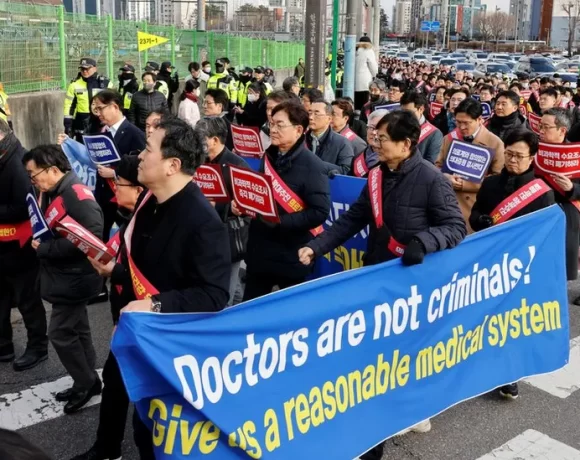
South Korea’s government is threatening to take legal action against thousands of striking junior doctors and revoke their medical licences if they do not return to work on Thursday.

Around three quarters of the country’s junior doctors have walked out of their jobs over the past week, causing disruption and delays to surgeries at major teaching hospitals.

The trainee doctors are protesting government plans to admit drastically more medical students to university each year, to increase the number of doctors in the system.

South Korea has one of the lowest doctor-to-patient ratios among developed countries, and with a rapidly aging population, the government is warning there will be an acute shortage within a decade.

The empty corridors of St Mary’s Hospital in Seoul this week gave a glimpse of what that future might look like. There was barely a doctor or patient to be seen in the triage area outside the emergency room, with patients warned to stay away.

Ryu Ok Hada, a 25-year-old doctor, and his colleagues have not been to work at the hospital for over a week.

“It feels weird not getting up at 4 a.m.,” Ryu joked. The junior doctor told the BBC he was used to working more than 100 hours a week, often for 40 hours without sleep. “It’s insane how much we work for such little pay”.

Although, doctors’ salaries in South Korea are relatively high, Ryu argues that given their hours, he and other junior doctors can end up earning less than the minimum wage. More doctors will not fix the structural issues within the healthcare system, that leave them overworked and underpaid, he says.

Healthcare in South Korea is largely privatised but affordable. The prices of emergency, life-saving surgeries and specialist care have been set too low, the doctors say, while less essential treatments, like cosmetic surgeries, pay too much. This means doctors are increasingly opting to work in more lucrative fields in the big cities, leaving rural areas understaffed and emergency rooms overstretched.

BBC / Titilayo Kupoliyi

Subscribe to our Telegram and YouTube Channels and also join our Whatsapp Update Group

Technology

Her face is a deep fake. Her body belongs to a team of similar-sized actors. But she sings, reads the news, and sells luxury clothes on TV as AI humans go mainstream in South Korea.

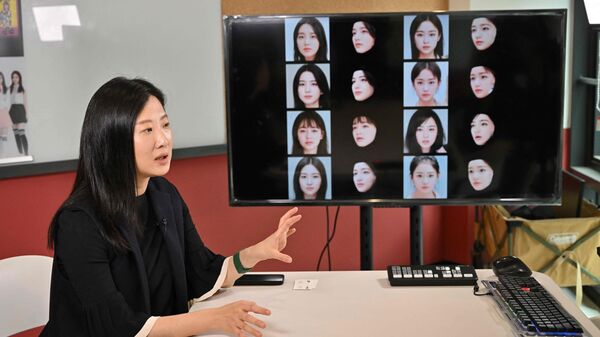
Meet Zaein, one of South Korea’s most active virtual humans, who was created by Pulse9, an artificial intelligence company that is working to bring corporate dreams of the perfect employee to life.

Pulse9 has created digital humans for some of South Korea’s largest conglomerates, including Shinsegae, with research indicating the global market for such life-like creations could reach $527 billion by 2030.

In South Korea, AI humans have enrolled as students at universities, interned at major companies, and appear regularly on live television driving sellouts of products from food to luxury handbag.

But Pulse9 says this is only the beginning. They are “working on developing the technology to broaden AI human use”, Park Ji-eun, the company’s CEO, told AFP.

Virtual humans are basically capable of carrying out much of what real people do,” she said, adding that the current level of AI technology means humans are still needed for now.

The demand for AI humans in South Korea was initially driven by the K-pop industry, with the idea of a virtual idol – not prone to scandals and able to work 24/7 – proving popular with the country’s notoriously hard-driving music agencies.

Experts around the world, including AI pioneers, have spoken out about its dangers, and several countries are seeking regulation of the powerful but high-risk invention.

But Park is not concerned. Her company is working on new virtual idols, virtual influencers, and virtual sales agents to take over customer-facing tasks for South Korean conglomerates, which are increasingly struggling with recruitment in the low-birthrate country.

South Korea — and the world — needs better, clearer regulations on what AI can do, she said, adding that when done properly, the technology can add to “the richness of life”.

The trouble, however, is that a deepfake can “make it impossible to tell what is real and fake”, Kim Myuhng-joo, a professor of information security at Seoul Women’s University, told AFP.

“It’s an egregious tool when used to harm others or put people in trouble. That’s why it’s becoming a problem,” he added.

Punch/ Oluwayemisi Owonikoko

Subscribe to our Telegram and YouTube Channels also join our Whatsapp Update Group

Sport

By Kayode Banjo

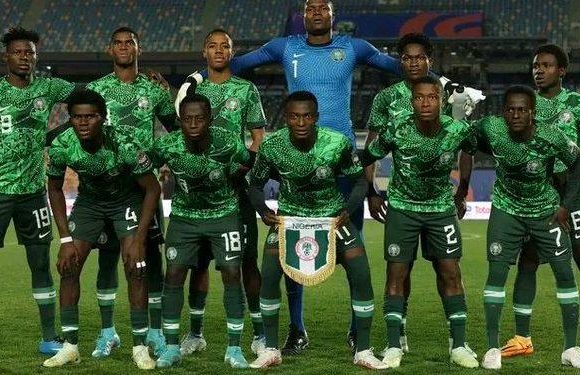
Flying Eagles of Nigeria have crashed out of the FIFA Under 20 World cup in Argentina.

The Nigerian team lost 1 nil to South Korea in their quarter final encounter Sunday’s evening.

The game which ended goalless after 90 minutes went into extra time.

In the 95th minute, Seok-Hyun Choi scored the only goal of the game to send the Asian country into the semi finals.

Also, Uruguay defeated USA 2 nil to advance to the semi finals.

The Semi final stage will hold on Thursday with Uruguay taking on Israel, while Italy tackles South Korea.

Subscribe to our Telegram and YouTube Channels also join our Whatsapp

Crime

South Korean police say they have arrested a woman accused of murdering her two children who were found in suitcases in New Zealand last month.

In a case that shocked the country, the bodies were discovered by strangers who had bought abandoned suitcases from a storage unit in Auckland.

Korean police said, the bodies of the victims who were aged 7 and 10, were believed to have been stored for a few years.

New Zealand has applied for the woman’s extradition from South Korea.

Police in Auckland said they had worked closely with South Korean authorities in their search for the woman, after saying last month they believed she was in South Korea.

The woman had fled to South Korea in 2018 after the children’s deaths, South Korean police said. She is a 42-year-old New Zealand national of Korean descent.

A global Interpol warrant had been issued for her arrest. Officers arrested her on Thursday in a midnight raid on an apartment in the south-eastern city of Ulsan.

It followed a stakeout after investigators received tips about her whereabouts, Seoul’s National Police agency said.

Last month, New Zealand police said they were searching for the woman after they managed to identify the children, whose names have not been disclosed.

“To have someone in custody overseas within such a short period of time have all been down to the assistance of the Korean authorities and the coordination by our NZ Police Interpol staff,” said New Zealand Police Detective Inspector Tofilau Fa’amanuia Vaaelua on Thursday.

Police have requested the suspect be denied bail prior to her extradition to New Zealand where she faces murder charges.

Local media there reported the family had lived in Auckland for a few years and the children’s father had died of cancer prior to their deaths. They reported the children’s grandparents still live in New Zealand.

The children’s bodies were discovered in early August after a separate family bought a trailer-load of goods, including the suitcases, in an online auction.

According to officers, the family had no connection to the deaths and had suffered great distress in the period following the discovery.

BBC/Taiwo Akinola

Sport


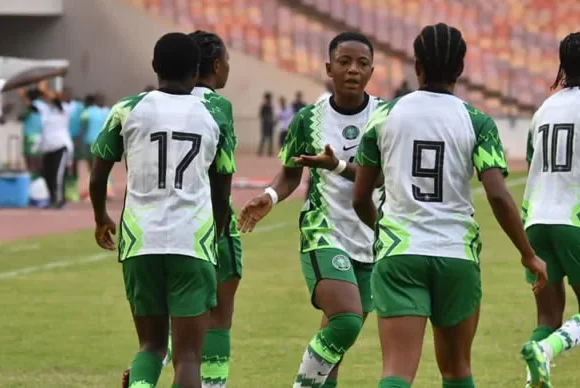
Nigeria beat South Korea 1-0 on Sunday in the Group C football match at the 2022 FIFA U-20 Women’s World Cup in Costa Rica.

Esther Onyenezide’s late strike gave the Falconets victory in their second match of the tournament.

The Falconets will face Canada in their final group match on Wednesday.

The match which was scheduled for 9 pm was shifted to 10.15 pm due to heavy rain.

According to report, the Falconets made their first attempt to score a goal in the third minute through Bashirat Amoo, who tried a long-range effort from a free kick but was calmly saved by South Korea keeper Kim Kyeong-Hee.

In the 22nd minute, the Koreans went on the attack again with Lee Soo-In hitting a long-range strike but the ball hit woodwork.

With four minutes left in the first half, Amoo made a long-range strike which went off target.

Five minutes into the second half, Onyenezide tried a long cross into the area on the back of a pouring attack but South Korea’s keeper rose high to claim the ball.

In the 82nd minute, the goal finally came thanks to a brilliant long-range strike from Onyenezide which flew past the Korean keeper into the back of the net.

Punch/Titilayo Kupoliyi

Subscribe to ourTelegram channel

Foreign

South Korea and the US launched eight missiles on Monday, in response to a volley of ballistic missiles fired by North Korea the previous day.

It comes as Pyongyang continues to escalate its missile tests.

South Korea’s president Yoon Suk-yeol said his government would respond sternly to any provocation from its northern neighbour.

“We will make sure there isn’t a single crack in protecting the lives and property of our people,” he said.

Speaking at a war memorial event in Seoul, he added that North Korea’s nuclear and missile programmes “are reaching the level of threatening not only peace on the Korean Peninsula but also in Northeast Asia and the world”, according to Yonhap.

Early on Monday, hours after North Korea had fired several missiles off its east coast, the two allies launched eight surface-to-surface Army Tactical Missile Systems (ATACMS) – one from the US and seven from South Korea.

Analysts say the moves are South Korea showing off its muscle, with the aid of US weaponry.

It is the second retaliatory display from the US and South Korea in as many weeks, with a similar move made last week after Pyongyang fired a series of missiles in the immediate aftermath of US President Joe Biden’s visit to the region.

Such displays had been rare under South Korea’s previous administration.

President Yoon, who was inaugurated last month, has pledged to take a more hardline approach on North Korea.

The isolated Communist state has test-fired dozens of missiles in recent months, including an intercontinental ballistic missile for the first time in five years.

The UN prohibits North Korea from ballistic and nuclear weapons tests, and has imposed strict sanctions after previous tests.

BBC/Simeon Ugbodovon

News Analysis

If you find yourself eating a whole fish in China, you might feel the urge to turn it over to get to the meat on the other side.

But we will warn you right now, don’t do it.

To turn a fish over, that means you have to turn the bones over, which symbolizes turning your back on someone or becoming a traitor.

It is also a no according to an old fishing superstition, which says that doing so could cause a boat to capsize. Whatever particular superstition your hosts may subscribe to, turning your fish over is generally frowned upon, so avoid it if you can. To get at the meat on the other side of the fish, just have patience and eat straight through it. Less efficient, sure, but you will draw fewer judgmental looks.

In Some Nigerian Cultures, children are served meals before the adults.  However, reverse is the case in South Korea.

No one is permitted to take a bite until the oldest person has started eating, a custom that’s viewed as a sign of great respect. It is also polite to wait for the oldest person to sit down before taking your own seat. Yeah, there’s a lot riding on the oldest person in the room, so you’d better hope they are hungry.

We all know a loud eater. They are that person who we try not to sit next to when they are eating spaghetti, because we will hear that annoying slurping sound all night.

Well, in Japan, that sound is not annoying, it is a sign that the eater is thoroughly enjoying their meal.

In addition to being a signal of respect, slurping is also believed to improve the flavour of noodles and allows you to enjoy hot food more quickly. Coating the noodles in saliva cools them down, meaning you don’t have to wait as long before you can dive in.

So, if you are in Japan, there is no need to delicately twirl your noodles on a spoon or cut them into fragments, Slurp away.

Titilayo Kupoliyi

Foreign

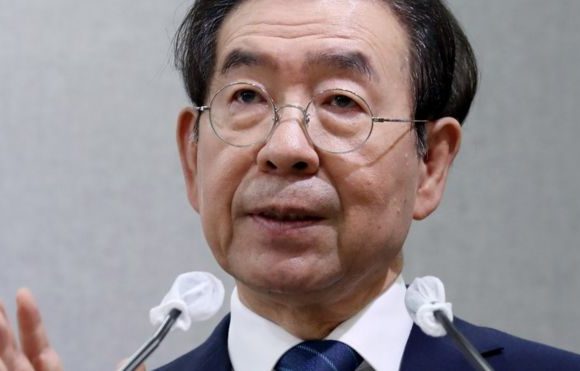
Police in the South Korea’s capital Seoul have found the body of the city’s mayor after he went missing on Thursday.

Park Won-soon’s daughter reportedly told police he had left a message before leaving the house, leading her to raise the alarm.

His body was found at Mount Bugak in northern Seoul, near where his phone signal was last detected.

No cause of death has yet been released.

It has emerged that a female employee had filed a sexual harassment claim against Mr Park in the hours before he went missing, but there has been no confirmation that this was a factor.

He did not show up for work on Thursday, cancelling a meeting with a presidential official at his Seoul City Hall office, Kim Ji-hyeong, an official from the Seoul Metropolitan Government, told the Associated Press.

Police officer Lee Byeong-seok told reporters that Park was seen by a security camera at 10:53 near the entrance to the wooded area where he phone signal was last detected.

About 600 police and fire officers using drones and dogs searched the area for hours on Thursday.

Crowds gathered outside the Seoul National University hospital late on Thursday amid unconfirmed reports that Mr Park had been found and taken there.

Mr Park was elected mayor of Seoul in 2011 and elected to his third and final term in June of last year.

As member of President Moon Jae-in’s liberal Democratic Party, Mr Park was reportedly under consideration as a potential presidential hopeful in the 2022 elections.

With his re-election last year, Mr Park became the first mayor of the city to begin a third term. He had carried his history as a civic activist and human rights lawyer into his tenure as mayor, and was an outspoken critic of social inequality and corruption in South Korea.

As a lawyer, he was credited with securing the country’s first sexual harassment conviction.

He clashed with the former president, Park Geun-hye, openly supporting millions of people who protested against her in 2017 and 2017, before she was eventually charged and imprisoned, on bribery and other charges.

BBC