Foreign

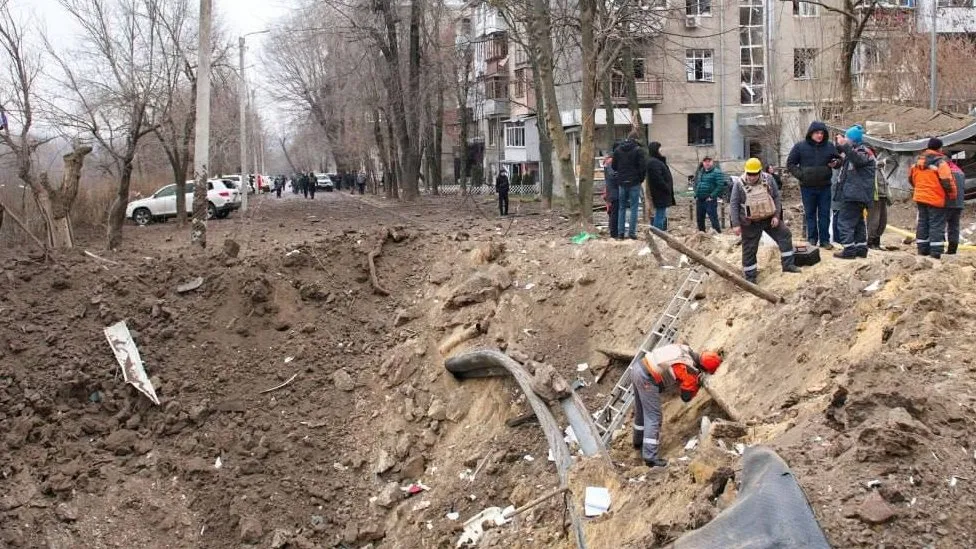
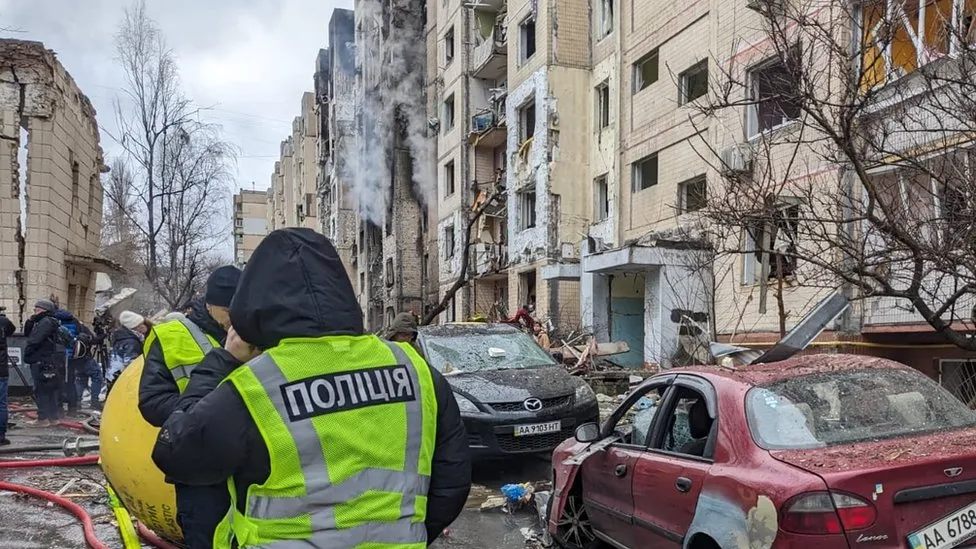
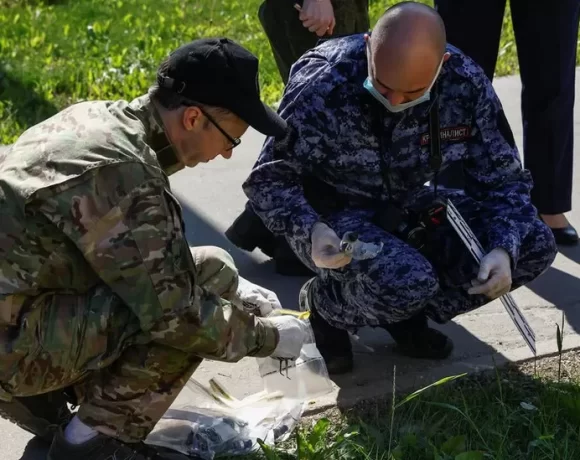
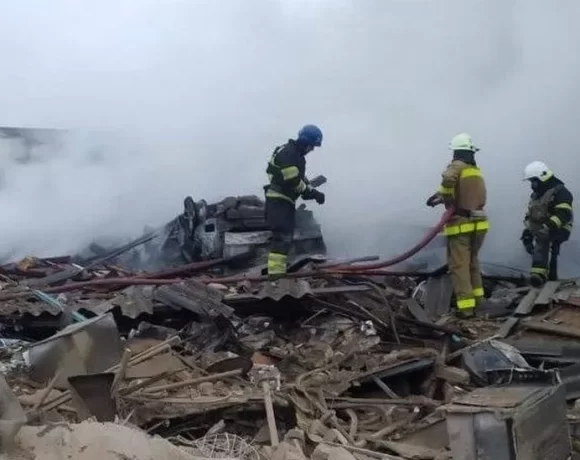
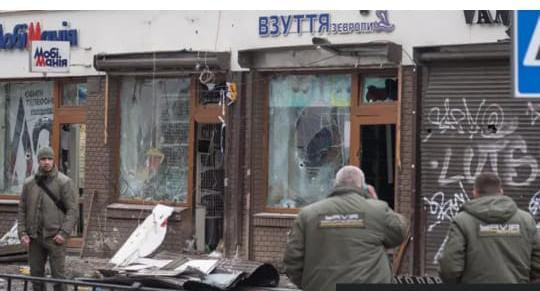
Ukrainian officials say, a 23‑year‑old female police officer has been killed and 25 people injured in a suspected terror attack in Lviv early Sunday.

Two homemade explosive devices, hidden in waste bins, detonated after police crews responded to a reported break‑in at a shop in the city centre shortly after midnight, the National Police of Ukraine reported.

According to report, the first blast struck when a patrol car arrived at the scene; a second explosion followed as a second crew arrived, injuring 11 people—six of them law‑enforcement officers in serious condition. The victim was identified as Viktoria Shpylka, who had joined the force at the start of the full‑scale invasion in the Kherson region.

President Volodymyr Zelenskyy confirmed that a suspect, a 33‑year‑old woman from the Rivne region, had been detained and that she allegedly acted on instructions from an agent of Russia’s special services. Interior Minister Ihor Klymenko said investigators are working to identify any additional co‑conspirators, while the regional prosecutor’s office has opened a terrorism investigation.

Lviv Mayor Andriy Sadovyi called the incident a “terrorist act” and urged residents to remain vigilant. The attack comes as Ukraine marks the fourth anniversary of Russia’s full‑scale invasion, which has left hundreds of thousands of military casualties on both sides and left Moscow in control of about 20 % of Ukrainian territory, including Crimea. 

BBC/Taiwo Akinola

Foreign

Ukraine has condemned a fresh wave of Russian strikes overnight which killed one person and injured 23 others, as talks with the US aimed at ending the war are set to resume.

Ukraine’s Foreign Minister, Andrii Sybiha said the “brutal” attack – “cynically” ordered by Russian leader Vladimir Putin had “hit not only our people, but also the negotiation table”.

Delegations from Russia, Ukraine and the US have been meeting in Abu Dhabi for the first trilateral talks since the Kremlin launched a full-scale invasion of its neighbour in 2022.

A source told the BBC that some progress had been made but the key issue of territory remains unresolved.

The mayor of Ukrainian capital Kyiv said one person had died and four had been wounded while Kharkiv’s mayor reported that 19 people had been hurt during a sustained assault on the city in the early hours of Saturday morning.

On the second day of the three-way talks in Abu Dhabi, Sybiha said the “barbaric” overnight assault proved “that Putin’s place is not at the board of peace, but at the dock of the special tribunal”.

US President Donald Trump said last week that Putin had accepted an invitation to join his Board of Peace – an organisation focused on ending global conflicts. Putin has not confirmed this.

Kyiv’s mayor Vitali Klitschko said on Telegram that three of the four people who had been injured had been hospitalised.

He added that the capital’s critical infrastructure had been damaged, leaving 6,000 buildings without heating.

Temperatures have fallen to around -12C in parts of Ukraine, according to the Met Office. In a statement following the assaults, President Volodymyr Zelensky said: “The main target of the Russians was the energy infrastructure.”

Last week, Russia attacked Kyiv’s power infrastructure, forcing Zelensky to initially call off his trip to the World Economic Forum in Davos, Switzerland.

In Kharkiv, Mayor Ihor Terekhov said 19 people had been injured during the strikes in the early hours of Saturday morning. A maternity hospital and a hostel for displaced people were damaged.

Russia occupies roughly 20% of Ukraine, including parts of the eastern Donbas region. The Kremlin wants Ukraine to hand over large areas of the territory, but Ukraine has ruled this out.

In Davos, Zelensky said: “It’s all about the land. This is the issue which is not solved yet.”

He said that he had reached an agreement with Trump on future US security guarantees for Ukraine in the event of a deal.

He gave no detail but said it would need to go before US Congress and the Ukrainian parliament before signing.

BBC / Titilayo Kupoliyi

Foreign

President Volodymyr Zelensky says intense Russian drone and missile strikes on cities in Ukraine have left at least six people dead, including two children.

Another 21 people were wounded, in another night of attacks that he said proved Moscow had not come under enough pressure for its continued war.

Hours earlier, US President Donald Trump said his plans for an imminent summit in Budapest with Russia’s Vladimir Putin had been shelved as he did not want a “wasted meeting”.

The Kremlin has rejected calls for a ceasefire along the current front lines made both Trump and European leaders.

Meanwhile, Ukraine’s military said it had attacked a Russian chemical plant in the Bryansk border region late on Tuesday with UK-supplied Storm Shadow missiles.

Calling the strike “a successful hit” that penetrated the Russian air defence system, military officials said the Bryansk plant “produces gunpowder, explosives and rocket fuel components used in ammunition and missiles employed by the enemy to shell the territory of Ukraine”.

Zelensky, who was due to visit Swedish defence contractor Saab on Wednesday, returned from talks with Trump last Friday, having failed to persuade the US president to provide long-range Tomahawk missiles.

“As soon as the issue of long-range missiles became a little further away for us, for Ukraine, then almost automatically Russia became less interested in diplomacy,” Zelensky said.

The Ukrainian capital came under a wave of attacks overnight, the first such strikes since 28 September.

A couple in their 60s were killed when a drone hit their high-rise building in the city, and four people were killed in the wider Kyiv region. Among the victims were a woman, a six-month-old baby and a girl aged 12.

The capital was under a ballistic missile warning for most of the night, and echoed to the sound of explosions. By morning, rescue teams fought fires in residential buildings.

Across Ukraine, Russian attacks once again targeted energy infrastructure and emergency power outages were imposed in several areas.

BBC/Ttilayo Kupoliyi

Subscribe to our Telegram and YouTube Channels, and also join our WhatsApp Update Group.

Foreign

Ukraine reports that Russia has launched its largest drone assault since the full-scale invasion began, targeting several regions, including Kyiv, where one person was killed.

By 08:00 Sunday (05:00 GMT), Ukraine’s air force said 273 drones had been launched, hitting the central Kyiv region, as well as Dnipropetrovsk and Donetsk in the east.

It explained that among the drones were Shahed attack drones, with 88 intercepted and 128 going astray “without negative consequences.”

The attack came a day before a scheduled call between Donald Trump and Russian President Vladimir Putin, amid US calls for a ceasefire.

Leaders from Germany, Britain, France, and Poland are set to meet virtually with Trump before his conversation with Putin on Monday.

Friday’s face-to-face talks in Turkey, the first between Russia and Ukraine in over three years, resulted only in a prisoner swap deal.

Ukrainian officials said the strikes demonstrate Moscow’s unwillingness to seek peace despite international pressure.

“For Russia, the Istanbul negotiations are just a pretence. Putin wants war,” said Andriy Yermak, a top aide to the Ukrainian president.

Meanwhile, Ukrainian President Volodymyr Zelensky met Pope Leo at the Vatican on Sunday following the pontiff’s inauguration, and later held a brief discussion with US Vice President JD Vance in Rome.

BBC/Maxwell Oyekunle

Subscribe to our Telegram and YouTube Channels, and also join our WhatsApp Update Group.

Foreign

Ukraine is ready for “direct negotiations at the highest level” and a “complete and unconditional ceasefire.”

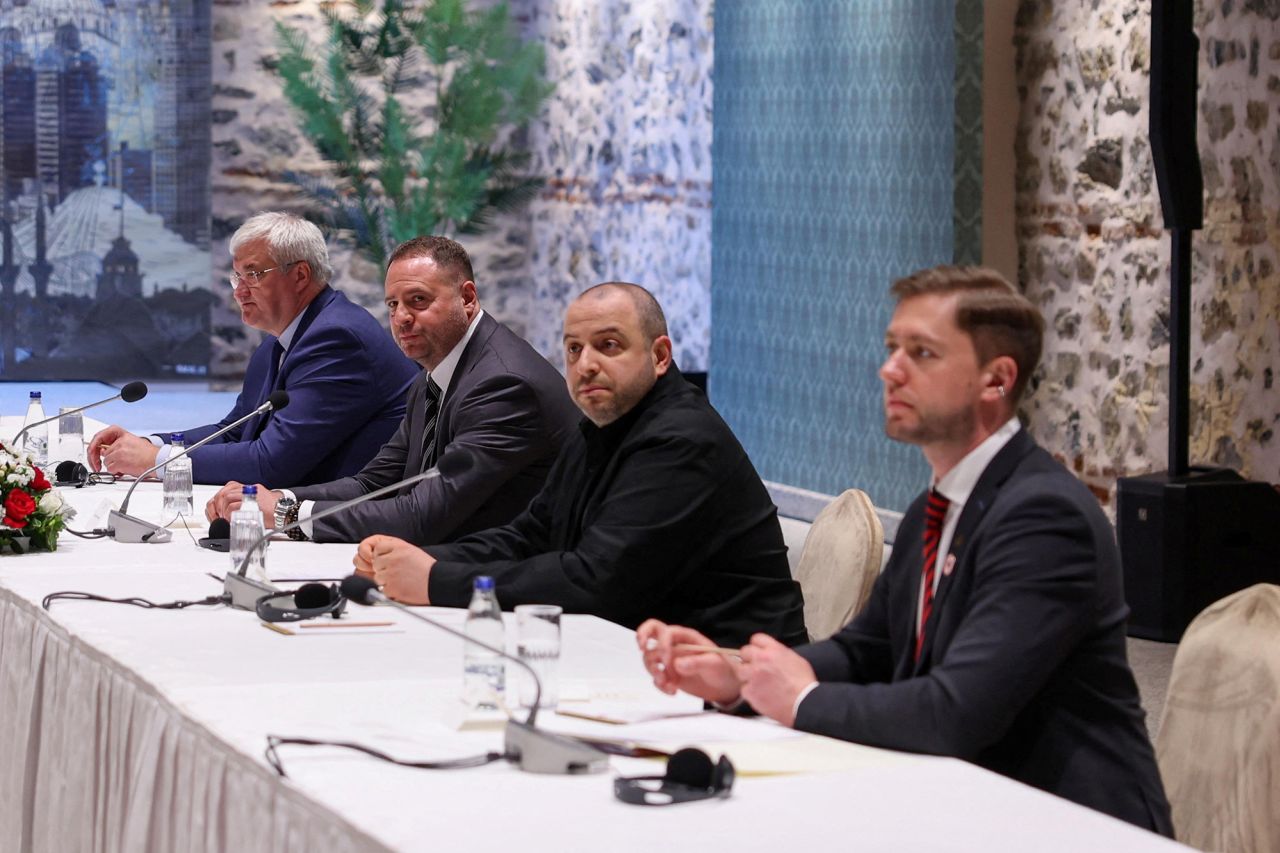
Ukraine’s Defence Minister, Rustem Umerov, who is heading Kyiv’s delegation for talks with Russia in Istanbul, made this known via a statement posted on Telegram.

Umerov said Ukraine had coordinated its stance with key allies – including the US, UK, France and Germany – ahead of the meeting, calling it a push to “find real ways to achieve a lasting and just peace.”

Peace is only possible if Russia shows readiness for concrete actions,” Umerov said, outlining demands including a “complete ceasefire for at least 30 days,” the return of forcibly deported Ukrainian children, and prisoner exchanges based on an “all for all” formula.

We continue our struggle for a just and lasting peace,” he said, “and will not cease our efforts to achieve it.”

In the meantime, the Russian state media agency, TASS, has reported that the Russian delegation has arrived at the Dolmabahce Presidential Complex in Istanbul for talks with Ukraine.

The meeting will be the first time the two sides have negotiated directly with one another since the early stages of the conflict in March 2022.

The meeting is scheduled to take place at the Turkish Presidency working office in Istanbul at 12.30 p.m. local time (05.30 a.m. ET) on Friday.

CNN/ Oluwayemisi Owonikoko

Subscribe to our Telegram and YouTube Channels, and also join our WhatsApp Update Group.

Foreign

Ukrainian forces have captured an injured North Korean soldier who was sent to support Russia’s war, South Korea’s spy agency confirmed on Friday.

According to the report, the soldier was believed to be the first North Korean prisoner of war captured since December, when Pyongyang deployed forces to support Russia’s war in Ukraine.

The confirmation comes after a photo purporting to show the wounded soldier circulated on Telegram.

North Korea has sent more than 10,000 soldiers to help Russia, according to Kyiv and Seoul – though Moscow and Pyongyang have neither confirmed nor denied their presence.

“This is the first in a string of captures and killings,” Yang Uk, a research fellow at the Asan Institute for Policy Studies, told the BBC. “For Ukrainians, it’s more beneficial to capture these North Korean troops and try to exchange them with Russians for Ukrainian prisoners of war.”

Recent images emerging from the Russia-Ukraine war confirmed speculations that “North Korean troops will be deployed in large numbers to the assault by Russian command,” Mr Yang said.

He also added, however, that “it will be challenging to prove their North Korean nationality”.

Ukrainian forces say that North Korean soldiers have been issued fake Russian IDs, while Ukrainian President Volodymyr Zelensky posted footage last week which he said showed Russian troops burning the faces of slain North Koreans to conceal their identities.

Ukrainian and South Korean intelligence services have said that many of the troops deployed to Russia are some of Pyongyang’s best, drawn from the 11th Corps, also known as the Storm Corps. The unit is trained in infiltration, infrastructure sabotage and assassinations.

Over 3,000 North Korean troops have died or been wounded while fighting in Russia’s Kursk region, Zelensky said Monday.

He added that the collaboration between Moscow and Pyongyang heightens the “risk of destabilization” around the Korean peninsula.

Russia launched a full-scale invasion of Ukraine in February 2022. The recent deployment of North Korean troops to Russia is a sign of a growing alliance between the two pariah states.

The development, which comes as North Korea ratchets up tensions with South Korea, has sparked worries in the West. China, a longstanding ally of both sides, is also keeping a cautious eye on the friendship.

Foreign

Ukraine says it has repelled a Russian armoured attack in the north-eastern Kharkiv region, after Moscow’s forces launched an incursion across the border and sought to break through defensive lines.

Kharkiv regional head Oleh Syniehubov said Russian reconnaissance groups had tried to penetrate the border, adding that “not a single metre has been lost”.

“Russia has launched a new wave of counteroffensive operations in the Kharkiv sector,” said Ukrainian President Volodymyr Zelensky.

Also on Friday, a huge fire broke out at an oil storage depot in Ukraine’s occupied Luhansk region after what Russian-installed officials said was a Ukrainian strike. Three people were killed in the attack, they added.

Ukrainian commanders have been expecting a summer offensive for some time, possibly even a bid to capture the regional capital, Kharkiv. But officials are adamant Russia does not have the resources to do so.

Russia had the capability to aggravate the situation in border areas but not the ability to capture Ukraine’s second city, said the head of Ukraine’s centre for countering disinformation, Andriy Kovalenko.

Ukrainian reports suggested Russia was trying to create a 10km buffer zone for its Belgorod region, after a series of Ukrainian cross-border attacks.

Friday’s small incursions over the Russian border form a familiar yet disturbing axis for Ukrainian forces.

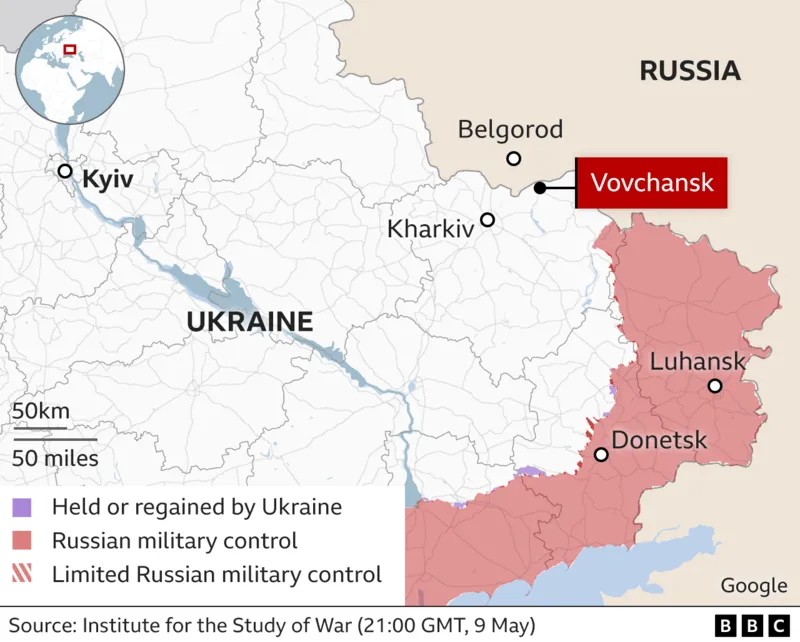
The defence ministry in Kyiv said the attack started with the heavy bombing of the town of Vovchansk “using guided aerial bombs” with the support of artillery. Then, small Russian “scouting groups” moved in across the border, reportedly in several places.

The local head in Vovchansk, 75km (45 miles) north-east of Kharkiv, said the town had come under heavy attack from the early hours of Friday and civilians were being evacuated. Some 3,000 people live in Vovchansk and at least one person was killed and five more injured in the barrage, according to Kharkiv’s regional leader.

“At approximately 05:00, there was an attempt by the enemy to break through our defensive line under the cover of armoured vehicles. As of now, these attacks have been repulsed, fighting of varying intensity continues,” the defence ministry said.

President Zelensky said the Russians had been engaged “with our troops, brigades and artillery”, but added that a fierce battle was under way.

Civilians were being evacuated from the Vovchansk district while reserve troops move in, officials added.

In the occupied Luhansk region, Russian officials reported that Ukrainian forces had attacked the city of Rovenky, killing three people and injuring seven.

The Russian-installed health ministry said four of those injured were in a serious condition.

“Because of the shelling, the oil depot was engulfed by flames and nearby houses were damaged,” Russian-installed Governor Leonid Pasechnik wrote on Telegram.

It was the second such attack this week. On Wednesday, an attack on another oil depot in the region injured five people.

Ukrainian bloggers and Telegram channels reported Friday’s attack and posted pictures of a large blaze.

However, there has been no comment from Ukrainian officials.

On Friday, the US announced a new $400m (£319m; €371m) military aid package for Ukraine.

It will be Washington’s third instalment of aid to the country after months of political deadlock and delays – adding to the previous package worth a total of $7bn sent in late April.

In a statement, US Secretary of State Anthony Blinken announced that the “urgently needed” aid would include air defence munitions, artillery rounds, anti-tank weapons and armoured vehicles.

On Friday, the White House gave its assessment of the situation, with National Security Spokesman John Kirby telling reporters the US thinks Russia “will make further advances in the coming weeks to try and establish a buffer zone along the Ukrainian border”.

However, he said that Washington was confident in Ukraine’s ability to withstand such attacks, and would be “working around the clock” to ensure the country had all the necessary tools and weapons to do so.

Moscow has been looking to capitalise on the delayed arrival of US ammunition and weaponry by continuing to push in the eastern Donetsk region.

The return of heavy fighting in the north-east further illustrates Russia’s growing confidence and ambitions.

The deputy chief of Ukraine’s military intelligence, Maj Gen Vadyn Skibitsky, told The Economist last week that Russia was gearing up for an assault on both Kharkiv and the northern region of Sumy. That warning was repeated by the commander of Ukrainian ground forces, Lt Gen Oleksandr Pavliuk.

Tens of thousands of Russian forces are said to have gathered on the border.

You could be forgiven for seeing a repeat of 2022, when Russia failed to capture Kharkiv and Sumy in the early weeks of its full-scale invasion. Russian forces did occupy the border town of Vovchansk for several months, until they were pushed out in September 2022.

Outwardly at least, officials and generals do not think either of the two regional capitals could fall.

Russia was unable to conquer either city when it had a larger, better-trained force than it does now. Ukrainian sources estimate around 90% of that original 150,000 army are either dead or wounded.

Military commentator Oleksandr Kovalenko has pointed out that Russia needed some 80,000 troops to capture the small eastern city of Avdiivka last February, after months of bombardment. Big cities such as Sumy and Kharkiv were on a completely different scale, he said.

Secondly, Russia has talked about creating a buffer zone between its Belgorod region and Ukraine.

That is because Ukrainian troops have continued to launch artillery strike on Russian territory, to the nervousness of some Western allies.

BBC/Simeon Ugbodovon

Subscribe to our Telegram and YouTube Channels and also join our Whatsapp Update Group
Foreign

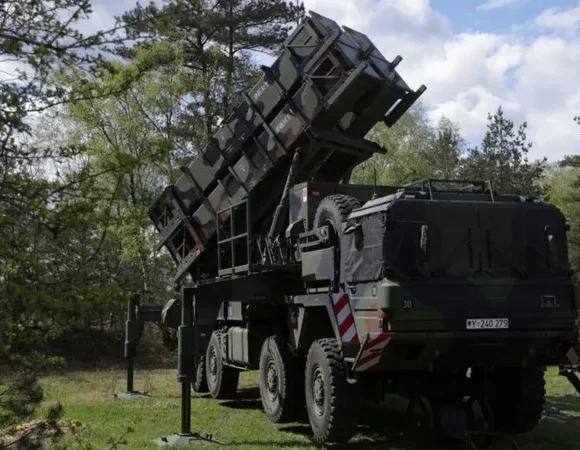
The Pentagon says it will “rush” Patriot air defence missiles and artillery ammunition to Ukraine as part of its new military aid package.

However Patriot systems for launching the missiles will not be sent, Defence Secretary Lloyd Austin said.

Ukrainian President Volodymyr Zelensky said Patriots were “urgently” needed to face a growing Russian air threat and “can and should save lives right now”.

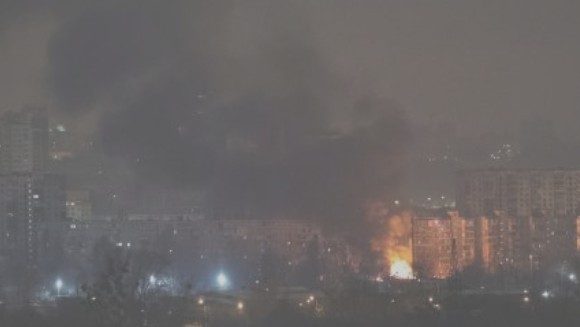
On Saturday, Ukraine said Russia had carried out another massive air attack.

Authorities in Kharkiv said a hospital was damaged. Energy facilities in three regions were attacked, Energy Minister German Galushchenko said.

Russia attacked with cruise missiles, S-300 surface-to-air missiles and Iskander ballistic missiles, Ukraine said, adding that 21 were downed using aircraft, air defence systems and jamming.

Ukraine claimed to have hit two Russian oil refineries across the border. Footage from one in the Russian region of Krasnodar appeared to have caused a large explosion, though local authorities denied significant damage.

Russian authorities said on Saturday they had shot down some 68 Ukrainian drones over Russian territory.

Subscribe to our Telegram and YouTube Channels and also join our Whatsapp Update Group
Foreign

Ukraine’s parliament has refused to consider a conscription bill that proposes a crackdown on draft dodgers.

Members of Parliament have criticized certain punishment measures included in the bill as unconstitutional.

Some have also suggested reducing the length of military service proposed in the bill from 36 to 18 months.

The bill was drafted in a bid to conscript more people, as Kyiv faces problems on the battlefield after nearly two years of war with Russia.

According to the report, it also included plans to lower the age at which men can be conscripted into the armed forces from 27 to 25.

Last month, Ukrainian President Volodymyr Zelensky said 450,000-500,000 extra soldiers were needed to fight Russia’s invasion.

But some clauses in the bill have caused outrage, such as limiting draft dodgers’ rights to own property and freely use their personal money.

The bill would also allow Ukrainians to be summoned electronically to join the armed forces. At the start of the war, tens of thousands of men volunteered to fight but almost two years on it is getting harder to convince anyone to join up.

In December, Ukrainians living abroad were told they could be asked to report for military service. Defence Minister Rustem Umerov described this as an invitation and the ministry later clarified that it did not imply any sanctions against those who refused to come back.

Mr Zelensky said achieving the increased number of troops was a “sensitive” and costly issue.

This all comes as Kyiv’s recent counter-offensive seems to have stalled and provisions of military aid have also taken a knock in recent months. US Republicans blocked a $61bn (€55bn; £48bn) military package and Hungary stopped an EU financial deal worth €50bn ($55bn; £43bn).

White House national security spokesman John Kirby said on Thursday that negotiations over further US assistance had “ground to a halt” as the government continues to negotiate its budget.

Mr Zelensky is currently on a tour of the Baltic states – and is currently in Latvia – to bolster further support including urging Western allies to provide more air defence weapons.

Speaking earlier in Tallinn, Estonia, he warned about the dangers of Western hesitation. He said: “Sometimes the insecurity of partners regarding financial and military aid to Ukraine only increases Russia’s courage and strength.”

His remarks came as a new US report warned that more than $1bn, £785m, worth of US military aid given to Ukraine since February 2022 was not properly tracked.

The findings by the Pentagon’s inspector general said US officials in Washington DC and Europe had failed to properly account for thousands of weapons, including stringer launchers and air defence missiles. It raises concerns that some of the $1.69bn in military aid supplied to Ukraine could have been misappropriated.

But in a letter responding to the report, Col Garrett W Trott of the US military’s European Command, emphasised that the report found “no evidence of unauthorised or illicit transfer of EEUM, Enhanced End Use Monitoring, defence articles provided to Ukraine”.

And the report itself conceded that it was “beyond the scope” of its inquiry to determine whether any arms had been misappropriated.

Subscribe to our Telegram and YouTube Channels and also join our Whatsapp Update Group

BBC/Taiwo Akinola

Foreign

Russia said it had accidentally bombed a village in its southern Voronezh region near Ukraine on Tuesday but stressed there were no casualties.

The accident occurred the same day as Russia hit Ukraine with a large-scale missile attack.

It is not the first such incident during Moscow’s almost two-year-long Ukraine offensive.

“On January 2, 2024, at around 9 am Moscow time (GMT), during a flight of the Aerospace Forces, an abnormal discharge of aircraft ammunition occurred over the village of Petropavlovka in the Voronezh region,” the Russian army said in a statement quoted by Russian news agencies.

“There are no casualties,” it added.

Petropavlovka lies some 150 kilometres (93 miles) east of the Ukraine border.

The ministry said six private houses were damaged in the accident, Russian news agencies reported.

“An investigation into the circumstances of the incident is underway. A commission is working on the ground to assess the nature of the damage and provide assistance to restoring houses,” the statement read.

The governor of the Voronezh region, Alexander Gusev, said some of Petropavlovka’s residents have been moved to temporary accommodation.

He also said there were no casualties but said there was “destruction recorded in seven households.”

In April last year, the Russian army acknowledged that one of its warplanes accidentally dropped a bomb in its own city of Belgorod, near the Ukraine border, causing a blast.

BBC / Titilayo Kupoliyi

Subscribe to our Telegram and YouTube Channels and also join our Whatsapp Update Group 
Foreign

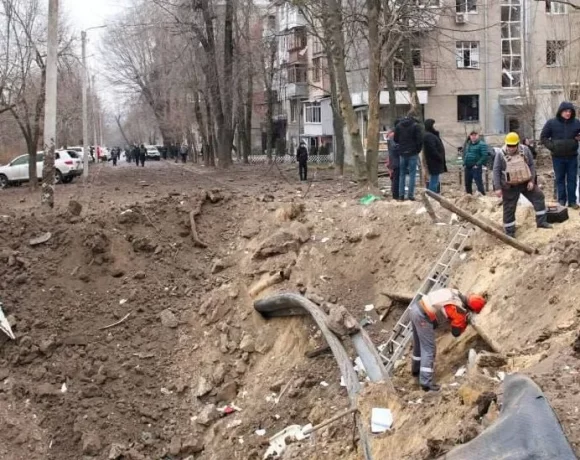
Russian missiles have hit Ukraine’s biggest cities, leaving four dead and dozens hurt, after Vladimir Putin vowed to intensify attacks.

Reports say, a woman was killed and 44 others were hurt in the north-eastern city of Kharkiv.

Kyiv Mayor Vitaliy Klitschko said at least one person died and 27 were wounded as several blocks of flats were hit as a result of the Russian strikes.

Two more deaths were reported in the broader Kyiv region.

There have been major aerial assaults by both sides in recent days.

Russia launched its biggest aerial bombardment of the war late last week, killing 39 people. Ukrainian forces responded with an attack on the Russian border city of Belgorod on Saturday, which killed at least 25 people and injured more than 100.

Russia’s Vladimir Putin vowed that attack would not go unpunished and Ukraine’s President Volodymyr Zelensky said since Sunday alone, Moscow had fired 170 drones and dozens of missiles.

According to Ukraine’s air force, on Tuesday, it had downed 35 drones launched by Russia on Monday night. Russian strategic bombers then followed up the drone strikes with further attacks.

Ukraine’s armed forces said after the drone strikes 99 missiles of various kinds had been fired in a repeat of last Friday’s onslaught, from sea and air. They said 72 cruise and supersonic missiles had been destroyed.

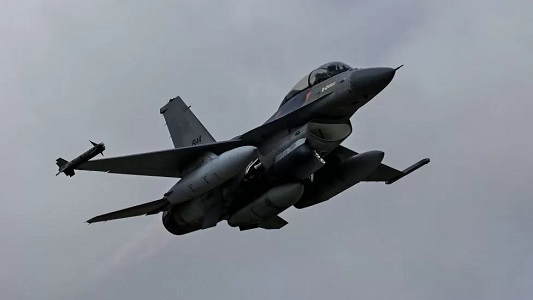
Poland said it had deployed four F-16 fighter jets to secure its airspace in light of Russia’s “long-range aviation activity”. Last Friday Poland said an unidentified object, probably a Russian missile, had entered Polish airspace for several minutes before turning back towards Ukraine.

Kyiv officials said debris from Russia’s attacks had hit high-rise flats, warehouses and supermarkets, and that an elderly woman had died of her wounds. Power and water supplies were cut to several areas of the capital and gas pipelines were damaged in one district.

Kharkiv regional governor Oleh Syniehubov said the centre of the city was hit and the air force said it was prepared for further attacks.

The mayor of Mykolaiv, in southern Ukraine, said air defences had brought down drones in the city, with debris causing a fire.

On New Year’s Day, six civilians were killed by Russian strikes in various Ukrainian cities.

In a separate development, Russian-installed officials in the occupied city of Donetsk said four people were killed and 13 wounded by Ukrainian shelling on Sunday.

Mr Putin suggested that Western rhetoric towards the war was beginning to change as they started to realise they could not “destroy” Russia.

Ukrainian President Volodymyr Zelensky countered these claims in an interview with The Economist, saying Mr Putin’s suggestion that Russia was winning the war was only a “feeling”. He highlighted Russia’s casualty figures in Ukraine, and said the opposing forces had been unable to take a single large city in 2023.

Mr Zelensky also expressed frustration with Kyiv’s Western allies, saying they had lost a sense of urgency.

BBC/Taiwo Akinola

Religion

By Kayode Oguntona

Until the crisis of hunger, bloodshed, injustice and prevailing sufferings around the world today are properly addressed, the Christmas celebration may continue to be a mere ritual.

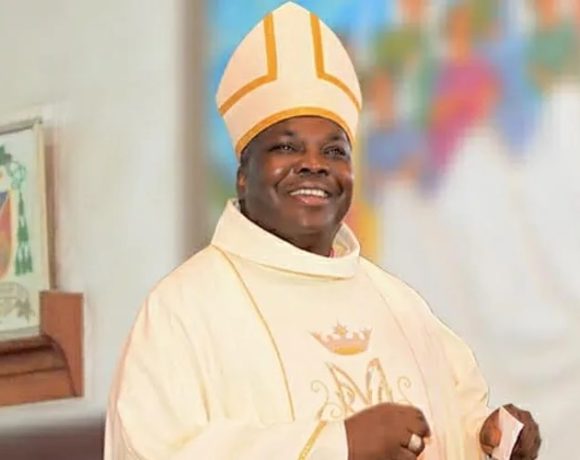
The Bishop, the Catholic Diocese of Oyo, the Most Reverend Emmanuel Adetoyese Badejo who stated this in his Christmas message in Oyo Town noted that the season would appear bleak this year in Ukraine, Russia, Israel, Gaza, Sudan and some parts of Nigeria where people are faced with war and discomfort.

Bishop Badejo said Father Christmas shows, the glittering gifts and lavish parties that come with the yuletide are not the reason for the season as usually painted by the modern media, but the spirit of love, compassion, peace and truth.

According to the cleric, the Christmas celebration indicts many world leaders who are supposed to be saving people from trouble and suffering because Jesus came to the world to destroy all discomforts of humanity, especially sin.

While urging the nation’s political class to allow the spirit of Christmas to reflect in their actions, Bishop Badejo also called on Nigerians to do the same in their hearts every day and not yearly.

Subscribe to our Telegram and YouTube Channels and also join our Whatsapp Update Group
Foreign

One of Ukraine’s staunchest allies, Poland, has said it is no longer supplying weapons to its neighbour, as a diplomatic dispute over grain escalates.

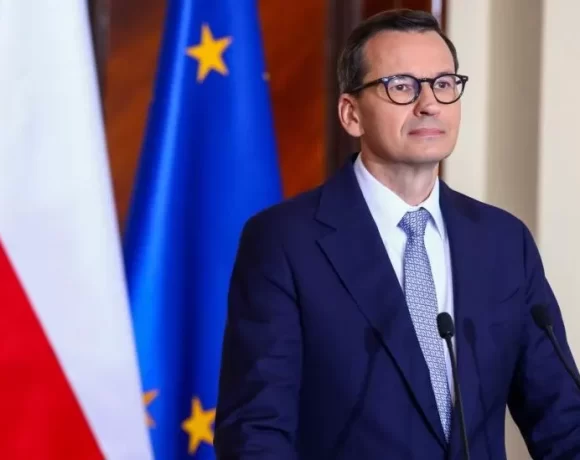
Prime Minister Mateusz Morawiecki said Poland’s focus was instead on defending itself with more modern weapons.

Poland has already sent Ukraine 320 Soviet-era tanks and 14 MiG-29 fighter jets and has little more to offer.

However, the remarks coincide with high tensions between the two neighbours.

On Tuesday, Poland summoned Ukraine’s ambassador over comments made by President Volodymyr Zelensky at the United Nations after Poland, Hungary and Slovakia extended a ban on Ukrainian grain.

Mr Zelensky said it was alarming how some of Ukraine’s friends in Europe were playing out solidarity “in a political theatre – making a thriller from grain”. Warsaw denounced his words as “unjustified concerning Poland, which has supported Ukraine since the first days of the war”.

Mr Morawiecki was interviewed on Wednesday night by the private Polsat news TV channel hours after the Ukrainian ambassador had been summoned to the foreign ministry in Warsaw in response to the Ukrainian leader’s speech.

“We are no longer transferring weapons to Ukraine, because we are now arming Poland with more modern weapons,” the prime minister said.

He was adamant Poland was helping Ukraine defeat the “Russian barbarian” by maintaining a military hub, but would not agree to Poland’s markets being destabilised by grain imports, Polish news agency Pap reported.

“Our hub in Rzeszow, in agreement with the Americans and Nato, is fulfilling the same role the whole time as it has fulfilled and will fulfil.”

Poland’s military has depleted its own military by about a third through transfers to Ukraine and is in the process of replacing it with modern Western-produced hardware.

Arms exports to Ukraine will not stop completely as Polish manufacturer PGZ is due to send about 60 Krab artillery weapons in the coming months.

Asked about the prime minister’s comments, Polish state assets minister Jacek Sasin told Radio Plus on Thursday that “at the moment it is as the prime minister said – in the future we will see”.

BBC / Titilayo Kupoliyi

Subscribe to our Telegram and YouTubeChannels also join our Whatsapp Update Group

Foreign

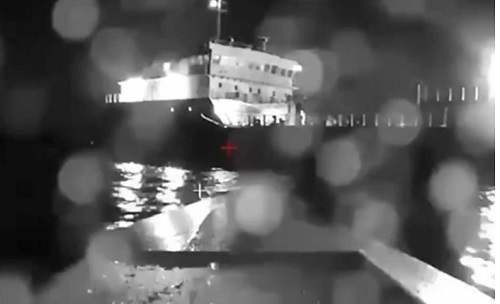
A Russian tanker with 11 crew members has been hit in a Ukrainian attack in the Black Sea, Russian officials say.

They said the vessel’s engine room was damaged in the overnight strike in the Kerch Strait. No-one was hurt.

Ukraine has not publicly commented. But a Ukrainian security service source told the BBC a sea drone had been used.

Saturday’s attack is the second in as many days involving such weapons. Russia, however, has not admitted any damage during Friday’s attack.

Naval drones, or sea drones, are small, unmanned vessels which operate on or below the water’s surface. Research by BBC Verify suggests Ukraine has carried out several attacks with sea drones.

The Kerch Strait connects the Black Sea and the Sea of Azov, separating Crimea – Ukraine’s peninsula annexed by Moscow in 2014 – and Russia’s Taman peninsula.

According to Ukraine’s SBU security service, Saturday’s operation was also conducted jointly with the Ukrainian navy and that 450kg of TNT explosive had been used.

The tanker was loaded with fuel, they said so the “fireworks” were visible from afar.

Russia’s maritime transport agency says the Sig tanker was located 17 miles (27km) south of the Crimean Bridge.

Russia’s state-run Tass news agency quoted an official from the country’s regional Marine Rescue Co-ordination Centre (MRCC) as saying that two tugs had already arrived at the scene of the attack – just to the south of the Kerch Strait.

“The engine room was damaged. Not much, but it was damaged,” the official said.

Russia’s maritime transport agency RosMorRechFlot later said the vessel had a hole “in the area of [the] engine room near the waterline from the starboard side, presumably as a result of an attack by a sea drone”.

“The ship is afloat,” it added.

Russian state-run media also reported that lights on the Crimean Bridge – further north – was turned off and all traffic halted amid warnings of an imminent attack.

On Friday, a Russian naval ship suffered a serious breach in a Ukrainian naval drone strike near Russia’s Black Sea port of Novorossiysk, Ukrainian security sources told the BBC.

Footage later emerged purportedly showing the drone hitting the Olenegorsky Gornyak large landing ship. Another unverified video showed a heavily listing vessel being towed to port.

But Russia’s defence ministry said it had repelled a Ukrainian attack on its naval base in Novorossiysk which involved two sea drones, but did not admit any damage.

Novorossiysk, a major hub for Russian exports, lies to the south-east of the Kerch Strait.

Clashes in the sea have increased in recent weeks, after Russia abandoned a major UN deal that enabled grain to be safely exported across the Black Sea.

Ukrainian ports have been pummelled by Russian drones and missiles, and Kyiv has threatened to retaliate.

“It is clear that it is impossible to win the war if you are not actively attacking,” said Ukraine’s presidential adviser Mykhailo Podolyak, when asked about Western allies who may be becoming nervous about this war spilling well beyond its borders.

He believes the apparent images of damaged Russian vessels will make Moscow “think twice about using the Black Sea for blackmail”.

While Kyiv denies drone strikes deeper inside Russia, it says it sees threats on occupied territories and surrounding waters as fair game.

Russia enjoys complete control of the Black Sea and Sea of Azov and two reportedly damaged ships are unlikely to change that.

But previous Ukrainian counter-offensives have been fuelled by their ability to cut off major Russian supply lines.

If it has indeed been able to immobilise a large Russian warship and oil tanker in two days, it will hope more will follow.

This war’s footprint seems to be getting bigger.

In a separate development, Saudi Arabia is due to host talks later on Saturday on how to end the war in Ukraine.

Invitations have been sent to about 30 countries – but not Russia – to attend the meeting in the Red Sea city of Jeddah.

Russian President Vladimir Putin launched his full-scale invasion of Ukraine in February 2022.

BBC/Simeon Ugbodovon

Subscribe to our Telegram and YouTube Channels also join our Whatsapp Update Group
Foreign

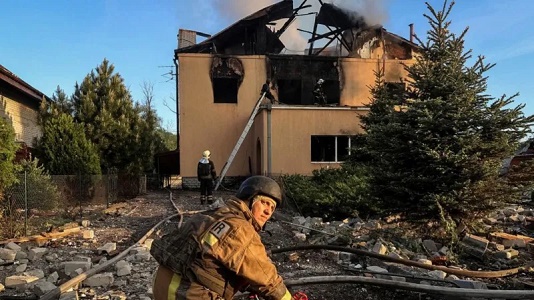
Russian President Vladimir Putin has said he does not reject the idea of peace talks on Ukraine.

Speaking after meeting African leaders in St Petersburg, he said African and Chinese initiatives could serve as a basis for finding peace.

President Putin also said it was hard to implement a ceasefire when the Ukrainian army was on the offensive.

Ukraine and Russia have previously said they will not come to the negotiating table without certain preconditions.

Kyiv says it will not concede any territory but Moscow says Kyiv must accept its country’s “new territorial reality”. Russia invaded its neighbour last year and is occupying territory in the country’s south and east.

Mr Putin told the late-night press conference on Saturday that there were no plans to intensify action on the Ukrainian front for now.

He also defended the arrest of critical voices, claiming some people were harming Russia from inside.

Criticism of Moscow’s invasion of Ukraine is outlawed and most prominent opposition members are behind bars or in exile.

In the wide-ranging briefing, the Russian president also told reporters that Moscow carried out some “preventive strikes” after an explosion on a Crimean bridge earlier this month.

Following the bridge incident – which left two people dead – Mr Putin vowed to respond to what he claimed was a “terrorist” act by Ukraine. Kyiv did not officially say it was responsible for the blast on the bridge, which links the occupied peninsula to Russia.

The Russia-Africa summit comes after an African contingent including leaders and representatives from seven countries met Ukraine’s President Volodymyr Zelensky and Mr Putin last month.

In the north-eastern Ukrainian city of Sumy, one person was killed and five others injured after a rocket attack, the country’s interior ministry said.

The ministry said on Telegram that a Russian missile hit an educational institution on Saturday evening. The BBC has not verified this information.

Elsewhere, two people were killed and another was injured after a missile hit “an open area” in the southern Ukrainian city of Zaporizhzhia on Saturday, an official said.

Anatoliy Kurtiev, secretary of the city council, said the blast wave caused by the “enemy missile” blew out apartment windows and damaged an educational institution and supermarket.

Russia said two office blocks were damaged in a drone attack on Moscow in the early hours of Sunday.

The city’s mayor Sergei Sobyanin said no one was injured in the attack, which he blamed on Ukraine.

The airspace over Moscow was temporarily closed but Vnukovo Airport has since reopened.

President Zelensky has been visiting Ukrainian special forces near Bakhmut, the city where some of the fiercest fighting of the war has been taking place.

Ukrainian authorities have said Kyiv’s troops are gradually moving forward near the eastern city, which Russian forces seized in May.

BBC/Simeon Ugbodovon

Subscribe to our Telegram and YouTube Channels also join our Whatsapp Update Group
Foreign

US President Joe Biden is heading to Europe ahead of a Nato summit after several allies questioned his decision to send cluster bombs to Ukraine.

The UK and Canada are among those who voiced concern about supplying the bombs, which are widely banned because of the danger they pose to civilians.

The US says they are needed because Ukraine’s weapon stocks are dwindling.

Mr Biden will arrive first in the UK, on Sunday evening, before heading to Lithuania for this week’s Nato summit.

On Monday, he will meet Prime Minister Rishi Sunak to discuss various issues, including the war in Ukraine.

He will also meet King Charles on Monday, the first time the pair have met since the King was crowned.

The US confirmed it was sending cluster bombs to Ukraine on Friday as part of a military aid package worth $800m (£626m).

Mr Biden said it had been a “very difficult decision” but that he had eventually acted because “the Ukrainians are running out of ammunition”.

But a number of Nato allies quickly distanced themselves from the decision.

Mr Sunak did not directly criticize his US counterpart but made clear that the UK was one of 123 countries that had signed up to the Convention on Cluster Munitions, which bans the production or use of weapons.

Canada, New Zealand and Spain, all Nato members, like the US and UK – also stated their opposition to the weapons.

“No to cluster bombs and yes to the legitimate defense of Ukraine, which we understand should not be carried out with cluster bombs,” Spain’s Defense Minister Margarita Robles said.

BBC/Adebukola Aluko

Subscribe to our Telegram and YouTube Channels also join our Whatsapp Update Group

Foreign

The war in Ukraine must end, South Africa’s President Cyril Ramaphosa has told Russia’s leader Vladimir Putin.

Mr Ramaphosa’s remarks came as he met Mr Putin in St Petersburg on Saturday as part of a peace mission with six other African countries.

Ukrainian President Volodymyr Zelensky told the delegation on Friday that he would not enter talks with Russia while they occupied Ukrainian land.

Mr Putin told the African leaders Ukraine had always refused talks.

At the meeting in St Petersburg, Mr Ramaphosa also called for both parties to return their prisoners of war, and said children removed by Russia should be returned home.

Mr Putin has been charged with war crimes by the International Criminal Court over the forced removal of hundreds of Ukrainian children from their families during Russia’s occupation of Ukraine.

As the African delegation called for the return of children to their families, Mr Putin interrupted their speech and claimed Russia was protecting them.

“Children are sacred. We moved them out of the conflict zone, saving their lives and health”, he said. The UN said they have evidence of the illegal transfer of hundreds of Ukrainian children to Russia.

Mr Ramaphosa also warned Mr Putin of the impacts of the war on Africa, and said it should be settled by diplomacy.

“The war cannot go on forever. All wars have to be settled and come to an end at some stage,” he said. “And we are here to communicate a very clear message that we would like this war to be ended.”

The war has severely restricted the export of grain from Ukraine and fertiliser from Russia, which has affected African countries in particular and intensified global food insecurity.

But Mr Putin blamed the West for the grain crisis – not the war in Ukraine – as he said only 3% of the grain exports permitted under a UN-sponsored deal to ensure its safe passage through the Black Sea had gone to the world’s poorest countries.

Russia has repeatedly complained that Western sanctions are restricting its own agricultural exports. Kremlin spokesman Dmitry Peskov said there were “no grounds for extending” the grain deal, because “so far what we were promised has not been done”.

Mr Putin praised what he described as Africa’s balanced position on the war, which Russia continues to call a “special military operation”.

The African delegation, made up of representatives from South Africa, Egypt, Senegal, Congo-Brazzaville, Comoros, Zambia, and Uganda has been specifically designed for breadth and balance, with members from different parts of Africa with different views on the conflict.

South Africa and Uganda are seen as leaning towards Russia, while Zambia and Comoros are closer to the West. Egypt, Senegal and Congo-Brazzaville have remained largely neutral.

African countries have primarily seen the conflict a confrontation between Russia and the West.

BBC/Simeon Ugbodovon

 Subscribe to our Telegram and YouTube Channels also join our Whatsapp Update Group
Foreign

Ukraine’s military has launched attacks on occupying Russian forces in the key southern Zaporizhzhia region, Russian officials and military bloggers say.

Reports say Ukrainian troops – backed by tanks, artillery and drones – are trying to advance south of the town of Orikhiv for the second night running.

A senior Ukrainian defence official said the enemy was in “active defence”.

Several military experts have said the focus of Ukraine’s long awaited counter-offensive will be Zaporizhzhia.

They argue Kyiv is trying to regain access to the Sea of Azov, splitting the occupying Russian forces in the region into two detached groupings.

That would not only weaken Russia’s combat capability but also eliminate a land bridge to Crimea, the southern peninsula illegally annexed by Russia in 2014.

Ukraine has been planning a counter-offensive for months, but it has wanted as long as possible to train troops and to receive advanced military equipment from Western allies.

The government is deliberately saying little about its plans but its forces are now probing Russian positions at several points along the front line, looking for signs of weakness.

Meanwhile Russian attacks on Ukraine continue. Overnight it launched fresh cruise missile and drone strikes, with falling debris killing at least one person in Zhytomyr to the west of the capital Kyiv.

Subscribe to our Telegram and YouTube Channels also join our Whatsapp

BBC/Taiwo Akinola

Foreign

Russia has accused Ukraine of launching an early morning drone attack on Moscow, the first time the city has been targeted by multiple drones since Russia’s invasion of Ukraine.

The Russian defence ministry said Kyiv had staged a “terrorist attack” using at least eight drones and causing minor damage to several buildings.

Moscow Mayor Sergei Sobyanin said no-one was seriously injured.

Ukraine has denied carrying out the drone strikes.

Presidential adviser Mykhailo Podolyak said that Kyiv was not directly involved, but that Ukraine had enjoyed watching events unfold and predicted an increase in such incidents.

Russia’s defence ministry said all eight drones had been intercepted.

“Three of them were suppressed by electronic warfare, lost control and deviated from their intended targets. Another five drones were shot down by the Pantsir-S surface-to-air missile system in the Moscow region,” the ministry said.

Earlier Russian media reports had said as many as 30 drones were involved. Authorities have also said several of them fell on buildings after being downed.

Mr Sobyanin said that some residents had been evacuated but were later allowed to return home. Two people had sought medical assistance, he said.

The BBC’s Russia editor Steve Rosenberg in Moscow heard an explosion in the distance at 06:24 local time in north-west Moscow, with the windows of his home shaking from the blast.

Another explosion was heard at 06:58, he says.

Judging by the conversations on social media, a lot of people in the Moscow area heard the explosions too, he adds.

For many in the Russian capital, the war in Ukraine had been something that was happening a “long way away, it was something that they saw on television”.

The aerial assaults struck some of Moscow’s most prominent neighbourhoods. Areas hit include Leninsky Prospekt, a grand boulevard created under Josef Stalin.

A part of western Moscow where Russia’s President Vladimir Putin has a residence, along with other members of the Russian elite, was also hit.

Some politicians have been quoted by Russian news agency Tass saying that the drone attacks were intended to cause panic, but that the attempt had failed.

Putin has been briefed about the incursion and has been working in the Kremlin, his spokesman reported.

The president’s long-time aide, Dmitry Peskov, also said Moscow’s air defences and the defence ministry had worked well in dealing with the aerial sortie.

However, Russia’s air defence systems are in need of modernisation, according to one politician quoted by local media.

The attacks in Moscow came as a complete surprise to the population, with no warning signals alerting that an aerial attack would happen, said Viktor Sobolev, talking to Federal Press.

Russia’s radar was unable to detect the drones and trigger the air raid alarm because they were flying very low, the former military officer explained. He added that Russia should create systems that can see drones at very low altitudes.

Subscribe to our Telegram and YouTube Channels also join our Whatsapp Update Group
BBC/Taiwo Akinola

Foreign

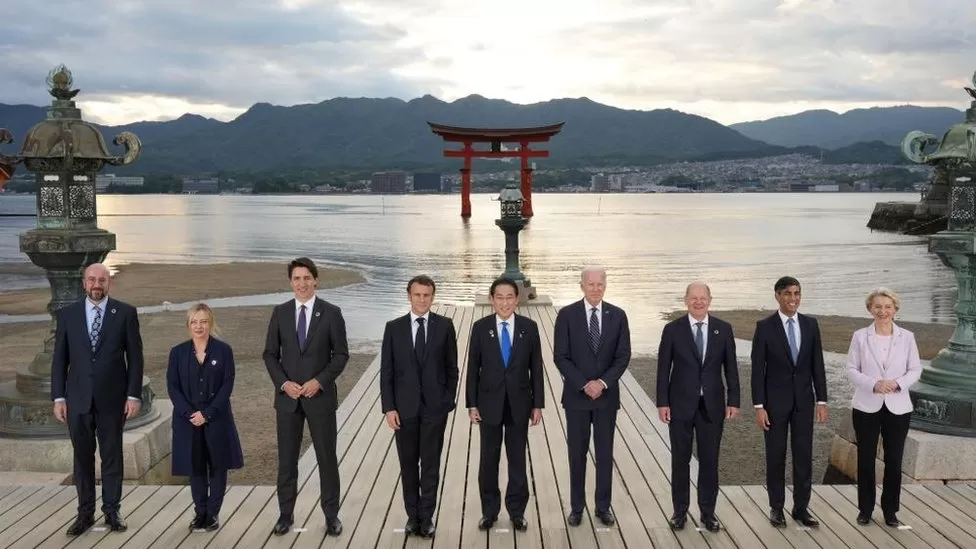
The US says it will allow its Western allies to supply Ukraine with advanced fighter jets, including American-made F-16s, in a major boost for Kyiv.

National security adviser Jake Sullivan said President Joe Biden “informed his G7 counterparts” of the decision at the bloc’s summit in Japan on Friday.

US troops will also train Kyiv’s pilots to use the jets, Mr Sullivan said.

Ukraine has long sought advanced jets and President Volodymyr Zelensky hailed the move as a “historic decision”.

The US legally has to approve the re-export of equipment purchased by allies and the move will clear the way for other nations to send their existing stocks of F-16s to Ukraine.

The US and allies had so far “focussed on providing Ukraine with the weapon and training of the system it needs to conduct offensive operations this spring and summer”, Mr Sullivan told reporters in Hiroshima.

“Now we have turned to discussions about improving the Ukrainian air force as part of our long-term commitment to Ukraine’s self-defence.

“As the training unfolds in the coming months, we will work with our allies to determine when planes will be delivered, who will be delivering them, and how many.”

Ukraine has repeatedly lobbied its Western allies to provide jets to help in its fight against Russia.

Ahead of Saturday’s official announcement, President Zelensky said the jets would “greatly enhance our army in the sky”, adding that he looked forward to “discussing the practical implementation” of the plan at the G7 summit in Hiroshima, where he will arrive on Sunday.

The US had been sceptical about providing Ukraine with modern fighter jets – at least in the near term. Its focus has instead been on providing military support on land.

Some Nato member countries have expressed worries that handing jets to Ukraine would be viewed as escalating the war, risking a direct confrontation with Russia.

Senior US military officials who have spoken to the BBC in the past have questioned whether Western-supplied fighter jets will dramatically alter the conflict, with Russia’s large air force still struggling to gain air superiority and the high density of air defence systems on the ground.

And in February, President Biden told reporters that he was “ruling out for now” sending advanced fighters to Ukraine.

But Mr Sullivan told reporters that the US had provided weapons to Kyiv as they were needed on the battlefield, and the decision to start supplying advanced fighters to Ukraine indicated the conflict had entered a new phase.

“Now we have delivered everything we said we were going to deliver, so we put the Ukrainians in a position to make progress on the battlefield through the counteroffensive. We’ve reached a moment where it is time to look down the road, and say what is Ukraine going to need as part of a future force to defend against Russian aggression,” he said.

Mr Sullivan also indicated the jets would only be used for defence purposes, adding the US would neither enable nor support attacks on Russian territory.

“The Ukrainians have consistently indicated that they are prepared to follow through on that,” he said.

While the change in US policy is significant, training pilots to fly F-16 jets will take time. Ukraine does have more trained fighter pilots than aircraft at present. But even training experienced fighter pilots on a new plane could take up to four months.

And then nations will need to agree to supply the jets. The F-16 is widely used by a number of European and Middle East nations as well as the US, which still manufactures the aircraft. Who is willing to supply the jets is the next key question.

The UK, Netherlands, Belgium and Denmark also welcomed the US move.

UK Prime Minister Rishi Sunak tweeted: “The UK will work together with the USA and the Netherlands, Belgium and Denmark to get Ukraine the combat air capability it needs.”

The UK does not have any F-16s in its air force itself.

Mr Zelensky is expected to join the G7 leaders in Japan

Denmark has announced it too will now be able to support the training of pilots, but did not confirm whether it would send any jets to Ukraine. Denmark’s air force has 40 F-16s, around 30 of which are operational.

Earlier this week, Mr Sunak and Dutch Prime Minister Mark Rutte said they would build an “international coalition” to provide fighter jet support for Ukraine.

Mr Sunak said the UK would set up a flight school to train Ukrainian pilots. French leader Emmanuel Macron said his country was willing to do the same but would not provide jets.

Some of the opposition to sending the jets has centred around maintenance issues, with former Nato official Dr Jamie Shea saying they require extensive maintenance after almost every fight.

At the start of Russia’s full-scale invasion, Ukraine was believed to have around 120 combat-capable aircraft – mainly consisting of ageing Soviet-era MiG-29s and Su-27s.

But officials say they need up to 200 jets to match Moscow’s air-power – which is thought to be five or six times greater than Kyiv’s.

Mr Zelensky has primarily been asking its allies for F-16s. First built in the 1970s, the jet can travel at twice the speed of sound and can engage targets in the air or on the ground.

While now eclipsed by the more modern F-35, it remains widely in use. Experts say modern fighters like the F-16 would help Ukraine strike behind Russian lines.

Earlier this year some Eastern European countries sent Soviet-era Mig fighter jets to Ukraine.

BBC/Simeon Ugbodovon

Subscribe to our Telegram and YouTube Channels also join our Whatsapp

Foreign

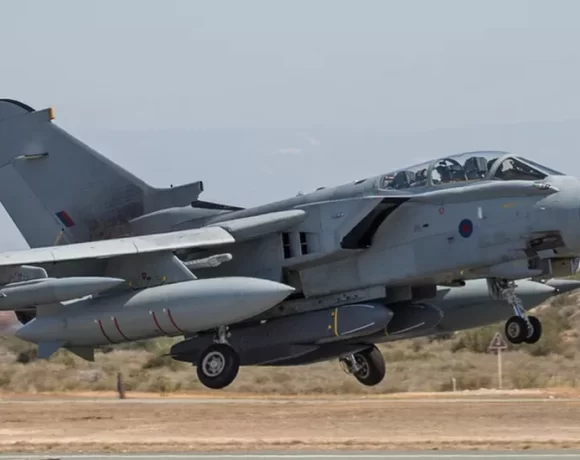
The UK has confirmed it is supplying Ukraine with long-range missiles it requested for its fight against invading Russian forces.

The Storm Shadow cruise missile has a range of over 250km (155 miles), according to the manufacturer.

By contrast, the US-supplied Himars missiles used by Ukraine only have a range of around 80 km (50 miles).

The weapons will give Ukraine the “best chance” of defending itself, UK Defence Secretary Ben Wallace said.

They are fired from aircraft, so the longer range means Ukrainian pilots will be able to stay further from the frontlines.

Once launched, the Storm Shadow drops to low altitude to avoid detection by enemy radar, before latching onto its target with an infra-red seeker.

The announcement was made in the House of Commons by Mr Wallace. The decision follows repeated pleas from Ukraine for more weapons from the West.

Mr Wallace said the missiles would “allow Ukraine to push back Russian forces based on Ukrainian sovereign territory”.

He said the UK took the decision after Russia “continued down a dark path” of targeting civilian infrastructure in Ukraine.

Mr Wallace wrote to his Russian counterpart Sergei Shoigu in December, he said, to warn that further attacks could result in the UK donating more capable weapons.

He said the missiles were “going into” or already in Ukrainian hands, and described the move as “calibrated and proportionate to Russia’s escalations”.

“None of this would have been necessary had Russia not invaded,” he said.

He said the missiles would be compatible with Ukraine’s existing, Soviet-era planes and praised the technicians and scientists who made that possible.

But he warned the range of the British-supplied Storm Shadows was “not in the same league” as Russia’s own missile systems – with some of Moscow’s weapons being able to travel far further.

Earlier this year, Ukrainian Defence Minister Oleksii Reznikov insisted longer-range missiles would not be used to attack targets within Russia itself.

“If we could strike at a distance of up to 300 kilometres, the Russian army wouldn’t be able to provide defence and will have to lose,” he told an EU meeting.

“Ukraine is ready to provide any guarantees that your weapons will not be involved in attacks on the Russian territory.”

In February, UK Prime Minister Rishi Sunak said he was prepared to send long-range missiles to Ukraine, and the British government opened a bidding process for their procurement.

“Together we must help Ukraine to shield its cities from Russian bombs and Iranian drones,” Mr Sunak said then. “That’s why the United Kingdom will be the first country to give Ukraine longer-range weapons.”

On Thursday, Kremlin spokesman Dmitry Peskov said Moscow would take an “appropriate” military response to any British-supplied Storm Shadow weapons used by Ukrainian forces.

The Storm Shadow missile has been operated by both British and French air forces and has been used previously in the Gulf, Iraq and Libya.

The British-supplied missiles can only be fired by aircraft, but French missiles can be fired from ships and submarines.

BBC/Simeon Ugbodovon

Subscribe to our Telegram and YouTube Channels also join our Whatsapp

Foreign

Ukrainian officials say air defenses downed 15 Russian cruise missiles which were launched overnight against the capital, Kyiv.

According to a senior Kyiv military official, Serhiy Popko, no casualties were recorded from the attack.

He said he believed the missiles had been launched by four bombers flying from the Caspian Sea region.

The new missile attacks came hours before Russia was due to celebrate Victory Day.

The 9 May holiday commemorates the Soviet Union’s victory over Nazi Germany during World War II.

Russian President Vladimir Putin has compared the Ukraine war – which he falsely defines as a battle against a “neo-Nazi regime” – to Adolf Hitler’s invasion of the Soviet Union.

Ukraine’s air force wrote on Telegram that “overnight into the ‘sacred’ May 9, Russia, launched an attack on the territory of Ukraine,”

Mr Popko said Russian forces were trying “to kill as many civilians as possible on this day”.

The latest attacks come after Ukraine said Russia launched its biggest drone attack of the war yet on Sunday night.

That wave of drone and missile strikes killed at least one person and injured five.

As Russia prepares for the main event of Victory Day – a military parade – the mood is one of nervousness in Moscow.

A series of explosions, drone attacks, and sabotage rocked Russia over the past week including an alleged drone attack on the Kremlin.

Moscow blamed Ukrainian drones but Kyiv denied any involvement.

BBC/Taiwo Akinola

Subscribe to our Telegram and YouTube Channels also join our Whatsapp

Foreign

Russia has launched a series of missile and artillery attacks on Ukraine, the second pre-dawn attack in three days.

One person died in the Kherson region and 25 people – including three children – were injured in Dnipropetrovsk.

Ukraine’s armed forces said 15 of 18 missiles fired were intercepted by the country’s air defence.

One of the main targets was the city of Pavlohrad near Dnipro – a Russian-installed official said resources for a Ukrainian offensive were hit.

Writing on Telegram with a thumbs-up gesture, Vladimir Rogov said missiles targeted railway infrastructure and fuel depots.

Nineteen high-rise apartment blocks, 25 private houses, six schools and kindergartens, and five shops were also damaged.

Pavlohrad is in Ukrainian-held territory, around 70 miles (110km) from the frontline.

Ukraine’s Dnipropetrovsk military administration described it as a “tragic night and morning”.

In Kyiv, the air raid alert sounded at around 04:00 local time (02:00 GMT) and lasted for about three hours. The military administration said all missiles and drones directed at the capital were destroyed.

In the Kherson region – which is still partly controlled by Russia – Ukrainian regional authorities said Russia had carried out 39 shellings.

They came from ground-based weapons, as well as drones and planes, the authorities said.

Recent days have seen an increase in attacks in Ukraine, with places away from the front lines being targeted. On Friday, 23 people were killed in the central city of Usman.

Ukraine says it is finishing plans for a long-awaited offensive against Russian forces, supported by Western-supplied weapons and military equipment.

Russia, meanwhile, is also preparing for a Ukrainian push and has fortified its positions in occupied territory.

In the latest change at the country’s military leadership, Cl Gen Mikhail Mizintsev – the Russian deputy defence minister who oversaw armed forces logistics – has been sacked, after being appointed to the role only last September.

There have been longstanding complaints that front-line troops are not getting sufficient military equipment, and suffer shortages of food and uniforms.

Meanwhile, a Ukrainian official on Monday said the army had ousted Russian forces from some positions in Bakhmut, an eastern city that has been under siege for months.

General Oleksandr Syrskyi, the commander of ground forces, said on Telegram the situation remained “quite difficult” – but “the enemy is unable to take control of the city”.

BBC/Adetutu Adetule

Subscribe to our Telegram and YouTube Channels also join our Whatsapp Update Group 
Foreign

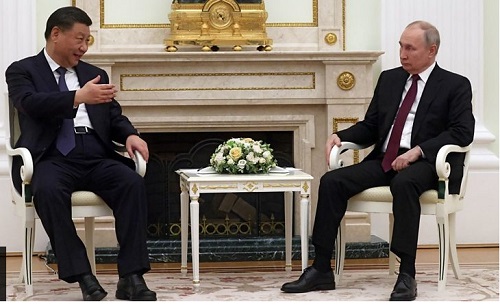
The US has urged Chinese President Xi Jinping to press Vladimir Putin on ceasing the “war crimes” being carried out by Russia in Ukraine.

The two will meet again on Tuesday for official talks during Mr Xi’s first visit to Moscow since the invasion.

The White House’s National Security Council spokesman called on Mr Xi to urge his Russian counterpart to withdraw troops from Ukraine.

John Kirby said seeking a ceasefire would not be enough.

“We hope that President Xi will press President Putin to cease bombing Ukrainian cities, hospitals and schools, to halt the war crimes and atrocities and to withdraw his troops,” he said.

“But we are concerned that instead, China will reiterate calls for a ceasefire that leaves Russian forces inside Ukraine’s sovereign territory and any ceasefire that does not address the removal of Russian forces from Ukraine would effectively ratify Russia’s illegal conquests.”

Mr Putin has said he will discuss a 12-point plan proposed by Mr Xi to “settle the acute crisis in Ukraine”.

“We’re always open for a negotiation process,” Mr Putin said, as the leaders called each other “dear friend”.

China released its plan to end the war last month – it includes “ceasing hostilities” and resuming peace talks.

China’s plan did not specifically say that Russia must withdraw from Ukraine – which Ukraine has insisted as a precondition for any talks.

Instead, it talked of “respecting the sovereignty of all countries”, adding that “all parties must stay rational and exercise restraint” and “gradually de-escalate the situation”.

The plan also condemned the usage of “unilateral sanctions” – seen as a veiled criticism of Ukraine’s allies in the West.

On Monday, a military band gave Mr Xi a warm welcome to Moscow at the start of the three-day visit. Mr Putin hailed China for “observing the principles of justice” and pushing for “undivided security for every country”.

He added that China had made” a tremendous leap forward in its development” in recent years, remarking: “We even feel a bit envious.”

In return, Mr Xi told Mr Putin: “Under your strong leadership, Russia has made great strides in its prosperous development. I am confident that the Russian people will continue to give you their firm support.”

Before Mr Xi’s arrival, Mr Putin wrote in China’s People’s Daily newspaper that the two nations would not be weakened by “aggressive” US policy.

Ukrainian leaders have been publicly emphasising the common ground they have with China – respecting the sovereignty and territorial integrity – but privately, they have been lobbying for a meeting or telephone call between President Volodymyr Zelensky and Mr Xi.

This was echoed by Mr Kirby, the US security spokesman, who urged Mr Xi “to play a constructive role” in the effort to end the conflict by speaking with Mr Zelensky.

The fear in Kyiv is that China’s support for Russia – currently based around technology and trade – might become military, potentially including artillery shells.

Russia is a source of oil for Beijing’s huge economy and is seen as a partner in standing up to the US.

In another development, Japan has announced that its Prime Minister, Fumio Kishida, will visit Kyiv on Tuesday for talks with President Zelensky. He is expected to voice solidarity and support for Ukraine following Russia’s invasion.

Mr Xi’s visit to Moscow comes days after the International Criminal Court (ICC) issued an arrest warrant for the Russian president over war crime allegations. This means Mr Putin could technically be arrested in 123 countries – though neither China nor Russia is on that list.

Western leaders have been attempting since last February to isolate Russia, following its full-scale invasion of Ukraine.

But they have been unable to establish a global consensus, with China, India and several African nations reluctant to condemn Mr Putin.

BBC/Simeon Ugbodovon

Subscribe to our Telegram and YouTubeChannels also join our Whatsapp Update Group
Foreign

US President Joe Biden has welcomed the International Criminal Court’s issuing of an arrest warrant against his Russian counterpart, Vladimir Putin.

The ICC accused President Putin of committing war crimes in Ukraine – something President Biden said the Russian leader had “clearly” done.

The claims focus on the unlawful deportation of children from Ukraine to Russia since Moscow’s invasion in 2022.

Moscow has denied the allegations and denounced the warrants as “outrageous”.

It is highly unlikely that much will come of the move, as the ICC has no powers to arrest suspects without the co-operation of a country’s government.

Russia is not an ICC member country, meaning the court, located in The Hague, has no authority there.

However, it could affect Mr Putin in other ways, such as being unable to travel internationally. He could now be arrested if he sets foot in any of the court’s 123 member states.

Mr Putin is only the third president to be issued with an ICC arrest warrant.

President Biden said that, while the court also held no sway in the US, the issuing of the warrant “makes a very strong point”.

“He’s clearly committed war crimes,” he told reporters.

His administration had earlier “formally determined” that Russia had committed war crimes during the conflict in Ukraine, with Vice-President Kamala Harris saying in February that those involved would “be held to account”.

The United Nations also released a report earlier this week that found Moscow’s forced removal of Ukrainian children to areas under its control amounted to a war crime.

In a statement on Friday, the ICC said it had reasonable grounds to believe Mr Putin committed the criminal acts directly, as well as working with others. It also accused him of failing to use his presidential powers to stop children being deported.

Russia’s commissioner for children’s rights, Maria Lvova-Belova, is also wanted by the ICC for the same crimes.

ICC prosecutor Karim Khan has said the warrants were “based upon forensic evidence, scrutiny and what’s been said by those two individuals”.

The court had initially considered keeping the arrest warrants a secret, but decided to make them public to try and stop further crimes being committed.

“Children can’t be treated as the spoils of war, they can’t be deported,” Mr Khan told the BBC.

“This type of crime doesn’t need one to be a lawyer, one needs to be a human being to know how egregious it is.”

Mr Khan also pointed out that nobody thought that Slobodan Milosevic, the Serbian leader who went on trial for war crimes in Croatia, Bosnia and Kosovo in the 1990s, would end up in The Hague to face justice.

“Those that feel that you can commit a crime in the daytime, and sleep well at night, should perhaps look at history,” Mr Khan said.

Kremlin spokesman Dmitry Peskov said any of the court’s decisions were “null and void” and former Russian President Dmitry Medvedev compared the warrant to toilet paper.

Russian opposition activists have welcomed the announcement. Ivan Zhdanov, a close ally of jailed opposition leader Alexei Navalny, has tweeted that it was “a symbolic step” but an important one.

Ukrainian President Volodymyr Zelensky has expressed his thanks to Mr Khan and the ICC for their decision to press charges against “state evil”.

BBC/Simeon Ugbodovon

Subscribe to our Telegram and YouTube Channels also join our Whatsapp Update Group