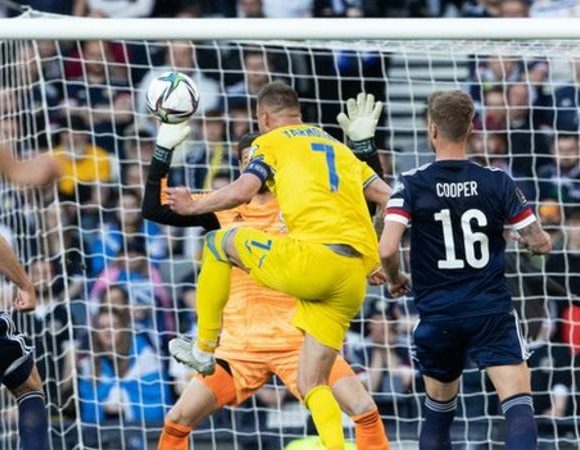
A heroic Ukraine roused a performance of spirit, endeavor and courage to stun Scotland and earn a historic World Cup play-off final against Wales.
With their country enshrouded in trauma amid the ongoing war with Russia, a team hauled together shone brightly at a sun-drenched Hampden.
Andriy Yarmolenko and Roman Yaremchuk struck either side of half-time before Callum McGregor gave Scotland hope late on. But Artem Dovbyk sealed a Qatar 2022 showdown in Cardiff on Sunday with the last kick of the ball.
While images of fans watching on in war-torn Ukraine circulated, 3,500 fans bedecked in light blue and yellow – including 65 orphans invited by the Scottish FA – celebrated wildly in Glasgow on a night none will forget.
It was an evening that started with the lyrics of the Ukrainian national anthem striking an emotional chord at a charged Hampden.
Moments after their side strode onto the pitch draped in flags of their homeland, the words which were belted out took on a whole new significance. “The glory and freedom of Ukraine have not yet perished. Luck will still smile on us brother-Ukrainians.”
As it transpired, luck had little to do with their team’s triumph here. In perhaps their finest hour, they were peerless.
This match was a long time coming. Originally planned for March but postponed in the hope Ukraine would be capable of playing the fixture, a series of friendlies were all Olexandr Petrakov had to prepare.
It’s been a gut-wrenching journey, with the tears on the face of Oleksandr Zinchenko in Tuesday’s pre-match news conference offering a poignant reminder to all of what this game means against the backdrop of Ukraine’s struggles.
But in Glasgow, there was no emotional fatigue. Not a hint of an adrenaline rush fading, not a whiff of the event getting the better of them.
Barring a late rally from the hosts, Petrakov’s men exposed Scotland’s vulnerabilities, which were made even more pronounced by the absence of Arsenal’s Kieran Tierney. The opener on 33 minutes articulated that perfectly.
Yarmolenko timed his run on to a through ball to perfection as Scotland’s high line failed. It was just him and the whites of Craig Gordon’s eyes. Those eyes soon gazed up as the ball floated sublimely over the goalkeeper’s head and into the back of the net.
Steve Clarke shuffled his pack at half-time, throwing on Ryan Christie. But just four minutes after the restart, the Scots were again ripped open with ease.
Oleksandr Karavaev was given the freedom of Mount Florida to bowl in another cross and Yaremchuk dealt with Aaron Hickey’s attention without much trouble, his arching header back across goal looping in.
Clarke stood still at the edge of his technical area as the Benfica striker raced to his countrymen and women behind the goal.
In truth, the warning signs had been there. Gordon had denied Viktor Tsygankov on the half volley, while the Hearts goalkeeper saved from Yarmolenko at point-blank range with the game goalless.
Then came the moment when Scotland saw their world flash in front of them. John McGinn, the Tartan Army’s darling, was gifted a header from six yards after Georgiy Bushchan flapped at a cross. With the goal at his mercy, the Aston Villa man headed wide. He looked on in disbelief.
On the touchline, Clarke seemed unmoved, preparing two substitutes for a late charge.
Scotland charged but toiled still, yet with 11 minutes they were gifted a lifeline. McGregor’s effort was again not dealt with by an increasingly rattled Bushchan, who palmed the ball into the air and just over the line before it was hacked clear. Hampden erupted in a primal roar of desperate hope rather than founded expectation.
But as Scotland pushed, they were even more exposed at the back. A series of long punts in the closing stages broke down, with one final roll of the dice allowing the Ukrainians to burst forward deep into injury time.
Substitute Dovbyk had all the time he wished to eventually dispatch the ball by Gordon. The Dnipro-1 forward, who has not played a competitive match since December, showed little emotion as the ball ruffled the net. Around him, his compatriots celebrated wildly on an astonishing night for Ukraine as a football team, and a nation.
BBC/Simeon Ugbodovon