Foreign

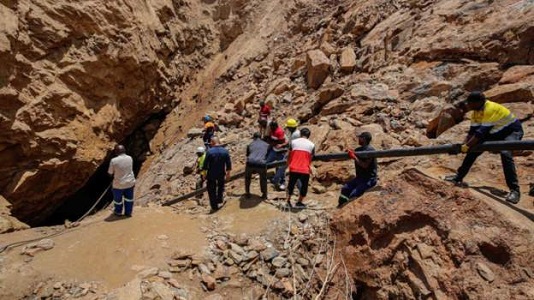
All fifteen miners trapped in a Zimbabwean gold mine for four days have been rescued.

Mines Minister Soda Zhemu said the workers were healthy and conscious.

The Redwing gold mine owned by Metallon Corporation caved in after the shaft collapsed on Thursday.

Officials said an earth tremor might have caused the accident.

Families of the trapped workers have been camping at the mine site in the mining village of Penhalongato – 270 km (167 miles) east of the capital Harare – waiting for the rescue.

The area is home to many undocumented workers who scrape a living amid economic hardship.

BBC/Simeon Ugbodovon

Subscribe to our Telegram and YouTube Channels and also join our Whatsapp Update Group 

Foreign

Zimbabwe has declared a state of emergency in the capital Harare over a cholera outbreak.

The outbreak has so far killed dozens of people with more than 7,000 suspected cases.

The city authorities say the outbreak, spreading throughout the city, has invoked memories of a deadly outbreak in 2008, in which thousands died.

“We have declared a state of emergency because of cholera,” local media quoted Mayor Ian Makone as saying.

The authorities are now asking for help to contain the spread and provide safe water, saying the aid being received is inadequate.

Health authorities have been struggling to contain the high number of admissions following the outbreak, according to the International Federation of the Red Cross (IFRC).

Zimbabwe has been battling the deadly cholera outbreak in recent months amid a lack of access to clean water.

The epicentre of the latest outbreak is Harare’s high-density suburb of Kuwadzana, which accounts for nearly half the reported cases, according to the authorities.

Cholera, an acute diarrhoeal infection is caused by consuming food or water contaminated with the bacterium Vibrio cholerae, It is treated with an oral rehydration solution, to replace the fluids and salts lost to diarrhoea and vomiting, the Harare Mayor said the cholera outbreak had similarities to the 2008 outbreak.

The outbreak then led to the deaths of over 4,000 people, with at least 100,000 infected, which led to a paralysis of basic services in the country.

This pushed then-President, Robert Mugabe into agreeing on a historic power-sharing deal with his long-time rival, Morgan Tsvangirai.

In 2018, the country declared a state of emergency after 20 deaths and more than 2,000 cases related to typhoid and cholera were reported

“The cholera outbreak has come with vengeance,” the mayor was quoted as saying on Thursday.

On Tuesday, the Ministry of Health announced that the country had recorded 7,398 suspected cases, 50 confirmed deaths, and 109 people in hospital.

The IFRC says the disease is quickly spreading, affecting multiple geographical areas in 45 out of 62 districts and in all 10 provinces of the country, It says the outbreak can be expected to cross the border.

Neighbouring countries including Malawi, South Africa, and Mozambique have also frequently experienced cholera outbreaks in the past.

BBC/Adebukola Aluko

Subscribe to our Telegram and YouTube Channels and also join our Whatsapp Update Group 
Foreign

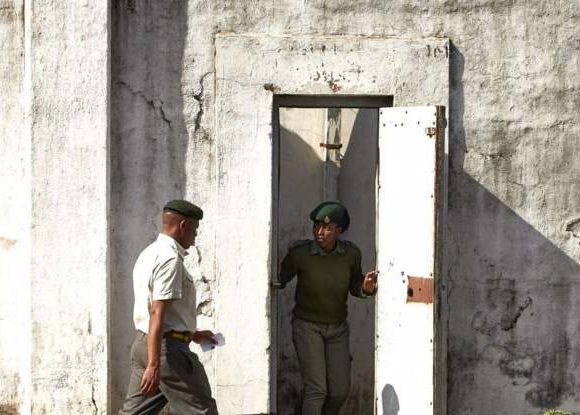
Zimbabwe’s main opposition coalition the Citizens Coalition for Change (CCC) has claimed that some of the more than 4,000 prisoners released on presidential amnesty last week include child rapists.

President Emmerson Mnangagwa pardoned the prisoners drawn from the country’s 47 prisons in an attempt to decongest the overcrowded jails.

Prison authorities had, however, said rape was among offences excluded from the amnesty

. However, viral videos showed what local media said were rapists celebrating their freedom with some who are said to have served less than a year of their term.

The CCC in a statement on Wednesday said it was “grossly irrational to release dangerous, unrehabilitated offenders back into society” before informing or preparing rape victims.

“Unleashing an unrehabilitated rapist who has not served his sentence back into his community unchecked and with no safeguards to protect victims endangers women and girls and can never be reasonably justifiable in a democratic society,” CCC spokesperson Fadzayi Mahere said.

Some Zimbabweans on social media have also demanded that the decision be reversed as it puts women in danger.

Prominent investigative journalist Hopewell Chin’ono said amnesty “is never granted to rapists or people who have committed violent crimes”.

Mr Chin’ono, a government critic, said Zimbabwean women were not safe following the pardon

. Zimbabwean authorities are yet to comment on the claims.

Subscribe to our Telegram and YouTube Channels also join our Whatsapp

Feature

The vaDoma tribe, also known as Doma or Dema, is the only hunter-gatherer tribe in Zimbabwe living in the Kanyemba region around the basins of a tributary of the Zambezi River Valley.


They speak the Dema language and believe their ancestors emerged from a baobab tree and walked upright to hunt and gather fruits. The secluded tribe is Zimbabwe’s only non-agricultural society.


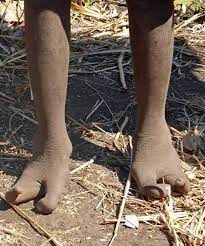
The tribe is rather famous for having the rare genetic condition known as Ectrodactyly or lobster claw syndrome. This is the absence of one or more fingers or toes at birth.


The inherited dominant genetic mutation affects only the feet of one in four children within the vaDoma population. Their middle three toes are absent and the two outer ones are turned in.


The condition resulted in the tribe being referred to as the “two-toed” or “ostrich-footed” tribe. It is against the tribal law for members to marry outside the group and as a result, the two-toed condition does not spread to other tribes.
Those with the condition are not considered disabled in the community and it is believed that their toes enable them to climb trees better.


The vaDoma people are reported to have resisted incorporation into the Korekore Shona kingdom of Mutapa prior to the European colonisation. This has cost them fertile land to grow crops.


They currently live their nomadic lifestyle in the Chewore Safari Area which has now become their mountain homeland. They are also facing threats from game rangers who are cracking down on poaching.

Titilayo Kupoliyi