Foreign

President Donald Trump has blamed Volodymyr Zelensky for starting the war with Russia, a day after a massive Russian attack killed 35 people and injured 117 others in Ukraine.

The US president said the Ukrainian leader shared the blame with Russian President Vladimir Putin for “millions of people dead” in the Ukraine war.

You don’t start a war against someone 20 times your size and then hope that people give you some missiles,” he told reporters at the White House, also blaming former US President Joe Biden for the conflict.

Trump’s comments come after widespread outrage over Russia’s attack on the Ukrainian city of Sumy on Sunday, which was the deadliest Russian attack on civilians this year.

Asked about the attack earlier, Trump said it was “terrible” and that he had been told Russia had “made a mistake“, but did not elaborate.

“Millions of people dead because of three people,” Trump said on Monday. “Let’s say Putin number one, let’s say Biden, who had no idea what the hell he was doing, number two, and Zelensky.”

It is estimated that hundreds of thousands, but not millions, of people have been killed or injured on all sides since Russia launched a full-scale invasion of Ukraine on 24 February 2022.

Questioning Zelensky’s competence, Trump remarked that the Ukrainian leader was “always looking to purchase missiles“.

When you start a war, you’ve got to know you can win,” the US president said.

Trump has repeatedly clashed with Zelensky since he returned to office this year, and has previously appeared to blame Ukraine for starting the war.

Tensions between the pair have been high ever since their heated confrontation at the White House in February.

During that meeting, Trump accused Zelensky of “gambling with World War Three” and chided him for not starting peace talks with Russia earlier.

By contrast, the US president has made efforts to improve relations with Moscow.

Trump said he had a “great” phone call with Putin last month, and the Russian president sent him a portrait as a gift a week later.

In February, Washington voted with Moscow against a UN resolution that identified Russia as the “aggressor” in Russia’s war against Ukraine.

After talks between US and Russian officials failed to produce a ceasefire in Ukraine, Trump said he was “very angry” with Putin, though he added he had a “good relationship” with the Russian leader.

BBC/Adetutu Adetule

Subscribe to our Telegram and YouTube Channels and, also join our WhatsApp Update Group

Foreign

US President Joe Biden has urged Hamas to accept a new Israeli proposal to end the conflict in Gaza, saying that “it’s time for this war to end”.

The three-part proposal would begin with a six-week ceasefire in which the Israel Defense Forces (IDF) would withdraw from populated areas of Gaza.

There would also be a “surge” of humanitarian aid, as well as an exchange of some hostages for Palestinian prisoners.

The deal would eventually lead to a permanent “cessation of hostilities” and a major reconstruction plan for Gaza.

Hamas said it views the proposal “positively”.

Speaking at the White House on Friday, Mr Biden said that the first phase of the proposed plan would include a “full and complete ceasefire”, the withdrawal of IDF forces from populated areas and the exchange of hostages for Palestinian prisoners.

“This is truly a decisive moment,” he said. “Hamas says it wants a ceasefire. This deal is an opportunity to prove whether they really mean it.”

The ceasefire, he added, would allow more humanitarian aid to reach the beleaguered territory, with “600 trucks carrying aid into Gaza every single day”.

The second phase would see all remaining living hostages returned, including male soldiers. The ceasefire would then become “the cessation of hostilities, permanently.”

Among those who have urged Hamas to agree to the proposal was UK Foreign Secretary David Cameron, who said on X that the group “must accept this deal so we can see a stop in the fighting”.

“We’ve long argued a stop in the fighting can be turned into a permanent peace if we are all prepared to take the right steps,” Lord Cameron added. “Let’s seize this moment and bring this conflict to an end.”

UN Secretary General Antonio Guterres also welcomed the development in a post to X, formerly known as Twitter. He said the world had “witnessed too much suffering [and] destruction in Gaza” and said it was “time to stop”.

“I welcome [President] Biden’s initiative [and] encourage all parties to seize this opportunity for a ceasefire, release of all hostages, guaranteed unhindered humanitarian access [and] ultimately a durable peace in the Middle East,” he added.

In his speech, Mr Biden acknowledged that negotiations between phases one and two would be difficult.

As recently as a few days ago, Israeli Prime Minister Benjamin Netanyahu was letting it be known that he was implacably opposed to agreeing to end the war as part of a ceasefire deal – making Mr Biden’s reference to the war’s end particularly significant.

While the plan includes many of the details from previous, ultimately failed rounds of talks, the US calls for a permanent ceasefire appear to be a significant concession designed to try and draw Hamas back to negotiations on terms they have already said they would agree to. A permanent ceasefire has been one of the group’s key demands.

The third phase of the proposal would see the final remains of any deceased Israeli hostages returned, as well as a “major reconstruction plan” with US and international assistance to rebuild homes, schools and hospitals.

In his remarks, Mr Biden acknowledged that some Israelis – including officials within Israel’s government – would likely be opposed to the proposal.

“I’ve urged the leadership in Israel to stand behind this deal,” he said. “Regardless of whatever [political] pressure comes.”

The US president also directly addressed the Israeli people, telling them that “we can’t lose this moment”.

Notably, Mr Biden said that Hamas has now been degraded to the extent that it can no longer repeat an attack such as that which its fighters conducted on 7 October – a likely signal to the Israelis that Washington sees the war as done.

In a statement, Prime Minister Netanyahu insisted that the war would not end until its objectives were achieved, including the return of all hostages and the elimination of Hamas’ military and governing capabilities. He said the latest plan would allow Israel to uphold these principles.

Hamas, for its part, said that it views the proposal “positively” because of its call for a permanent ceasefire, the withdrawal of Israeli forces from Gaza, reconstruction and the exchange of prisoners.

The group said it was ready to “deal positively and constructively” with any proposal centred on a permanent ceasefire, provided that Israel “declares its explicit commitment to that”.

Another Palestinian official familiar with the negotiations who has seen the new Israeli proposal said that the document did not include a guarantee that the war will end, nor that IDF troops would withdraw from Gaza completely.

The proposal has been transmitted to Hamas through mediators based in Qatar.

Meanwhile, US Secretary of State Antony Blinken called his counterparts in Jordan, Saudi Arabia and Turkey to try to build a wider support for the proposal.

Mr Blinken “emphasized that Hamas should accept the deal and that every country with a relationship with Hamas should press it to do so without delay,” state department spokesman Matthew Miller said on Friday night.

Faced with mounting civilian casualties in Gaza, President Biden has faced growing domestic criticism over the level of US support for Israel, and calls to do more to encourage the warring sides to negotiate.

Earlier this week, however, the White House said that it does not believe that Israeli operations in Rafah amount to a “major ground operation” that could cross a red line and trigger a possible change in US policy.

The statement came after an Israeli air strike and resulting fire killed at least 45 Palestinians on Sunday.

In a separate announcement on Friday, US lawmakers from both sides of the political spectrum formally invited Mr Netanyahu to address Congress in Washington.

It is unclear when the address would take place.

More than 36,000 have been killed across Gaza since the start of the conflict, according to the Hamas-run health ministry.

The war began in October when Hamas gunmen launched an unprecedented attack on Israel, killing about 1,200 people and taking 252 back to Gaza as hostages.

BBC/Simeon Ugbodovon

Subscribe to our Telegram and YouTube Channels and also join our Whatsapp Update Group

Foreign

US President Joe Biden has hit back angrily at an investigation that found he mishandled top secret files and struggled to recall key life events.

“My memory is fine,” he insisted in a surprise news briefing.

He gave an emotional response to a claim that he could not recollect when his son died, saying: “How the hell dare he raise that?”

The inquiry found Mr Biden “wilfully retained and disclosed” classified files, but decided not to charge him.

Department of Justice Special Counsel, Robert Hur determined Mr Biden had improperly kept classified documents related to military and foreign policy in Afghanistan after serving as vice-president.

The scathing 345-page report, released earlier in the day, said the president’s memory had “significant limitations”.

Even as Mr Biden sought to rebut reporters’ questions about his age and mental acuity, he inadvertently referred to Egyptian leader Abdul Fattah al-Sisi as the “president of Mexico”.

Asked to comment on the latest in the Israel-Gaza war, he said: “I think as you know initially, the president of Mexico, Sisi, did not want to open up the gate to allow humanitarian material to get in.”

Mr Hur interviewed the 81-year-old president over five hours as part of the inquiry.

The special counsel, a Republican appointed to the role by Biden Attorney General Merrick Garland, said Mr Biden could not recall when he was vice president (from 2009 to 2017), or “even within several years when his son Beau died” (2015).

At Thursday night’s news conference, an emotional Mr Biden lashed out at the passages casting doubt on his recollection of events.

“Frankly, when I was asked the question, I thought to myself, was none of their damn business,” he said.

“I don’t need anyone to remind me when he [Beau Biden] passed away.”

BBC/Titilayo Kupoliyi

Subscribe to our Telegram and YouTube Channels and also join our Whatsapp Update Group
Foreign

*Joe Biden in Constant Touch with Tinubu, Other European Allies.

The United States of America has warned the Niger junta that America may be pushed to be involved militarily if the country’s military rulers do not return to constitutional order.

The US acting Deputy Secretary, Victoria Nuland, in a special briefing on Niger disclosed this via a teleconference on Tuesday.

She noted, “…There is still a lot of motion here on many sides with regard to where the governance situation will go.

“So we will be watching that closely and there are a number of regional meetings coming up and consultations with allies and partners that we need to make.

“So we’ll be watching the situation, but we understand our legal responsibilities and I explained those very clearly to the guys (Niger junta) who were responsible for this and that it is not our desire to go there, but they may push us to that point, and we asked them to be prudent in that regard and to hear our offer to try to work with them to solve this diplomatically and return to constitutional order.”

Nuland noted that President Joe Bden has been in constant touch with President Tinubu, the ECOWAS Chairman as well as many other European allies.

“He’s also been in regular touch with President Tinubu of Nigeria, who is currently head of ECOWAS, with AU Chairperson Faki, and with a number of European allies with whom we work in Niger, particularly on counterterrorism.

“And all of this has been rooted in our shared values, including the sense of democracy, which was why it was so difficult, and remains difficult, to see the current challenge to the democratic order which began on July 26,” she stressed.

Vanguard/Simeon Ugbodovon

Subscribe to our Telegram and YouTube Channels also join our Whatsapp Update Group
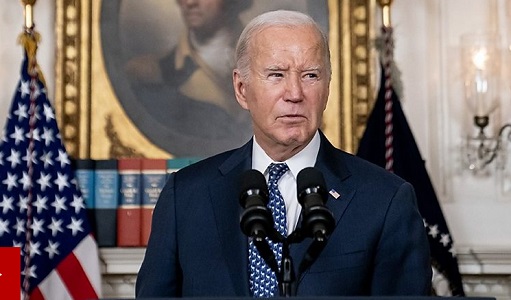
Foreign

The US government has stopped approving licences for American firms to export most items to Chinese technology giant Huawei.

According to the report, it comes as the Biden administration continues to tighten its rules on exports of US technology to China.

Washington has previously accused Huawei of being a threat to US national security and of working with the Chinese Communist Party.

The company and the Chinese government have repeatedly denied the allegations.

The US Commerce Department has told some American firms that it would no longer issue licences for US technology exports to Huawei, according to the Financial Times, which first reported the story.

The move comes as Washington moves towards a total ban on the sale of US technology to the Chinese telecom equipment giant.

“Working closely with our interagency export controls partners at the Departments of Energy, Defense and State, we continually assess our policies and regulations and communicate regularly with external stakeholders,” a US Commerce Department spokesperson told the BBC.

“We do not comment on conversations with or deliberations about specific companies,” they added.

Huawei declined to comment on the reports.

The Biden Administration had continued to tighten restrictions on Huawei as political tensions between Washington and Beijing increased over Taiwan, where most of the world’s computer chips are made.

In October, US Under Secretary of Commerce for Industry and Security Alan Estevez said “the threat environment is always changing.”

“We are appropriately doing everything in our power to protect our national security and prevent sensitive technologies with military applications from being acquired by the People’s Republic of China’s military, intelligence, and security services,” he added.

For several years Shenzhen-based Huawei has faced US export restrictions on items for the high-speed fifth generation, 5G, telecoms equipment and artificial intelligence technology.

In 2019, during the presidency of Donald Trump, US officials added the company to a so-called “entity list.”

It means that US companies need to obtain a licence from the government to export or transfer some technologies, especially over concerns that they will be used by the Chinese military.

However, in that time licences have been granted to some US companies, including Intel and Qualcomm, to supply Huawei with technology that was not related to 5G.

BBC/Taiwo Akinola

Subscribe to our Telegram and YouTube Channels also join our Whatsapp Update Group
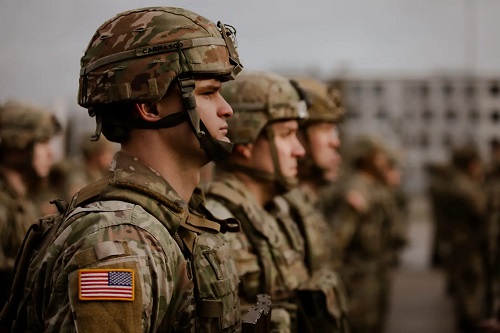
Foreign

The risk of a nuclear “Armageddon” is at its highest level since the 1962 Cuban Missile Crisis, US President Joe Biden has said.

Mr Biden said Russia’s President Vladimir Putin was “not joking” when he spoke of using tactical nuclear weapons after suffering setbacks in Ukraine.

The US was “trying to figure out” Mr Putin’s way out of the war, he added.

The US and the EU have previously said Mr Putin’s nuclear sabre-rattling should be taken seriously.

However, the US National Security Adviser Jake Sullivan last week said that, despite Moscow’s nuclear hints, the US had seen no signs that Russia was imminently preparing to use a nuclear weapon.

Ukraine has been retaking territory occupied by Russia, including in the four regions Russia illegally annexed recently.

For several months US officials have been warning that Russia could resort to the use of weapons of mass destruction if it suffers setbacks on the battlefield.

President Biden said the reason the Russian leader had not been “not joking” when he talked about using tactical nuclear, biological or chemical weapons – “because his military is, you might say, significantly underperforming”.

“For the first time since the Cuban Missile Crisis, we have a direct threat to the use of nuclear weapons, if in fact, things continue down the path they’d been going,” Mr Biden told fellow Democrats.

“We have not faced the prospect of Armageddon since Kennedy and the Cuban Missile Crisis.”

In 1962, the US and the Soviet Union – under President John F Kennedy and Nikita Khrushchev – came close to a nuclear showdown over the deployment of Russian nuclear weapons in Cuba.

The confrontation is considered by many experts to be the closest the world has ever come to full-scale nuclear war.

During a speech last Friday, President Putin said the US had created a “precedent” by using nuclear weapons against Japan at the end of World War Two – a comment that would not have gone unnoticed by Western governments, our Russia editor Steve Rosenberg points out.

Mr Putin has also threatened to use every means at his disposal to protect Russian territory.

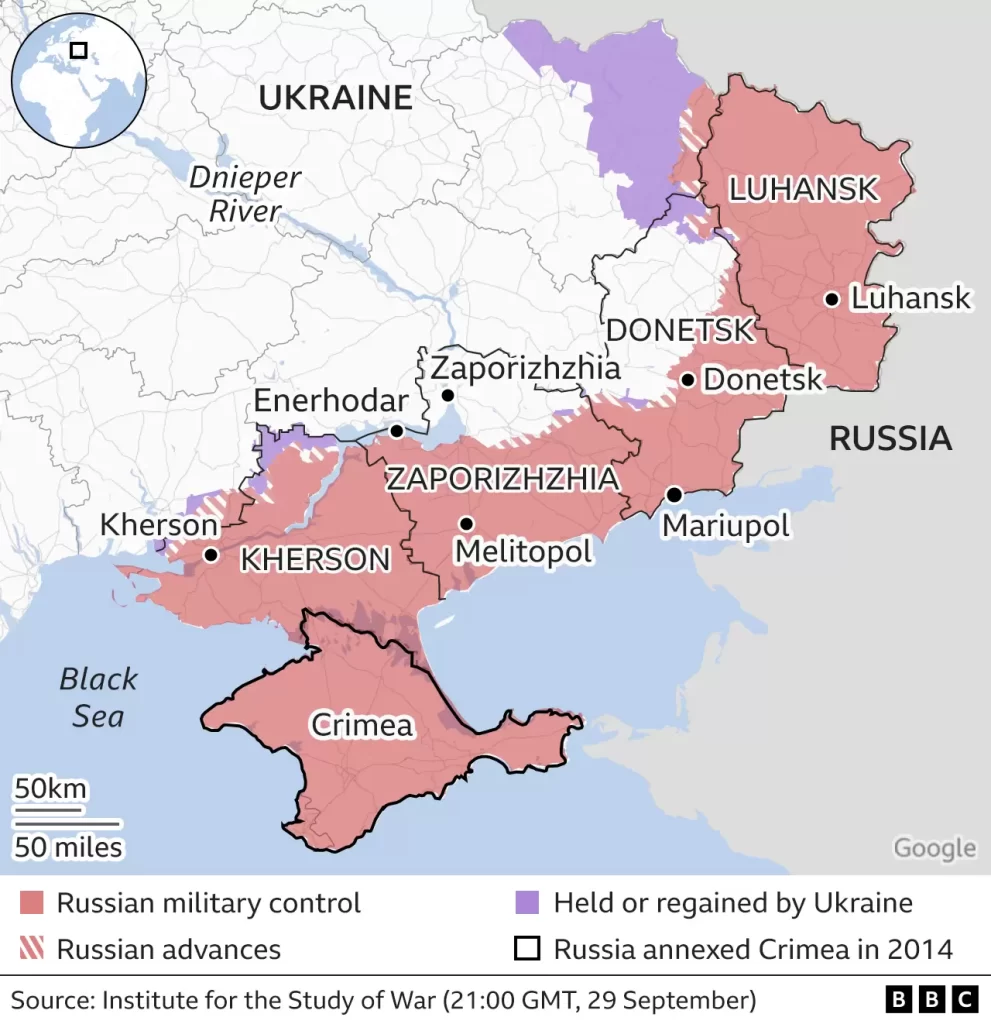
Even as Mr Putin signed the final papers formally annexing four regions of Ukraine – Luhansk, Donetsk, Zaporizhzhia and Kherson – Kyiv’s forces were advancing inside those areas he had claimed.

Hundreds of thousands of men have been fleeing Russia rather than wait to be drafted to fight in Ukraine.

Ukraine’s President Volodymyr Zelensky has previously dismissed Moscow’s nuclear threats as a “constant narrative of Russian officials and propagandists”.

Paul Stronski, of the Carnegie Endowment for International Peace, told the BBC that Russia’s “destabilising rhetoric” is aimed at deterring the West.

There has also been some pushback against Moscow’s nuclear threats in Russia itself. An editorial in the country’s mainstream Nezavisimaya Gazeta newspaper was heavily critical of “senior Russian officials” for “talking about the nuclear button”.

“To allow, in thoughts and words, the possibility of a nuclear conflict is a sure step to allowing it in reality.”

Russia’s foreign ministry spokeswoman told reporters on Thursday that Moscow had not changed its position that nuclear war “must never be waged”.

Mr Biden’s comments came at the New York home of James Murdoch, son of media mogul Rupert Murdoch, during a Democratic fundraising event.

BBC/Simeon Ugbodovon

Subscribe to our Telegram Channel and join our Whatsapp Update Group
Foreign

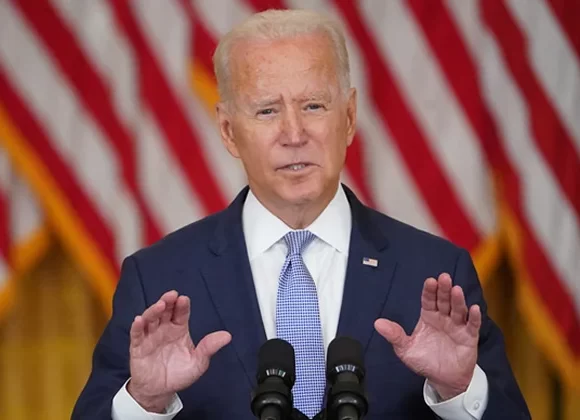
President Joe Biden has warned Russia that the United States will not be intimidated by reckless threats after Vladimir Putin declared the annexation of four occupied regions of Ukraine.

On Friday, President Putin appeared to make a veiled threat to use nuclear weapons to defend those regions.

He said they would “forever” be Russian – but Ukraine vowed to liberate them.

Nato chief Jens Stoltenberg said the Russian move was “the most serious escalation since the start of the war”.

In a speech in Moscow, the Russian leader claimed citizens in Ukraine’s eastern Donetsk and Luhansk regions, as well as in Kherson and Zaporizhzhia in the south had voted to be “with their people, their motherland”.

He was referring to so-called referendums held in the regions in recent days, but Ukraine and Western governments have condemned the votes as a sham.

Much of Mr Putin’s speech was used to rail at the West.

He said the US had created a “precedent” by using nuclear weapons against Japan at the end of World War Two, in an apparent threat.

Mr Putin last week said his country had “various weapons of destruction” and would “use all the means available to us”, adding: “I’m not bluffing.”

The Kremlin has made clear that any attack on the regions claimed by Russia would be seen as an attack on Russian soil, signalling an escalation in the war.

Russia does not fully control any of the four regions, and in his speech Mr Putin did not clear define the borders.

President Biden called out his Russian counterpart’s “reckless words and threats”, but added that Mr Putin was “not going to scare us”.

“America and its allies are not going to be intimidated,” President Biden said at the White House.

He then addressed the Russian president directly, pointing his finger into the camera.

“America’s fully prepared, with our Nato allies, to defend every single inch of Nato territory,” he said, in reference to the Western security bloc.

“Mr Putin, don’t misunderstand what I’m saying: every inch.”

Shortly after, Mr Biden’s top national security official said while there was a chance of Moscow resorting to nuclear weapons, there did not appear to be an imminent threat.

Ukraine launched a new, fast-track bid to join Nato soon after Mr Putin’s speech.

After a crisis meeting of Ukraine’s National Security and Defence Council, President Volodymyr Zelensky said Kyiv had long been a “de facto” member of the security bloc and accused Moscow of redrawing borders “using murder, blackmail, mistreatment and lies”.

Mr Zelensky vowed to liberate all Ukrainian territories, including Crimea – Ukraine’s southern peninsula annexed by Russia in 2014. And he also ruled out any further negotiations with Mr Putin.

Meanwhile, Mr Stoltenberg of Nato was reluctant to be drawn on the bid, saying the decision rested with the bloc’s 30 members.

The alliance’s members “do not and will not” recognise any of the annexed territories as part of Russia, Mr Stoltenberg told reporters, accusing Mr Putin of “irresponsible nuclear sabre-rattling”.

He called the annexation a “pivotal moment” in the war.

EU Commission President Ursula von der Leyen said “the illegal annexation proclaimed by Putin won’t change anything”.

“All territories illegally occupied by Russian invaders are Ukrainian land and will always be part of this sovereign nation.”

Turkey described the Russian move as a “grave violation” of international law.

South Korea said it did not recognise the attempted annexations, adding that Ukraine’s sovereignty, territorial security and independence must be protected.

As Mr Putin spoke in Moscow, 750km (466 miles) to the south, his forces were being surrounded by Ukrainian troops in Lyman, a strategically important town in the eastern region of Donetsk.

Ukraine’s military has been keen to conceal the pace of its troops’ advance in the area, but one video on social media appeared to show Kyiv’s forces in the centre of Yampil, just 16km (9 miles) southeast of Lyman.

And late on Friday night, Kyiv’s defence ministry said it had taken the village of Drobysheve, 8km (4 miles) north-west of Lyman.

Elsewhere, Ukraine reported on Saturday morning that the director of Zaporizhzhia’s nuclear power plant – Europe’s biggest – has been detained by Russians and taken “in an unknown direction”. Russia occupied the plant shortly after launching its invasion on 24 February.

This comes just hours after Ukraine accused Russia of killing 30 people in a rocket strike on a civilian convoy in the city of Zaporizhzhia.

Russia blamed Ukraine for that attack – one of the deadliest in recent weeks.

In another development on Friday, Russia vetoed a UN Security Council resolution which would have condemned its annexation of the four occupied regions. Moscow’s ambassador, Vasily Nebenzia, complained that it was unprecedented to seek the condemnation of a permanent member of the body.

While the Kremlin’s blocking of the motion was anticipated, both India and China abstained.

BBC/Simeon Ugbodvon

Subscribe to our Telegram Channel and join our Whatsapp Update Group
Yoruba

Àarẹ ilẹ̀ America, Joe Biden ni yio se pàdépọ̀ pẹ̀lú àwọn adarí ilẹ̀ Palestine tí wọ́n wà lágbègbè West Bank lóni sáàjú kó tó lọ síbi ìpàdé àpérò ni Saudi Arabia.

Gẹ́gẹ́bí ohuntí àwọn ònwòye sọ, ó seese kí ǹkan lọ́ jái níbi ìpàdé náà pẹ̀lú Mahmoud Abbas nítorí gbúngbùngbún tó wà láàrin wọn pẹ̀lú ìsèjọba àarẹ Trump.

ọ̀gbẹ́ni Biden yio tún sèpàdépọ̀ pẹ̀lú adarí ilẹ̀ Saudi Arabia, Ọmọba Mohamined bin Salman àti bàbá rẹ, ọba Salman níbití wọ́n yio ti gíròrò lórí ìpèsè iná ọba, ẹ̀tọ́ ọmọnìyàn àti ìfọwọ́sowọ́pọ̀  lórí ọ̀rọ̀ ààbò.

Ao mu wá sí ìrántí wípé àarẹ Biden ti sèlérí a kojú oro sí orílẹ̀ èdè Saudi Arabia nítorí ìsekúpani oníròyìn Khasinoggi látọwọ́ àwọn òsìsẹ́ ilẹ̀ Saudi lọ́dún 2018.

BBC/Yemisi Owonikoko

Foreign

The United States would defend Taiwan militarily if it was attacked, President Joe Biden said at a news conference in Japan.

Biden added that China had no right to seize the island by force.

He stated that a forcible takeover of Taiwan would dislocate the entire region, and was comparable to Russia’s invasion of Ukraine.

“We remain committed to supporting the peace and stability across the Taiwan Strait and ensuring that there is no unilateral change to that status quo,’’ Biden added.

The briefing was a joint news conference with Japanese Prime Minister, Fumio Kishida.

China is flirting with danger with its current manoeuvres around Taiwan, Biden warned, while adding that he did not expect China to attempt an attack on Taiwan.

Punch/Opeyemi Olugbenga

Foreign

In the US state of New Hampshire, President Joe Biden said that he’s not sure whether he’ll travel to Ukraine.

“The answer is, I don’t know,” Biden told newsmen.

“I’ve been to Ukraine many times, just haven’t been there recently.”

White House officials have been saying since last week that a senior official may travel to Kyiv to meet President Volodymyr Zelensky.

Report says, Zelensky has also invited Biden to personally make the trip.

White House Press Secretary Jen Psaki said that there are currently no plans for Biden to go.

She later added that if there were plans in the works, she would not tell reporters in advance anyway.
Officials say it’s more likely that the US will send the Secretary of State or Secretary of Defence.

BBC/Taiwo Akinola