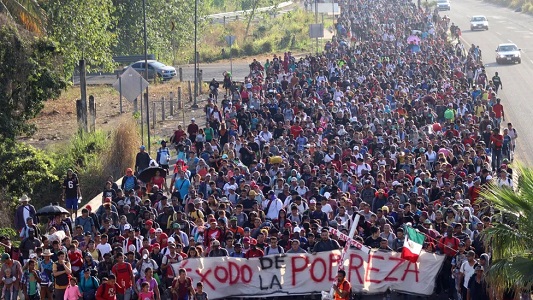
The Christmas Eve caravan departed from the southern Mexican city of Tapachula, near the country’s southern border with Guatemala.
One Honduran migrant who joined the procession said he was escaping a criminal gang which had threatened to kill him.
José Santos told Reuters news agency: “I was scared so I decided to come to Mexico hoping I’ll be allowed to go to go to the US.”
On Friday, Mexican President Andrés Manuel López Obrador said he was willing to work again with the US to address concerns about migration.
The Mexican leader is due to meet the US secretary of state on Wednesday.
The White House said in a statement Mr Blinken would discuss “unprecedented irregular migration” in the western hemisphere and identify ways the two countries would “address border security challenges”.
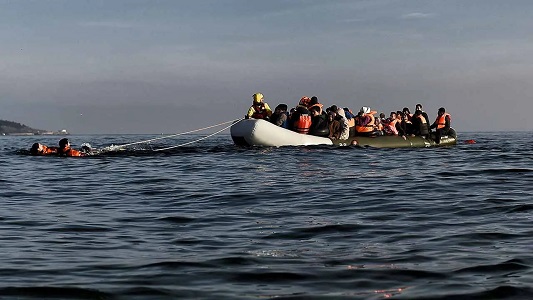
Sixty-one migrants, including women and children, from Nigeria, Gambia, and other African countries have drowned following a shipwreck off Libya, the International Organisation for Migration, IOM, a United Nations, agency has said.
The boat originally contained 86 people and left the Libyan shores from Zwara, according to IOM.
It said: “The central Mediterranean continues to be one of the world’s most dangerous migration routes.”
According to AFP, most of the victims of the latest incident were from Nigeria, Gambia, and other African countries.
The IOM said 25 people survived and were transferred to a Libyan detention centre.
An IOM team “provided medical support” and the survivors were all in good condition, the IOM office said.
Flavio Di Giacomo, an IOM spokesperson, wrote on X that more than 2,250 people had died so far this year on the central Mediterranean migration route, a “dramatic figure, which demonstrates that unfortunately not enough is being done to save lives at sea.”
Libya and Tunisia are principal departure points for people risking dangerous sea voyages in hopes of reaching Europe, via Italy.
Drowning was the main cause of death on migration routes globally in the first half of 2023, with 2,200 recorded fatalities in the period, according to the IOM report.
The central Mediterranean route was the deadliest, accounting for a total of 1,727 deaths and disappearances along its shores in the period, the IOM report said.
The majority of the deaths were recorded in Tunisia, followed by Libya, it said.
The figures remain an undercount, IOM said in its report.
Sea migrant arrivals to Italy have almost doubled in 2023 compared with the same period last year, with around 140,000 people coming ashore so far. Some 91 per cent came from Tunisia, with the tiny Italian island of Lampedusa bearing the brunt of landings.
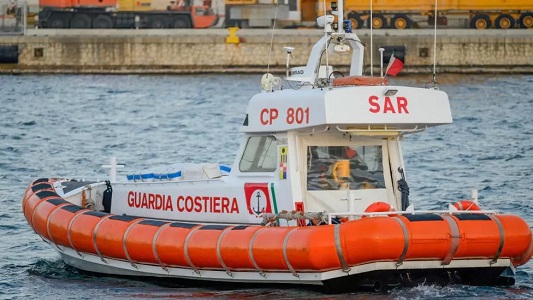
A large operation is underway off Italy’s coast to rescue 1,300 migrants in overcrowded boats.
The country’s navy and coastguard say they are racing to help three vessels near the southern region of Calabria.
Italy’s coastguard described the operation as “particularly complex”, because of the number of boats and people at risk.
The rescue effort comes almost two weeks after at least 73 migrants died in a shipwreck in the same region.
The victims included a six-year-old boy whose body was discovered on Friday.
After last month’s disaster, Italy’s far-right government was accused of not doing enough to prevent the loss of lives.
Prime Minister Giorgia Meloni responded by taking her cabinet to the site of the wreck in the town of Cutro.
She has proposed prison terms of up to 30 years for people smugglers responsible for deaths and serious injuries.
Italy has seen an increase of migrants arriving by sea this year. It has recorded three times as many arrivals as during the same period last year, according to its interior ministry.
At least 59 migrants, including 12 children, have died and dozens more are feared missing after their boat sank in rough seas off southern Italy.
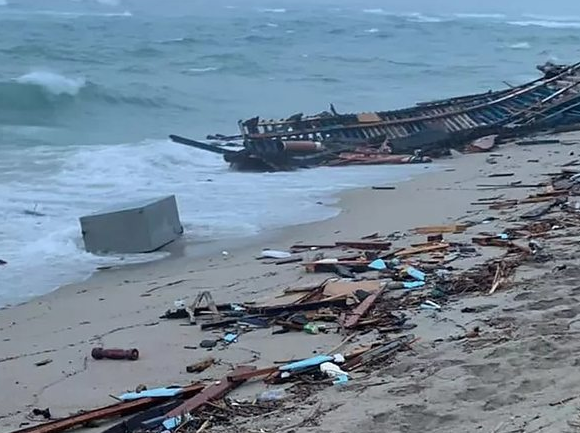
The overloaded vessel broke apart while trying to land with at least 150 people aboard near the coastal town of Crotone in the Calabria region.
Many bodies have been recovered from the beach at a nearby seaside resort.
Large numbers of people fleeing conflict and poverty make the crossing from Africa to Italy each year.
A baby thought to be only a few months old was among the dead, according to Italy’s Ansa news agency. Interior Minister Matteo Piantedosi, who visited the scene, said as many as 30 people may still be missing.
The coastguard said 80 people had been recovered alive, “including some who managed to reach the shore after the sinking”.
The boat, which sailed from Turkey several days ago, was carrying passengers from Afghanistan, Pakistan, Somalia and Iran. President Sergio Mattarella said many were fleeing “very difficult conditions”.
One survivor was arrested on migrant trafficking charges, customs police said.
The vessel is reported to have sunk after it crashed against rocks during rough weather, sparking a large search-and-rescue operation on land and at sea.
Video footage shows timber from the wreckage that has been smashed into pieces washing up on the beach, along with parts of the hull.
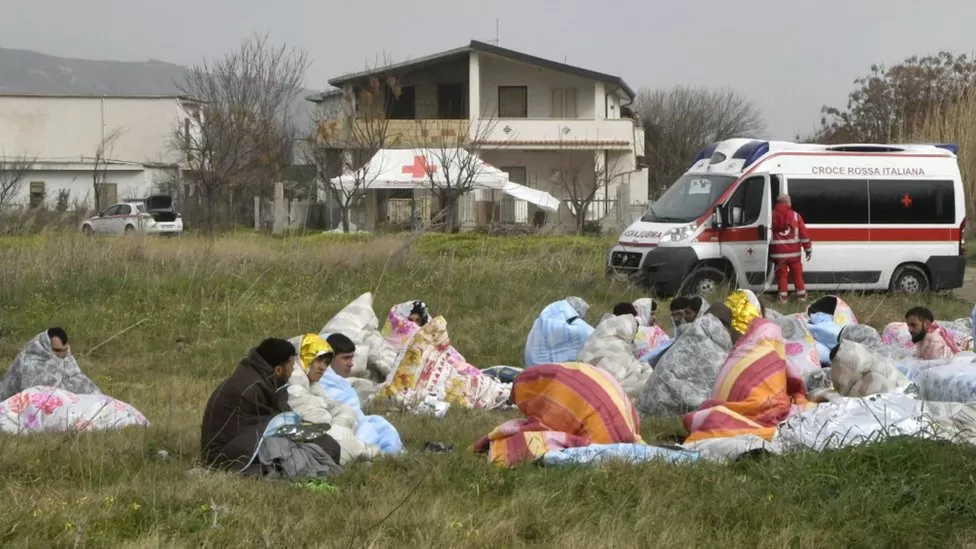
Survivors are seen huddled under blankets, attended to by Red Cross workers. Some have been taken to hospital.
Dozens of people managed to survive the boat’s sinking
“There had been landings but never a tragedy like this,” the mayor of Cruto, Antonio Ceraso, told Rai News.
Italian Prime Minister Giorgia Meloni – elected last year partly on a pledge to stem the flow of migrants into Italy – expressed “deep sorrow” for the incident, blaming the deaths on traffickers.
“It is inhumane to exchange the lives of men, women and children for the price of the ‘ticket’ they paid in the false perspective of a safe journey,” she said in a statement.
“The government is committed to preventing departures, and with them the unfolding of these tragedies, and will continue to do so.”
Ms Meloni’s right-wing government has vowed to stop migrants reaching Italy’s shores and in the last few days pushed through a tough new law tightening the rules on rescues.
Carlo Calenda, Italy’s former economy minister, said people in difficulty at sea should be rescued “whatever the cost”, but added that “illegal immigration routes must be closed”.
According to monitoring groups, more than 20,000 people have died or gone missing at sea in the central Mediterranean since 2014.
European Commission President Ursula van der Leyen said she was “deeply saddened” by the incident, adding that the “loss of life of innocent migrants is a tragedy”. She said it was crucial to “redouble our efforts” to make progress on reforming EU asylum rules to tackle the challenges regarding migration to Europe.
Pope Francis, who often defends the rights of migrants, has said he is praying for the dead, the missing and those who survived.
Regina Catrambone, director of the Migrant Offshore Aid Station which carries out search and rescue operations in the Mediterranean, told the BBC that European countries must work together to help those in need.
She also called for an end to the “myopic vision” that says that countries that are physically closer to Africa and the Middle East should take the lead on tackling the issue.
“Still there is no cooperation among the European states to actively co-ordinate together to go and help the people in need,” she said, urging governments to work together to improve search and rescue efforts and develop safe and legal routes.
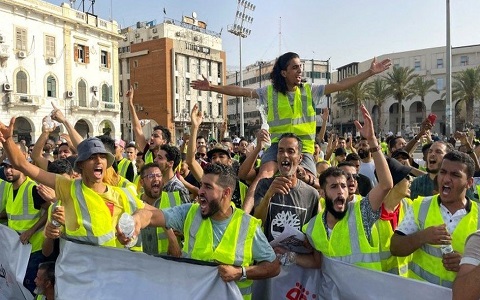
Protesters have stormed Libya’s parliament in the eastern city of Tobruk and are reported to have set fire to part of the building.
Images posted online showed thick columns of smoke as the demonstrators burned tyres outside.
There have been rallies in other Libyan cities against continuing power cuts, rising prices and political deadlock.
In the capital, Tripoli, where a rival administration holds sway, protesters called for elections.
Their demand was backed by the head of the interim unity government, Abdul Hamid Dbeibah, who said all the country’s institutions needed to be changed.
The unrest comes a day after United Nations-brokered talks in Geneva aimed at paving the way for a ballot ended with little progress.
Libya has been in chaos since the Nato-backed uprising in 2011 that ousted long-serving ruler Col Muammar Gaddafi.
The oil-rich country, a key departure point for some of the thousands of migrants travelling to Europe, once had one of the highest standards of living in Africa, with free healthcare and free education.
But the stability that led to its prosperity has been shattered and Tripoli has seen frequent fighting between rival forces.
Felicitating with the Christians at Easter, in its good-will message, the Journalists International Forum For Migration (JIFORM) has charged the media and the governments across the world to show unconditional love to migrants.
Urging the media to be at the forefront of dispelling misinformation about migration, particularly concerning migrants and refugees, the body with over 300 journalists spread across the continents said the greatest love for humanity with sincerity of purpose was demonstrated by Jesus Christ while on earth and demanded the same from the media practitioners.
The president Ajibola Abayomi, in a statement, called on the developed nations to see migrants as economic developers because “they are always drivers of labour serving various needs in nations.”
He said the media should always exercise restraint by not using the word ‘illegal’ to qualify migrants at any point saying “the resurrection of Christ should teach us all how to love and not to stigmatize our fellow men and women. Therefore all acts that could provoke xenophobic attack should be guided against in the spirit of Easter”.
He counseled journalists to always report facts embellished with human face on migration matters.
JIFORM is reputable for organizing an annual global migration summit since 2018, African Migration Summit in partnership with the Nekotech Center of Excellence in Ghana in February 25-26, 2021