News

By Mosope Kehinde

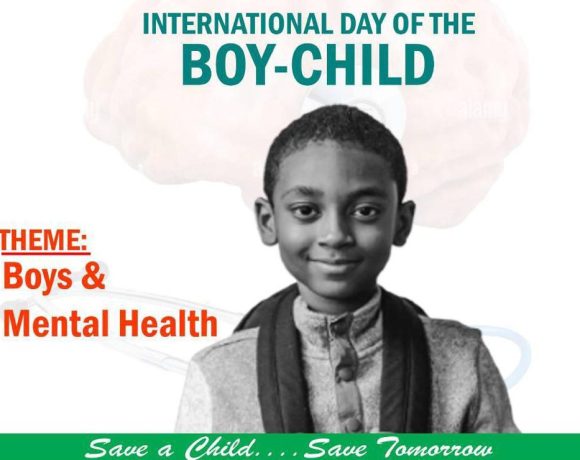
Government at all levels have been advised to invest more in the cause of the boychild with a view to making them a good ambassador of the society.

A child rights advocate and executive director, Hope For Second Chance Foundation, HOSEC, Mrs Ibukunoluwa Otesile stated this on the sideline of this Year’s International Boys Day being commemorated on 16th of May, every year.

Mrs Otesile said government, donor agencies, International, National, State and Local NGOs as well as other stakeholders must give heed to the travails of the boy child, advocating against the usual practice of forcing them to grow, in the name of being hero. 

“We stifle their emotions, pains, fears under the guiles of being ‘heroes’.”

“Today we choose to stand for the Boy Child because all children matter. No one child matter more than the other. No child asked to be born either male or female and as such should not be treated based on the fact of a choice he did not make.”

“Friends, look around you? What is the ratio of boys to girls in the indices of substance abuse, organized crime, gansterism and other anti social behaviors? Is the boy child born bad?”

“Today as the world stands still for the Boy Child, I dare say, we as a society again have failed our children, our boys!” 

“The only way to end Gender Based Violence is to break the cycle of abuse. When one is abused, without support or intervention, with time, he or she will perpetrate one form of abuse or the other on another!”

Subscribe to our Telegram and YouTubeChannels also join our Whatsapp Update Group

Lifestyle

The need for parents, government, NGOs, social workers, educationist and other relevant agencies to live up to their responsibilities in the proper upbringing of children formed the bases of the third anniversary of Hope for Second Chance Foundation, HOSEC held at Jericho in Ibadan.

The event which attracted child rights activists, government representatives, community development partners and National Orientation Agency highlighted the neglect, sexual assault and violence against Nigerian children and women.

In an address of welcome, the executive director of the foundation, Mrs Ibukunoluwa Otesile said the increasing number of hoodlums in Nigeria was as a result of failed parenting and unconcerned posture of stakeholders to the plight of abandoned children.

In their separate goodwill messages, the Senior Special Adviser to Oyo State Governor on Diaspora Matters Mrs Bolanle Sarumi-Aliyu, Representatives of Oyo State Commissioner Of Education, Aderibigbe Adekunle, State Coordinator of National Orientation Agency, Mrs Folake Ayoola and the Senior Special Adviser to the Governor on Security Matters Mr Fatai Owoseeni, stressed the need for individual homes to imbibe the right values in their children, cultural rejuvenation by all for all children,

The failure of these, according to them, portends great dangers for the nation in the nearest future.

Apart from stage adaptation and the launch of a book titled “cost of silence”, the event also featured cutting of the third anniversary cake of the foundation

Rotimi Famakin

Lifestyle

Non-governmental organizations are entities which are independent of government’s involvement. 

 They are usually non-profit organization, many of which are active in humanitarian or the social services.

 In 1987, the idea of a formalized collaboration between the Federal Government of Nigeria and non-government organizations, NGOs, was first muted during the military administration of General Ibrahim Babangida. 

 It was however in 1992, that advisory group on the development of NGO’s in Nigeria was established.

 The Nigeria network of NGOs was thereafter established.

From sixty numerical strength in 1992, NGOs have grown to over two thousand.

 It is worthy of note that out of the staggering figure, only few of them are known to be active and performing, as majority of the organizations only appear and disappear at their own whims and caprices.

The important role of NGOs in socio-economic re-engineering, political re-invigoration, civil and human rights advocacy, ethno religious direction and promotion of sectional interest cannot be disputed.

The Nigeria’s nascent democracy needs to draw strength and support from non-governmental organizations and civil societies for policy-making process to be democratized through consultation, political debate and legislation.     

 This is evident in the proceedings of the Federal and State lawmakers as all bills and important policies are being made to go through public hearing before it could be passed. 

Most NGOs typically pick up government’s deficits in services and social protection for citizens through the philanthropy of donors and socially conscious organizations.

 In recent times, findings have shown that NGOs are being abused and used to advance selfish interest.

 Although NGOs lay claim to being non-profit making organizations, the claim is however doubtful.

 Most NGOs are sponsored and supported with funds from international organizations annually to the tunes of millions of dollars.   

 Perhaps, this is a source of attraction for the alarming growth and proliferation of NGOs drawing quacks to their rank and file.     

  Worried by this ugly trend, the House of Representatives under the leadership of its Speaker, Femi Gbajabiamila said it would investigate fraudulent application and receipt of foreign grants from international organizations by civil society groups in the country. 

The motive for the investigation is to ensure that the operation and activities of the NGOs is transparent and in line with international best practice.

Also in a bid to regulate the activities of NGOs and other organizations, President Muhammadu Buhari signed the companies and allied matters act, CAMA, 2020 into law

By virtue of section eight hundred and thirty-nine of CAMA 2020, the Corporate Affairs Commission, CAC, must publish the names of officially registered and recognised NGOs and civil society groups in the country, as unregulated NGOs poses serious threat to the image of the country.

 NGOs operating illegally in the country must be prohibited while their members prosecuted

 This will serve as a deterrent to others, who want to dubiously benefit from foreign grants by international donor agencies.

 Tayo Sanni