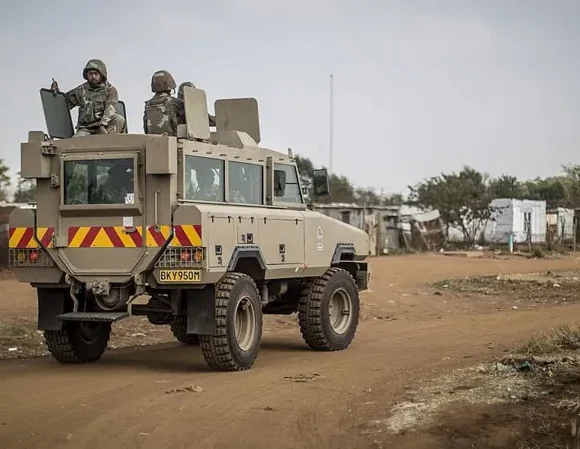
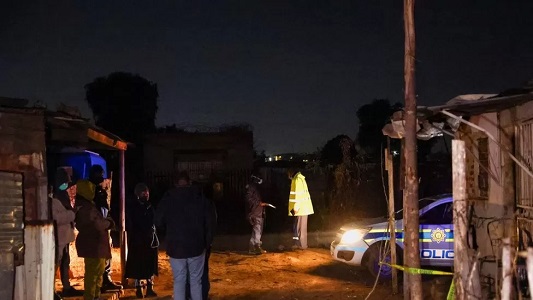
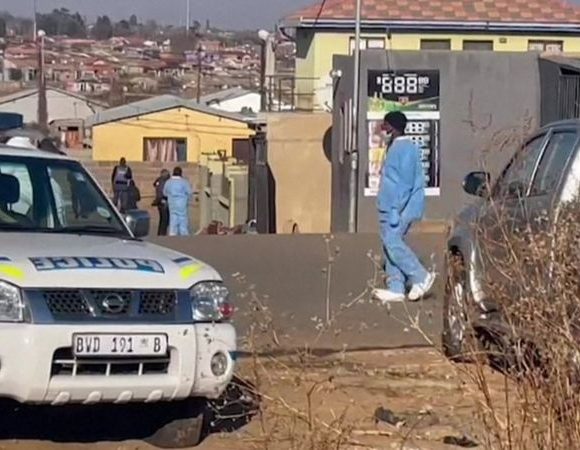
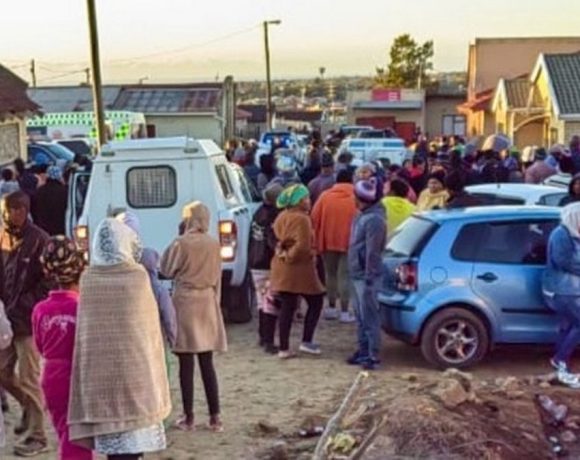
South African Police say a manhunt is under way after a shooting at a tavern left nine people dead and another 10 injured in a township near Johannesburg.
They say about 12 unidentified gunmen arrived in two cars in Bekkersdal, “opened fire at tavern patrons and continued to shoot randomly as they fled the scene”.
The shooting happened at about 01:00 local time on Sunday (23:00 GMT Saturday). The Police added that the tavern was licensed.
South Africa has one of the highest murder rates in the world, at 45 people per 100,000 according to 2023-24 figures from the United Nations Office on Drugs and Crime.
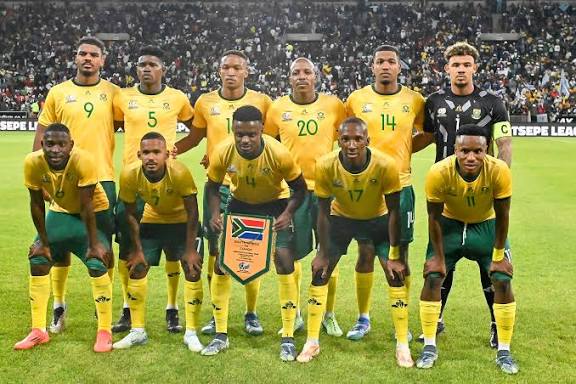
The FIFA Disciplinary Committee has sanctioned the South African Football Association (SAFA) for fielding an ineligible player, Teboho Mokoena, in the South Africa versus Lesotho match played on 21 March 2025 in the FIFA World Cup 2026 preliminary competition.
According to a statement by FIFA, the act breached article 19 of the FIFA Disciplinary Code (FDC) and article 14 of the FIFA World Cup 2026 Preliminary Competition Regulations.
Consequently, the FIFA Disciplinary Committee has declared the match in question to have been forfeited by the representative team of South Africa by a score of 3-0.
SAFA has also been ordered to pay a fine of CHF 10,000 to FIFA, while Teboho Mokoena has been issued with a warning.
The parties were notified of the terms of the FIFA Disciplinary Committee’s decision on Monday.
In accordance with the relevant provisions of the FDC, they have ten days in which to request a motivated decision, which, if requested, would subsequently be published on legal.fifa.com.
The forfeiture decision remains subject to a potential appeal before the FIFA Appeal Committee.
A 59-year-old grandfather was tragically trampled to death by an elephant on Saturday while trying to save his grandchildren from the charging animal.
The incident, which happened at South Africa’s iconic Kruger National Park, was reported by Times Live on Sunday.
The fatal encounter unfolded near the park’s Malelane Gate, a popular entry point, when the family was capturing photos and videos of the elephant.According to a police statement, the animal suddenly charged, prompting the man’s two grandchildren, aged five and eleven, to flee.
The children stumbled, and the elephant struck the older child with its trunk.“It was during this time when the grandfather went to assist … when the elephant turned and trampled on him before it left them and returned into the Kruger National Park premises,” the statement read.
The man died from his injuries at the scene, while the 11-year-old boy sustained a leg injury and was transported to a hospital for treatment.
JP Louw, spokesperson for South African National Parks (SANParks), confirmed the incident and appealed to witnesses to respect the family’s grief by refraining from sharing photos or videos of the tragedy.
“The sensitivity of the matter cannot be overstated.“The SANParks board and management extend their deepest condolences to the friends and family of the deceased,” he said
Louw also noted that investigations into the incident are ongoing and assured the public that more details would be released in due course.
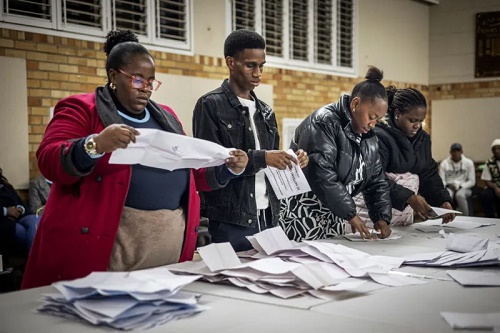
With almost all (99.51%) of the votes announced, the African National Congress (ANC) which has governed the country since 1994, is certain to lose its majority in parliament
The party once led by Nelson Mandela, which brought white-minority to an end, has 40% of the vote – its worst result in 30 years
This means that to stay in power, it will have to do a deal with one or more smaller parties
The president is not directly elected – he or she is chosen by parliament, where they would need the support of 50% of MPs
The obvious options for the ANC are either the DA, which came second with 22%, or the MK of former President Jacob Zuma
The centre-right DA opposes core ANC policies such as black economic empowerment so a deal could be tricky
MK says it cannot work with the ANC while Cyril Ramaphosa is president
He ousted Zuma as ANC leader and president in 2018 after a bitter power struggle
Meanwhile, the Electoral Commission (IEC) has given an update on the vote count.
Here are the key things from the update:
Processing of the final results is nearing completion
But they are not rushing to announce the results to avoid errors
IEC agrees to look into objections and appeals filed late
Despite technical issues, the results remain uncompromised
Recounting of votes will be done where discrepancies are confirmed
All South Africans urged to remain call as vote counting nears conclusion
The commission is due to give another update later today
The first results have been announced from what is seen as South Africa’s most closely fought elections since the African National Congress (ANC) came to power 30 years ago.
With results from just over 11% voting districts counted so far, the ANC is leading with 43%, followed by the DA with 26%.
The radical EFF and the uMkhonto weSizwe Party (MK Party) of former President Jacob Zuma are on around 8%.
Final results are expected over the weekend.
Opinion polls suggest the ANC could lose its majority in parliament for the first time in 30 years, forcing it into a coalition.
The ANC has lost support due to anger over high levels of corruption, crime and unemployment.
But it is too early to predict the final outcome.
Wednesday’s election saw long lines of voters outside polling stations late into the night across the country.
One electoral official in Johannesburg told the BBC the queues were reminiscent of the historic 1994 election, when black people could vote for the first time, and which saw Nelson Mandela become president.
Many thousands of people were still waiting to vote when polls officially closed at 2100 local time (1900 GMT) but the electoral commission said they would all be allowed to cast their ballots.
Sifiso Buthelezi, who voted in Johannesburg’s Joubert Park – the biggest polling station in South Africa – told the BBC: “Freedom is great but we need to tackle corruption.”
Change has been a recurring sentiment, especially among young voters.
Ayanda Hlekwane, one of South Africa’s “born-free” generation, meaning he was born after 1994, said despite having three degrees he still doesn’t have a job.
“I’m working on my PhD proposal so that I go back to study in case I don’t get a job,” he tells the BBC in Durban.
But Mr Hlekwane said he was optimistic that things would change.
The queues, like this one in Johannesburg, are said to be reminiscent of the 1994 vote
A record 70 parties and 11 independents were running, with South Africans voting for a new parliament and nine provincial legislatures.
Analysts say this shows that many people are disillusioned with the ANC.
“We are entering the next phase of our democracy, and it is going to be a big transition,” political analyst Richard Calland told the BBC.
“We will either become a more competitive and mature democracy, or our politics will become more fractured.”
The main opposition party, the Democratic Alliance (DA), has signed a pact with 10 other parties, agreeing to form a coalition government if they get enough votes to dislodge the ANC from power.
But this is highly unlikely, with the ANC expected to remain the biggest party, putting it in pole position to lead a coalition if its support does drop below 50%.
It got 57.5% of the vote in the last election compared to the DA’s 21%.
South Africans do not directly vote for a president. Instead they vote for members of parliament who will then go on to elect the president.
So current President Cyril Ramaphosa is likely to remain in power.
Former President Jacob Zuma caused a major shock when he announced in December that he was abandoning the ANC to campaign for the new uMkhonto weSizwe (MK), which translates as Spear of the Nation.
Although he has been barred from running for parliament because of a conviction for contempt of court, his name still appeared on the ballot paper as MK leader.
The MK is expected to do especially well in Mr Zuma’s home province of KwaZulu-Natal, where tensions have been high, with some incidents of violence reported during the campaign.
Police and the army have been deployed to polling stations across the country to ensure that voting takes place peacefully, and that ballot papers are not stolen.
More than 27 million people were registered to cast their ballots, including a high percentage of young voters, who could prove decisive.
Artist Njabulo Hlophe, 28, said young people in South Africa tend to get marginalised but, “this is as much our country as our parents… they’re leaving it to us, so someone that really cares about the young people is someone I’m really looking at”.
Support for the ANC is expected to be higher among the older generation.
One 89-year-old woman, Elayne Dykman, told the BBC in Durban she hoped that young people in South Africa did not take their vote for granted.
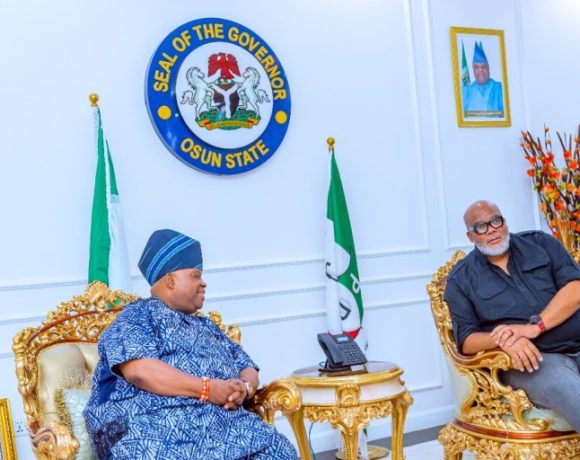
Governor Ademola Adeleke of Osun state has appealed to South African authority to intervene and halt the constant harassment and molestation of Nigerians in South Africa.
The governor made the appeal while hosting the Consul-General of Republic of South Africa to Nigeria, Professor Bobby J Moroe and his Vice Consul, Ms Busisiwe Dlamini at the Government House, Osogbo.
He described the hostile attitude to Nigerians as “quite disturbing” and “a threat to the historical bond and brotherhood between the two countries.
“I urge you to convey our apprehension to your home government. It is wrong to a profile a whole nation as criminals. Every country has its own share of good and bad eggs.
“In South Africa, there are thousands of Nigerians legitimately operating their businesses and services. They suffer a lot due to the negative profiling. We need to put an end to this increasingly molestation of our nationals in your great country” the Governor noted.
Responding, the Consul-General noted that the concerns raised by his host is genuine but added that his government is doing a lot to ensure harmonious relationship between South Africans and foreign nationals.
According to him, the Government of South Africa values her relationship with Nigeria in view of historical brotherhood and very close economic and Diplomatic relationship between the two countries.
He cited the fact that many South Africans are married to Nigerians and vice versa, promising to also convey the concerns of the Governor to her home country.
Both the Governor and the Consul General reviewed the economic opportunities between the two countries and proposed a Memorandum of Understanding between Osun State and the South African provine of Gauteng, the most developed of South African provinces.
The two team specifically agreed that the target of the partnership will be agro-processing technologies and mining, the two areas in which both states have comparative advantages. Gauteng province in South Africa is mostly referred to as face of Gold alongside its developed agro-industrial sector.
The details of the agreement which will see a joint meeting between Governors of the two states are being worked upon.
The authorities in South Africa’s Western Cape Province are searching for six prisoners who escaped from the holding cell of a magistrates’ court
One of the prisoners has been arrested but the other five are still on the run.
Authorities say that the prisoners, aged between 20 and 33, are “armed and dangerous”.
The prisoners were waiting to be transported to a correctional detention facility after appearing in court earlier on Wednesday.
“Preliminary investigation suggests that the detainees overpowered one of the police officials and disarmed him. Several shots were fired in the direction of the police officials, but no-one was hit or wounded,” police spokesman, Malcolm Pojie told South Africa’s News 24 outlet.
He added that the offenders escaped on foot.
The offenders were on trial for multiple serious charges, including murder, attempted murder, aggravated robbery and assault.
Following their escape, the authorities have further charged them with escape from lawful custody, attempted murder and robbery of a firearm.
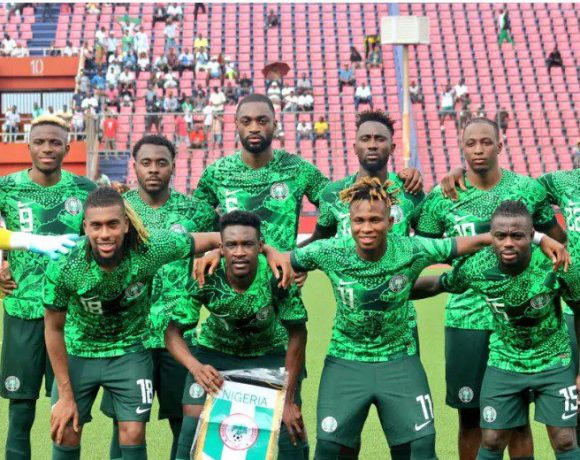
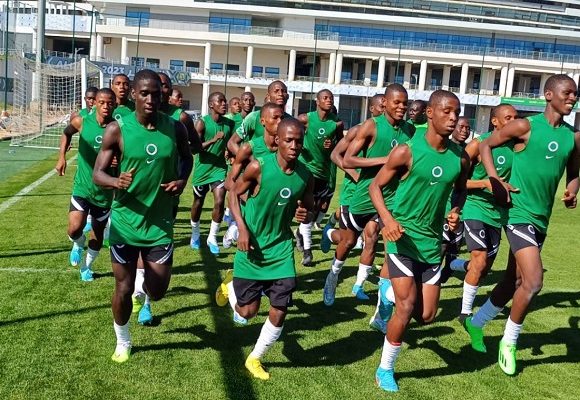
Nigeria, South Africa and Morocco could be placed in the same group when the Africa Cup of Nations draw is made in the Ivory Coast on Thursday.
The six top seeds include Morocco, who created history at the 2022 World Cup in Qatar by becoming the first semi-finalists from Africa.
Nigeria is among the second seeds while South Africa has had to settle for a place among the third seeds for the draw in Abidjan, the Ivorian economic capital.
Add surprise 2021 Cup of Nations quarter-finalists Gambia from the fourth seeds and it would be a striking “group of death,” the term given to particularly tough sections.
Nigeria, three-time winners of the premier African football competition, and former champions South Africa were unlucky not to be seeded higher.
The Super Eagles lie sixth in the continental rankings and, ordinarily, would have been a top seed, avoiding Morocco, title-holders Senegal, Tunisia, Algeria and Egypt in the group stage.
But host countries not only automatically qualify for the two-year tournament, they are also always among the first seeds.
To accommodate the ninth-ranked Ivory Coast, sixth-placed Nigeria had to give way and now share second-seed status with Cameroon, Mali, Burkina Faso, Ghana and the Democratic Republic of Congo.
South Africa had been ranked above DR Congo for some time but, in the rankings that decided the seedings, they were placed one place below the Congolese.
It was an ironic change of positions as South Africa defeated DR Congo in a friendly match just a couple of days before the rankings were released.
The other third seeds are Cape Verde, Guinea, Zambia, Equatorial Guinea and Mauritania while the fourth seeds include Guinea-Bissau, Mozambique, Namibia, Angola, Gambia and Tanzania.
Shock 2012 champions thanks to a penalty shootout victory over Didier Drogba-inspired Ivory Coast, Zambia are back at the Cup of Nations after three straight failures to qualify.
Zambia and Mozambique, whose last appearance was in 2010, are the only qualifiers who have not featured in at least one of the last two tournaments.
Despite a poor Cup of Nations record, Morocco is set to be installed as favourites to win the January 13-February 11 competition.
They have been champions just once in 33 editions topping a 1976 group in Ethiopia in one of only two editions where a mini-league determined the champions.
In the last Cup of Nations, hosted by Cameroon in 2022, Morocco was eliminated by Egypt in the quarter-finals.
Morocco coach, Walid Regragui, mastermind of the stunning World Cup campaign after taking charge just a few months earlier, says he will quit if his team fails to at least reach the semi-finals.
“We must be at least in the semi-finals of the CAN (Cup of Nations). If I do not go to the semi-finals, I will leave on my own,” he told the Moroccan media.
“I told my players that we cannot be kings of the world before being kings of our continent. Everyone wants to beat Morocco after our results in Qatar.
“This makes it more difficult for us to win, but it also motivates the players to improve and I welcome that.”
All six top seeds plus Nigeria, Cameroon, Ghana, DR Congo, South Africa and Zambia have won the Cup of Nations. The other champions Ethiopia, Sudan and Congo Brazzaville did not qualify.
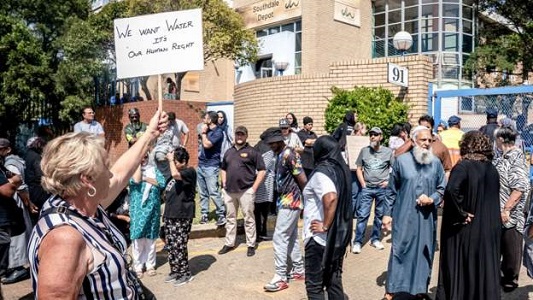
Water suppliers in Johannesburg, South Africa, have asked residents of the city and its suburbs to use less water amid an intensifying water shortage that they warn could “result in the collapse of the system”.
Rand Water and Johannesburg Water on Sunday said that high water consumption by residents “is putting a strain on the system” and has resulted in significantly low water reservoir levels.
The companies have asked residents to save water by limiting their showers to two minutes, only flushing toilets after long calls and only washing cars on weekends using buckets.
The companies have also asked residents to stop filling swimming pools until water scarcity ends, avoid watering gardens and lawns with clean water and fix or report water leakages.
Johannesburg is currently under the yearly water restrictions, which often last during South Africa’s dry season between September and March.
In recent weeks, some of the city’s residents and institutions such as hospitals have gone without water, causing public discontent.
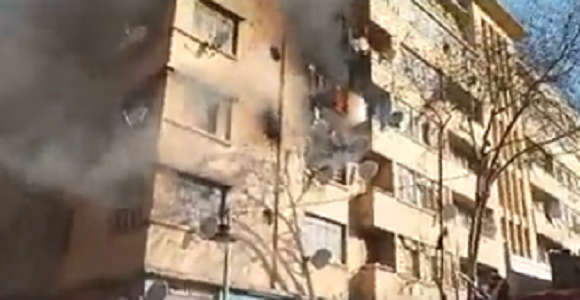
Two children, aged five and seven, have died in the South African city of Johannesburg after a fire broke out in a residential building where they had been left unattended and locked inside an apartment.
The blaze, in the inner city area of Hillbrow, began on Wednesday afternoon.
A reporter from South Africa’s Times Live has recently tweeted a video from the scene filmed after firefighters arrived:
Squatters often move into old and abandoned buildings in the area – which colloquially are said to have been “hijacked”.
Mayor Kabelo Gwamanda visited the scene later in the evening, commending firefighters for their efforts and saying Hillbrow’s old buildings did not meet health and safety standards.
“This particular property has been at the centre of the City [of Johannesburg’s] efforts to reclaim hijacked buildings from illegal occupants and crime syndicates,” New24 quoted him as saying.
The city’s emergency services say the children appear to have died from smoke inhalation and their bodies were later found “burnt beyond recognition”.
The cause of the fire is not yet known and the police are conducting investigations.
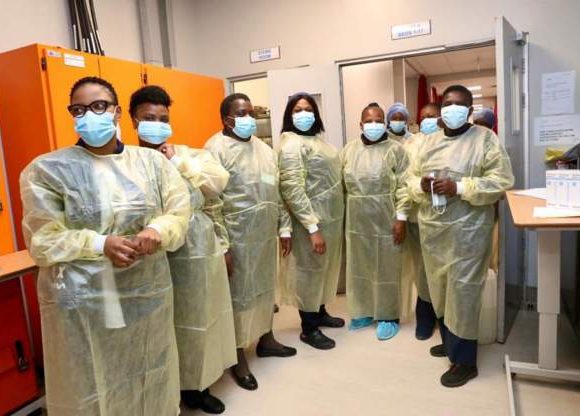
An outbreak of cholera has killed at least 10 people in South Africa’s most populous province of Gauteng, health authorities have said.
At least 95 people have since last Monday visited hospitals showing cholera symptoms in Hammanskraal, an area north of the capital, Pretoria.
Lab tests on Sunday confirmed at least 19 were cases of cholera, the Gauteng health department said in a statement.
It added that 37 people were admitted in critical condition.
The victims included a three-year-old child and nine adults.
Nomantu Nkomo-Ralehoko, the provincial head for health, has urged the public to take extra precautionary measures and maintain proper hand hygiene.
The city of Tshwane is warning residents of Hammanskraal and surrounding areas not to drink water from their taps, adding that water tankers were being supplied.
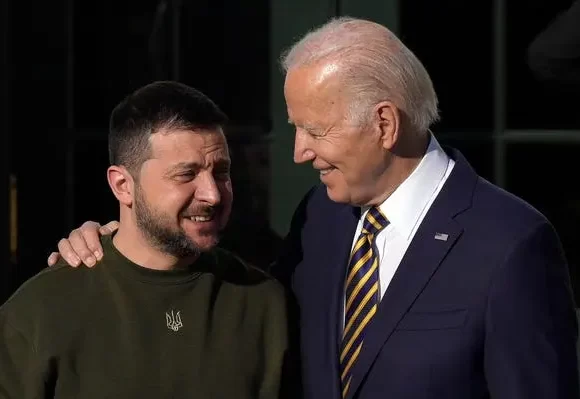
The United States of America, USA’s envoy to South Africa, on Thursday, accused the country of having provided military support to Russia despite its professed neutrality in the Ukraine war, local media said.
Ambassador Reuben Brigety reportedly said the US was “confident” weapons and ammunition had been loaded onto a Russian freighter in Cape Town in December.
He added: “The arming of the Russians is extremely serious, and we do not consider this issue to be resolved.”
South Africa’s Foreign Minister Naledi Pandor has said the government will have to discuss the arrest warrant issued by the ICC against Russian President Vladimir Putin before considering any action.
Mr Putin is scheduled to travel to South Africa for the Brics (Brazil, Russia, India, China and South Africa) summit in August.
The International Criminal Court (ICC) on 17 March issued an arrest warrant against Mr Putin over alleged war crimes in Ukraine.
As a signatory to the Rome Statute, South Africa is legally bound to detain Mr Putin and bring him to trial.
Ms Pandor said the South African authorities will first consult with the Russian side regarding the warrant.
“South Africa will have to look at existing provisions of our legislation. We also will have to have a discussion as cabinet, as well as with our colleagues in Russia, and really determine the way forward,” Ms Pandor told state-run SABC News
South Africa enjoys tight relations with Moscow in spite of Western condemnations.
In 2015, the South African government was criticised for letting then Sudan’s President Omar al-Bashir leave the country despite an ICC arrest warrant.
Mr Bashir had gone to South Africa for an African Union summit and the government argued he enjoyed diplomatic immunity.
South Africa’s scandal-hit President Cyril Ramaphosa has been re-elected leader of the governing African National Congress (ANC).
He defeated his rival Zweli Mkhize by 2,476 votes to 1,897.
Mr Ramaphosa won despite being dogged by allegations of money laundering, and a last-minute surge in support for Mr Mkhize, who has also been accused of corruption. Both deny the allegations.
His victory puts him in pole position to lead the ANC in the 2024 election.
But he is still at risk as he is being investigated by police, the tax office and central bank over allegations that stashed at least $580,000 in a sofa at his private farm, and then covered up its theft.
A panel of legal experts, appointed by the speaker of parliament, said that impeachment proceedings should be instituted against him as he may have both violated the constitution and broken anti-corruption legislation.
Mr Ramaphosa’s re-election bid was bolstered by the fact the ANC used its parliamentary majority to vote down the findings of the panel.
The president has denied any wrongdoing, and has launched legal action to annul the panel’s report.
He said the $580,000 came from the sale of buffaloes, but the panel said there was “substantial doubt” over whether a transaction took place.
Mr Mkhize was the health minister in Mr Ramaphosa’s government, until he was forced to resigned last year over allegations of misspending funds set aside to deal with the Covid-19 pandemic.
He too has denied any wrongdoing, and his supporters saw the allegations as an attempt to discredit him.
Mr Ramaphosa was the odds-on favourite to win, but Mr Mkhize gained more votes than expected after offering key posts to other powerful leaders in deals struck just ahead of delegates cast at the conference.
Both sides denied accusations of vote-buying.
The ANC has been in power since white-minority rule ended in 1994, and is hoping to secure a sixth term in the 2024 parliamentary election. But opinion polls suggest that its vote has shrunk considerably because of widespread corruption in government, high unemployment and poor public services – including constant power cuts.
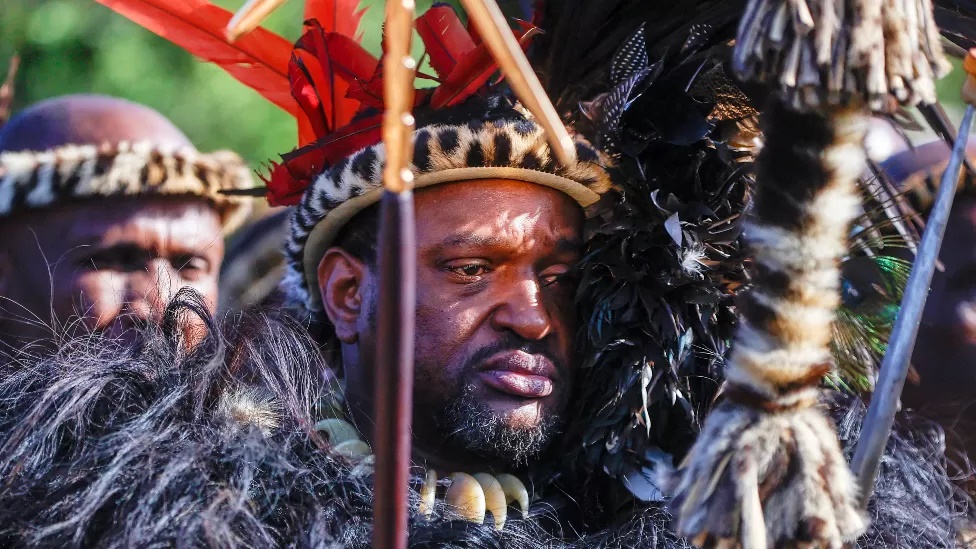
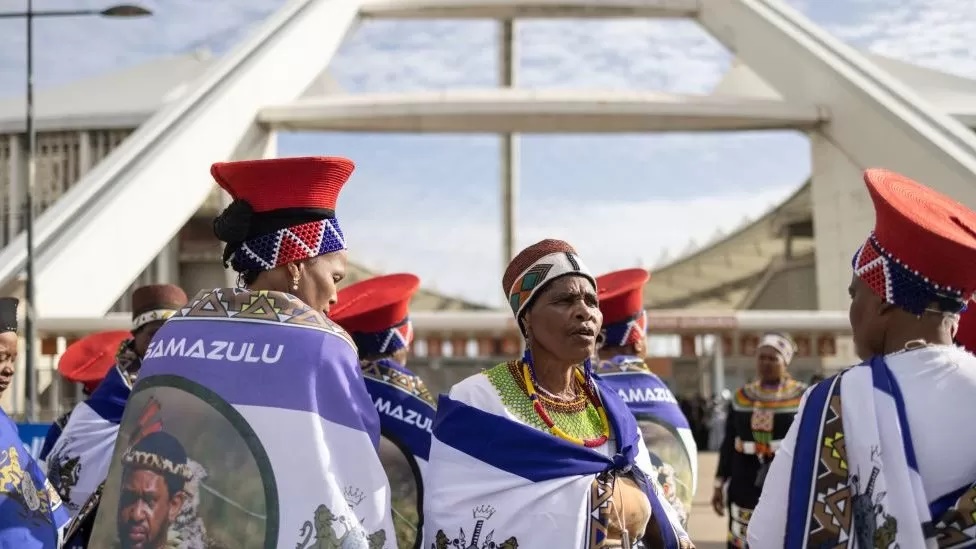
Celebratory songs, chants and dance have filled the main stadium in South Africa’s coastal city of Durban ahead of the historic coronation of the Zulu king.
King Misuzulu ka Zwelithini, 49, will be formally acknowledged as a monarch.
King Misuzulu ka Zwelithini
It will be the first Zulu coronation since South Africa became a democracy in 1994.
The event takes place days after the US warned of a risk of a terror attack in the country but Police Minister, Bheki Cele has said the threats won’t impact the ceremony at the Moses Mabhida Stadium where several local and foreign dignitaries are among tens of thousands of people attending.
The event will mark a lot of firsts for South Africa.
King Zwelithini will be formally acknowledged as monarch by President Cyril Ramaphosa – the first time a black president has been involved in a Zulu coronation.
It will be the first Zulu coronation since the country became a democracy in 1994.
Zulu women clad in traditional dresses arrive at the Moses Mabhida Stadium
In another first, the coronation is being broadcast live on national television.
It will also finally put an end to the fierce family feud that dogged his succession to the throne – an embarrassing battle played out in public.
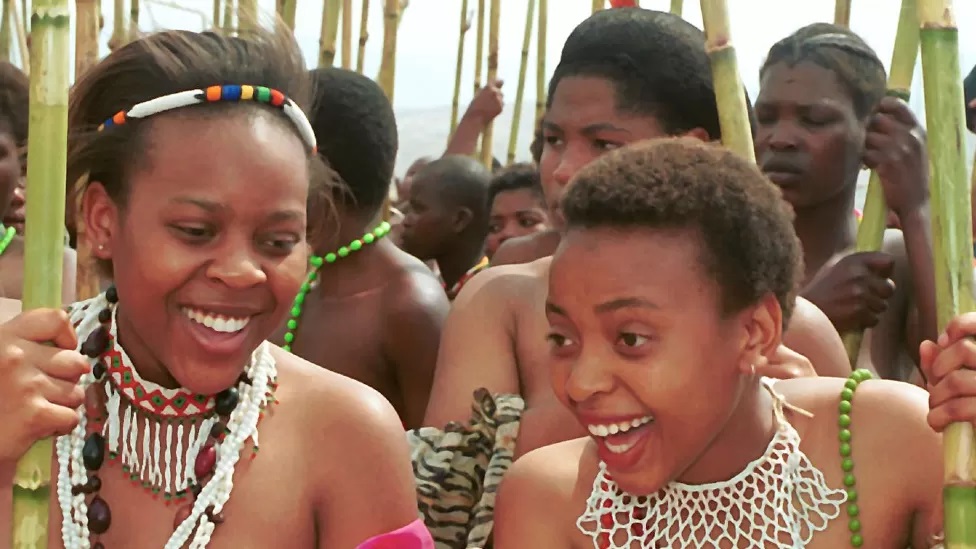
The Reed Dance is a rite of passage for young Zulu women and teenage girls
The last coronation took place on a rainy day back in 1971 under the apartheid government, when King Goodwill Zwelithini ka Bhekuzulu was crowned.
Then, as now, South Africa’s traditional leadership was regulated by the government but the white-minority authorities at the time expected the young monarch to wear Western attire.
BBC/Maxwell Oyekunle
Subscribe to our Telegram Channel and join our Whatsapp Update Group
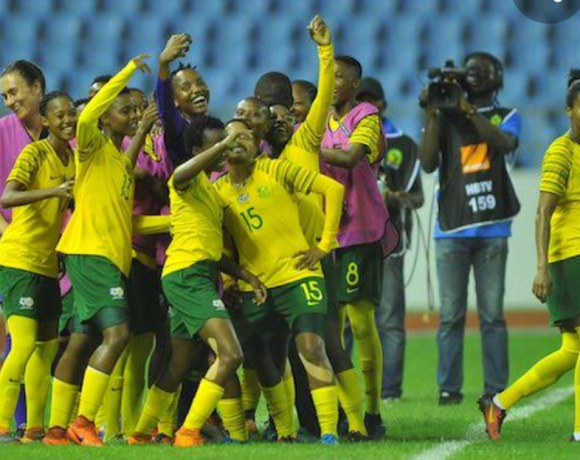
Bayana Bayana of South Africa have been crowned the new champions of the Women Africa Cup of Nations, WAFCON.
The South Africa female National team defeated Host Nation Morocco by 2 goals to 1 in the final of the 2022 WAFCON played at the Prince Moulay Abdellah stadium.
South Africa took the lead in the 63rd minute through a strike from Hildah Magaia before she struck again in the 71st minute to double the lead.
The Atlas Lioness of Morocco pulled a goal back in the 80th minute through Rosella Ayane.
Despite late pressure by the Host Nation, the Bayana Bayana were able to hold on to win the game and clinch their first ever WAFCON title.
At least 15 people have been shot dead in a bar in the South African township of Soweto.
Police said gunmen entered the Orlando East tavern in the early hours of Sunday morning and started firing randomly at a group of young people.
They then fled the scene in a white minibus. No motive for the attack has been established, police said.
According to report, several more people are in a critical condition in hospital.
The victims are believed to be between 19 and 35 years old.
Bodies were on top of each other with blood all over. We were looking for our loved ones, we had to jump over bodies looking for our brothers,” said local resident Ntombikayise Meji.
Gauteng province’s head of police, Lt-Gen Elias Mawela, told the BBC the shooting appears to have been “a cold-blooded attack on innocent tavern patrons”.
A press statement released by his office said the gunmen had been armed with rifles and 9mm pistols when they entered the bar.
Police are searching for the suspects, whose identities remain unknown, it said.
Thaban Moloi, a community leader in Soweto, was angered by the amount of time it took police to arrive at the scene.
“It’s terrible, I’m telling you. People don’t know what to do. If you were there you could see women and children crying,” he said.
Mr Moloi said the attack happened at 23:00 local time (21:00 GMT) on Saturday but police didn’t arrive until 04:00 on Sunday.
“It took five hours for them to come, honestly,” he said.
Four other people were killed in a separate tavern shooting in the south-eastern province of KwaZulu-Natal, police said on Sunday.
President Cyril Ramaphosa expressed his condolences to the relatives of victims of both shootings.
“As a nation, we cannot allow violent criminals to terrorise us in this way, regardless of where such incidents may occur,” he added.
Shootings are not uncommon in South Africa. They are often linked to gangs or alcohol.
But this is an exceptionally high death toll and comes soon after the death of 21 teenagers thought to have been either gassed or poisoned at another bar in the city of East London.
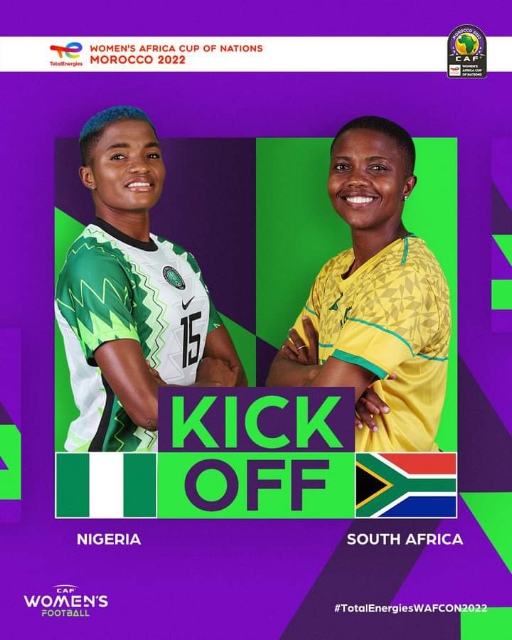
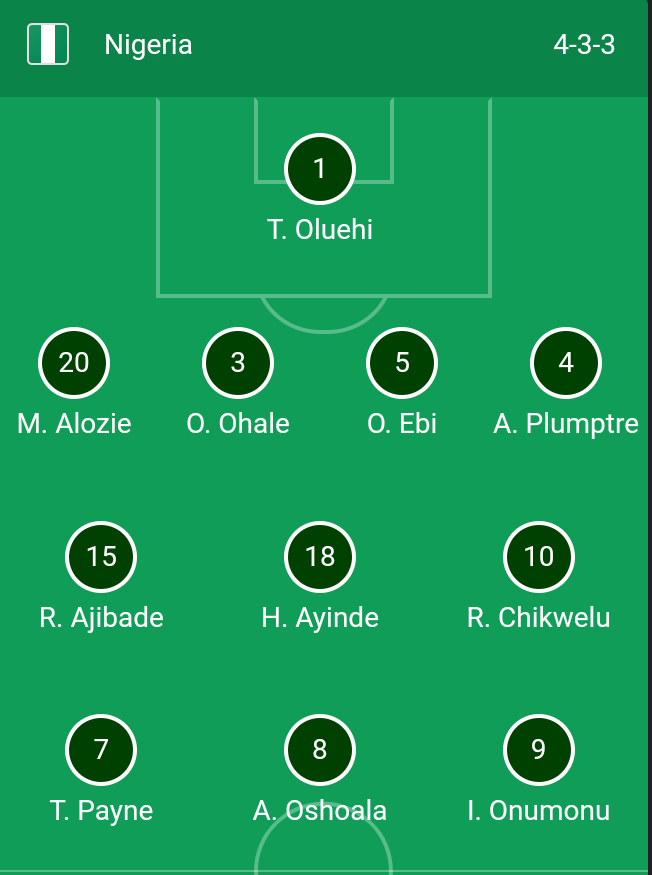
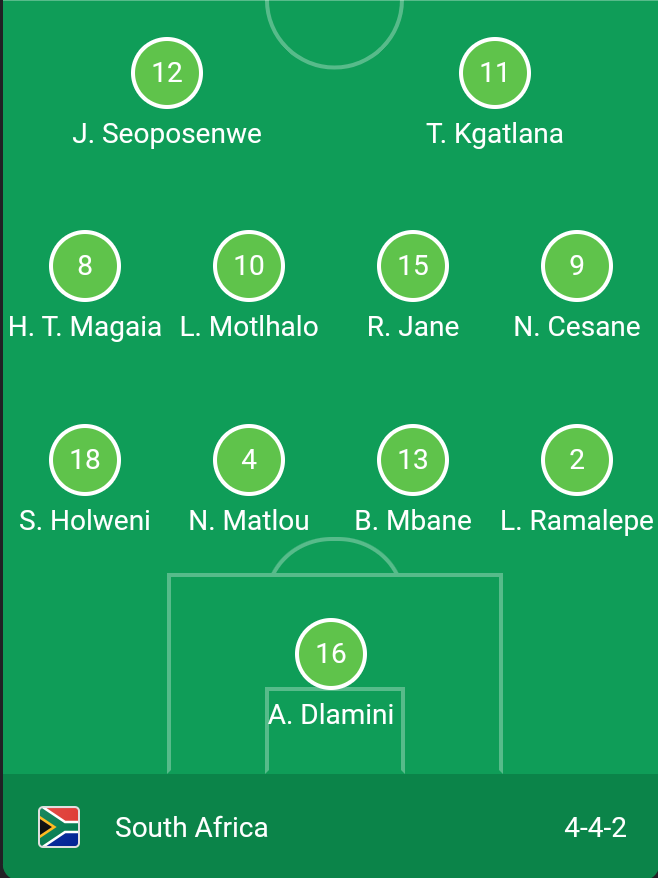
Nigeria’s Super Falcons have lost their opening match at the ongoing 2022 Women’s African Cup of Nations, WAFCON, holding in Morocco.
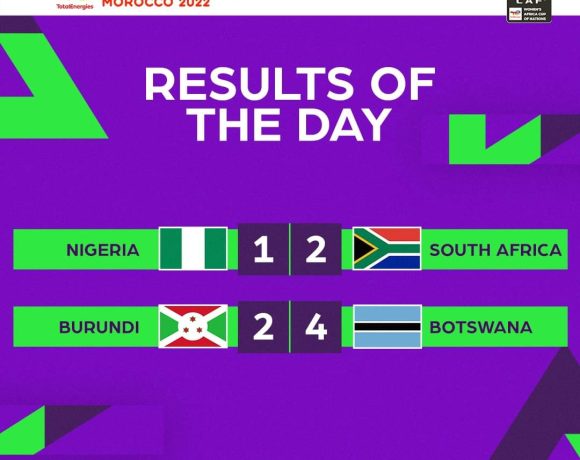
The Super Falcons fell by 1-2 to perennial rivals South Africa in the Group C match while Burundi were hit 4-2 by Botswana.
Two quick-fire goals from the South Africans through Jermaine Seoposenwe in the 61st minute and Hildah Tholakele Magaia only two minutes proved too much of an hurdle for the Super Falcons to scale.
Rasheedat Ajibade scored deep in stoppage time but it was too little too late.
The win extends South Africa’s dominance over Nigeria in recent years as the Super Falcons had not won or scored against South Africa in the continental showpiece since 2016.
In the other Group C match, Botswana registered the biggest win of the tournament so far when they saw off fellow debutants Burundi 4-2 at the Moulay Hassan Stadium in Rabat.
The Mares opened their scoring through Karabo Dithebe a minute to the halftime mark.
With the lead, Botswana went into the break with their heads held up high while looking to extend their lead.
A minute into the second half, Lesego Radiakanyo did just that as she doubled Botswana’s lead to 2-0.
Sandrine Niyonkuru scored to keep Burundi’s hopes of winning the game alive, but it was Botswana’s Tholakele who scored a quick brace in the 55th and 59th minutes to hand the Mares a 4-1 lead to knock the stuffing out of the Burundians.
The Burundians found the back of the net in the 81st minute with a fine finish to make the score 4-2.
Botswana, who are now Group C table leaders, face Nigeria in their next game on Thursday, July 7 at 2000Hrs GMT while Burundi will be up against South Africa at 1700Hrs GMT.
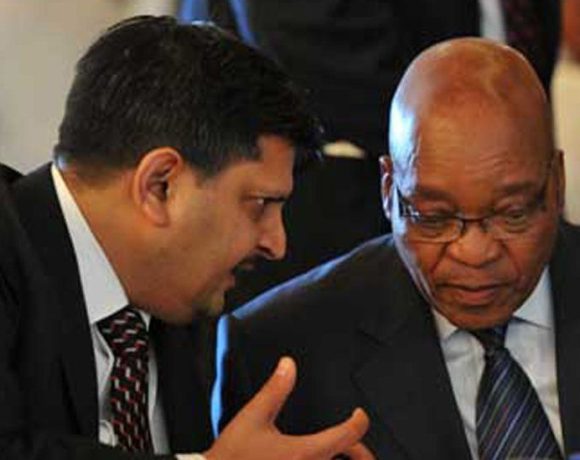
Two brothers from the wealthy Gupta family have been arrested in the United Arab Emirates, the South African and Emirati authorities have announced.
Atul and Rajesh Gupta are accused in South Africa of profiting from their close links with former president Jacob Zuma and exerting unfair influence.
Extradition talks are taking place between the two countries.
The brothers fled South Africa after a judicial commission began probing their involvement in corruption in 2018.
They are accused of paying financial bribes in order to win lucrative state contracts and influence powerful government appointments.
They deny any wrongdoing.
A statement by Dubai Police said the two men were being held “in connection with money laundering and criminal charges in South Africa”.
The force said it acted after receiving an Interpol “red notice” – a request to law enforcement organizations to provisionally arrest a wanted person pending extradition.
The Gupta family moved from India to South Africa in 1993. They also face accusations of money laundering in India, where tax officials raided properties belonging to them in 2018 in multiple cities, including their company office in the capital Delhi.
Many of the most serious corruption allegations leveled against the Indian-born brothers focus on their relationship with Jacob Zuma, who was president of South Africa from 2009 until he was forced to step down amid a storm of corruption allegations nine years later.
The Gupta family is accused of using their close links with Mr Zuma to wield enormous political power across all levels of South African government – winning business contracts, influencing high-profile government appointments, and misappropriating state funds.
Mr Zuma, along with the Guptas, denies the allegations.
After the brothers fled the country, South Africa negotiated an extradition treaty with the UAE in 2021.
President Cyril Ramaphosa’s government has said it hoped the agreement would lead to the return of the Guptas to face charges, but it was not immediately clear following the arrests whether the brothers would return to South Africa.
South African police have opened a murder case against a father for the death of three of his sons aged six, 13 and 16 after they consumed an energy drink that he allegedly gave them.
Two of the siblings died at school and the third died on the way to hospital.
A fourth child who consumed the drink is said to be in a critical condition at a local hospital. A fifth brother did not consume the energy drink and is fine.
“We have a case of murder that has been opened with three counts and a case of attempted murder,” police spokesperson Brig Brenda Muridili said.
The father is reportedly under guard in hospital after allegedly trying to poison himself.
In a statement, the education department in Gauteng province expressed sadness over the deaths of the three siblings at Ratanda Primary and Khanya Lesedi Secondary Schools.
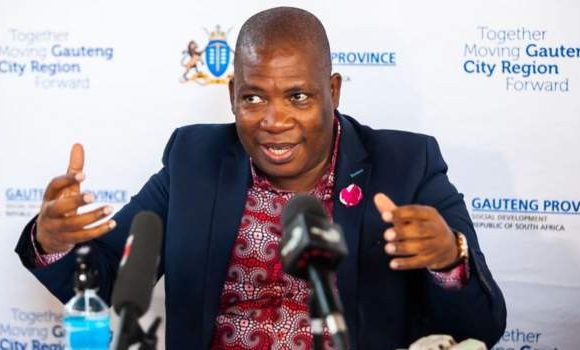
County education official Panyaza Lesufi termed it “a deliberate act” when asked whether the deaths were as a result of contamination or poisoning.
“It looks like it was a deliberate act because the information at our disposal is that the father also attempted to commit suicide. It’s an indication that indeed this thing was planned,” he told local TV station eNCA.
“We also got unconfirmed reports that the mother is also hospitalised, but this is information that we need to verify.”
The official said they would be visiting the schools and family on Friday.
A psycho-social support unit has been sent to offer counselling to the bereaved family and the school community.
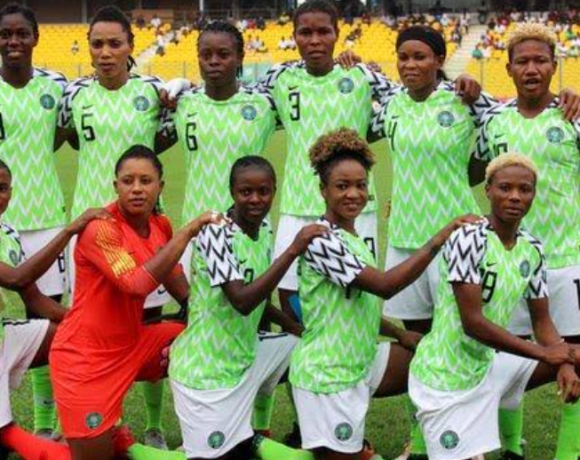
Nigeria’s Super Falcons have South Africa as their Group C rivals in the 2022 Women’s Africa Cup of Nations (WAFCON), as well as Botswana and Burundi.
They were drawn in the same group at the official draw ceremony held at the Complex Mohamed VI in Rabat, Morocco on Friday.
The News Agency of Nigeria (NAN) reports that Group A of the women football competition billed for July in Morocco has the hosts, Burkina Faso, Senegal and Uganda.
Group B has Cameroon, Zambia, Tunisia and Togo.
NAN reports that it is the first time 12 teams will be participating in the tournament with Togo, Burundi, Burkina Faso and Botswana as debutants.
The tourney kicks off in Rabat on July 2 with the final match to be played on July 23.